

Case Background
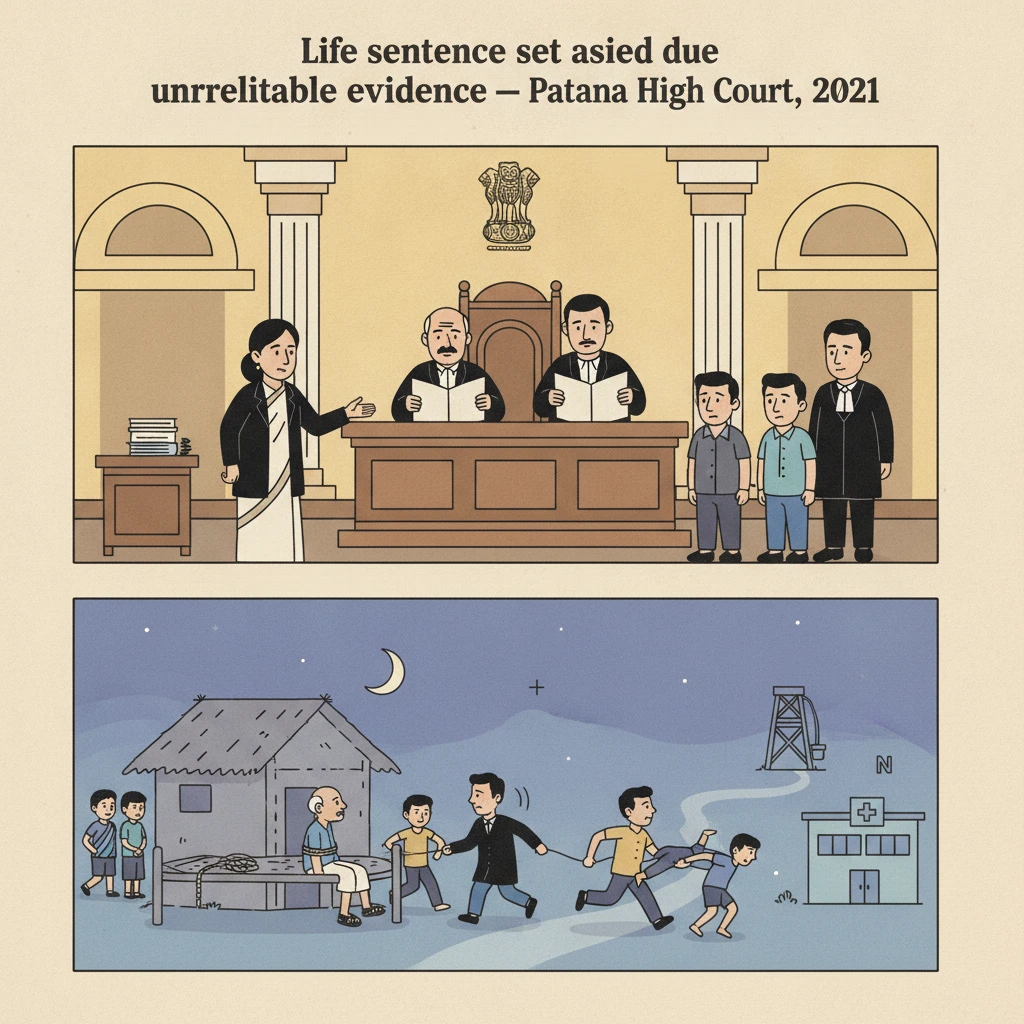
The case arose from an incident in the intervening night of 11.12.1988 and 12.12.1988 in village Chiranjibipur, Police Station Bachhawara, District Begusarai.
According to the First Information Report (FIR) lodged by the informant, Ramdeo Choudhary (P.W.8), he was sleeping at his Bathan (cattle shed) with his son Ajay Kumar. Around midnight, four persons allegedly came, tied him to the stand of the chowki (cot) with a rope, and forcibly took away his son towards the north.
The informant claimed that he identified all four as Nokhe Sharma, Dayanand Sharma, Munshi Sah and Magnu Sah @ Mannu Sah. He stated that after the assailants left, he somehow freed himself, went to the village and informed co-villagers. With some villagers, he searched for his son and found him lying seriously injured to the north of his Bathan, bleeding from head and body. The son was taken to the Government Hospital at Dalsingsarai, where he died during treatment. The motive was said to be a quarrel four days earlier between the deceased and the accused persons.
On the basis of the oral statement of the informant, recorded by Assistant Sub Inspector A. Ram at the hospital, Bachhawara P.S. Case No. 121 of 1988 was registered on 12.12.1988 at 5.00 P.M. under Section 302 read with Section 34 of the Indian Penal Code (IPC) against the four named accused.
The Station House Officer of Bachhawara Police Station himself took up the investigation. After completion of investigation, charge-sheet under Section 302/34 IPC was submitted on 07.03.1989 against all four accused.
The Chief Judicial Magistrate, Begusarai took cognizance and, after following Section 207 of the Code of Criminal Procedure (CrPC), committed the case to the Court of Session. The Sessions Judge, Begusarai framed charge under Section 302 read with Section 34 IPC. The accused pleaded not guilty and claimed trial.
During trial in Sessions Case No. 65 of 1990, the prosecution examined eight witnesses, including the informant, relatives, villagers and the doctor who conducted post-mortem. No defence witness was examined. On 27.09.1995, the learned District and Sessions Judge, Begusarai convicted all four under Section 302/34 IPC and sentenced them to rigorous imprisonment for life.
The convicted persons filed Criminal Appeal (DB) No. 354 of 1995 before the Patna High Court. When the appeal was finally heard, Ms. Vaishnavi Singh appeared as amicus curiae for the appellants and Mr. Abhimanyu Sharma, Additional Public Prosecutor, appeared for the State of Bihar. The oral judgment was delivered on 09.12.2021.
What the Court Examined and Decided
The Patna High Court closely re-examined the prosecution evidence to see whether the conviction for murder could be sustained. The central piece of evidence was the testimony of the informant (P.W.8), as there was no eye witness to the actual assault.
P.W.8 repeated in court that he and his son Ajay Kumar were sleeping at their Bathan on the night of the incident. He stated that at midnight, the four accused came, tied his belly with rope to the stand of the chowki and took his son away towards the north. He claimed he later freed himself and informed co-villagers Kamal Choudhary (P.W.4), Balram Choudhary (P.W.2), Sunil Choudhary (P.W.5) and Baliram Choudhary (P.W.1). Together, they searched for the boy at about 1.30 A.M. on 12.12.1988 and found him unconscious near a boring north of the Bathan, bleeding from his head. From there, he was taken to Dalsingsarai Government Hospital, where he died during treatment.
However, during cross-examination, the informant made admissions that raised doubts. He admitted that when the accused were tying him with rope, he did not raise any alarm or try to run away, even though both his hands were left free. He also admitted that his son was awake, did not resist and was taken away without raising any hulla. He further admitted that his son was found in the field of one Ramashray Sah and that there was no pumping set of Ramashray Sah installed at that place, though the FIR earlier referred to a boring pump in the north of his Bathan.
The Court then compared his version with the evidence of other prosecution witnesses.
P.W.1 Baliram Choudhary stated that after hearing from the informant, he accompanied him in search of the son during the night, but they could not trace the boy then and returned home. He said that only in the morning he found the informant’s son injured at the place where the pumping set of appellant Munshi Sah was installed. This directly contradicted the informant, who had claimed that the son was found in the night itself and in the field of Ramashray Sah.
P.W.2 Ram Balak Choudhary, who was shown as one of the persons accompanying the informant at night, did not support that version. He did not say that the informant had told him about the occurrence in the night or that he had joined any search then. He deposed that he came to know about the incident only in the morning of 12.12.1988 and that the victim was found injured at the place where the pumping set of Munshi Sah was installed.
P.W.4 Kamal Kishore Choudhary also failed to support the informant’s night-search story. He said that in the night he was asleep, was awoken by neighbour Baliram Choudhary (P.W.1) due to some noise in the western side, but by the time he awoke, the noise had stopped and he decided to see in the morning. In the morning, he went to the pumping set of Munshi Sah, found many persons assembled, and saw the informant’s son lying unconscious and injured. He stated that the informant there told people that the four accused had assaulted his son.
P.W.5 Sunil Kumar Choudhary, nephew of the informant and cousin of the deceased, stated that the dead body was recovered from the field of Ramashray Sah. He then said that at that time the informant’s son was injured and unconscious, and that P.W.1 and P.W.4 were with him. P.W.6 Ramanand Choudhary stated he saw the dead body of Ajay Kumar at the place where a boring pump was installed. He said the informant told him that the four accused had killed his son, but he admitted in cross-examination that he had not given such a statement to the police.
P.W.7 Prem Kumar Choudhary was declared hostile. He stated that he had not given any statement to the police and that at the time of occurrence he was at Patna.
From this, the Court noted that except the informant, no one claimed to have seen the tying of the informant or the taking away of his son by the accused. There was also no eye witness to the assault itself. All others were hearsay witnesses who relied on what the informant later told them.
Importantly, their accounts conflicted on basic facts. There were contradictions regarding:
- Whether the victim was found in the night or only the next morning;
- Whether he was alive but unconscious and injured, or already dead when found;
- The exact place where he was found – field of Ramashray Sah or at the pumping set of appellant Munshi Sah, or near an unspecified boring pump;
- Who accompanied the informant in the night search, if any such search actually took place.
The Court also examined the medical evidence. P.W.3 Dr. Anand Kumar conducted the post-mortem on 13.12.1988 at 10.00 A.M. He found two external lacerated wounds – one on the upper occipital region of the scalp and another on the left leg – along with multiple fractures of the left parietal and occipital bones, intracranial blood clot, ruptured membrane and lacerated brain tissue. In his opinion, death was due to shock and haemorrhage caused by these ante-mortem injuries, which were sufficient to cause death in the ordinary course of nature. He opined that a hard and blunt substance was likely used. He estimated time since death as within 48 hours.
But in cross-examination he admitted that there was no external bleeding from the injuries and that they could have been caused by a fall on a hard substance. This clashed with the informant’s claim and other witnesses’ statements that the victim was “profusely bleeding” from head and body when found.
The Court found this inconsistency between the medical evidence and the prosecution’s oral account significant. The description of profuse external bleeding was not supported by the post-mortem findings, where the doctor clearly denied external bleeding.
A further major weakness in the prosecution case was that the Investigating Officer (I.O.) was not examined in the trial. The Court accepted the amicus curiae’s argument that this seriously prejudiced the defence. Because of this, crucial aspects such as the exact place of occurrence, seizure of bloodstained earth or other material, and clarification of contradictions in witnesses’ police statements could not be tested in court.
In paragraphs 33 to 35 of the judgment, the Court summarised that there was no consistency among prosecution witnesses regarding the place where the victim was found, the time when he was found, and his condition at that time. Many of the supposed search companions of the informant did not support his version. Several witnesses were clearly hearsay witnesses with differing stories.
The Court found the informant’s story about being tied by the belly to the stand of the chowki, with both hands left free and yet not raising any hulla or resisting, and his son also not resisting or crying out while being taken away, to be “highly unbelievable”. The post-mortem doctor further contradicted the claim of profuse bleeding.
In paragraph 36, the Court explained the principle that while minor discrepancies can be ignored, contradictions that go to the root of the matter and shake the basic version of the prosecution cannot be brushed aside. Here, the contradictions were of a serious nature and directly affected the reliability of the entire prosecution story.
Concluding that the prosecution evidence did not inspire confidence and it would be unsafe to rely on such testimony to uphold a conviction for murder, the High Court held that the trial court had not correctly appreciated the evidence.
Accordingly, in paragraph 37, the Patna High Court set aside the judgment of conviction dated 27.09.1995 and the consequent sentence in Sessions Case No. 65 of 1990. In paragraph 38, it ordered that the appellants, who were already on bail, were discharged from their bail bond liabilities. The criminal appeal was allowed. The Court also directed the Patna Legal Services Committee to pay Rs. 7,500/- to the amicus curiae as consolidated fee.
Why This Judgment Matters
This judgment is important for anyone facing false or weak criminal charges, especially in serious offences like murder.
First, the Patna High Court showed that a conviction cannot stand merely on suspicion or on the strength of one doubtful statement. When witnesses give conflicting versions on basic facts like time, place and condition of the victim, the benefit of doubt must go to the accused.
Second, the Court underlined the importance of medical evidence. When the doctor’s scientific findings do not match what witnesses are saying, courts will be careful before accepting the witness version.
Third, the case highlights how crucial the Investigating Officer’s evidence is. If the I.O. is not examined, the defence loses the chance to question how the investigation was done, where exactly the incident happened, and what was recorded during the site inspection. This can weaken the prosecution case.
Overall, this decision reinforces that in criminal law, especially in cases carrying life imprisonment, courts must be fully satisfied about the truth of the prosecution story. If serious doubts remain, acquittal is the rule.
Legal Issues and Answers
Issue: Whether the prosecution evidence was reliable and consistent enough to sustain the appellants’ conviction under Section 302/34 IPC for murder.
Answer: No. The Patna High Court found major contradictions among witnesses, inconsistency with medical evidence, absence of the Investigating Officer’s testimony, and an overall improbable story, making it unsafe to uphold the conviction.
Issue: Whether non-examination of the Investigating Officer prejudiced the defence and affected proof of the place of occurrence.
Answer: Yes. The Court held that because the Investigating Officer was not examined, the place of occurrence could not be properly established and the defence was seriously prejudiced.
Cases Cited by the Court
- The judgment does not mention or rely upon any specific cited precedents by name.
Case Details
Case Number: Criminal Appeal (DB) No. 354 of 1995
Trial Court Case Number: Sessions Case No. 65 of 1990
Case Title: Munshi Sah & Ors. v. The State of Bihar
Court: High Court of Judicature at Patna
Coram: Hon’ble Mr. Justice Ashwani Kumar Singh; Hon’ble Mr. Justice Rajeev Ranjan Prasad
Date of Patna High Court Judgment: 09.12.2021
Impugned Order: Judgment of conviction and order of sentence dated 27.09.1995 passed by the learned District and Sessions Judge, Begusarai in Sessions Case No. 65 of 1990
Citation: 2024(4) PLJR 175
Advocates: Ms. Vaishnavi Singh, amicus curiae for the appellants; Mr. Abhimanyu Sharma, Additional Public Prosecutor for the State
Offences Alleged: Section 302 read with Section 34 of the Indian Penal Code
Nature of Case: Criminal appeal (Division Bench) against conviction and life sentence in a sessions trial
Final Outcome: Appeal allowed; conviction and life sentence set aside; appellants discharged from bail bond liabilities; fee directed to be paid to amicus curiae
Link to Judgment: Click here to read the full Patna High Court judgment
If you found this explanation helpful and wish to stay informed about
how legal developments may affect your rights in Bihar,
you may consider following Samvida Law Associates for more updates.







