

Case Background
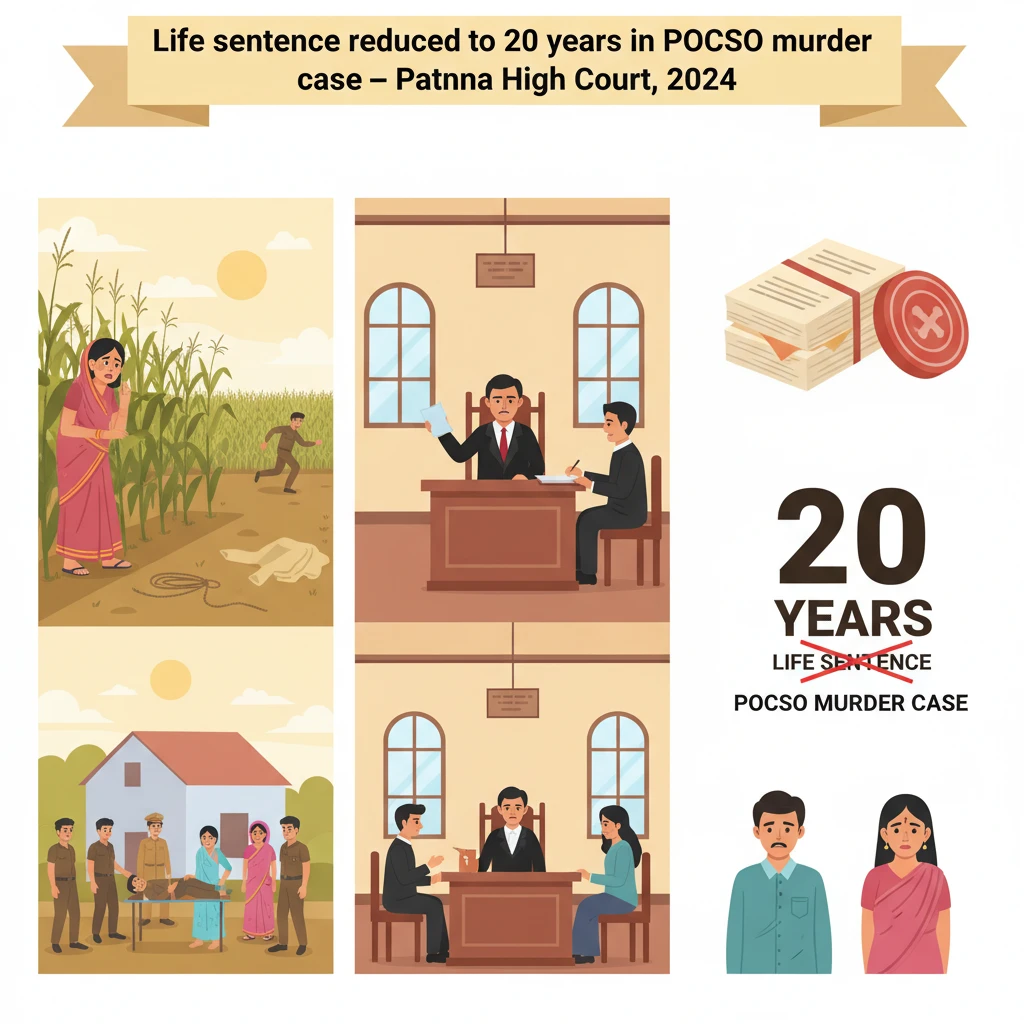
The case arose out of Kasba P.S. Case No. 53 of 2017, District Purnea. The incident took place on 10.04.2017 in a maize field near the victim’s house. The victim was a 17-year-old girl, then a student of Class IX, whose date of birth was stated as 04.02.1998.
On the morning of 10.04.2017, the victim went to the fields to attend the call of nature. A little later, her 19-year-old elder sister (P.W. 5) also went to the same fields for the same purpose. While returning, P.W. 5 noticed movement in the maize crop sown on land taken for share cropping by their uncle, Lakshami Sah (P.W. 2). Thinking it could be an animal damaging the crop, she moved closer.
There she saw a horrific scene. Her younger sister was lying naked, with her hands and legs tied with rope and her mouth gagged with a piece of cloth. The appellant, a neighbour, was on top of the victim, raping her. On being seen, the appellant got up and ran towards the west.
P.W. 5 found her sister motionless, with nail-bite marks, bruises on the body and injuries on the neck. She believed her sister had died. She raised an alarm and rushed home to inform her parents and other family members. Villagers and family members went to the place of occurrence, untied the body and brought it back home, by which time the victim had died.
Before informing the police, the family and some villagers went to the appellant’s house to find him, but found that he and his family members had absconded. The police received a telephone call stating that a teenaged girl had been raped and killed. A police party reached the house of the deceased, recorded the fardbeyan of P.W. 5 at about 12 noon on 10.04.2017, and later inspected the field.
On the basis of the fardbeyan, Kasba P.S. Case No. 53 of 2017 was registered under Sections 376 and 302 of the Indian Penal Code and Sections 3, 4 and 6 of the POCSO Act, 2012. During inspection of the field, the police found and seized an Aadhaar card bearing the appellant’s name, photograph and signature.
The body was sent for post-mortem the same day. The Investigating Officer (P.W. 9) seized the towel used to gag the victim and pieces of rope used to tie her hands and legs, prepared inquest and seizure memos, and recorded statements of villagers who had reached the spot on hearing the cries of P.W. 5.
After investigation, charge-sheet was submitted against the appellant. The case was tried as Special POCSO Case No. 24 of 2017 before the 1st Additional Sessions Judge-cum-Special Judge, Purnea. The trial court examined ten prosecution witnesses and two defence witnesses, convicted the appellant under Sections 376(2)(m), 376A and 302 IPC and Sections 4 and 6 of the POCSO Act, and by order dated 31.07.2017 sentenced him to imprisonment for the remainder of his life and fine of Rs. 25,000/- on each of the three IPC counts, with no separate sentence under the POCSO provisions.
The appellant filed Criminal Appeal (DB) No. 1026 of 2017 before the Patna High Court challenging both conviction and sentence.
What the Court Examined and Decided
The Division Bench of the Patna High Court, comprising Hon’ble Mr. Justice Ashutosh Kumar and Hon’ble Mr. Justice Nani Tagia, heard the appeal and delivered an oral judgment on 18.01.2024.
First, the Court reassessed the evidence on record to test the correctness of the conviction. The core prosecution evidence was the eyewitness account of P.W. 5, the elder sister of the deceased. She had lodged the fardbeyan on the same day and later gave a statement under Section 164 Cr.P.C. recorded by Judicial Magistrate Divya Prakash (P.W. 10). At trial, she repeated the same account without contradiction or embellishment.
P.W. 5’s testimony clearly described seeing the appellant on top of her younger sister in the maize field, with the victim’s hands and legs tied and mouth gagged, and then seeing the appellant flee westward when he noticed her. She described the injuries on the victim’s neck and nose, the nail-bite marks, and how the body was brought home after being untied. She also confirmed seizure of the appellant’s Aadhaar card from the field and of the ropes and small towel used in the crime.
The Court noted that her testimony remained unshaken in cross-examination. There were no inconsistencies between her fardbeyan, her Section 164 Cr.P.C. statement, and her deposition before the trial court.
The medical evidence from Dr. Bijay Kumar (P.W. 8), who conducted the post-mortem at about 2:30 p.m. on 10.04.2017, supported the prosecution story. The doctor found multiple nail-bite marks on the neck and nose, lacerated neck muscles, heavily contused tracheal muscles, and a lacerated wound around the entry of the vagina. The hymen was ruptured at two to three places. Though the vaginal swab report for semen was negative, the doctor opined that death occurred due to asphyxia resulting from strangulation/throttling and rape, and fixed the approximate time of death at around 24 hours prior to the examination.
The Investigating Officer (P.W. 9) confirmed that an anonymous phone call had informed the Station House Officer that the appellant had raped and murdered the girl and fled. This indicated that within a short time of the incident, villagers had come to know of the appellant’s involvement, which matched the prosecution version that P.W. 5 immediately informed others and villagers reached the spot on her cries.
P.W. 9 also described reaching the house of the deceased, recording P.W. 5’s fardbeyan in the presence of her father (P.W. 7), inspecting the body, and getting a lady chowkidar to inspect the private parts where a red injury was found. He found a red and white small towel around the neck, and two pieces of special rope near the body, which witnesses explained had been untied when the body was brought home. He prepared the inquest report, seized the towel and ropes, and then proceeded to the maize field of one Govind Yadav near the house of the deceased. There, he recovered the appellant’s Aadhaar card (Ext. 6/1) and recorded the statements of villagers P.W. 1, P.W. 2 and P.W. 3.
These villagers were not eyewitnesses to the act of rape and killing, but they had rushed to the field on hearing P.W. 5’s shouts and on being told by her what had happened. One of them, P.W. 3, saw the appellant running away from the field. P.W. 2, the deceased’s uncle, had sown maize on the land as a sharecropper and was naturally connected with that place of occurrence. The Court held that these villagers were not “chance witnesses”, as early morning villagers commonly go out for household chores, inspection of crops, or to answer nature’s call.
Dilip Kumar Sah, the deceased’s brother, also testified that he saw the appellant running away towards the west. P.W. 6 (Chander Mahaldar) and P.W. 7 (the father) fully supported the prosecution version.
The defence produced two witnesses. D.W. 1, Amrina Khatoon, the appellant’s sister, claimed that the police had forced open their house and, under duress, seized the Aadhaar card and other documents from inside. D.W. 2, Md. Anveer, claimed that on the day of occurrence the appellant was working as a mason in another village.
The High Court rejected both defence versions. It relied on the seizure memo showing that the Aadhaar card was seized at about 12:50 p.m. on 10.04.2017 from the field, at around the same time the FIR was lodged. Shortly before that, a seizure memo for the ropes and towel near the dead body was prepared. Further, when the appellant was arrested on 11.04.2017, ropes of similar quality, a knife and an earthen pot for smoking ganja were recovered from his house. D.W. 2’s alibi statement was found to be vague and unsupported by any detail, rendering it unreliable.
The appellant’s counsel argued that except P.W. 5, no one had seen the appellant at the place of occurrence and that other witnesses were only narrating hearsay statements of P.W. 5. The Court held that since their statements were made contemporaneously with the incident and were recorded promptly, they were rightly admitted under Section 6 of the Indian Evidence Act (res gestae) by the trial court.
The defence also alleged false implication due to enmity. The High Court found no evidence of any prior animosity between the two families. On the contrary, the appellant’s house was only a stone’s throw away from the victim’s house, suggesting close neighbourhood rather than hostility. The Court concluded that the appellant, “overcome by lust”, had committed a horrendous act of raping and killing a minor with “utmost depravity”, immobilizing her by tying her limbs and gagging her when he found her alone in the fields.
After carefully examining the inquest report, post-mortem report, seizure lists and witness depositions, the High Court concluded that this was an “open and shut case” against the appellant. It affirmed the trial court’s finding of guilt under Sections 376(2)(m), 376A and 302 IPC and Sections 4 and 6 of the POCSO Act.
The Court then turned to the question of sentence. The trial court had imposed imprisonment for the remainder of the appellant’s life on each of the three IPC charges, treating it as an alternative to the death penalty, though it ultimately did not award death sentence. The High Court held that this was beyond the jurisdiction of the trial court.
To explain why, the Bench surveyed Supreme Court case law on sentencing, especially in death penalty matters. It referred to Bachan Singh v. Union of India (1980) 2 SCC 684, which introduced the “rarest of the rare” doctrine for death penalty; Machhi Singh v. State of Punjab (1983) 3 SCC 470, which mandated balancing aggravating and mitigating circumstances; Santosh Kumar Satishbhushan Bariyar v. State of Maharashtra (2009) 6 SCC 498, which required a two-step process including evaluation of possibility of reformation; and Shankar Kishanrao Khade v. State of Maharashtra (2013) 5 SCC 546, which emphasised consideration of both crime and criminal.
The Court then discussed Swamy Shraddananda @ Murali Manohar Mishra v. State of Karnataka (2008) 13 SCC 767, where the Supreme Court held that, in appropriate cases, constitutional courts could substitute the death penalty with life imprisonment for the remainder of the convict’s life or a fixed term beyond 14 years without remission. This proposition was later upheld by a Constitution Bench in Union of India v. V. Sriharan @ Murugan (2016) 7 SCC 1, which recognised the “special category” of life sentences exceeding the usual 14-year remission yardstick.
However, in Sriharan, the Supreme Court also made it clear that only the Supreme Court and High Courts, as constitutional courts, could impose such special or fixed-term life sentences; trial courts could not. The High Court further relied on Vikash Chaudhary v. State of Delhi, 2023 SCC OnLine SC 472, where the Supreme Court explained that special or fixed-term sentences serve as alternatives in capital cases and to address particularly serious crimes, but again clarified that trial courts are “absolutely prohibited” from imposing such modified or specific terms beyond what the Code of Criminal Procedure contemplates.
The Bench summarised that trial courts have only two options in capital-eligible cases: life imprisonment with ordinary remissions, or death sentence. If death penalty is considered, courts must examine both aggravating and mitigating circumstances, and the State must furnish material to show absence of mitigating factors and lack of possibility of reformation.
Turning back to the present case, the High Court noted that the trial court itself had recorded that the appellant was a first-time offender with no criminal history, had good reputation regarding conduct and social behaviour, and belonged to a young age group and poor strata of society. The trial court also accepted that the case did not cross the “rarest of the rare” threshold. Yet, it still imposed imprisonment for the remainder of the appellant’s natural life, which, in light of the above Supreme Court rulings, it was not empowered to do.
The High Court therefore held that while the conviction was unassailable, the sentence required modification. It found there was no material on record regarding the appellant’s conduct in jail or a detailed assessment of his chances of reformation. However, in the absence of any negative report and considering his age at the time of occurrence and his social background, the Court held that directing a minimum actual imprisonment of 20 years on each of the three IPC counts, to run concurrently, would be appropriate.
Accordingly, the appeal was dismissed as to conviction, but the sentence was modified from “remainder of life” to a minimum term of 20 years’ actual imprisonment under Sections 376(2)(m), 376A and 302 IPC, to run concurrently. The Court directed that a copy of its judgment be sent to the Superintendent of the concerned jail for compliance and that the trial court records be returned.
Why This Judgment Matters
This judgment has two clear practical effects. First, it confirms the conviction of a neighbour who raped and killed a minor girl in a village field, showing that strong eyewitness testimony from a family member, supported by medical and scientific evidence, can sustain conviction even when semen is not detected in forensic tests.
Second, it clarifies sentencing powers. The Patna High Court reiterates that trial courts in Bihar and across India cannot on their own fix life imprisonment “for the remainder of natural life” or for any fixed term beyond the usual 14 years as an alternative to the death sentence. That special power lies only with the Supreme Court and High Courts.
For affected families and accused persons alike, the ruling shows that while heinous crimes will attract very long jail terms, the sentence must still follow the framework laid down by the Supreme Court. Mitigating factors such as age, lack of criminal history and social background need to be recorded and considered. At the same time, in gruesome rape-and-murder cases, constitutional courts may still order long minimum terms of actual imprisonment, like the 20-year term imposed here.
Legal Issues and Answers
- Issue: Whether the evidence on record was sufficient to sustain the appellant’s conviction for rape and murder of a minor under the IPC and POCSO Act.
Answer: Yes. The Patna High Court held that the consistent and credible eyewitness account of the victim’s sister, supported by medical, investigative and circumstantial evidence, proved beyond reasonable doubt that the appellant raped and murdered the victim. - Issue: Whether the trial court was legally empowered to sentence the appellant to imprisonment for the remainder of his natural life on each IPC count.
Answer: No. Relying on Supreme Court precedents, the High Court held that trial courts cannot impose special or fixed-term life sentences beyond the norm; such power rests only with the Supreme Court and High Courts. - Issue: What sentence was appropriate in the facts, given the brutality of the crime and the mitigating factors recorded.
Answer: The Court decided that a minimum actual imprisonment of 20 years on each of the three IPC counts (Sections 376(2)(m), 376A and 302), to run concurrently, was suitable in the absence of material showing impossibility of reformation.
Cases Cited by the Court
- Bachan Singh v. Union of India; 1980 (2) SCC 684
- Machhi Singh v. State of Punjab; 1983 (3) SCC 470
- Santosh Kumar Satishbhushan Bariyar v. State of Maharashtra; (2009) 6 SCC 498
- Shankar Kishanrao Khade v. State of Maharashtra; 2013 (5) SCC 546
- Swamy Shraddananda @ Murali Manohar Mishra v. State of Karnataka; (2008) 13 SCC 767
- Gopal Vinayak Godse v. State of Maharashtra; (1961) 3 SCR 440
- Dalbir Singh v. State of Punjab; (1979) 3 SCC 745
- Subash Chander v. Krishan Lal; (2001) 4 SCC 458
- Shri Bhagwan v. State of Rajasthan; (2001) 6 SCC 29
- State of Madhya Pradesh v. Ratan Singh; (1976) 3 SCC 470
- Union of India v. V. Sriharan @ Murugan & Ors; (2016) 7 SCC 1
- Sangeet & Anr v. State of Haryana; 2013 (2) SCC 452
- Vikash Chaudhary v. The State of Delhi; 2023 SCC OnLine SC 472
- Manoj v. State of Madhya Pradesh; (2023) 2 SCC 353
- Rajendra Prahladrao Wasnik v. State of Maharashtra; (2019) 12 SCC 460
- Channulal Verma v. State of Chhattisgarh; (2019) 12 SCC 438
Case Details
Case Number: Criminal Appeal (DB) No. 1026 of 2017; arising out of Kasba P.S. Case No. 53 of 2017; Special POCSO Case No. 24 of 2017
Case Title: Md. Amzad @ Amzad v. The State of Bihar
Coram: Hon’ble Mr. Justice Ashutosh Kumar and Hon’ble Mr. Justice Nani Tagia
Citation: 2024 (1) PLJR 782
Advocates: Mr. Amit Kumar Anand, Advocate for the appellant; Mr. Satya Narayan Prasad, APP for the State
Nature of the Case: Criminal appeal (Division Bench) against conviction and sentence in a Special POCSO case involving offences under Sections 376(2)(m), 376A and 302 IPC and Sections 4 and 6 of the POCSO Act, 2012
Date of Patna High Court Judgment: 18.01.2024
Link to Judgment: https://patnahighcourt.gov.in/viewjudgment/NSMxMDI2IzIwMTcjMSNO-J1bGFhD2B04=
If you found this explanation helpful and wish to stay informed about how legal developments may affect your rights in Bihar, you may consider following Samvida Law Associates for more updates.







