

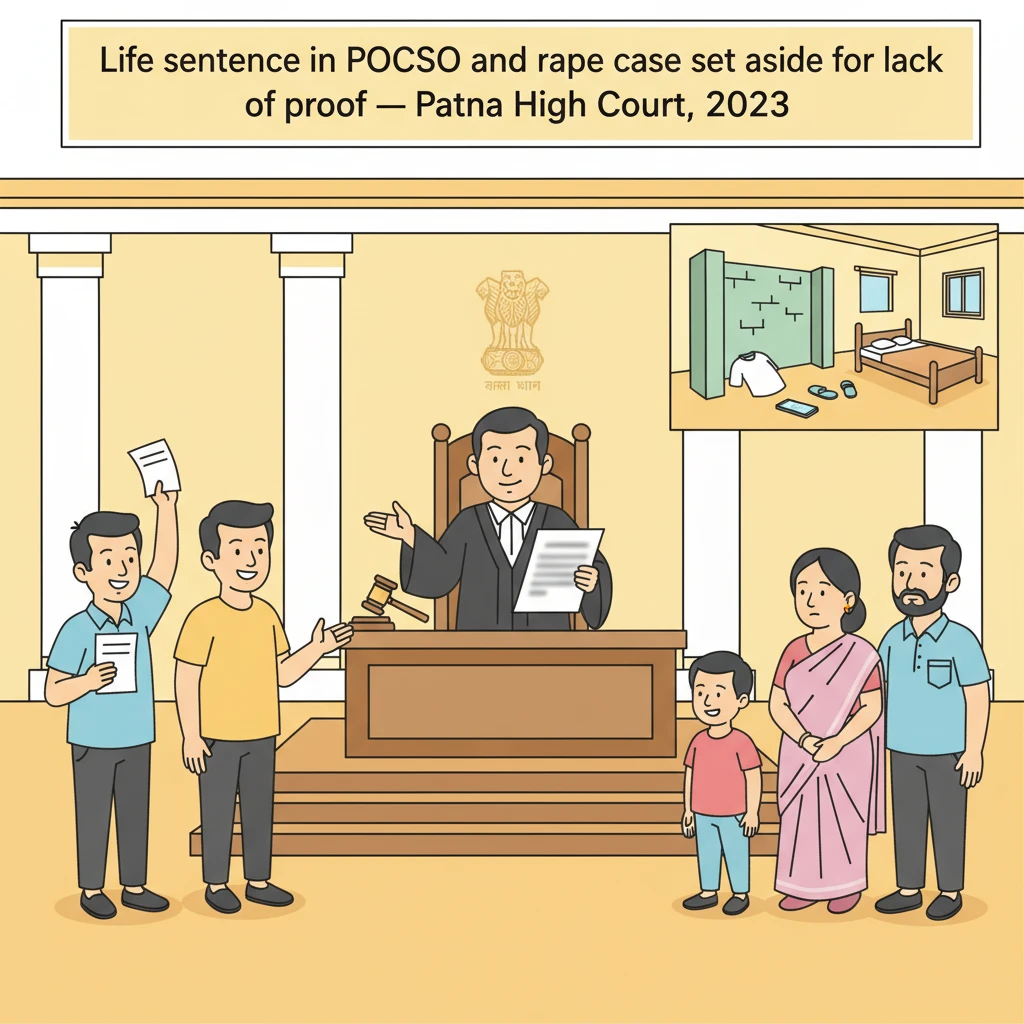
Case Background
This criminal appeal was filed against the judgment of conviction dated 14.02.2022 and order of sentence dated 16.02.2022 passed by the Additional Sessions Judge VI-cum-Special Judge POCSO, Jehanabad, in POCSO Case No. 24 of 2020, arising out of Barabar Paryatan P.S. Case No. 41 of 2020.
The trial court had convicted the appellant for offences under Sections 363, 365, 376 and 506 of the Indian Penal Code and Section 4 of the POCSO Act. He was sentenced to rigorous imprisonment for life on all major counts, with different fines, all sentences to run concurrently.
The criminal case began with a written information dated 10.06.2020 given by the victim’s father (P.W. 9) to the Director General of Police, Patna. On the basis of this written application, Barabar Paryatan Police Station registered F.I.R. Case No. 41 of 2020 on 16.06.2020 for kidnapping, rape, criminal intimidation, and POCSO offences.
According to the written report, the informant’s minor daughter allegedly used to take tuition from the appellant, who taught his children of Class 9th and 10th. The father alleged that on the midnight of 07.05.2020, the appellant was hiding near the bathroom. When the girl went out for a natural call around 12 midnight, the appellant allegedly covered her mouth with cloth, took her to the corridor, raped her and threatened to kill her.
The informant’s wife allegedly woke up at about 3:00 a.m. for a natural call and saw the victim half-naked. She raised an alarm. The informant and neighbours rushed to the spot, saw the appellant, and the informant claims to have assaulted him 2–4 times before the appellant escaped by jumping over the semi-constructed wall. The appellant’s shirt, slippers and mobile phone were said to have been left behind.
The informant further alleged that later the appellant telephoned and threatened to kill his family members if the incident was reported to the police. Out of fear, he did not immediately report the incident. The written application also stated that on 08.06.2020 the appellant eloped with the girl, who then became traceless. On these allegations, action was sought against the appellant.
During investigation, the Investigating Officer examined witnesses under Section 161 Cr.P.C., got the victim’s statement recorded under Section 164 Cr.P.C., and referred her for medical examination. The victim initially refused medical examination, but later was examined by a Medical Board on 11.06.2020. The appellant was arrested on 17.06.2020, and after completion of investigation, charge-sheet was submitted.
The trial court took cognizance, framed charges under Sections 363, 365, 376, 506 IPC and Section 4 POCSO Act on 18.12.2019, read them over to the appellant, who pleaded not guilty and claimed trial.
What the Court Examined and Decided
The Patna High Court (Division Bench) heard the appeal filed by the appellant against the conviction and life sentence. The Court carefully re‑appreciated the entire evidence placed before the trial court.
The prosecution examined nine witnesses. P.Ws. 1 and 3 were uncles of the victim. They stated that on hearing noise they went to the victim’s house and saw her naked near the door inside the house, and were informed that the appellant had forcibly raped her. They admitted in cross‑examination that no written complaint was given at the time of the incident of 07.05.2020 and that they did not know whether the victim had mentioned any love affair in her statement.
P.W. 2, the victim’s mother, stated that on the midnight of 08.06.2020 the incident took place, and that the victim was 16 years old. She claimed she actually saw the appellant raping the minor by stuffing cloth in her mouth. When she raised an alarm, her husband came, caught the appellant and slapped him; the appellant then escaped by jumping over the wall. P.W. 2, however, was not cross‑examined as the defence did not appear on that date.
P.W. 4, a constable, merely produced seized articles (shirt and slippers) in court, and admitted that he had no personal knowledge of when and from whom they were recovered. The High Court found that his evidence carried little value in proving the case.
P.W. 5, the victim herself, deposed that about 7–8 months ago, at midnight, when she went to the bathroom, the appellant who was hiding there closed her mouth with a dupatta and committed “wrongful acts” on her. Her mother allegedly saw this, shouted, and her father came and slapped the appellant who then escaped by jumping over the wall.
She further stated that about one month later the appellant came again, tied her mouth and eyes, threatened her with a gun, took her away, kept her for two days, committed “wrong things” with her and later left her at the gate of the police station after coming to know that a case had been filed. She said she was treated by a doctor and her statement was recorded in court.
The victim identified the shirt and slippers of the appellant in court. She also stated that the appellant used to come to their house to teach her siblings and talk to her while her parents lived outside. In cross‑examination, however, she admitted that she had “also said something wrong” in her statement before the Magistrate because the appellant had threatened to kill her and her parents. She admitted she had not informed the police about this alleged threat nor made any application regarding it.
P.W. 6, a neighbour, stated that on hearing noise, he woke up, went out, saw the victim in naked condition and saw the appellant running away. He came to know that the appellant had committed rape on the victim.
P.W. 7, a Medical Officer of Sadar Hospital, Jehanabad, was part of the Medical Board that examined the victim on 11.06.2020 at 4:10 p.m. He found no external injury on the victim, pregnancy test negative, secondary sexual characters present, hymen ruptured, no internal injury and no foreign body in the private part. Microscopic examination showed no spermatozoa, only a few epithelial cells. He opined that the victim was “sexually active” but clearly stated that he could not say whether rape had been committed. In cross‑examination, he stated that in cases of rape a woman is expected to protest leading to external or internal injuries, and that hymen rupture can occur for various reasons such as cycling, wrestling etc. The Court noted that the medical report did not support the prosecution story of recent violent rape.
P.W. 8, the Investigating Officer, detailed the steps of investigation and confirmed that the written application dated 10.06.2020 was addressed to the DGP and that on its basis the F.I.R. was registered only on 16.06.2020, though the alleged elopement took place on 08.06.2020. He also accepted that the victim came to the police station with her relatives, rather than being recovered from the appellant.
P.W. 9, the informant and father of the victim, stated that the first alleged rape occurred on 07.05.2020 in the midnight and was witnessed by his wife at 3:00 a.m. on 08.05.2020. He said the second occurrence of kidnapping took place on 08.06.2020 and the victim was traced after two days. In cross‑examination, he admitted that no case was lodged at the time of the first occurrence; he submitted the written application only when his daughter went missing in June 2020.
On this material, the High Court first highlighted the unexplained delay in reporting the alleged first incident of rape. Neither parent lodged any complaint on 07.05.2020 or 08.05.2020, even though they claimed to have witnessed or known about the incident. This cast serious doubt on whether that incident actually occurred in the manner alleged.
The Court then turned to the most crucial evidence: the victim’s own statement under Section 164 Cr.P.C., recorded earlier before the Magistrate, which was exhibited as Exhibit 7. In that statement, the victim stated that she loved the appellant, had physical relations with him on several occasions, and on 09.06.2020 at about 11:00 a.m. she herself ran away from home and asked the appellant to marry her. The appellant allegedly told her he would marry her once she attained 18 years of age.
She also stated that her parents had come home for Holi; her father came to know about their love affair and scolded her not to talk to the appellant. She told this to the appellant. One day when the appellant came to their house to procure a book, people outside saw him and beat him. He then left behind his slippers and bag and went away. She further told the Magistrate that she wanted to stay with her parents but feared they might do something to her.
The Division Bench noted that this earlier statement clearly suggested a consensual relationship and voluntary departure from home. It directly contradicted her later testimony in court where she alleged forcible rape and kidnapping at gunpoint.
The Court observed that statements under Section 161 Cr.P.C. are for corroboration or contradiction, and here the Section 164 Cr.P.C. statement of the victim contradicted her trial testimony on material aspects. No satisfactory explanation was offered for this major change in her version.
Next, the Court assessed the medical evidence. It found that no external or internal injuries, no spermatozoa, and an old ruptured hymen, along with the doctor’s inability to say whether rape occurred, did not support the prosecution’s allegation of forcible sexual assault around the relevant dates.
The Bench also noted that the trial court had not properly determined the age of the victim. Though the Investigating Officer said the date of birth was 10.12.2003, no documentary proof like school certificate or birth certificate was produced. Without clear proof that she was below 18 years, the stringent provisions of the POCSO Act could not safely be applied.
On an overall appreciation of oral and documentary evidence, the High Court concluded that the appellant and the victim had been in a physical relationship for a long time with the victim’s consent. It held that it could be reasonably construed that no such incident of rape had occurred on the midnight of 07.05.2020 as alleged. The second incident also appeared to be voluntary companionship rather than kidnapping, considering the victim’s own earlier statement and the fact that she later came to the police station with her family.
Given these serious doubts about the prosecution story, contradictions in the victim’s versions, lack of medical support, and absence of reliable proof of the victim’s age, the Court held that the prosecution had failed to prove the appellant’s guilt beyond reasonable doubt. Consequently, the appellant was entitled to the benefit of doubt.
The Division Bench therefore set aside the conviction and sentences passed by the Special POCSO Court. The appeal was allowed, and the Court directed that the appellant be released forthwith if not required in any other case.
Why This Judgment Matters
This judgment shows how closely the Patna High Court examines evidence in serious cases like rape and POCSO offences. Even when allegations are grave, the Court insisted that guilt must be proved beyond reasonable doubt.
The decision highlights that:
First, if a victim’s earlier voluntary statement before a Magistrate contradicts her later version in court, the court will treat her evidence with caution unless there is a convincing explanation.
Second, medical reports are important. When they do not show injuries or other signs supporting the story of forced sexual assault, that weakens the prosecution case, especially where other evidence is shaky.
Third, for applying the POCSO Act, the prosecution must prove that the victim was below 18 years. Mere oral claims or an unproved date of birth are not enough.
For accused persons, this case underlines that convictions can be overturned if the trial court ignores major contradictions and gaps in the evidence. For complainants and families, it signals the importance of timely reporting, truthful statements and proper documentation of age and medical findings.
Legal Issues and Answers
- Issue: Did the prosecution prove beyond reasonable doubt that the appellant committed kidnapping, rape and criminal intimidation, and that he sexually assaulted a child under the POCSO Act?
Answer: No. The Patna High Court held that contradictions in the victim’s statements, lack of supporting medical evidence, delayed complaint, and absence of reliable age proof created serious doubt. The conviction was set aside and the appellant was given the benefit of doubt. - Issue: Was the burden under Section 29 of the POCSO Act effectively triggered and discharged in this case?
Answer: The Court found that because the prosecution failed to first establish foundational facts, especially regarding age and the manner of occurrence, the appellant was not proved guilty even with the statutory presumption. The presumption stood rebutted by the contradictions and evidence on record.
Cases Cited by the Court
- The judgment does not mention or rely on any other reported cases by name or citation.
Case Details
Case Number: Criminal Appeal (DB) No. 212 of 2022; arising out of Barabar Paryatan P.S. Case No. 41 of 2020; POCSO Case No. 24 of 2020.
Case Title: Indrajeet Paswan @ Indrajeet Rai @ Indrajeet Kumar vs. The State of Bihar.
Citation: 2024 (1) PLJR 408.
Court: High Court of Judicature at Patna.
Coram: Hon’ble Mr. Justice Chakradhari Sharan Singh and Hon’ble Justice Smt. Gunnu Anupama Chakravarthy.
Date of High Court Judgment: 10.11.2023.
Trial Court: Court of Additional Sessions Judge VI–cum–Special Judge POCSO, Jehanabad.
Nature of Case: Criminal appeal (Division Bench) against conviction and sentence in a POCSO and rape case.
Advocates: For the appellant: Mr. Sharda Nand Mishra, Advocate. For the State: Mr. Manish Kumar No. 2, APP.
Final Outcome: Appeal allowed; conviction and sentences set aside; appellant directed to be released forthwith if not required in any other matter.
Link to Judgment: Click here to read the full judgment of the Patna High Court
If you found this explanation helpful and wish to stay informed about how legal developments may affect your rights in Bihar, you may consider following Samvida Law Associates for more updates.







