

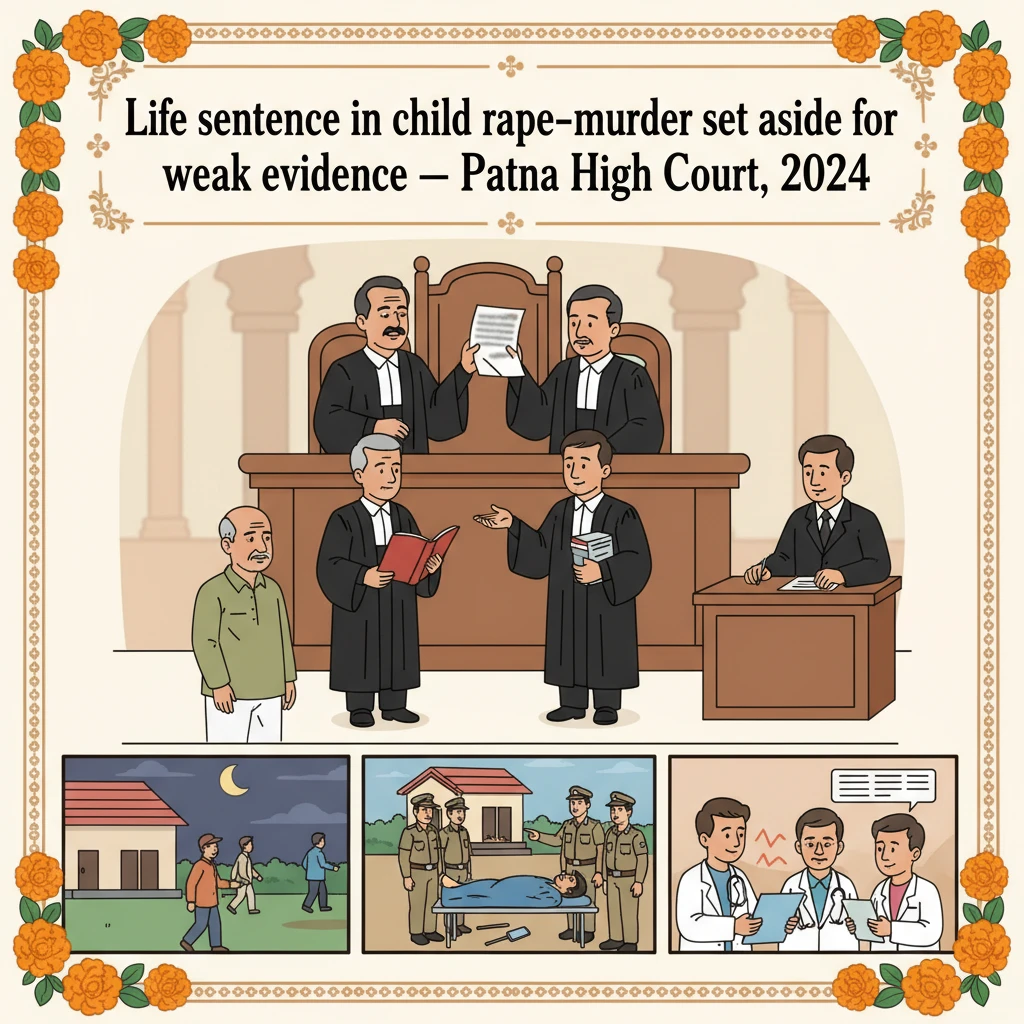
Case Background
This case arose from a tragic incident in village Malmal, Police Station Kaluahi, District Madhubani. On the night of 17.08.2020, around 9:00–9:30 p.m., the daughter of the informant went out of the house to ease herself and did not return.
The family members searched for her throughout the night but could not find her. In the morning, villagers informed them that the dead body of a girl was lying in the house of a disabled villager, father of the present appellant. The informant went to the police station and informed the police. He accompanied the police party to that house and identified the body as that of his daughter.
According to the written report, the informant suspected that the appellant and several co-villagers had together kidnapped, committed gang rape on, and murdered his daughter, and had hidden the body in the house of the appellant’s father. He expressed only suspicion, based on discussions among villagers and articles found at the spot.
On this basis, Kaluahi P.S. Case No. 116 of 2020 was registered. Investigation was carried out, statements were recorded, and a charge-sheet was submitted. The case, being exclusively triable by the Court of Sessions and involving the POCSO Act, was committed to the Court of Sessions and numbered as G.R. POCSO Case No. 43 of 2020.
The Additional Sessions Judge-VI-cum-Special Judge, POCSO, Madhubani tried the case. The prosecution examined nine witnesses, including relatives, doctors and the investigating officer. The defence examined two witnesses in support of the appellant.
By judgment of conviction dated 07.06.2023 and order of sentence dated 14.06.2023, the Trial Court convicted the appellant under Section 302 of the Indian Penal Code and Section 6 of the POCSO Act read with Sections 376(A) and 376(D) IPC, and sentenced him to rigorous imprisonment for life on both counts, with fines. The life sentence under POCSO was directed to mean imprisonment for the remainder of the appellant’s natural life. Sentences were to run concurrently.
The appellant filed Criminal Appeal (DB) No. 727 of 2023 under Section 374(2) of the Code of Criminal Procedure challenging his conviction and sentence before the Patna High Court.
What the Court Examined and Decided
The Division Bench of Hon’ble Mr. Justice Vipul M. Pancholi and Hon’ble Mr. Justice Sunil Dutta Mishra re-examined the entire record. They treated it as a case resting purely on circumstantial evidence, as there was no eye-witness to the crime.
The appellant argued that the prosecution had examined only related and interested witnesses, that there were major contradictions in their testimonies, and that the chain of circumstances was incomplete. Supreme Court precedents on circumstantial evidence and “last seen together” theory were heavily relied upon by the defence.
On the other side, the State and the informant’s counsel argued that some witnesses had seen the deceased going towards the house of one of the co-accused, followed by three boys including the appellant. They claimed that this supported the “last seen together” theory, that the conduct of the accused in absconding was suspicious, that the medical evidence proved rape and homicidal death, and that recovery of the dead body from the house of the appellant’s father linked the appellant to the crime.
The Court first analysed the testimonies of the key prosecution witnesses.
P.W.1, a neighbour and cognate of the informant, stated that around 9:30 p.m. he saw the deceased walking alone on the path in front of his house. Later, he came to know in the morning that she had been raped and killed and that her body was found in the house of the appellant’s father. Importantly, in cross-examination he clearly admitted that when he saw the girl she was going alone.
P.W.2, also a female relative, deposed that she saw the informant’s daughter going from north to south at about 9:00–9:30 p.m. After some time, she saw three boys, including the appellant, going on the same route. In cross-examination, she admitted that the girl was going alone and that 5–10 minutes later the boys were seen going in the same direction. Her police statement had been recorded three days after the incident.
P.W.3, another uncle of the deceased, stated that at about 9:15 p.m. he saw the deceased walking on the road, and some time later saw the three accused following the same route. Around 10:30 p.m., the informant came to him saying his daughter was missing, and they searched but could not find her. Early next morning, at about 5:30 a.m., he claimed to have seen the three accused running away, and later learned that the dead body was found in the house of the appellant’s father. He stated that all three boys used to sleep in that house because there was no female member there, and that he later came to know that the deceased and co-accused Vijay were in telephonic contact.
The mother of the deceased (P.W.4) confirmed that the girl had gone out at about 9:00 p.m. to obey nature’s call and did not return. Next morning, the dead body was found in the house of the appellant’s father. She said P.W.3 told her that three boys had been following her daughter that night.
P.W.5, the informant and father of the deceased, repeated in his deposition that his daughter had gone out for defecation and did not come back; he and his wife searched for her and later learned that a girl’s dead body was in the house of the disabled villager, who is the appellant’s father. He also stated that P.W.3 told him that he had seen the deceased going towards the Chowk and the three boys going some distance behind her.
Critically, the High Court noted that this alleged information from P.W.3 about “last seen” and the three boys following the deceased was not mentioned in the written complaint lodged by P.W.5. It surfaced for the first time in his oral evidence before the Court. This omission was treated as material.
The Court concluded that none of P.W.1, P.W.2 or P.W.3 actually saw the deceased in the company of the appellant. Each of them acknowledged that the deceased was walking alone and only sometime later the three accused were seen on the same path. On this basis, the Bench held that the prosecution’s reliance on the “last seen together” theory was misplaced and not supported by the evidence.
The Court then considered the mobile phone evidence. At the place where the body was found, a Nokia phone was recovered. The SIM inside it was in the name of one Anula (or Anula) Devi, who was neither made an accused nor cited as a witness. Separately, the informant handed over a red-coloured mobile phone, allegedly found beneath the deceased’s pillow at home. Its SIM was in the name of co-accused Vijay. Call detail records showed frequent conversations between the deceased and Vijay, including on the night of the incident and a day before it. The Investigating Officer also stated that, from villagers, it appeared to be a matter of love affair.
The CDRs further revealed calls between the deceased’s phone and numbers registered to Rakesh Kumar (location Bangalore) and Sangeeta Kumari/Abhishek on the very night of occurrence. Yet none of these persons was made an accused or a witness. Importantly, there was no suggestion from the records that the appellant had any mobile contact with the deceased.
From the defence side, D.W.1 and D.W.2, who were close relatives of the appellant, deposed that the appellant’s mother had left the house when he was a child, his father was handicapped, and after his sister’s marriage the appellant had gone to live at his sister’s in-laws’ house. They stated that the village head had taken the appellant away on the pretext that police were searching for him, and that he was not present in the village at the time of occurrence. Their evidence also suggested that the appellant was not residing in or possessing the house from which the dead body was recovered.
The High Court noted that the house where the body was found belonged to the appellant’s handicapped father, yet he was neither made an accused nor examined as a witness. Considering the defence evidence, the Court accepted that the appellant had discharged the burden of showing that he was not in possession of that house.
Another important aspect noticed by the Court was the statement of the informant (P.W.5) that, in his view, the accused wanted to throw the dead body in a Muslim locality to create communal tension, but when they could not do so in the early morning, they dumped the body in the house of the appellant’s father and locked it from outside. The Bench observed that, if this is so, it itself suggests that rape and murder were not committed inside that house but elsewhere. Simply finding the dead body in that house could not connect the appellant to the crime.
The medical evidence was undisputed. The Medical Board (P.W.6, P.W.7 and P.W.9) found clear signs of strangulation, torn genital parts and presence of spermatozoa in the vaginal swab. They opined that death was due to asphyxia caused by strangulation along with sexual assault and that rape was confirmed. Time since death was within 24 hours. Thus, homicidal death and rape were fully proved. The central question remained: who committed the offence?
The Court further recorded that the prosecution had not produced any documentary proof of the age of the deceased, such as school records or birth certificate, despite evidence that she had studied up to 8th standard. Therefore, the Bench held that even the minor status of the victim under POCSO was not proved by cogent evidence.
After reviewing all circumstances, the Patna High Court relied on several Supreme Court decisions, including Ravi Sharma v. State (Govt. of NCT of Delhi), Anjan Kumar Sarma v. State of Assam, Ravi v. State of Karnataka, Reena Hazarika v. State of Assam and Sharad Birdhichand Sarda v. State of Maharashtra, which lay down the strict requirements for conviction based on circumstantial evidence and last seen theory.
Applying these principles, the Bench held that the prosecution had failed to establish a complete chain of circumstances pointing only to the guilt of the appellant. The time, place and manner of occurrence, motive, and the appellant’s specific involvement were not proved beyond reasonable doubt. Mere suspicion, recovery of the dead body from his father’s house, and absence of explanation could not replace proof.
Consequently, the High Court set aside the judgment of conviction dated 07.06.2023 and order of sentence dated 14.06.2023 passed by the Trial Court, allowed the appeal, and directed that the appellant be released from custody forthwith, if not required in any other case.
Why This Judgment Matters
This judgment is important for families, accused persons, lawyers and police officers in Bihar and beyond. It shows that even in the most serious and heartbreaking offences like rape and murder of a young girl, courts will not uphold a conviction unless the evidence clearly links the accused to the crime.
The Patna High Court emphasised that suspicion, gossip in the village, or the fact that a body is found in or near someone’s family house cannot by itself be treated as proof. Relatives’ statements about having “heard later” or “coming to know” are not enough when there is no direct evidence connecting the accused.
The decision also underlines that in cases based on circumstantial evidence, the prosecution must close every gap: who was last with the victim, where the offence took place, what was the motive, and how the accused can be singled out from others. If these questions remain open, the benefit of doubt must go to the accused.
For investigating agencies, the judgment is a reminder to thoroughly examine mobile records, identify all persons in contact with the victim, and either examine them as witnesses or explain their role. Leaving out such persons, while pressing charges against someone not shown to be in contact, can weaken the case badly.
For the public, the ruling shows that courts are bound by evidence and legal standards. Even in an emotionally charged case, a conviction cannot rest on assumptions. This protects everyone from wrongful conviction and reinforces the rule of law.
Legal Issues and Answers
- Issue: Whether the circumstantial evidence, especially the “last seen together” theory and recovery of the dead body from the appellant’s father’s house, proved beyond reasonable doubt that the appellant committed rape and murder of the victim girl.
Answer: No. The Patna High Court held that none of the witnesses actually saw the deceased in the company of the appellant, the chain of circumstances was incomplete, and the evidence did not exclude other possibilities. Therefore, conviction could not be sustained. - Issue: Whether the prosecution had proved essential elements like time, place and manner of occurrence, motive, complicity of the appellant and POCSO applicability.
Answer: No. The Court found that the prosecution failed to prove time and place of offence, failed to show how and where rape and murder took place, did not establish a clear motive against the appellant, and did not even prove the age of the victim through reliable documents. Hence, the appellant was entitled to benefit of doubt.
Cases Cited by the Court
- Ravi Sharma v. State (Government of NCT of Delhi) & Anr, (2022) 8 SCC 536
- Anjan Kumar Sarma & Ors. v. State of Assam, (2017) 14 SCC 359
- Ravi & Anr. v. State of Karnataka, (2018) 16 SCC 102
- Reena Hazarika v. State of Assam, (2019) 3 SCC 289
- Sharad Birdhichand Sarda v. State of Maharashtra, (1984) 4 SCC 116
Case Details
Case Number: Criminal Appeal (DB) No. 727 of 2023; arising out of Kaluahi P.S. Case No. 116 of 2020; G.R. POCSO Case No. 43 of 2020
Case Title: Ram Nath Sahni v. The State of Bihar
Citation: 2024(2) PLJR 270
Coram: Hon’ble Mr. Justice Vipul M. Pancholi; Hon’ble Mr. Justice Sunil Dutta Mishra
Advocates:
- For the Appellant: Mr. Dhananjay Nath Tiwary, Advocate; Mr. Bhavesh Kumar Sah, Advocate; Mr. Priyesh Kumar, Advocate
- For the State: Mr. Ajay Mishra, APP
- For the Informant: Mr. Bimal Kumar, Advocate
Nature of the Case: Criminal appeal (db) under Section 374(2) Cr.P.C. against conviction and sentence under Section 302 IPC and Section 6 of the POCSO Act (read with Sections 376(A) and 376(D) IPC)
Date of Patna High Court Judgment: 01.03.2024
Link to the Judgment: Click here to read the full judgment of the Patna High Court
If you found this explanation helpful and wish to stay informed about
how legal developments may affect your rights in Bihar,
you may consider following Samvida Law Associates for more updates.







