

Case Background
The case arises from Belhar P.S. Case No. 94 of 2010, District Banka. The written report was lodged by the son of the deceased, Ashok Yadav, on 18.06.2010.
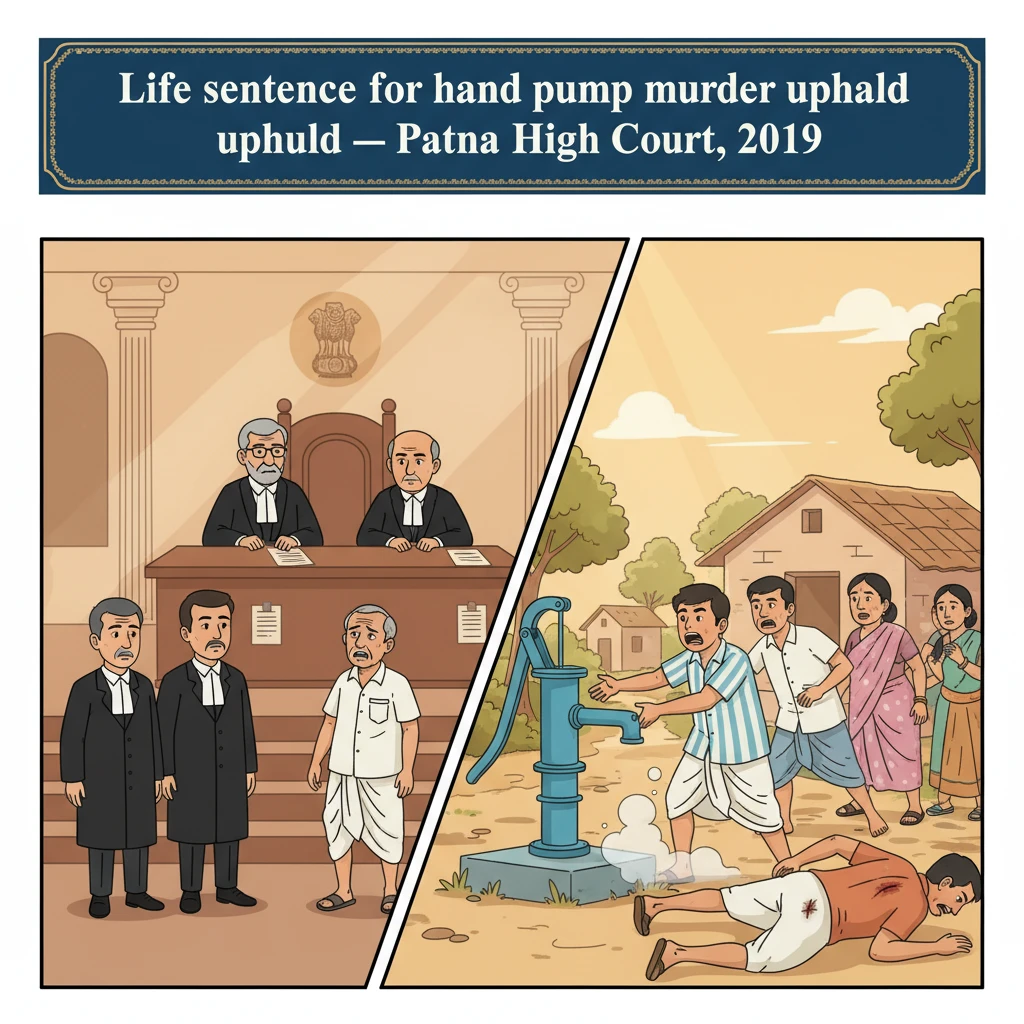
According to this report, around 6 p.m. on 18.06.2010, the informant’s father, Sushil Yadav, went to a public hand pump to fetch water. At that moment, neighbour Surendra Yadav allegedly came out of his house, stopped him from drawing water and claimed that the hand pump was on his own land. An argument started.
Hearing the commotion, the informant rushed to the spot and protested against Surendra Yadav’s behaviour. This led to a further quarrel between the informant and Surendra. In the meantime, Jagdish Yadav and Manohar Yadav @ Munna also reached there. They allegedly abused the informant and his father and also stopped them from using the hand pump.
The written report states that, on protest by the informant side, all three accused became angry. They allegedly ordered that the informant and his father be eliminated. Surendra Yadav then went inside his house, brought out a musket, pointed it at the informant, and when the informant raised alarm, his father ran towards him to save him. At that point, Surendra allegedly fired, hitting Sushil Yadav, who fell to the ground and died on the spot. The deceased’s wife, daughters-in-law and other villagers were said to have seen the incident.
Police registered the FIR under Sections 302/34 of the Indian Penal Code and Section 27 of the Arms Act against Surendra Yadav, Jagdish Yadav and Manohar Yadav @ Munna. After investigation, the Investigating Officer submitted charge-sheet only against Surendra Yadav and Manohar Yadav, keeping investigation pending against Jagdish Yadav.
The Magistrate took cognizance and committed the case to the Court of Sessions. On transfer, it was tried by the Additional Sessions Judge-I, Banka as Sessions Trial No. 1203 of 2010.
Charges were framed against Surendra Yadav and Manohar Yadav @ Munna under Sections 302/34 IPC and Section 27 of the Arms Act. Both pleaded not guilty and claimed trial.
The prosecution examined nine witnesses, including the informant, female family members who claimed to be eye witnesses, two other villagers, the Investigating Officer and the doctor who conducted the post mortem. Some documents, including the post mortem report, were also proved. The accused were examined under Section 313 CrPC and denied the occurrence. They examined two defence witnesses to support their version.
The trial court convicted both Surendra and Manohar under Section 302/34 IPC and further convicted Surendra under Section 27 of the Arms Act. Both were sentenced to rigorous imprisonment for life with a fine of Rs. 20,000/- each, and in default six months’ further rigorous imprisonment. Surendra received an additional three years’ rigorous imprisonment and a fine of Rs. 1,000/- under the Arms Act, with one month’s default sentence. Sentences were to run concurrently.
Being dissatisfied, Surendra Yadav filed Criminal Appeal (DB) No. 699 of 2013 and Manohar Yadav @ Munna filed Criminal Appeal (DB) No. 885 of 2013 before the Patna High Court. Both appeals were heard together and decided by a common judgment dated 11.01.2019.
What the Court Examined and Decided
The central question before the Patna High Court was whether the prosecution had proved, beyond reasonable doubt, that Surendra Yadav fired the fatal shot killing Sushil Yadav and that Manohar Yadav shared a common intention with him so as to be liable for murder under Section 302 read with Section 34 IPC.
On behalf of the appellants, counsel argued that the deceased did not die from firing by the appellants but from a shot allegedly fired by the informant himself, which accidentally hit his father. It was further submitted that there was no direct allegation of firing against Manohar Yadav, nor any claim that he brought any weapon or actively participated in the shooting. Therefore, according to the defence, Section 34 could not apply to him.
The appellants’ counsel also stressed that all main witnesses, except two (P.W.2 and P.W.3), were family members of the deceased and were “interested witnesses”. No independent villager supported the prosecution, so their evidence, according to the defence, should not be trusted.
Supporting the trial court’s view, the Additional Public Prosecutor submitted that the informant and other eye witnesses had fully supported the prosecution version. Their accounts were in line with one another and were further supported by medical evidence. The trial judge, after properly appreciating the evidence, had rightly convicted both appellants.
The High Court then closely examined the evidence of the informant, Ashok Yadav (P.W.7). In his examination-in-chief he repeated the story given in his written report. He said that Surendra Yadav first stopped his father from using the public hand pump and abused him. When he himself intervened, Manohar came and abused them, followed by Jagdish, who ordered Surendra to bring the musket and eliminate the father and son. Surendra then fetched the musket from his house, pointed it at the informant, and when the informant shouted, his father ran towards him. At that time Surendra fired at his father’s back. The father fell and died on the spot, and the accused fled.
The High Court noted that P.W.7 was thoroughly cross-examined but nothing substantial was brought out to discredit his presence at the scene or his narration of events. The Court found that he had “stood the test of cross-examination tenaciously”.
The Court then examined the testimonies of the four female family members: Parmila Devi (P.W.1), China Devi (P.W.4), Pairiya Devi (P.W.5) and Rekha Devi (P.W.6). All four independently stated that Sushil Yadav had gone to the public hand pump; Surendra stopped him and abused him; the informant came and protested; Jagdish and Manohar also came, abused and forbade them from taking water; Jagdish ordered Surendra to fetch the musket and kill them; Surendra took out the musket and pointed it at the informant; on the informant’s alarm, Sushil rushed to save him; and Surendra then fired at Sushil’s back, causing his death on the spot. The accused then ran away.
The High Court pointed out that each of these witnesses was vigorously cross-examined but nothing “convincing and cogent” was elicited to show they were not present or that they had not seen the occurrence. Additionally, these witnesses corroborated each other’s presence at the scene. P.W.1 confirmed that P.Ws.4, 5, 6 and 7 were present; P.W.4 confirmed P.Ws.1, 5 and 7; P.W.5 confirmed P.Ws.1, 4, 6 and 7; P.W.6 confirmed P.Ws.1, 4 and 7; and P.W.7 confirmed P.Ws.1, 4, 5 and 6.
Two other villagers, Manoj Kumar Yadav (P.W.2) and Binod Paswan (P.W.3), were not eyewitnesses to the actual firing. They stated that they saw the accused running away from the spot with a musket after the incident. P.W.3 added that, on reaching the spot, the family members told him that Surendra had shot the deceased. However, none of the family members confirmed that they had given this information to P.W.3. The Court therefore treated this part of P.W.3’s evidence as inadmissible hearsay for want of corroboration.
On the question of distance and manner of firing, the Court relied on both ocular and medical evidence. P.W.4 stated that at the time of firing the accused was about ten hand-lengths (around 15 feet) north of the deceased. P.W.1 also said that firing was done from about ten hand-lengths. The doctor, Dr. Ashok Kumar (P.W.9), who conducted the post mortem, did not find any blackening or charring on the wound and said that the shot was fired from a distance of more than 4–5 metres. The High Court held that this matched the eyewitness accounts of a shot fired from around 15 feet.
According to the post mortem report (Exhibit 7) and the doctor’s evidence, the deceased had the following ante mortem injuries: an entry wound on the right side of the back of the chest wall measuring 2” x 1” with inverted margins and no tattooing; fracture of the 2nd and 3rd thoracic vertebrae; an exit wound measuring 1½” x 1” below the left shoulder along the left anterior axillary line; and a lacerated wound on the right side of the scalp measuring 3 cm x ½ cm. The Court found that these injuries were fully consistent with a gunshot hitting the back and exiting near the shoulder, as described by the witnesses. The scalp injury, the Court observed, could have been caused when the deceased fell after being shot.
Evidence about the damage to the deceased’s clothes also supported the firing version. P.W.1 and P.W.4 both said that the bullet had made a hole in the deceased’s shirt. The Investigating Officer (P.W.8), Deo Narain Ram, stated that he found the deceased’s clothes torn by a bullet. This further confirmed the prosecution story that a gunshot injury had been inflicted at the spot.
Turning to the defence case, the High Court examined the statements of Janardan Yadav (D.W.1) and Jai Prakash (D.W.2). It found that D.W.1 was a cousin of Surendra and an adviser to him; D.W.1 himself admitted that he had advised Surendra to lodge a counter-case against the prosecution party, which Surendra did. The Court also noticed that the versions of D.W.1 and D.W.2 about how the deceased was shot were seriously contradictory.
D.W.1 claimed that during a brawl, the informant Ashok Yadav went home, brought a gun and fired at Manohar Yadav, but the shot hit Sushil as well, and splinters injured Manohar. On the other hand, D.W.2 claimed that after an altercation between Sushil and Manohar, Ashok took a double barrel gun from his house and fired two shots: the first hit Manohar’s shoulder and the second hit Sushil. The High Court held that in view of these contradictions, coupled with their close relationship and interest in protecting the accused, the defence witnesses were not reliable and their evidence could not create any reasonable doubt about the prosecution case.
The Court also addressed minor discrepancies regarding which accused gave the order to fire, who used which abusive words, and the exact description of the firearm. It held that such small contradictions are natural because people perceive and recall details differently. They did not affect the core facts that Surendra fired the gun and Sushil died as a result.
Regarding Manohar Yadav’s role, the defence had argued that he did nothing more than being present and did not carry a weapon. The High Court rejected this. It pointed out that, according to the consistent evidence, Manohar came to the spot, abused the informant and his father, forbade them from taking water and joined with others in giving the order to Surendra to bring the musket and kill them. P.W.6 specifically added that upon arriving, Manohar threatened to eliminate the informant and his father. The Court held that these acts showed that Manohar shared a common intention with Surendra and Jagdish to kill. In furtherance of this common intention, Surendra fired the fatal shot. Therefore, Section 34 IPC applied and Manohar was also liable for murder.
On the argument that the eyewitnesses were all related to the deceased and hence “interested”, the Court said that mere relationship is not a ground to reject testimony. Such evidence must instead be examined carefully. After such careful scrutiny, the Court found their evidence consistent, unblemished and trustworthy, with only minor contradictions not touching the heart of the case. Thus, the prosecution had, in the Court’s view, firmly established its case.
In the final analysis, the Patna High Court held that the prosecution had “successfully substantiated its case and succeeded to bring home the charges levelled against the appellants beyond reasonable doubt” through consistent ocular and medical evidence. It concluded that the trial court’s judgment of conviction and sentence did not require any interference and upheld it in full. Consequently, both criminal appeals were dismissed.
Why This Judgment Matters
This judgment shows how the Patna High Court deals with violent disputes arising out of everyday village issues, such as access to a public hand pump. Even in a simple quarrel over water, if someone brings a gun, fires and causes death, the Court treats it as a clear case of murder.
The decision is important for families who may worry that, because they are related to the victim, their evidence will not be believed. The Court clearly states that being a wife, son or daughter-in-law of the deceased does not make a witness unreliable. What matters is whether their statements are consistent and withstand cross-examination.
The ruling also clarifies that a person can be punished for murder even if he does not himself fire the gun. If he abuses, threatens, stops the victim from acting, and joins in giving the order to kill, he can be held to share a “common intention” and be convicted under Section 302/34 IPC.
For lawyers and accused persons, the judgment underlines that a defence theory must be consistent and credible. Here, the Court rejected the version that the informant accidentally shot his own father because the defence witnesses contradicted each other and appeared biased.
Legal Issues and Answers
-
Issue: Did the prosecution prove beyond reasonable doubt that Surendra Yadav fired the musket and caused the death of Sushil Yadav?
Answer: Yes. Consistent eyewitness accounts, supported by medical and investigative evidence, established that Surendra fired the fatal shot. -
Issue: Could Manohar Yadav be convicted for murder with the aid of Section 34 IPC even though he did not fire the gun?
Answer: Yes. The Court held that his presence, abuses, threats, and participation in giving the order to kill showed a shared common intention, attracting Section 302/34 IPC. -
Issue: Should the testimony of close relatives of the deceased be discarded for being “interested” witnesses?
Answer: No. The Court held that mere relationship is not a ground to reject evidence; after careful scrutiny their evidence was found reliable and was accepted.
Cases Cited by the Court
- The judgment, as recorded, does not mention or rely on any earlier decided case. The decision is based on appreciation of evidence on record.
Case Details
Case Number: Criminal Appeal (DB) No. 699 of 2013 with Criminal Appeal (DB) No. 885 of 2013; arising out of Belhar P.S. Case No. 94 of 2010, Sessions Trial No. 1203 of 2010.
Case Title: Surendra Yadav @ Surender Yadav vs. The State of Bihar; Manohar Yadav @ Munna vs. The State of Bihar.
Citation: 2019(2) PLJR 897.
Coram: Hon’ble Mr. Justice Rakesh Kumar and Hon’ble Mr. Justice Prakash Chandra Jaiswal (Oral Judgment per Hon’ble Mr. Justice Prakash Chandra Jaiswal).
Advocates: For the appellants – Mr. Ajay Mukherjee, Advocate; Mr. Arjun Prasad, Advocate. For the State – Mr. Satyanarayan Prasad, APP.
Date of Patna High Court Judgment: 11.01.2019 (uploaded and transmitted on 17.01.2019).
Nature of Case: Criminal appeals (Division Bench) against judgment of conviction and sentence for offences under Section 302/34 IPC and Section 27 of the Arms Act passed by the Additional Sessions Judge-I, Banka.
Link to Judgment: Click here to access the full Patna High Court judgment.
If you found this explanation helpful and wish to stay informed about
how legal developments may affect your rights in Bihar,
you may consider following Samvida Law Associates for more updates.







