

Case Background
The petitioner had purchased 10 dhur of land in Saran district. The land is described as part of Plot No. 334 under Khata No. 271, situated at Mohalla Chhota Telpa, Ward No. 36, Holding No. 931, within Chapra town.
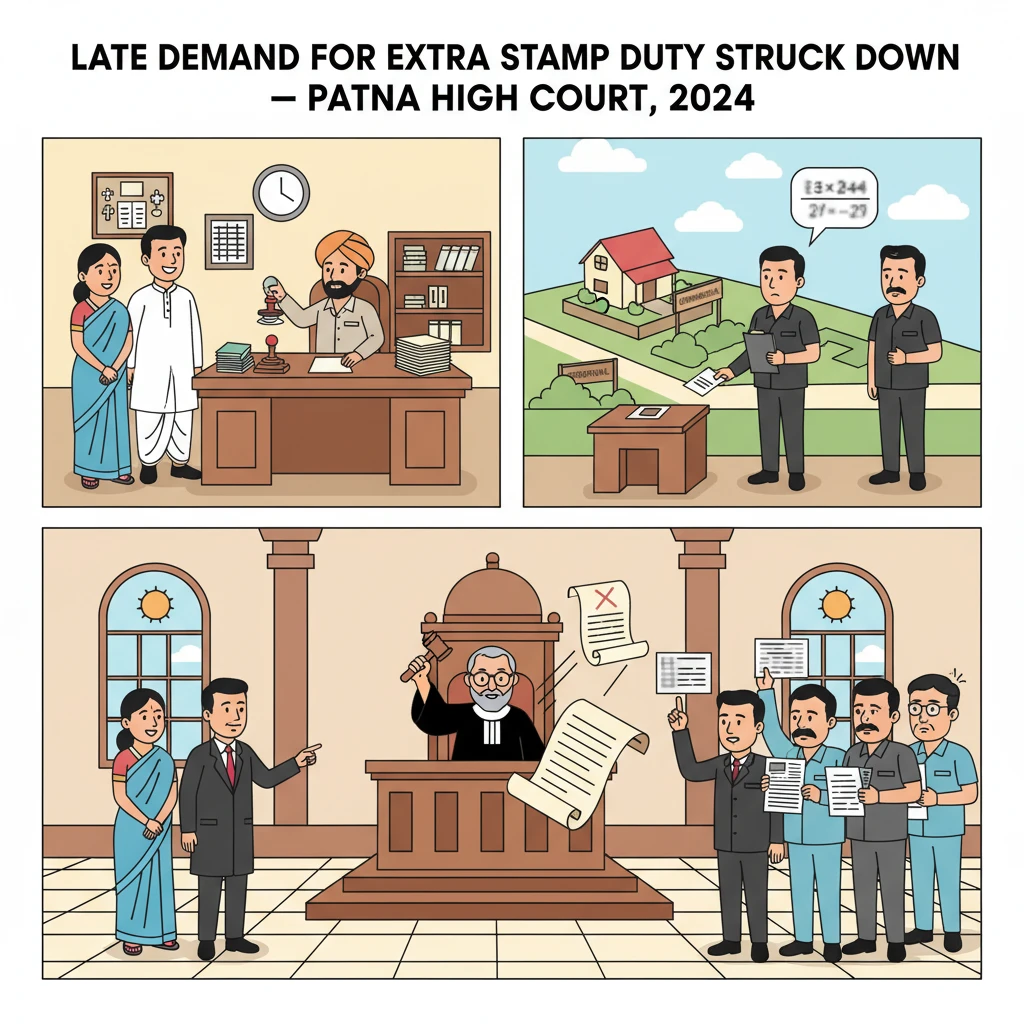
The sale deed was registered on 31.08.2019. At that time, the petitioner paid the stamp duty and registration charges as required. In the document, she mentioned the category of the land, including the structure standing on it, as residential.
According to the petitioner, everything was completed at the time of registration, and no objection was raised by the Registering Officer.
More than three years later, the petitioner suddenly received a notice dated 11.11.2023. This notice referred to an order earlier passed on 09.07.2022 in Stamp Case No. 41 of 2022 by the Assistant Inspector General, Registration, Saran Division.
By that order, the petitioner was directed to pay deficit stamp duty of Rs. 1,38,046/- and penalty of Rs. 13,805/-, totalling Rs. 1,51,851/-. The notice demanded an even higher figure of Rs. 1,85,313/- to be deposited within seven days. The basis mentioned was that the land should have been treated as “fit for commercial use” instead of “residential”.
What the Court Examined and Decided
The core question before the Patna High Court was whether the authorities could, after several years, re-open a duly registered sale deed and demand extra stamp duty by changing the category of land from residential to commercial.
The petitioner attacked the order dated 09.07.2022 mainly on two grounds.
First, she said the order was passed ex parte, that is, behind her back. According to her, no notice was issued to her before imposing such a heavy liability of deficit duty and penalty.
Second, and more importantly, she argued that the very reference made by the District Sub-Registrar (respondent no. 5) to the Assistant Inspector General, Registration (respondent no. 4) was illegal under the Indian Stamp Act, 1899.
The petitioner relied on Section 47-A(1) of the Act. This provision deals with the power of the Registering Officer when he suspects that the classification, measurement or market value of the property in a document is not correctly stated.
Under Section 47-A(1), while registering an instrument of conveyance, exchange, gift, partition or settlement, if the registering officer is satisfied that the classification of the property or measurement of the structure is wrong, or that the market value is lower than what appears in the Guideline Register of Estimated Minimum Value, he must refer the instrument to the Collector for determination of proper market value and stamp duty.
Importantly, the section says he must refer such instrument “before registering it”.
The proviso to Section 47-A(1) adds another situation. If the market value shown in the deed is not less than the value prescribed in the guideline register, but the registering officer still believes that the real market value is higher than that minimum value, he may, after registering the instrument, refer it to the Collector. However, he must assign proper reasons for this belief while making the reference.
The petitioner’s submission was that in her case, the Sub-Registrar did not make any such reference at the time of registration on 31.08.2019. The sale deed was registered without objection. The reference was made only long afterwards, on 09.05.2022, when the Sub-Registrar sent the matter to the Assistant Inspector General, Registration, leading to Stamp Case No. 41 of 2022.
To support this interpretation, the petitioner cited a Division Bench decision of the Patna High Court in The State of Bihar and others v. Smt. Tetra Devi, reported in 2018 (3) PLJR 136. In that case, the Division Bench had held that the Collector’s notice for deficit stamp duty, exercising suo motu power, must be issued within two years of registration. The Bench also held that the Sub-Registrar could not make a delayed recommendation when no reference was made at the time of registration.
The petitioner also relied on a decision of a co-ordinate Bench in Shahnaz Begam vs. The State of Bihar & Ors., reported in 2018 (2) PLJR 293. In that judgment, the Court had clearly held that a registering authority can refer a matter to the Collector for determination of proper market value only before registering the instrument under Section 47-A(1). After registration, any fresh proceeding could only be by the Collector suo motu under Section 47-A(3) and that too within two years from the date of registration.
Section 47-A(3), as quoted in Shahnaz Begam and again examined in the present case, gives the Collector or Assistant Inspector General Registration the power to call for and examine a registered instrument, on his own, within two years from the date of its registration, where it has not already been referred under Section 47-A(1). If he finds that the market value was not correctly stated, or is less than even the minimum value fixed under the rules, he can determine the correct value and duty and demand the difference.
Thus, the law provides two distinct routes: one, a reference by the registering officer at or before registration; two, a suo motu action by the Collector within two years after registration, where no earlier reference exists.
On the other side, the State’s counsel tried to justify the impugned order. He said that upon spot verification, it was found that the land category mentioned in the sale deed as residential did not match the actual category on the ground. According to him, this discrepancy was reported to the department by a letter dated 20.02.2022. On that basis, the District Sub-Registrar, Saran at Chapra, referred the matter to the Assistant Inspector General, Registration, Saran Division, by letter dated 09.05.2022. Stamp Case No. 41 of 2022 was then started, leading to the order dated 09.07.2022 asking the petitioner to pay Rs. 1,51,851/- as deficit stamp duty and penalty.
The Court heard both sides and examined the documents on record. It found that the sale deed was registered on 31.08.2019. The Sub-Registrar’s reference to the Assistant Inspector General was made only on 09.05.2022. This was clearly after more than two and a half years from the date of registration.
Justice Mohit Kumar Shah held that under Section 47-A(1) of the Indian Stamp Act, 1899, the respondent no. 5, i.e., the District Sub-Registrar, had no jurisdiction to refer the matter after such a delay and after registration had already been completed. The provision expressly ties the reference to the stage “while registering” and, in the normal clause, “before registering” the instrument.
The Court also looked at Section 47-A(3) in detail. It noted that if any proceeding was to be initiated after registration, that could only be done by the Collector or Assistant Inspector General Registration on his own (suo motu) and only within two years from the date of registration. This power is independent of any reference from the Registering Officer.
However, in the present case, even this two-year window had passed. The proceedings were actually initiated after more than two and a half years from the registration date of 31.08.2019. Therefore, even under Section 47-A(3), no fresh action could have been lawfully taken against the petitioner for recovery of alleged deficit stamp duty.
The Court noted that the facts of the present case were squarely covered by the earlier co-ordinate Bench decision in Shahnaz Begam. In both cases, the reference by the Registering Officer was made after registration and beyond the legally permissible time, making the proceedings unsustainable.
In the final analysis, the Court held that the actions of respondent no. 5 (District Sub-Registrar) in making the delayed reference, and of respondent no. 4 (Assistant Inspector General, Registration) in passing the order dated 09.07.2022, were arbitrary, perverse, and against the clear mandate of Section 47-A of the Indian Stamp Act, 1899.
Consequently, the Patna High Court quashed the impugned order dated 09.07.2022 passed in Stamp Case No. 41 of 2022 by the Assistant Inspector General, Registration, Tirhut Division, Saran. The writ petition was allowed. No further directions were recorded regarding recovery, meaning the demand raised under the quashed order cannot be enforced against the petitioner.
Why This Judgment Matters
This judgment is important for ordinary land buyers and sellers in Bihar, especially in urban areas like Chapra and Patna where land use categories often become points of dispute.
The Patna High Court has made it clear that once a sale deed is registered and the buyer has paid the required stamp duty, the authorities cannot reopen the transaction after a long gap at their own convenience. The law fixes strict stages and time limits for checking under-valuation or wrong classification.
If the Sub-Registrar suspects that the land is wrongly described or under-valued, he must act then and there, at or before registration, or record proper reasons for referring it immediately thereafter. If no such action is taken, the Collector’s suo motu power to re-examine the document is also limited to two years from registration.
For property buyers, this ruling provides some security that they will not face surprise demands for huge additional stamp duty and penalty years after registration, provided the registration was completed without objection and within the guideline values.
Legal Issues and Answers
- Issue: Can the District Sub-Registrar refer a registered sale deed to the Assistant Inspector General, Registration for deficit stamp duty determination more than two years after registration under Section 47-A(1) of the Indian Stamp Act, 1899?
Answer: No. The Patna High Court held that the Sub-Registrar had no jurisdiction to make such a reference after registration and after more than two and a half years had passed. Any reference under Section 47-A(1) must be at or before registration. - Issue: Can proceedings for determination of alleged deficit stamp duty be initiated more than two years after registration by invoking Section 47-A(3) of the Indian Stamp Act, 1899?
Answer: No. The Court held that even under Section 47-A(3), the Collector or Assistant Inspector General can act suo motu only within two years from the date of registration. In this case, as proceedings started after more than two and a half years, they were time-barred and invalid. - Issue: Was the order dated 09.07.2022 directing payment of Rs. 1,51,851/- as deficit stamp duty and penalty legally sustainable?
Answer: No. The Court found the order arbitrary, perverse and contrary to Section 47-A of the Indian Stamp Act, 1899, and therefore quashed it and allowed the writ petition.
Cases Cited by the Court
- 2018 (3) PLJR 136 – The State of Bihar and others v. Smt. Tetra Devi
- 2018 (2) PLJR 293 – Shahnaz Begam vs. The State of Bihar & Ors.
Case Details
Case Number: Civil Writ Jurisdiction Case No. 698 of 2024
Case Title: Raj Kumari Devi v. The State of Bihar & Ors.
Coram: Hon’ble Mr. Justice Mohit Kumar Shah
Date of Judgment: 22.08.2024
Citation: 2024 (4) PLJR 53
Advocates:
- For the petitioner: Mr. Koshalendra Rai, Advocate
- For the respondents (State): Mr. Vikas Kumar, SC-11; Mr. Rewti Kant Raman, J.C. to SC-11
Nature of the Case: Writ petition under civil writ jurisdiction challenging an order in stamp duty proceedings (Stamp Case No. 41 of 2022) seeking quashing of demand for deficit stamp duty and penalty.
Impugned Order: Order dated 09.07.2022 passed by the Assistant Inspector General, Registration, Saran Division, in Stamp Case No. 41 of 2022.
Result: Impugned order quashed; writ petition allowed.
Link to Judgment: View full judgment on Patna High Court website
If you found this explanation helpful and wish to stay informed about how legal developments may affect your rights in Bihar, you may consider following Samvida Law Associates for more updates.







