

Case Background
The petitioner in this case was a private limited company engaged in manufacturing two-wheelers. It was registered under the Bihar Finance Act with Registration No. BR 3229 (R) and under the Bihar Entry Tax Act, 1993 with Registration No. PR 170.
The dispute did not concern the basic liability to pay commercial tax. The core question was limited to interest on refund of excess commercial tax collected for the assessment years 1996–97 and 1997–98. The excess tax itself had already been refunded by the Commercial Taxes Department.
The company approached the Patna High Court under Article 226 of the Constitution of India. It sought a direction to the State of Bihar and the tax authorities to pay statutory interest on the belated refund, by invoking Section 43 of the Bihar Finance Act, 1981.
Section 43 of the Act provides that any amount refundable, if not refunded within six months from the date of receipt of an application by the dealer or person concerned, shall carry interest at 9% per annum from the expiry of that six-month period.
The basic facts were admitted. What remained in dispute was from which date the refund application should be counted, and whether the refund was actually belated within the meaning of Section 43.
What the Court Examined and Decided
The Patna High Court, through a Division Bench, heard the matter on 25.11.2021. The oral judgment was delivered by Hon’ble Mr Justice Chakradhari Sharan Singh, with Hon’ble Mr Justice Madhuresh Prasad concurring.
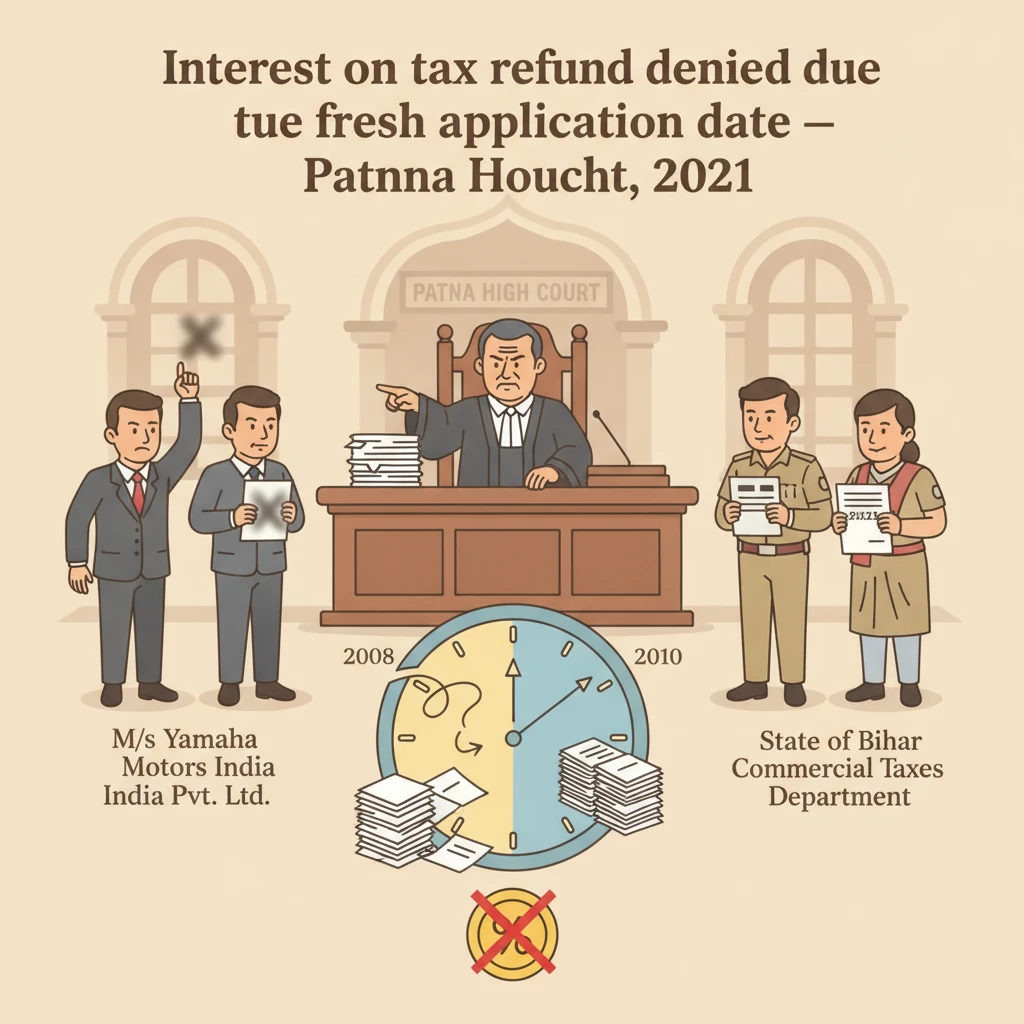
The Court first noted that an initial application for refund was made by the petitioner on 25.04.2008. However, this application was found to be defective. The order-sheet maintained by the office of the Deputy Commissioner of Commercial Taxes, Patliputra Circle, showed that the petitioner was repeatedly asked to remove defects in the application.
The nature of the defects was recorded as “fundamental”, meaning that without curing them the authorities could not process the claim for refund. The company did not remove these defects despite being given opportunities through subsequent orders by the Deputy Commissioner.
According to the State’s stand in its counter affidavit, the petitioner later filed a fresh application for refund on 18.03.2010. This application, in Form A–VIII, was brought on record as Annexure A to the counter affidavit.
The last paragraph of this fresh application carried a clear declaration by the representative of the company. He expressly stated that no application for refund of the amount had been made by him or on his behalf before that date. This declaration became central to the Court’s reasoning.
Acting on the application dated 18.03.2010, the competent authority passed an order on 26.03.2010 directing refund of the excess tax. The District Treasury Officer, Patna, actually released the refund to the petitioner on 31.03.2010.
The petitioner’s counsel argued that, in reality, the company had removed the defects in the earlier application of 25.04.2008. Therefore, according to the petitioner, the effective date of the refund application should be taken as 25.04.2008, not 18.03.2010.
If 25.04.2008 was treated as the application date, then the refund made on 31.03.2010 would clearly be far beyond six months, and the petitioner would become entitled to 9% interest under Section 43 of the Bihar Finance Act.
On the other hand, the State’s counsel maintained that the 2008 application had been rejected as defective and could not be acted upon. The State submitted that the only valid and operative application was the fresh one dated 18.03.2010. Since the refund order was passed on 26.03.2010 and the amount was paid by 31.03.2010, all within days of the fresh application, there was no delay that could attract Section 43.
The Court framed the real dispute in simple terms: which date should be treated as the date of the refund application for purposes of Section 43—25.04.2008 or 18.03.2010.
The Bench observed that there was no dispute that the initial application dated 25.04.2008 was “too defective to be processed” and that “no order for refund could be passed thereon.” The order-sheet showed repeated directions to the petitioner to remove these defects, which it failed to do.
The judges then turned to Annexure A, the fresh application dated 18.03.2010. They emphasised the petitioner’s own declaration that no refund application had been made before that date. This declaration, in the Court’s view, was given in light of the earlier application having been found defective by the authority.
The Court also noted a statement in paragraph 4 of the supplementary affidavit filed on behalf of the petitioner. There, the petitioner itself admitted that “a fresh application was filed on 18.03.2010.” This reinforced the Court’s understanding that the 2010 application was not a mere curing of defects but a new, independent application.
From these materials, the Court concluded that the undisputed facts were: the initial application dated 25.04.2008 was defective; and a fresh application was indeed made on 18.03.2010. On that fresh application, the refund order was promptly passed and the money refunded within two weeks.
Importantly, the petitioner accepted this refund “without demur.” There was no protest at the time of receiving the amount, nor any immediate claim that interest was due on account of delay from 2008. Only after receiving and enjoying the refund did the petitioner approach the High Court to claim interest.
The Bench held that by filing a fresh application on 18.03.2010, and by giving an express declaration that no previous refund application existed, the petitioner had effectively accepted that the earlier application was defective and stood rejected.
Therefore, the petitioner could not later rely on the defective 2008 application to argue that refund was delayed. The Court used the principle that a person cannot “approbate and reprobate”, meaning one cannot accept a position when it suits him and then deny it later.
The Court held that the petitioner was clearly estopped from placing reliance on the defective application dated 25.04.2008 for the purpose of claiming interest under Section 43.
To support its reasoning on estoppel, the Court relied on the Supreme Court decision in D. Sarojakumari v. R. Helen Thilakom and Others, (2017) 9 SCC 478. In that case, the Supreme Court collected several earlier judgments where candidates who took part in a selection process, knowing the rules and method, were later barred from challenging the process after being unsuccessful.
The key principle drawn from those cases is that if someone takes a calculated chance and participates in a legal or administrative process, they cannot, after getting an unfavourable result, turn around and challenge the very process they accepted.
Applying that principle here, the High Court reasoned that the petitioner, by filing a fresh application and accepting the refund on that basis, could not later revert to its earlier defective application to claim a better financial outcome by way of interest.
On this basis, the Court held that the “date of application” for Section 43 purposes was 18.03.2010. Since the refund was ordered on 26.03.2010 and paid by 31.03.2010, well within six months, Section 43 did not come into play at all. Therefore, there was no legal right to interest.
In paragraph 15 of the judgment, the Bench stated that the petitioner had not been able to make out a case for direction to pay interest under Section 43, the date of application being 18.03.2010. It clearly held that the petitioner could not legally claim interest on the refunded amount.
Consequently, in paragraph 16, the Court concluded that the writ application had no merit and dismissed it. In paragraph 17, it ordered that there would be no order as to costs.
Why This Judgment Matters
This judgment is important for businesses and dealers seeking refund of excess tax from the State of Bihar, and particularly from the Commercial Taxes Department.
It shows that if a refund application is defective and the dealer later files a fresh application, the clock for interest under Section 43 of the Bihar Finance Act will start from the fresh application, not from the original defective one.
The decision also highlights the risk of giving declarations in official forms. Here, the petitioner’s own statement that no previous refund application existed was used against it. Such declarations can close the door on later claims based on earlier steps.
The judgment further reinforces that once a party accepts a benefit without protest—such as receiving a refund—courts may not allow that party to later challenge the underlying process just to seek additional financial advantage like interest.
For taxpayers, the practical lesson is to file refund applications carefully, ensure defects are removed promptly, and be cautious before filing fresh applications or making declarations that may waive earlier rights.
Legal Issues and Answers
-
Issue: From which date should the petitioner’s refund application be reckoned for claiming interest under Section 43 of the Bihar Finance Act, 1981—25.04.2008 or 18.03.2010?
Answer: The Patna High Court held that 18.03.2010, the date of the fresh refund application containing the petitioner’s declaration, was the relevant date. The earlier application of 25.04.2008 was defective and treated as rejected. -
Issue: Was the petitioner entitled to statutory interest on the refunded excess tax under Section 43 of the Bihar Finance Act, 1981?
Answer: No. Since the refund order was passed on 26.03.2010 and the refund paid on 31.03.2010, within days of the valid application dated 18.03.2010, there was no delay beyond six months. Section 43 did not apply, and no interest was payable. -
Issue: Could the petitioner rely on its earlier defective application after filing a fresh application and accepting refund on that basis?
Answer: No. The Court held that the petitioner was estopped and could not approbate and reprobate. By declaring that no prior application existed and by enjoying the benefit of refund under the fresh application, it could not later rely on the defective application to claim interest.
Cases Cited by the Court
- D. Sarojakumari v. R. Helen Thilakom and Others, (2017) 9 Supreme Court Cases 478.
- The Patna High Court also referred to earlier Supreme Court cases discussed within D. Sarojakumari, including G. Sarana v. University of Lucknow, Madan Lal v. State of J&K, Manish Kumar Shahi v. State of Bihar, Ramesh Chandra Shah v. Anil Joshi, and Madras Institute of Development Studies v. K. Sivasubramaniyan, as part of the extracted passage.
Case Details
Case Number: Civil Writ Jurisdiction Case No. 633 of 2011
Case Title: M/s Yamaha Motors India Private Limited v. The State of Bihar & Others
Coram: Hon’ble Mr Justice Chakradhari Sharan Singh and Hon’ble Mr Justice Madhuresh Prasad
Citation: 2022(1) PLJR 120
Advocates: For the petitioner – Ms Manju Jha, Advocate. For the respondents – Mr Sriram Krishna and Mr Akash Chaturvedi, Assistant Counsels to Standing Counsel XI.
Nature of the Case: Writ petition under Article 226 of the Constitution of India seeking interest on refund of excess commercial tax under Section 43 of the Bihar Finance Act, 1981.
Date of Judgment: 25.11.2021
Link to the Judgment: Click here to view the official Patna High Court judgment
If you found this explanation helpful and wish to stay informed about
how legal developments may affect your rights in Bihar,
you may consider following Samvida Law Associates for more updates.







