

Case Background
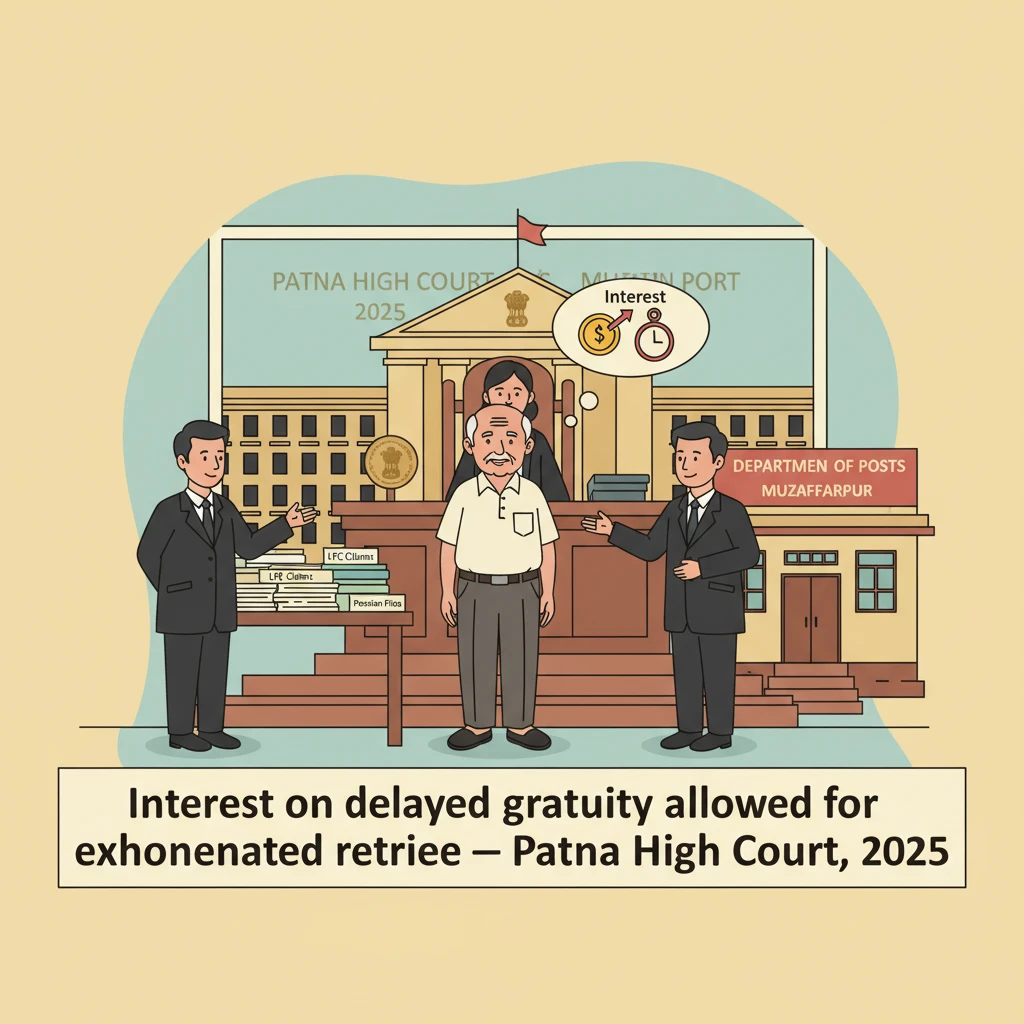
The petitioner was a Sorting Assistant in the Department of Posts, working in the RMS “U” Division at Muzaffarpur. He retired on 28.02.2017 from the post of L.S.G. Sorting Assistant.
Before his retirement, on 18.12.2012, the Superintendent RMS “U” Division, Muzaffarpur served him with a charge‑sheet under Rule 14 of the Central Civil Services (Classification, Control & Appeal) Rules, 1965. The sole article of charge accused him of falsely claiming LTC advance and submitting bogus LTC bills for the block year 2002‑2005, to gain money and cause loss to the Department. It was alleged that this conduct violated Rule 16(1) of the CCS (LTC) Rules, 1988 and Rule 3(1)(i) and (iii) of the CCS (Conduct) Rules, 1964.
A full departmental enquiry followed. The Inquiry Officer submitted an elaborate report on 09.08.2016. Relying on that report, the disciplinary authority, the Postmaster General (Northern Region), Muzaffarpur, issued an order on 24.02.2017. He held that Article‑I was not proved and, after considering the petitioner’s representation and the material on record, exonerated the petitioner of all charges.
Despite this, when the petitioner retired on 28.02.2017, only a provisional pension order was issued. Gratuity was withheld. On 21.04.2017, the Chief Postmaster General, Bihar Circle, Patna, invoked Rule 29 of the CCS (CCA) Rules, 1965. Holding that the Postmaster General (Northern Region) had no jurisdiction to exonerate the petitioner and that the competent authority was the Director Postal Services (Northern Region), Muzaffarpur, the Chief Postmaster General treated the exoneration order dated 24.02.2017 as ab initio void.
The petitioner approached the Central Administrative Tribunal, Patna Bench, in OA No.050/00287/2017, challenging the order dated 21.04.2017. By order dated 14.12.2017, the Tribunal declined to interfere with that order. However, it directed the postal authorities to expedite the matter and either pass a final order within four months or release the retiral benefits, subject to the final outcome of follow‑up action on the Chief Postmaster General’s order.
The petitioner then filed C.W.J.C. No.2321 of 2018 before the Patna High Court. On 06.02.2018, a Co‑ordinate Bench disposed of the writ petition, directing the competent authorities to take a decision in terms of the Tribunal’s order dated 14.12.2017 within 3½ months.
Even then, no final disciplinary order was passed within the time fixed by either the Tribunal or the High Court, and the petitioner’s gratuity remained unpaid.
Eventually, on 09.08.2018, the Director (PG & VP), Ministry of Communications, Department of Posts, Government of India, issued an order under Rule 9 of the CCS (Pension) Rules, 1972. Noting that the Inquiry Officer’s report dated 09.08.2016 had held Article‑I “not proved” and that the charge was not grave enough to attract Rule 9 (cut in pension and/or gratuity), the President ordered that the disciplinary proceedings initiated by memo dated 18.12.2012, and continued under Rule 9 after retirement, “be dropped”. The order also recorded that, due to pendency of these proceedings, only provisional pension had been sanctioned and no other retirement benefits were paid.
After this order, the petitioner finally received gratuity: Rs. 9,32,818 on 02.08.2018 and Rs. 1,03,646 on 04.10.2018. However, he was not paid any interest for the delay from 01.03.2017 till the dates of payment.
He again approached the Tribunal in OA No.050/887/2018, claiming statutory and penal interest on delayed gratuity. By judgment dated 14.11.2024, the Tribunal dismissed the OA, holding that there was no culpable delay in settlement and disbursement of DCRG and that he was not entitled to interest. His review application, R.A. No.050/001/2025, was also rejected on 21.01.2025.
Against these two orders of the Tribunal, the petitioner filed the present writ petition, C.W.J.C. No.17889 of 2025, before the Patna High Court.
What the Court Examined and Decided
The Patna High Court focussed on two central questions. First, whether the disciplinary outcome amounted to the petitioner being “fully exonerated” or merely a dropping of proceedings with no exoneration. Second, whether the delay in paying gratuity was due to administrative lapses, attracting interest under Rule 68 of the CCS (Pension) Rules, 1972 and related Government of India decisions.
The petitioner relied on Rule 68 of the 1972 Rules, which allows interest when payment of gratuity is authorised later than when it becomes due and the delay is attributable to administrative lapses, provided the employee has not caused the delay. Rule 68 also requires the Secretary of the concerned Ministry or Department to consider such cases and sanction interest, followed by Presidential sanction.
The petitioner further relied on Government of India decisions dated 11.07.1979 and 10.01.1983. These clarify that:
• Normally, gratuity becomes due immediately on retirement.
• When disciplinary or judicial proceedings are pending on the date of retirement, gratuity is withheld until their conclusion and final orders.
• To reduce hardship where the government servant is fully exonerated on conclusion of proceedings, interest on delayed payment of retirement gratuity may be allowed. In such cases, for calculating interest, gratuity is deemed to have fallen due on the day after retirement.
• This benefit is not available where the employee dies during pendency of the proceedings and proceedings are then dropped.
The petitioner argued that he had been exonerated because the Inquiry Officer had found the charge not proved and, on that basis, the President ordered dropping of proceedings. Since the delay in paying gratuity was entirely due to departmental action and pendency of the case despite exoneration, interest had to be paid under Rule 68 and these decisions.
The Union of India opposed the claim. Its counsel submitted that the order dated 09.08.2018 only stated that the proceedings were “dropped” and did not record a formal exoneration. According to the respondents, the Government of India decisions grant interest only where a government servant is “fully exonerated” after conclusion of proceedings. Where proceedings are merely dropped, interest is not payable.
After hearing both sides, the Division Bench (Hon’ble Mr. Justice Mohit Kumar Shah and Hon’ble Justice Smt. Soni Shrivastava) examined the record in detail.
The Court first noted that the petitioner had already been exonerated once, by the Postmaster General (Northern Region) on 24.02.2017, on the basis of the Inquiry Officer’s report. That order clearly held Article‑I not proved and exonerated the petitioner from all charges. It was only later that the Chief Postmaster General, by invoking Rule 29 of the CCS (CCA) Rules, treated this exoneration as ab initio void on the ground of lack of jurisdiction.
After retirement, the disciplinary proceedings were converted into proceedings under Rule 9 of the CCS (Pension) Rules, 1972. Yet, in the final order dated 09.08.2018, the Director (PG & VP) again accepted the Inquiry Officer’s finding that Article‑I was not proved and that the charge was not grave enough to warrant any cut in pension or gratuity. On that basis, the President directed that the proceedings be dropped.
The Bench held that, in substance, this meant the charge against the petitioner had not been proved and he stood exonerated. Dropping the proceedings in these circumstances “amounts to exoneration of the petitioner of the charge levelled against him”.
Next, the Court considered whether there were administrative lapses causing delay. It recalled that the Tribunal’s order dated 14.12.2017 in OA No.050/00287/2017 had directed the authorities to either pass a final order within four months or release the retiral benefits, subject to the outcome of follow‑up action. The High Court’s own order dated 06.02.2018 in C.W.J.C. No.2321 of 2018 had further directed that decision be taken within 3½ months.
Despite these clear directions, no final disciplinary order was passed and no gratuity was paid within the stipulated periods. Gratuity was released only after the 09.08.2018 order, and that too in two instalments in August and October 2018. The Court observed that neither the respondents’ final order nor the gratuity payment was made within the time frames fixed by the Tribunal and the High Court, which “definitely goes to show the administrative lapses on the part of the respondents”.
Having thus found both exoneration and administrative lapse, the Court turned to interpretation of the rules. It emphasised the “beneficial rule of interpretation” applicable to social welfare and employee‑welfare provisions, quoting extensively from several Supreme Court judgments:
• Hindustan Lever Ltd. v. Ashok Vishnu Kate, 1995 (6) SCC 326, and Workmen v. American Express International Banking Corpn., 1985 (4) SCC 71 on purposive and liberal interpretation of welfare statutes.
• State of Rajasthan v. O.P. Gupta, 2022 (18) SCC 382, where the Supreme Court held that when pension rules admit more than one interpretation, courts must prefer the one favourable to employees.
• Madan Singh Shekhawat v. Union of India, 1999 (6) SCC 459, stressing that beneficial provisions must receive a wider, not restrictive, meaning.
• D.S. Nakara v. Union of India, 1983 (1) SCC 305, which held that pension is a right governed by rules, not a bounty depending on government discretion.
Applying these principles, the Patna High Court held that pension and gratuity are not matters of grace, and the rules regarding interest on delayed payment must be interpreted liberally to secure employees’ rights. Rule 68 and the Government of India decisions are beneficial provisions meant to protect retired employees from hardship due to departmental delay.
The Bench also referred to a Division Bench judgment of the Allahabad High Court in Ram Roop Parasar v. C.A.T., Allahabad through its Chairman & Others, 2013 SCC OnLine All 13237. In that case too, disciplinary proceedings had been dropped after the Central Vigilance Commission advised exoneration. The Allahabad High Court held that there was no real distinction, in such circumstances, between “dropping of proceedings” and “full exoneration” for the purpose of granting interest on delayed gratuity. It directed consideration of interest under Rule 68 and the same Government of India decisions of 1979 and 1983.
The Patna High Court found the present case similar. Here too, the very reason for dropping the proceedings was the Inquiry Officer’s finding that the charge was not proved and not grave. The order dated 09.08.2018 itself recorded that only provisional pension had been sanctioned because of the pending case. Therefore, the delay in paying the petitioner’s gratuity was wholly due to the departmental decision to keep proceedings alive, even though the charge had not been established.
On this basis, the Court rejected the respondents’ attempt to distinguish between “dropping” and “exoneration”. It clarified that the only exception mentioned in the Government decisions—where interest is not payable—is for government servants who die during pendency of the proceedings and whose proceedings are then dropped. That scenario did not apply here, as the petitioner was alive and had been effectively cleared of charges.
Consequently, the Court concluded that Rule 68 of the CCS (Pension) Rules, 1972, read with the Government of India decisions dated 11.07.1979 and 10.01.1983, squarely applied. The petitioner, having been exonerated and having suffered delayed gratuity due to administrative lapses, was entitled to interest.
In the result, the Court held that the Tribunal’s orders dated 14.11.2024 (in OA No.050/887/2018) and 21.01.2025 (in R.A. No.050/001/2025) were “not sustainable in the eyes of law” and set them aside. It directed the respondents to pay interest on the delayed payment of retirement gratuity to the petitioner at the prescribed rate and in accordance with instructions issued from time to time under Rule 68, within three months from 02.12.2025. The writ petition was allowed.
Why This Judgment Matters
This judgment is important for retired government employees, especially postal staff and other Central government servants in Bihar and beyond. Many retirees face situations where departmental enquiries continue till or beyond retirement, and gratuity is withheld for years.
The Patna High Court has made clear that if the enquiry ultimately finds the charges not proved and the employee is effectively exonerated, gratuity cannot be treated as a favour. If there is delay in payment because the department did not act in time, interest must be paid under Rule 68 of the CCS (Pension) Rules, 1972.
The Court has also clarified that where proceedings are dropped for the very reason that charges are not proved, this counts as exoneration for the purpose of interest. Departments cannot escape liability for interest merely by labelling the outcome as “dropping of proceedings”.
For retirees, this ruling means that when gratuity is delayed due to pending cases that ultimately end in their favour, they can rely on this Patna High Court decision to claim interest, provided there is no delay on their part in submitting papers.
Legal Issues and Answers
Issue: Is a retired government servant entitled to interest on delayed payment of gratuity when disciplinary proceedings are ultimately dropped after the charge is found not proved?
Answer: Yes. The Patna High Court held that where the charge is found not proved and proceedings are dropped on that basis, it amounts to exoneration. If gratuity is delayed due to administrative lapses and pendency of such proceedings, interest must be paid under Rule 68 of the CCS (Pension) Rules, 1972 and the Government of India decisions dated 11.07.1979 and 10.01.1983.
Issue: Can the department avoid paying interest by arguing that proceedings were only “dropped” and the employee was not “fully exonerated”?
Answer: No. The Court rejected this distinction. In the petitioner’s case, dropping of proceedings was based on a clear finding that the charge was not proved and not grave. This, in effect, exonerated the petitioner, making him eligible for interest on delayed gratuity.
Issue: Whether the Central Administrative Tribunal was right in holding there was no culpable delay in settlement and disbursement of DCRG?
Answer: No. The High Court held that failure to pass final orders or release gratuity within the periods fixed by the Tribunal and by a Co‑ordinate Bench of the High Court itself showed administrative lapses. On this ground also, Rule 68 was attracted and the Tribunal’s orders were set aside.
Cases Cited by the Court
- Hindustan Lever Ltd. v. Ashok Vishnu Kate & Others, 1995 (6) SCC 326.
- Workmen of American Express International Banking Corporation v. Management of American Express International Banking Corporation, 1985 (4) SCC 71.
- State of Rajasthan & Others v. O.P. Gupta, 2022 (18) SCC 382.
- Madan Singh Shekhawat v. Union of India & Others, 1999 (6) SCC 459.
- D.S. Nakara v. Union of India, 1983 (1) SCC 305.
- Deokinandan Prasad v. State of Bihar (citation discussed within D.S. Nakara).
- State of Punjab v. Iqbal Singh (citation discussed within D.S. Nakara).
- Ram Roop Parasar v. C.A.T., Allahabad through its Chairman & Others, 2013 SCC OnLine All 13237.
Case Details
Case Number: Civil Writ Jurisdiction Case No.17889 of 2025
Case Title: Bimal Kumar Singh v. Union of India & Others
Citation: 2026 (2) PLJR 29
Court: High Court of Judicature at Patna
Bench: Hon’ble Mr. Justice Mohit Kumar Shah and Hon’ble Justice Smt. Soni Shrivastava
Date of Judgment: 02.12.2025
Advocates:
- Mr. Om Prakash Singh, Advocate – for the petitioner
- Mr. Krishna Murari Prasad, Central Government Counsel – for the Union of India
- Mr. Dhiraj Kumar, Advocate – for the Union of India
Nature of the Case: Writ petition under Article 226 of the Constitution challenging orders of the Central Administrative Tribunal in an original application and review application concerning interest on delayed payment of retirement gratuity.
Link to Judgment: Click here to view the official Patna High Court judgment
If you found this explanation helpful and wish to stay informed about how legal developments may affect your rights in Bihar, you may consider following Samvida Law Associates for more updates.







