

Case Background
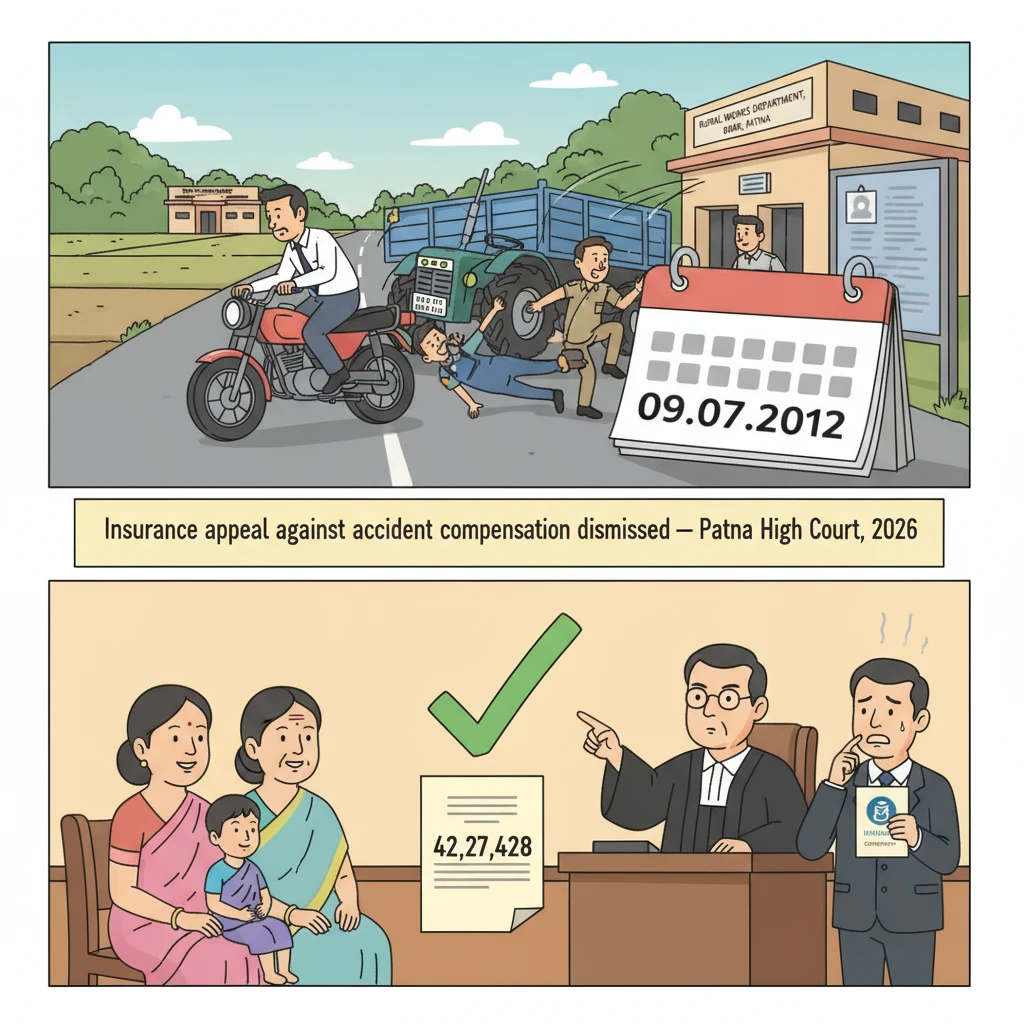
On 09.07.2012, an Assistant Engineer with the Rural Works Department, Bihar, Patna, was travelling on his motorcycle towards Darbhanga. When he reached near Taralahi in Bahadurpur police station area, District Darbhanga, a tractor bearing Registration No. BR-07-G-4161 came from behind.
The tractor allegedly hit the motorcycle in a rash and negligent manner. The engineer sustained grievous injuries and was taken to Darbhanga Medical College and Hospital, Darbhanga, where he died the same day during treatment.
After the accident, a usual criminal process followed. An FIR was lodged as Bahadurpur P.S. Case No. 252 of 2012 on 09.07.2012. Investigation was carried out and a charge-sheet was submitted. The tractor involved in the accident was insured with The New India Assurance Company Limited.
The deceased’s family members, including his wife and minor children, filed a claim case before the Motor Vehicle Accident Claims Tribunal, Muzaffarpur. The case was registered as Claim Case No. 326/12 titled “Vijaya Kumari & Ors. vs. Jyoti Devi & Another”. The owner of the tractor was made respondent, and the insurer was the second respondent.
The 12th Additional District Judge-cum-Motor Vehicle Accident Claim Tribunal, Muzaffarpur (the Tribunal) framed multiple issues, such as the occurrence of the accident, rash and negligent driving, insurance coverage, validity of driving licence, maintainability of the claim, and the quantum and liability for compensation.
By judgment dated 07.11.2015 and award dated 26.11.2015, the Tribunal held that the tractor hit the deceased’s motorcycle due to rash and negligent driving, and that the vehicle was insured with the insurance company at the time of the accident. It assessed the deceased’s monthly income at Rs. 47,941/-, considered his age as 54–55 years, applied necessary deductions, and awarded total compensation of Rs. 42,27,428/-.
Since Rs. 50,000/- had already been paid as interim compensation, the net amount payable was fixed at Rs. 41,77,428/-, with interest at 6% per annum from the date of filing of the claim case until payment. The insurer, being aggrieved and dissatisfied with this judgment and award, filed Miscellaneous Appeal No. 702 of 2016 before the Patna High Court.
What the Court Examined and Decided
The Patna High Court, through Hon’ble Mr. Justice Rajiv Roy, heard the appeal filed by The New India Assurance Company Limited. The insurer raised two main objections before the Court.
First, the company argued that the FIR in Bahadurpur P.S. Case No. 252 of 2012 had been lodged against an “unknown” tractor driver. Therefore, according to the appellant, it could not be conclusively said that the tractor bearing Registration No. BR-07-G-4161 was involved in the accident. On this basis, the company claimed it had no liability to pay the awarded compensation.
Second, the insurer contended that the Tribunal had calculated the compensation using the gross salary of the deceased, Rs. 47,941/- per month, without deducting income tax. The company submitted that there should have been a 30% income tax deduction from the salary, which would have reduced the final amount of compensation.
On the other side, counsel for the claimants opposed both grounds. Regarding the first point, he produced material from the case diary of Bahadurpur P.S. Case No. 252 of 2012. These records showed that, though the widow, who was not present at the spot, had understandably lodged the FIR against an “unknown tractor”, the police investigation soon identified the offending vehicle.
The case diary showed that the police seized the tractor bearing Registration No. BR-07-G-4161 along with a trailer BR-07-G-4197 on 09.07.2012 itself, the very date of the accident. The police also requested the Motor Vehicle Inspector to conduct an inspection of this vehicle. On this basis, the claimants argued that there was clear evidence connecting this particular tractor to the fatal accident, and therefore the insurer could not escape liability.
As to the second point, the claimants drew the High Court’s attention to the Supreme Court decision in Ranjana Prakash and Ors. vs. Divisional Manager & Anr., reported in 2011 (5) SCC 382. In that case, the Supreme Court referred to its earlier decision in Sarla Verma.
The principle from Sarla Verma, as noted by the Supreme Court in Ranjana Prakash, is that if a deceased had a permanent job with a regular salary and provisions for periodic increases, then 30% of the current income should be added towards future prospects when the deceased was between 40 and 50 years of age. At the same time, income tax actually payable is to be deducted from the annual income to arrive at the net “income” for calculating compensation.
The Court in Ranjana Prakash observed that, if both steps are done (30% addition for future prospects and around 30% deduction towards income tax), in some cases these may cancel out each other and leave the income adopted by the Tribunal effectively unchanged.
The claimants’ counsel argued that in the present case the Tribunal had not added 30% towards future prospects, though it should have, considering the deceased’s status as an Assistant Engineer with a fixed salary. If that addition were made and at the same time a 30% income tax deduction was applied, both would cancel out, and the final figure of income used by the Tribunal would remain the same. Therefore, according to the claimants, the insurer’s plea for income tax deduction could not reduce the compensation already granted.
After hearing both sides and perusing the record, the Patna High Court recorded certain key facts:
The deceased was working as an Assistant Engineer with the Rural Works Department, Bihar, on a fixed salary. He was riding his motorcycle on 09.07.2012 when the tractor bearing Registration No. BR-07-G-4161 hit him from behind. The Court noted that the police had seized this tractor on 09.07.2012 itself, as reflected in the case diary, and that a request for inspection had been made to the Motor Vehicle Inspector.
The Court further recorded that the tractor was insured with the appellant insurance company for the period from 29.05.2012 to 28.05.2013. The accident date, 09.07.2012, fell squarely within the policy period. On these facts, the Court held that the first objection of the insurer, questioning involvement of the insured tractor, could not be accepted. The Tribunal’s finding that the tractor was involved in the accident and that the insurance company was liable, was therefore upheld.
Turning to the second issue of income tax deduction, the High Court carefully examined the Supreme Court’s reasoning in Ranjana Prakash & Ors. The Court quoted paragraphs 9 and 10 of that judgment, where the Supreme Court explained that, in some circumstances, 30% addition for future prospects and 30% deduction towards income tax would “cancel each other”, resulting in no change in the income taken for computation and therefore no change in the compensation amount.
Applying this principle, the Patna High Court held that even if the appellant company’s plea for a 30% income tax deduction were accepted, there would also have to be a 30% increase towards future prospects. Once both were applied, they would offset each other, and the income figure adopted by the Tribunal would remain unchanged. As a result, the compensation fixed by the Tribunal could not be reduced on that ground. The Court thus rejected the second contention of the insurer as well.
The High Court then noted that no other point had been raised by the appellant company. Consequently, it found no reason to interfere with the Tribunal’s judgment and award. Miscellaneous Appeal No. 702 of 2016 was dismissed.
Since Rs. 50,000/- had already been paid to the claimants, the Court directed that the remaining amount of Rs. 41,77,428/-, along with interest at 6% per annum, must be paid to the widow by 19.02.2026.
The Court further ordered that, if the insurance company failed to make payment by 19.02.2026, the widow claimant would be entitled to Rs. 25,000/- as cost. This cost could be recovered from the erring official responsible for the delay in payment.
At the same time, the Court clarified that, if there had been any statutory violation, the insurance company would still have the right to agitate the matter in accordance with law. The Court also directed that any statutory amount deposited in the appeal, if any, should be returned.
Why This Judgment Matters
This judgment is important for families of road accident victims, especially where the offending vehicle is a tractor or similar commercial vehicle. It shows that an insurance company cannot escape liability merely because the initial FIR mentioned an “unknown” vehicle, if later investigation clearly identifies the offending vehicle and that vehicle is insured.
The Patna High Court relied on the case diary entries showing seizure of the specific tractor on the very day of the accident and the request for its inspection. This confirms that documentary investigation records can strongly support claimants in accident compensation cases.
The judgment also clarifies how income tax deductions and future prospects interact in calculating compensation. Where a deceased person had a permanent, salaried government job, courts may add a percentage for future prospects and, at the same time, deduct income tax. As explained by the Supreme Court and applied here, these two figures can cancel each other out, leaving the original income figure unchanged.
For claimants, this means that an insurer’s demand for income tax deduction does not automatically reduce compensation. Courts will consider whether, once future prospects are correctly added, any such deduction really makes a difference.
The direction to complete payment by a fixed date, and the warning that delay will attract additional cost recoverable from the responsible officer, also sends a clear message. Insurers must comply promptly with court-awarded compensation, or their own staff may face financial consequences.
Legal Issues and Answers
-
Issue: Was the insured tractor bearing Registration No. BR-07-G-4161 proved to be involved in the fatal accident despite the FIR being against an “unknown” tractor?
Answer: Yes. The Court held that seizure of the specific tractor on 09.07.2012 and the request for inspection, along with other material, established its involvement. The insurer’s objection was rejected. -
Issue: Should 30% income tax have been deducted from the deceased’s salary for calculating compensation, thereby reducing the award?
Answer: No. Applying the Supreme Court’s ruling in Ranjana Prakash & Ors., the Court held that any 30% tax deduction would be offset by a 30% addition towards future prospects, leaving the income and compensation unchanged. -
Issue: Did the Patna High Court interfere with the Tribunal’s award of Rs. 42,27,428/- (net Rs. 41,77,428/- after earlier payment)?
Answer: No. The Court dismissed the insurer’s appeal and directed payment of the remaining Rs. 41,77,428/- with 6% interest by 19.02.2026, with additional cost of Rs. 25,000/- in case of delay.
Cases Cited by the Court
- Ranjana Prakash and Ors. vs. Divisional Manager & Anr., reported in 2011 (5) SC 382, with reliance on the principles stated in Sarla Verma regarding future prospects and income tax deduction.
Case Details
Case Number: Miscellaneous Appeal No. 702 of 2016; arising out of Claim Case No. 326/12
Case Title: The New India Assurance Company Limited vs. Vijaya Kumari & Ors.
Court: High Court of Judicature at Patna
Coram: Hon’ble Mr. Justice Rajiv Roy
Date of Judgment: 22.01.2026
Citation: 2026(2) PLJR 231
Advocates:
For the Appellant (Insurance Company): Mr. Durgesh Kumar Singh, Advocate; assisted by Mr. Abhijeet Kumar Singh, Advocate
For the Respondent Claimants: Mr. Bal Govind Sharma, Advocate; Mr. Dhannjay Kumar No.2, Advocate
Nature of the Case: Miscellaneous appeal by insurer against award of Motor Vehicle Accident Claims Tribunal in a fatal accident claim.
Link to Judgment: Click here to read the full judgment of the Patna High Court
If you found this explanation helpful and wish to stay informed about
how legal developments may affect your rights in Bihar,
you may consider following Samvida Law Associates for more updates.







