

Case Background
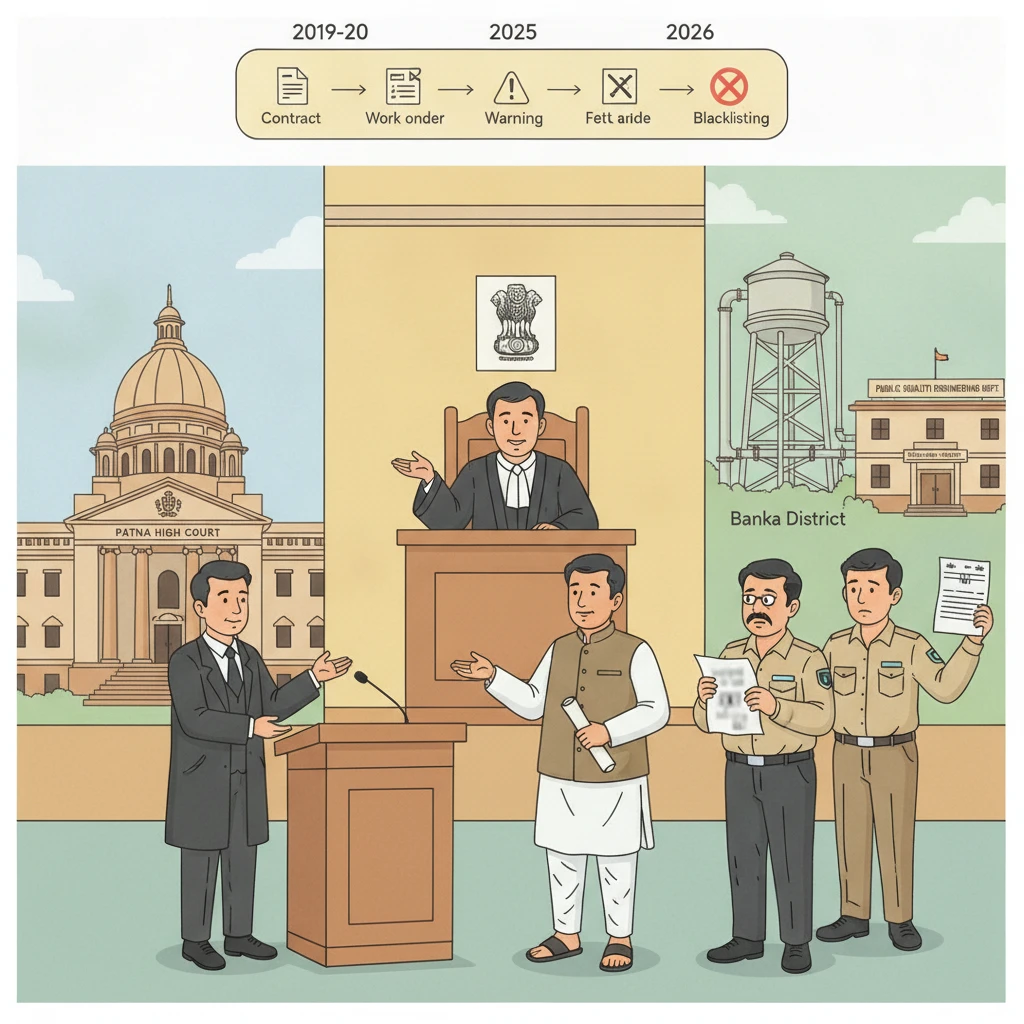
The case arose from a dispute between a registered government contractor and officials of the Public Health Engineering Department in Bihar.
The petitioner firm is a Class I contractor registered under the Bihar Contractors Registration Rules, 2007. It holds a registration certificate dated 26.08.2020 issued by the Chief Engineer (Urban), Public Health Engineering Department, Government of Bihar, Patna. This authority acts as the registering authority for the petitioner and granted registration for a period of five years.
The firm participated in a tender under the Mukhya Mantri Peyjal Nischay Yojana for Banka district. The work related to managing safe and pure drinking water in areas affected by high fluoride content. The job involved establishing or constructing Fluoride Removal or Treatment Units and then operating and maintaining them for five years.
The petitioner’s bid was accepted. This led to execution of Agreement No. 158/2019-20 between the petitioner and the Executive Engineer, Public Health Division, Banka (respondent no.4). A formal work order was issued on 26.12.2025. The petitioner states that it completed the work.
Later, disputes arose regarding payment of electricity bills connected with the project. On 17.12.2025, the Executive Engineer issued an office order directing the petitioner to deposit up-to-date electricity bills with receipts. The order warned that if the petitioner failed to do so, the bills would be paid from amounts due to the firm and further actions like debarment, blacklisting or rescinding of the agreement could follow as per the contract and law.
Subsequently, on 09.01.2026, the Executive Engineer passed Office Order No. 06, contained in Memo No. 105 of the same date, debarring the petitioner firm. The debarment was for an indefinite period.
On 14.01.2026, the Executive Engineer issued another letter calling upon the petitioner to pay electricity dues within 24 hours, failing which debarment or rescinding of the contract would be initiated.
The petitioner approached the Patna High Court under its civil writ jurisdiction seeking quashing of Office Order No. 06 dated 09.01.2026 and the subsequent letter dated 14.01.2026.
What the Court Examined and Decided
The Division Bench of the Patna High Court, comprising Hon’ble Mr. Justice Mohit Kumar Shah and Hon’ble Mr. Justice Arun Kumar Jha, heard the matter. The oral judgment was delivered by Hon’ble Mr. Justice Mohit Kumar Shah on 18.04.2026.
The petitioner firm attacked the debarment on two main grounds: first, that an indefinite ban is unlawful; second, that the officer who passed the order was not legally competent to do so under the Bihar Contractors Registration Rules, 2007.
On the first point, counsel for the petitioner relied on the Supreme Court decision in Khulja Industries Limited v. Chief General Manager, Western Telecom Project Bharat Sanchar Nigam Limited and Others, reported in (2014) 14 SCC 731. Paragraph 25 of that judgment was quoted by the High Court.
The quoted passage explains that “debarment” is a recognised tool to discipline erring suppliers or contractors who commit fraud or other serious breaches. However, it emphasises that debarment is never permanent. The period must depend on the nature of the offence committed by the contractor.
Relying on this, the petitioner argued that an order debarring a contractor indefinitely is illegal because it effectively imposes a permanent and disproportionate punishment.
On the second point, the petitioner referred to Rule 11(d) of the Bihar Contractors Registration Rules, 2007. This rule states that the order of blacklisting or suspension shall be passed by the officer who is competent to register the contractor, or by the officer under whom that registering officer works.
The petitioner’s registration certificate, annexed to the writ petition, shows that the Chief Engineer (Urban), Public Health and Engineering Department, Government of Bihar, Patna (respondent no.3) is the registering authority. Therefore, as per the petitioner, only respondent no.3, or the officer over him, could issue a show cause notice or pass an order of blacklisting or debarment.
The petitioner thus contended that the Executive Engineer, Public Health Division, Banka (respondent no.4) was not competent under the Rules, 2007 to pass the debarment order or even to initiate the show cause process for blacklisting.
On the other hand, counsel for the State argued that principles of natural justice had been complied with. It was pointed out that respondent no.4 had issued show cause notices on 06.11.2025, 19.11.2025 and 17.12.2025, along with other notices, before passing the final order on 09.01.2026. Therefore, according to the State, the contractor was given adequate opportunity to respond.
However, when the Bench asked, the State’s counsel could not point to any provision either in the record or in the Bihar Contractors Registration Rules, 2007 to show that the Executive Engineer was the competent authority to initiate or complete the debarment or blacklisting process for this contractor.
After hearing both sides, the Court first checked who the registering authority was. From the registration certificate (Annexure P/1), it found that respondent no.3, the Chief Engineer (Urban)-cum-Registering Authority, Public Health and Engineering Department, Government of Bihar, Patna, had registered the petitioner.
Applying Rule 11(d) of the Rules, 2007, the Bench held that only this registering authority or his superior officer could issue show cause notices for debarment/blacklisting and pass a final order. Respondent no.4, the Executive Engineer, did not fall into this category in relation to the petitioner’s registration.
Therefore, the Court concluded that both the show cause notices and the final order of debarment issued by respondent no.4 were without authority. A debarment or blacklisting order passed without a valid show cause notice from the competent authority is not only invalid but also violates the principles of natural justice.
The Court clearly stated that such an order is liable to be quashed on this ground alone.
The Bench then turned to the second major flaw: the indefinite nature of the debarment.
The Court observed that it is well-settled law that blacklisting or debarment for an indefinite period is legally unsustainable. It violates the principles of natural justice, the doctrine of proportionality, and the fundamental right to carry on trade.
In this case, the impugned order dated 09.01.2026 placed the petitioner firm under debarment for an indefinite period. Referring again to the Supreme Court’s judgment in Khulja Industries Limited, the Court noted that the law is no longer in doubt on this point: debarment can never be permanent.
On this additional ground, the Patna High Court found the impugned order unsustainable in law.
Having reached these conclusions, the Court decided not to close the matter entirely. Instead, it opted to correct the legal process while allowing the department to proceed afresh, if it so chooses, in accordance with law.
The Court quashed Office Order No. 06 dated 09.01.2026. It remanded the matter back to respondent no.3, the Chief Engineer (Urban)-cum-Registering Authority.
The Court directed respondent no.3 to issue a fresh show cause notice to the petitioner. After receiving the petitioner’s objections, respondent no.3 must pass a reasoned and speaking order, in accordance with law and the contract between the parties.
With these directions, the writ petition was allowed.
Why This Judgment Matters
This judgment is important for contractors working with government departments in Bihar, especially under schemes like the Mukhya Mantri Peyjal Nischay Yojana.
First, it confirms that only the officer who registered a contractor, or that officer’s superior, can order blacklisting or debarment under the Bihar Contractors Registration Rules, 2007. An Executive Engineer or similar field officer cannot assume that power unless the Rules clearly say so.
Second, it reinforces that debarment cannot be indefinite. Government departments must mention a specific period, proportionate to the alleged misconduct. An open-ended or permanent ban violates basic legal principles and the contractor’s right to carry on business.
Third, the case shows that even where notices have been issued, they must come from the correct authority. If the wrong officer sends the show cause and passes the final order, the entire process can be struck down.
For contractors, this judgment from the Patna High Court offers a clear remedy when they face arbitrary or illegal blacklisting. It also guides departments to follow the proper legal route and to record detailed reasons before taking such harsh steps.
Legal Issues and Answers
-
Issue: Can an Executive Engineer who is not the registering authority validly issue show cause notices and debar a registered contractor under the Bihar Contractors Registration Rules, 2007?
Answer: No. Only the officer competent to register the contractor, or the officer under whom that registering officer works, can pass orders of blacklisting or suspension. Orders passed by an incompetent authority are invalid and violate natural justice. -
Issue: Is an order debarring a contractor for an indefinite period legally sustainable?
Answer: No. Indefinite debarment is contrary to settled law, breaches the principles of natural justice and proportionality, and infringes the fundamental right to carry on trade. Debarment cannot be permanent. -
Issue: What is the proper course when a debarment order is found illegal on these grounds?
Answer: The illegal order must be quashed and the matter remanded to the competent registering authority to issue a fresh show cause notice and pass a reasoned, speaking order according to law and the contract.
Cases Cited by the Court
- Khulja Industries Limited v. Chief General Manager, Western Telecom Project Bharat Sanchar Nigam Limited and Others, (2014) 14 SCC 731
Case Details
Case Number: Civil Writ Jurisdiction Case No. 1422 of 2026
Case Title: Sindhuja Engineer and Contractor v. The State of Bihar & Ors.
Citation: 2026(3) PLJR 463
Court: High Court of Judicature at Patna
Coram: Hon’ble Mr. Justice Mohit Kumar Shah and Hon’ble Mr. Justice Arun Kumar Jha
Date of Judgment: 18.04.2026
Advocates:
For the petitioner: Mr. Prabhat Ranjan, Advocate; Mr. Shubham Prakash, Advocate
For the State: Mr. Yogendra Pd. Sinha, AAG 7
Nature of the Case: Civil writ petition challenging debarment/blacklisting order and related communication
Impugned Orders: Office Order No. 06 dated 09.01.2026 contained in Memo No. 105 dated 09.01.2026; letter dated 14.01.2026 issued by the Executive Engineer, Public Health Division, Banka
Final Outcome: Writ petition allowed; Office Order dated 09.01.2026 quashed; matter remanded to Chief Engineer (Urban)-cum-Registering Authority to issue fresh show cause and pass a reasoned, speaking order in accordance with law and the agreement
Link to Judgment: Click here to read the full judgment of the Patna High Court
If you found this explanation helpful and wish to stay informed about how legal developments may affect your rights in Bihar, you may consider following Samvida Law Associates for more updates.







