
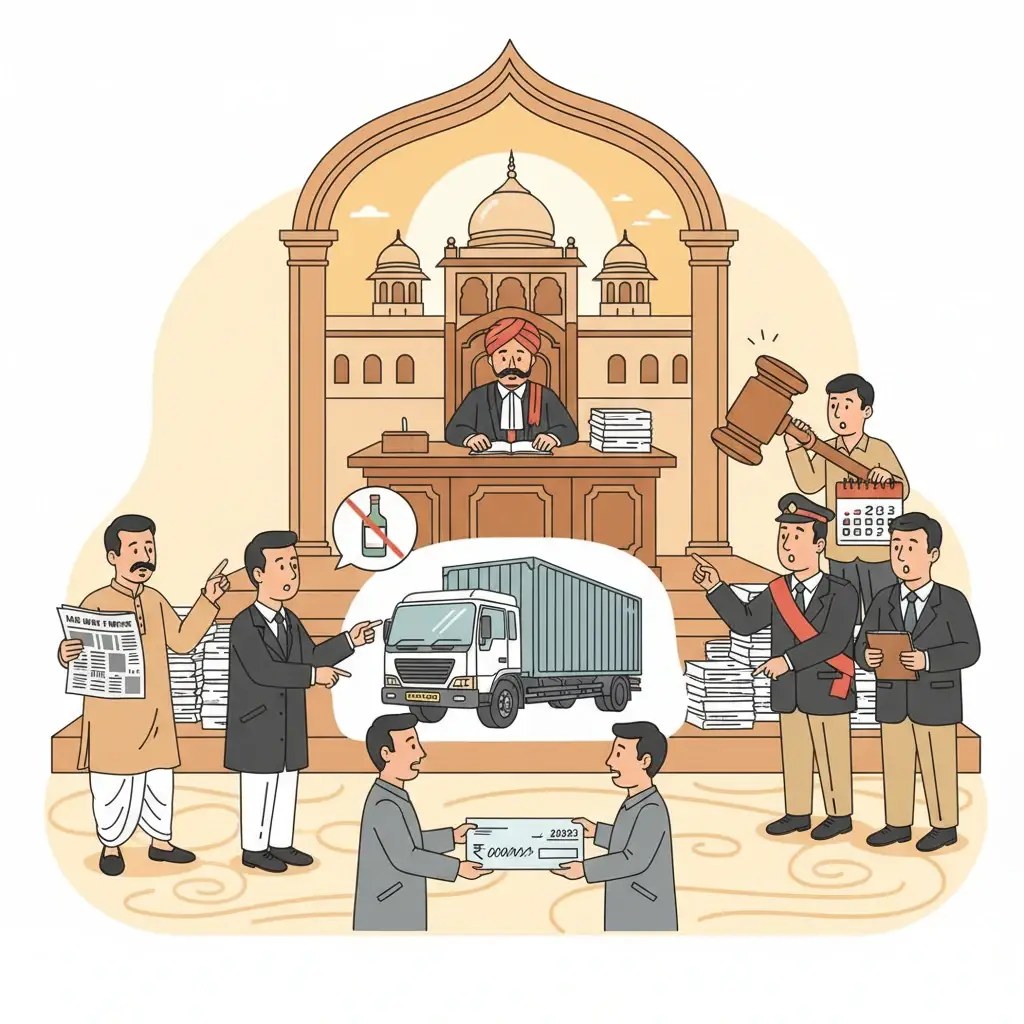
It found that authorities violated natural justice and acted without proper legal basis.
The confiscation order was quashed and the State was directed to pay the truck’s insured value, subject to a statutory penalty.
The truck owner will receive money in place of the already auctioned vehicle.
Case Background
The case arose from seizure of a container truck bearing Registration No. MH-04JU-0423 on 26.12.2022. From this vehicle, 477 litres of Indian made foreign liquor were recovered.
On the same day, Patepur P.S. Case No. 346 of 2022 was registered under Sections 30(a), 32(2), 41(1) of the Bihar Prohibition & Excise Act, 2016 against the owner and other apprehended accused persons. The driver and cleaner of the truck were apprehended at the spot.
On 27.12.2022, the Station House Officer, Patepur Police Station, sent a proposal for confiscation of the seized vehicle vide Memo No. 1347/22. Based on this proposal, Excise Confiscation Case No. 04 of 2023 was initiated.
On 20.02.2023, the Additional Sub Divisional Officer, Mahua (respondent no. 5) passed an order in Excise Confiscation Case No. 04 of 2023, directing confiscation of the truck and recommending its auction. Later, by order dated 29.09.2023, the Sub-Divisional Officer, Mahua, Vaishali auctioned the vehicle to one Sandeep Kumar for Rs. 2.2 lakhs.
The petitioner, a Maharashtra resident and registered owner of the truck, approached the Patna High Court in Civil Writ Jurisdiction Case No. 18561 of 2023. He challenged the confiscation and auction on the ground that he was never served any notice and that the proceedings were in violation of principles of natural justice and the Bihar Prohibition and Excise Act, 2016.
What the Court Examined and Decided
The petitioner argued that he is the bona fide owner of the container truck and had hired it out to a transport company, operating through a driver and cleaner. He stated that he had given the vehicle on rent to respondent no. 7, and only came to know of the seizure about three months later when the agreement holder informed him.
According to the petitioner, after the seizure on 26.12.2022, the authorities initiated confiscation solely on the SHO’s proposal. No proper effort was made to trace or contact him despite his ownership being easily verifiable from transport records. Instead, the confiscating authority issued a notice only through publication in a local Bihar newspaper.
The petitioner lives in Mumbai and the truck had a national permit. He contended that a local newspaper notice in Bihar could not be treated as adequate notice to him. He further asserted that the District Transport Officer, Vaishali never forwarded any verification report about his name and address, and that the entire process showed a casual approach by the officials in handling confiscation and auction of vehicles under the Excise law.
The State, on the other hand, defended the action. It said that the confiscation and auction were part of collective proceedings under instructions in Letter No. 633 dated 25.01.2023 issued by the then Additional Secretary, Prohibition, Excise & Registration Department to all District Magistrates in Bihar. The State also argued that the petitioner was not vigilant about his rights and failed to submit an application in Form-IV for release of his vehicle under Rule 12A of the Bihar Prohibition & Excise Rules, 2021.
Before deciding, the Patna High Court carefully examined the relevant statutory provisions of the Bihar Prohibition and Excise Act, 2016 and the Bihar Prohibition and Excise Rules, 2021. It referred particularly to Sections 47, 57B, 58, 61, 92, 93, 95 of the Act and Rule 12A of the Rules.
Section 47 deals with punishment of a person who, having control or use of a conveyance, knowingly permits it to be used for commission of an offence under the Act. Section 57B (inserted in 2022) permits release of a seized vehicle or premises on payment of a penalty fixed by the Collector, and applies even to pending confiscation proceedings.
Section 58 lays down the procedure for confiscation. It mandates that the seizing officer must promptly report to the District Collector. On receipt of the report, the Collector, if satisfied that an offence under the Act has been committed, may order confiscation, but only after giving a reasonable opportunity of hearing to the person concerned under Section 58(3).
Section 61 states that once a confiscation order under Section 58 becomes final, the property vests in the State Government free of encumbrances. Sections 92 and 93 provide the appeal and revision framework within the excise department, while Section 95 authorises the State Government to make rules, under which the Bihar Prohibition & Excise Rules, 2021 have been framed.
Rule 12A (also inserted in 2022) deals with release of vehicles and conveyances on payment of penalty. It requires an application in Form IV by the owner. It also says that where the owner is not traceable or does not come forward within 15 days from seizure, the Collector may proceed to confiscate and auction the vehicle as per the Act.
Importantly, Rule 12A(2) requires the authority to have due regard to the quantity of liquor recovered, the involvement of the vehicle owner and the insured value while fixing the penalty. In no case can the penalty be less than 10% of the insured value or more than Rs. 5 lakhs.
From this legal framework, the Court drew two central conditions (twin prerequisites) for valid seizure and confiscation of a vehicle:
First, the vehicle must have been used in the commission of an offence under the Act, typically in transporting illicit liquor or intoxicants (as covered by Section 30). Second, there must be consent, knowledge, or connivance of the owner, or at least sufficient material to treat the owner as an accused, such as by invoking Section 47 of the Act.
The Court noted that the mere fact that liquor was recovered from a vehicle is not enough to punish or confiscate against the owner. The owner’s involvement must be established, either as a direct accused or through evidence of permission or connivance in the illegal transport.
In this context, the Court also referred to a Government letter dated 07.02.2020 (Letter No. 13/HC-06-55/2020-670) issued by the Additional Chief Secretary, Home Department cum Prohibition, Excise and Registration Department to all District Collectors and relevant officers. That letter, issued in light of previous judgments of the Patna High Court, clarified that vehicles from which no liquor is recovered shall not be confiscated, and if only the driver is drunk but no liquor is recovered, only the driver should be prosecuted under the Act. This reflected the State’s own acceptance that confiscation should be linked to actual recovery and proper legal basis.
Turning to the facts of this case, the Court found that on 26.12.2022 the truck was seized with 477 litres of liquor and the driver and cleaner were apprehended. Because the petitioner was the registered owner, his name was included as an accused in the police case, although he was not present at the site. However, there was no allegation in the record of his direct or indirect involvement, beyond bare registration of the vehicle in his name.
The Court then examined the process followed in confiscation. It noted that the authorities did not verify the petitioner’s name and address from the District Transport Officer before initiating confiscation, despite being able to do so. Instead, they relied on a “flimsy” local newspaper publication in Bihar, even though the owner resided in Mumbai and the vehicle had a national permit. The Court viewed this as a mere formality, not a meaningful effort to give notice or a reasonable opportunity of being heard, as required by Section 58(3).
The Court also took note of the vehicle’s insured value. The insurance papers showed that on the date of seizure (26.12.2022), the insured value of the truck was Rs. 21 lakhs. At the time of the auction sale on 29.09.2023, the insurance value was Rs. 9,47,893. Yet, the vehicle was auctioned at only Rs. 2.2 lakhs, which the Court described as a “throwaway price”.
On 19.03.2025, in earlier proceedings in this very writ petition, the Patna High Court had already observed that officials erred in determining the auction valuation. It had directed the Principal Secretary, Department of Registration and Excise, Patna to register a criminal case against the concerned officials. It also ordered the State of Bihar to deposit Rs. 21 lakhs (the insured value at seizure) in the Registry of the Court within eight weeks.
The State challenged this order before the Supreme Court in Special Leave to Appeal (C) No. 12926/2025. The Supreme Court rejected the SLP on 07.05.2025, thereby letting the High Court’s directions stand.
Subsequently, in compliance with the Patna High Court’s order, the State filed a counter affidavit stating that a Demand Draft of Rs. 21,00,000/- (DD No. 634446 dated 12.05.2025 of Punjab National Bank) had been issued in favour of the Registrar General, Patna High Court.
After reviewing all these facts, the Patna High Court held that the twin prerequisites for lawful seizure and confiscation of the vehicle were not satisfied in this case. Though liquor was recovered from the truck, there was no material to show the petitioner’s consent, knowledge, or connivance. There was also a clear violation of the statutory requirement of giving a reasonable opportunity of hearing before confiscation.
The Court held that the confiscation order dated 20.02.2023 was arbitrary, violative of Article 14 (equality before law) and violative of the petitioner’s constitutional right to property under Article 300A of the Constitution, which protects against deprivation of property without authority of law. The Bihar Prohibition and Excise Act, 2016, it held, did not authorise seizure and confiscation in the facts of this case in the manner done.
Since the vehicle had already been auctioned and could not be restored in kind, the Court crafted a monetary remedy. It directed the Registrar General of the Patna High Court to release the Demand Draft of Rs. 21 lakhs in favour of the petitioner, this amount representing the insured value as on the date of seizure.
At the same time, the Court took note that 477 litres of liquor had in fact been recovered from the vehicle. Applying the scheme of Section 57B and Rule 12A on penalty, it directed the petitioner to deposit the maximum penal amount of Rs. 5,00,000/- before the concerned authority. The petitioner was directed to submit the receipt of such deposit before the Registrar General for release of Rs. 21 lakhs.
The Court allowed flexibility: the petitioner must deposit Rs. 5 lakhs in the government exchequer within eight weeks. Alternatively, the amount of Rs. 21 lakhs already deposited by the State could be apportioned by releasing Rs. 5 lakhs to the Government and the remaining Rs. 16 lakhs to the petitioner, if payment of Rs. 5 lakhs by him was adjusted in that manner.
With these directions, the writ petition was disposed of.
Why This Judgment Matters
This judgment is important for vehicle owners whose trucks or commercial vehicles are seized under the Bihar Prohibition and Excise Act, 2016.
The Patna High Court made it clear that the government cannot simply confiscate and auction a vehicle without properly notifying the owner and giving a fair chance to be heard. A formal newspaper notice in a distant district is not enough when the owner’s identity and address are available in transport records.
The Court also emphasised that just because liquor is found in a vehicle, the owner cannot automatically be punished or lose the vehicle. The authorities must show that the owner was involved, consented, or connived in the illegal use. If the owner had only given the vehicle on hire and had no role in the crime, confiscating the vehicle without proper procedure violates Articles 14 and 300A of the Constitution.
Another practical point is the Court’s approach to valuation and penalty. Auctioning a vehicle worth many lakhs for a fraction of its value, without proper process, can expose officials to criminal action and the State to heavy compensation. At the same time, the Court affirmed that a significant penalty can still be imposed under the Act when liquor is recovered, even if full confiscation is set aside.
For truck owners and transport operators, this decision from the Patna High Court shows that they can challenge arbitrary confiscation and undervalued auction, especially where no proper notice or hearing was given and where their involvement in the offence is not established.
Legal Issues and Answers
-
Issue: Whether the confiscation and auction of the petitioner’s truck under the Bihar Prohibition and Excise Act, 2016, without proper notice and proof of the owner’s involvement, were legal and valid.
Answer: No. The Patna High Court held that the confiscation order was arbitrary, violated Articles 14 and 300A, and was without authority of law. It quashed the confiscation and ordered monetary compensation, subject to payment of statutory penalty. -
Issue: What conditions must be satisfied for lawful seizure and confiscation of a vehicle under the Bihar Prohibition and Excise Act, 2016.
Answer: The Court held that two prerequisites must be met: (1) the vehicle must have been used in transporting liquor or intoxicants in violation of the Act, and (2) there must be consent, knowledge, or connivance of the owner, or at least sufficient basis to treat the owner as an accused. Additionally, the owner must be given a reasonable opportunity of hearing under Section 58(3). -
Issue: How should the Court balance statutory penalty with protection of property rights when a confiscated vehicle has already been auctioned.
Answer: The Court directed payment of the insured value of the vehicle (Rs. 21 lakhs) to the owner as compensation, while requiring the owner to bear the maximum statutory penalty of Rs. 5 lakhs, either by depositing it or through adjustment from the amount lying with the Court.
Cases Cited by the Court
- No specific prior case names or citations are mentioned in the judgment extract. The Court refers generally to “various judicial pronouncements” of the Patna High Court and a government letter dated 07.02.2020 issued in light of those decisions, but does not identify particular reported cases by name.
Case Details
Case Number: Civil Writ Jurisdiction Case No. 18561 of 2023
Case Title: Sharad Navnath Gange v. The State of Bihar & Ors.
Citation: 2025 (2) PLJR 431
Coram: Hon’ble the Acting Chief Justice; Hon’ble Mr. Justice S. B. Pd. Singh (CAV Judgment per Hon’ble Mr. Justice S. B. Pd. Singh)
Date of Judgment: 01.09.2025
Court: High Court of Judicature at Patna
Advocates:
- For the Petitioner: Mr. Deo Prakash Singh
- For the Respondents (State): Mr. Madhaw Pd. Yadaw (GP 23)
Nature of the Case: Writ petition (Civil) challenging confiscation and auction order in an Excise Confiscation Case under the Bihar Prohibition and Excise Act, 2016.
Impugned Order Challenged: Order dated 20.02.2023 passed in Excise Confiscation Case No. 04/2023 by respondent no. 5, and consequential auction order dated 29.09.2023 by the Sub-Divisional Officer, Mahua, Vaishali.
Link to Judgment: Click here to read the full judgment of the Patna High Court
If you found this explanation helpful and wish to stay informed about
how legal developments may affect your rights in Bihar,
you may consider following Samvida Law Associates for more updates.







