
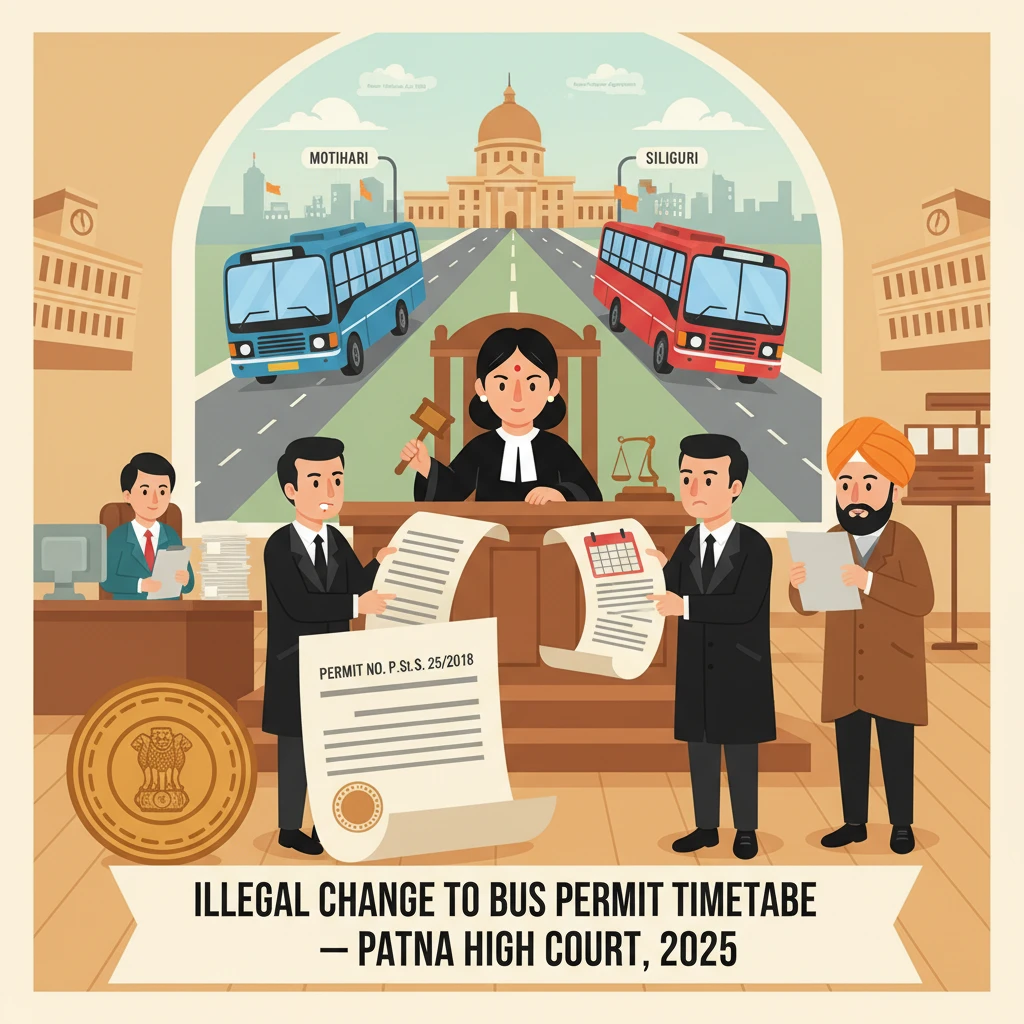
Case Background
The case arose from an inter-state bus service on the Motihari to Siliguri route, operated under a permanent Inter-State Stage Carriage Permit granted by the State Transport Authority, Bihar.
Under a Reciprocal Transport Agreement between the States of Bihar and West Bengal, published in the Bihar Gazette on 09.05.2016, ten vacancies were notified for Inter-State Stage Carriage Permits on this Motihari–Siliguri route.
The petitioner, a bus operator, applied for one such permit in the prescribed form, deposited the required fees, and submitted a proposed timetable for his buses bearing registration numbers BR-06PD-8290 and BR-06PD-8291.
The State Transport Authority (S.T.A.), Bihar, invited objections by publishing the proposed timetable on the official website. After considering objections, the S.T.A. placed the petitioner’s application on the agenda for its meeting held on 24.07.2018.
In that meeting, the S.T.A. sanctioned the permit in favour of the petitioner. The proceedings were signed on 25.07.2018. The petitioner then furnished all necessary vehicle documents and other papers for issuance of the formal permit.
On 17.09.2018, Permanent Inter-State Stage Carriage Permit No. 25/2018, along with an attached timetable, was issued by the S.T.A. The petitioner received this permit on 24.09.2018. This permit was valid from 30.08.2018 to 29.08.2023.
According to the petitioner, the timetable attached to this issued permit was not the same as the timetable he had proposed and on which the permit had been sanctioned. This alleged unilateral modification of the timetable is what led to the writ petition before the Patna High Court.
What the Court Examined and Decided
The central dispute concerned the modification of the petitioner’s approved timetable by the Secretary, State Transport Authority, Bihar (respondent no. 3), without any express order of the S.T.A. and without any request from the petitioner.
The petitioner contended that after the S.T.A. granted him a permanent inter-state permit with a proposed timetable duly considered, the Secretary could not later alter that timetable on his own. He alleged that arrival and departure timings at several notified bus stands along the route had been deleted.
Specifically, the petitioner stated that timings at Muzaffarpur, Begusarai, Khagaria, Purniea, Dalkhola, Kishanganj and Islampur were removed in the modified timetable. According to him, these were “notified bus terminals” on the route where buses should be allowed to halt and handle passengers.
The petitioner relied on Clause (xiii) of the Reciprocal Transport Agreement between Bihar and West Bengal. This clause provides that both reciprocating States shall allow stage carriages of the other State to pick up and set down passengers at their respective notified bus terminals.
He argued that deleting halt timings at these notified terminals violated this Clause (xiii). He further referred to Section 2(40) of the Motor Vehicles Act, 1988, which defines “stage carriage”, and to Section 2(38), which defines “route” as a line of travel with specified highways and via points, including notified bus terminals where stoppages could be scheduled.
On this basis, the petitioner submitted that the Secretary’s unilateral action in issuing a modified timetable, without any order of the S.T.A. and without his consent, was illegal and contrary to the Motor Vehicles Act and the Reciprocal Transport Agreement.
The petitioner also highlighted the practical impact of the changed timetable. He stated that the revised schedule effectively required a continuous journey of around eight hours without any halts, which he described as impracticable.
He argued that such a continuous journey contravened Section 91 of the Motor Vehicles Act, 1988, when read with Section 15 of the Motor Transport Workers Act, 1961. These statutory provisions were invoked to emphasize the need for rest intervals for drivers and workers and reasonable stoppages for passenger comfort, including access to restrooms and other essential facilities.
According to the petitioner, the S.T.A. office had acted without jurisdiction by issuing a timetable inconsistent with both the permit granted and the governing statutory framework. He also pointed out that there was no statutory appeal or revision specifically against issuance or modification of timetables, which is why he had to approach the Patna High Court under its writ jurisdiction.
During the pendency of the case, an important development occurred. The petitioner’s original permit, valid from 30.08.2018 to 29.08.2023, came up for renewal. The State Transport Authority, Bihar, renewed this permit for another five years, with effect from 30.08.2023 to 29.08.2028, by order dated 05.06.2023 of the Secretary, S.T.A., Bihar.
The petitioner brought this renewal order on record through a supplementary affidavit, annexing the renewal as Annexure-5. The Court specifically noted that the competent authority had renewed Inter-State Stage Carriage Permit No. 25/2018(W.B.) for this extended period and that the permit remained valid until 29.08.2028.
On the other side, the respondents, representing the State authorities, explained the background of the Reciprocal Transport Agreement. They stated that the Government of Bihar, acting under Section 88(5) of the Motor Vehicles Act, 1988, issued a draft notification of the proposed agreement with West Bengal, published in the Bihar Gazette on 26.05.2014 and inviting objections and suggestions within 30 days.
Objections were received from transport owners, associations and members of the public. The State Transport Commissioner, Bihar, held a hearing on 02.07.2015 and considered these objections. After disposal of objections, the final Reciprocal Transport Agreement was published in the Bihar Gazette (Extraordinary) on 09.05.2016 in compliance with Section 88(5).
Under this agreement, ten permits each were created for both Bihar and West Bengal on the Motihari–Siliguri route via Muzaffarpur and Purnia. Applications were invited and the petitioner applied with his proposed timetable.
The respondents contended that the petitioner’s proposed timetable did not match the “via” points provided in the Reciprocal Transport Agreement. According to them, no permit could be granted for operations beyond the specified via points Muzaffarpur and Purnia.
On this reasoning, the respondents submitted that the timetable actually allotted to the petitioner properly confined timings only at the designated via points and that this was in strict compliance with the Agreement. They also interpreted Clause (xiii) of the Agreement as merely allowing picking up and setting down passengers at notified bus terminals of the respective States, not as requiring that a timetable be issued for all such terminals within the broader route.
The respondents further argued that the authority granting the permit retained discretion to fix timetables to avoid clashes with timings of other operators on the same or overlapping routes. On this basis, they submitted that the relief sought by the petitioner was contrary to the terms of the Reciprocal Transport Agreement and that the writ petition deserved to be dismissed.
The Court heard both sides and carefully considered the documentary record, including the original issuance of the permit and the later renewal order.
A key factor for the Court was that the Secretary, S.T.A., had issued a modified timetable that did not align with the terms under which the permit had been granted, and this was done despite the continuing validity and renewal of the permit itself.
After examining the facts and the applicable legal framework, the Patna High Court formed the view that the modified timetable in Annexure-4 was not legally sustainable. The Court held that the modified timetable was issued in a manner contrary to the terms of the permit and the “relevant legal provisions”. The Court also took note that the competent authority had already renewed the permit up to 29.08.2028.
On this basis, the Court quashed and set aside Annexure-4. As a result, the petitioner’s writ petition was allowed. Any interlocutory applications were also disposed of in view of the main relief being granted.
Why This Judgment Matters
This decision of the Patna High Court is significant for bus operators holding inter-state stage carriage permits and for passengers who depend on these services.
First, it makes clear that transport authorities cannot arbitrarily or unilaterally alter an operator’s approved timetable in a way that goes against the terms of the permit or governing legal provisions. Administrative convenience cannot override the conditions upon which a permit is granted.
Second, where a permit has been validly issued and even renewed for a further period, any changes that effectively curtail or disturb the operator’s legitimate operations require proper legal backing. A simple office-level modification is not enough when it runs contrary to the permit framework.
Third, by accepting the petitioner’s challenge and quashing the modified timetable, the Court indirectly reinforces the importance of safe and reasonable travel conditions for drivers, workers and passengers. Although the Court did not go into detailed analysis of Section 91 of the Motor Vehicles Act or Section 15 of the Motor Transport Workers Act, it recognised that a timetable must comply with “relevant legal provisions”.
For other operators, this judgment shows that if their timetables are modified without basis or in a manner inconsistent with their permits or the applicable agreement between States, they can approach the High Court under its writ jurisdiction, especially where no specific statutory appeal or revision remedy is available.
Legal Issues and Answers
- Issue: Whether the Secretary, State Transport Authority, Bihar, could unilaterally modify the petitioner’s approved timetable for an inter-state stage carriage permit in a manner inconsistent with the permit and applicable legal provisions.
Answer: No. The Patna High Court held that the modified timetable (Annexure-4) was not sustainable in law as it was issued contrary to the terms of the permit and the relevant legal provisions and despite the permit having been renewed till 29.08.2028. Annexure-4 was therefore quashed and set aside.
Cases Cited by the Court
- The judgment does not record any specific prior case law citations relied upon by the Court.
Case Details
Case Number: Civil Writ Jurisdiction Case No. 22599 of 2018
Case Title: Gopal Krishna Tiwary v. The State of Bihar & Ors.
Citation: 2025(4) PLJR 667
Coram: Hon’ble Justice Smt. G. Anupama Chakravarthy
Advocates:
For the Petitioner: Mr. Ajay Kumar Jha, Advocate
For the Respondents: Mr. Anuradha Singh, GP 21
Nature of the Case: Writ petition under Article 226 of the Constitution challenging the modified timetable attached to an Inter-State Stage Carriage Permit.
Link to Judgment: Click here to view the official Patna High Court judgment
If you found this explanation helpful and wish to stay informed about
how legal developments may affect your rights in Bihar,
you may consider following Samvida Law Associates for more updates.







