
Case Background
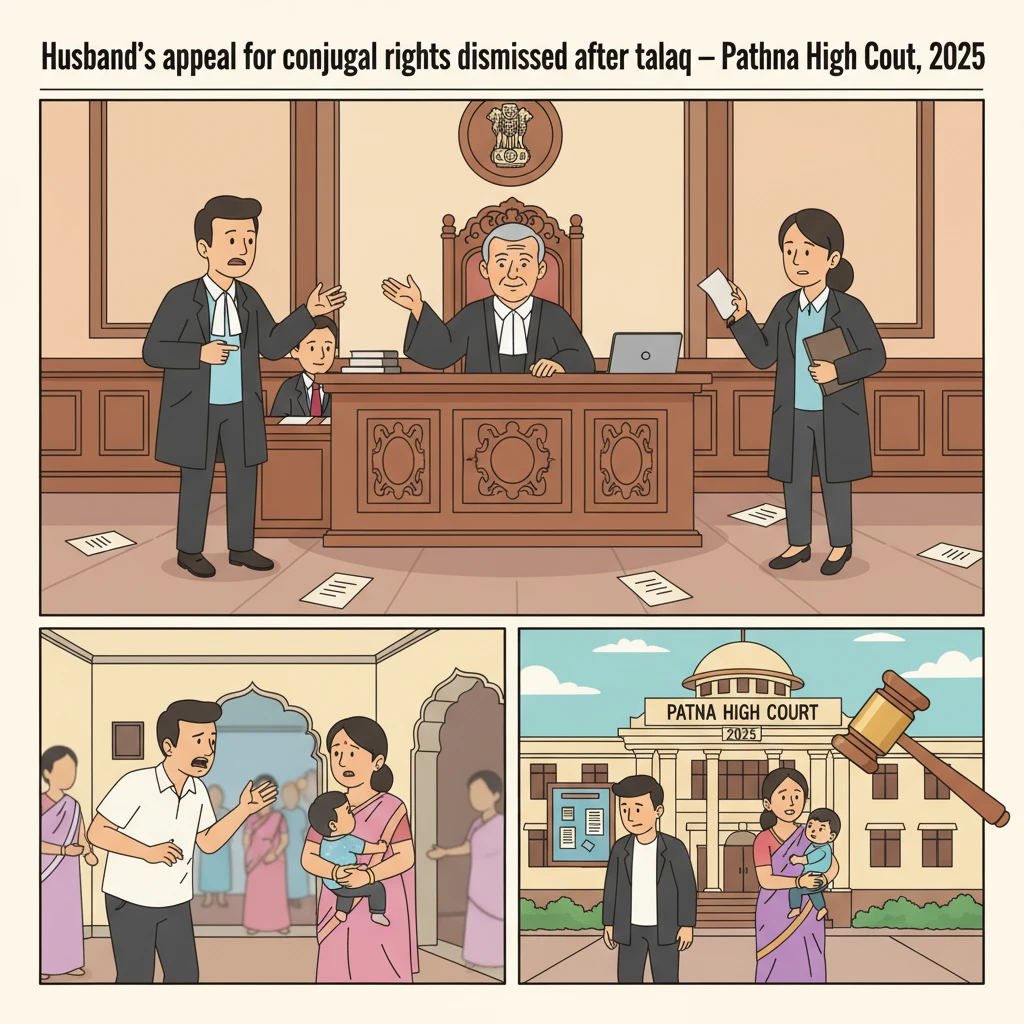
This case came to the Patna High Court as Miscellaneous Appeal No. 936 of 2016 under Section 19(1) of the Family Courts Act, 1984. The appeal was filed by the husband against a judgment and decree dated 25.06.2016 passed by the Principal Judge, Family Court, Darbhanga in Matrimonial Case No. 209 of 2012.
The matrimonial case before the Family Court had been filed by the husband under Section 281 of the Principles of Mohomedan (Muslim) Law. Through that case, he sought a decree for restitution of conjugal rights against his wife, asking the court to order her to resume living with him as his spouse.
According to the husband’s petition, his marriage with the respondent-wife was solemnised in the year 2003 according to Muslim Shariyat Law. The marriage was consummated and three children were born out of the wedlock.
The husband alleged that the wife left the matrimonial home with the third child, who was then about three years old, and went to her parental home. He further stated that when he went to his sasural to take her back (rukhsati), the wife and her family members refused to send her.
He described the wife as a quarrelsome person, alleging that she used to quarrel with him and other in-laws on petty issues. He also stated that two minor children were living with him, and without the mother’s presence it had become difficult to take care of them. On this basis, he asked the Family Court for restitution of conjugal rights.
After receiving summons and notices, the wife appeared before the Family Court and filed her written statement. In it she denied the husband’s allegations and gave a completely different picture of the marriage.
The wife stated that after the marriage, when she went to her sasural, she was tortured, abused and assaulted by the husband and his family members for not meeting their dowry demands. She asserted that even after the birth of their three children, the behaviour and attitude of the husband and his family did not change.
According to her, she always tried to lead a normal conjugal life with her husband, but it was the husband who repeatedly assaulted her without any fault or reason. She described his behaviour during assaults as so wild that he would not even care whether she was dead or alive.
The wife further alleged that it was not she who left voluntarily; rather, the husband himself had driven her out of the matrimonial home. She stated that her life was always in danger at the husband’s house. Given these circumstances, she clearly expressed before the Family Court that she did not want restitution of conjugal rights with the husband.
She specifically prayed that the petition filed by the husband under Section 281 of Muslim Law for restitution of conjugal rights should be dismissed.
After considering the pleadings and evidence, the Family Court, Darbhanga dismissed Matrimonial Case No. 209 of 2012, refusing to order restitution of conjugal rights. Aggrieved by this decision, the husband filed the present appeal before the Patna High Court.
What the Court Examined and Decided
The Patna High Court, comprising Hon’ble the Acting Chief Justice and Hon’ble Mr. Justice S. B. Pd. Singh, heard the appeal. The judgment was delivered on 02.09.2025 by Hon’ble Mr. Justice S. B. Pd. Singh (CAV judgment).
The central legal basis of the husband’s claim was Section 281 of the Principles of Mohomedan Law. The High Court reproduced the provision as follows:
“281. Suit for restitution of conjugal rights (1) Where a wife without lawful cause ceases to cohabit with her husband, the husband may sue the wife for restitution of conjugal rights.”
This provision makes it clear that a husband can seek restitution of conjugal rights only where the wife, without lawful cause, stops living with him as his wife. Therefore, two key questions arise:
First, whether the wife had “lawful cause” to live apart. Second, whether the marital relationship was even subsisting at the time of the suit and appeal.
A very important piece of evidence before the courts was an attested copy of a Talaqnama certificate. This document was produced not by the husband, but by the wife herself.
The Talaqnama certificate was issued by “USTAJ MADARSA RAHMANIYA, SUPAUL, BIRAUL, DARBHANGA”. According to the High Court, this document clearly showed that the husband had already divorced the wife.
The Family Court, in paragraph 12 of its judgment (quoted by the High Court), had discussed this Talaqnama. It noted that the wife had filed the attested copy of the Talaqnama certificate to support the allegations in her written statement dated 19.07.2013 and petition dated 07.02.2014.
The Family Court observed that the contents of the Talaqnama supported the wife’s allegations and indicated the husband’s attitude. It concluded that the family situation and atmosphere between the two spouses was not healthy or suitable for a harmonious married life.
The Family Court also remarked that, even though it was not necessary to go into great detail about the Talaqnama at that stage, the document could not be ignored. It clearly reflected the bitter relationship between the spouses.
The High Court accepted this assessment. It pointed out that the respondent-wife herself had annexed the attested copy of the Talaqnama certificate, which “clearly suggests that appellant-husband has divorced the respondent-wife”.
Importantly, the High Court noted that in the entire evidence, the husband had not denied the wife’s assertion regarding the Talaqnama. This silence on his part was significant. In appellate proceedings, the Court treated the Talaqnama and the absence of any denial as clear indicators that a talaq had in fact taken place.
The Court then examined the effect of this talaq under Muslim Law. It observed that Muslim law clearly stipulates that once talaq is pronounced and considerable time passes, the only way for a divorced couple to again lead a conjugal life is by remarriage.
The High Court referred to Section 336(5) of the Principles of Mohomedan Law, which deals with remarriage of divorced couples. The section explains when and how a divorced couple may remarry, including additional conditions when there have been three pronouncements of talaq.
The Court summarised that, depending on the form and number of talaq pronouncements, remarriage may be possible only after certain conditions are fulfilled, such as an intervening marriage and divorce. In other cases, remarriage can take place as if there had been no divorce, either during the iddat period or after its completion.
By citing this section, the High Court underlined a crucial legal point: once talaq has taken place, the previous marriage comes to an end. There is no automatic revival of conjugal rights. If the parties wish to resume marital life, they must remarry in accordance with Muslim law.
Against this legal background, the husband’s prayer for restitution of conjugal rights could not stand. Restitution assumes a continuing valid marriage. Here, by virtue of the Talaqnama and the husband’s non-denial, the Court found that the marital bond had already been severed.
The Court also considered the wife’s clear stand. She had stated she did not want to live with the husband because of his cruel behaviour and the danger to her life at the matrimonial home. This reinforced the conclusion that a forced restoration of conjugal life would be neither lawful nor meaningful.
Taking all these facts and legal principles together, the Patna High Court held that there was no reason to interfere with the Family Court’s judgment dismissing the husband’s suit.
In paragraph 8 of the High Court judgment, it concluded that, considering the fact that talaq had already been performed between the parties, that the husband had not denied the wife’s assertion about the Talaqnama, and that the wife herself did not want to continue the matrimonial relationship, the appeal had no merit.
The Court therefore affirmed the Family Court’s decision in Matrimonial Case No. 209 of 2012 and dismissed the husband’s Miscellaneous Appeal No. 936 of 2016.
Why This Judgment Matters
This judgment is important for Muslim spouses in Bihar and beyond who may be facing similar disputes about restitution of conjugal rights after talaq.
First, the Patna High Court makes it clear that a husband cannot successfully seek restitution of conjugal rights once he has already divorced his wife through talaq. The remedy of restitution is available only during a subsisting marriage.
Second, the judgment shows that the Court will look carefully at documents like a Talaqnama, especially when produced by the wife and not denied by the husband. Such evidence can be decisive in determining whether the marriage is still legally in place.
Third, the Court recognises that even in matrimonial disputes, the wishes and safety of the wife matter. Where the wife alleges cruelty, danger to life and clearly states she does not want to resume conjugal life, the Court is not inclined to compel her to return, particularly after talaq.
Finally, by referring to Section 336(5) of the Principles of Mohomedan Law, the Court explains that if a divorced couple wants to live together again, the proper route is remarriage in accordance with law, not a restitution of conjugal rights petition based on the earlier dissolved marriage.
Legal Issues and Answers
-
Issue: Can a husband obtain a decree for restitution of conjugal rights against his wife under Section 281 of the Principles of Mohomedan Law when he has already divorced her by talaq?
Answer: No. The Patna High Court held that since talaq had already been pronounced and not denied by the husband, the marital bond had ended. Restitution of conjugal rights is not available after such divorce; the only way to resume conjugal life would be remarriage. -
Issue: Is the Family Court’s dismissal of the husband’s suit for restitution of conjugal rights justified where the wife alleges cruelty, danger to life, files a Talaqnama, and clearly refuses to return?
Answer: Yes. The Patna High Court affirmed the Family Court’s dismissal, relying on the Talaqnama, the husband’s non-denial, and the wife’s refusal to live with him, holding that there was no ground to interfere with the lower court’s decision.
Cases Cited by the Court
- No earlier judicial precedents or reported cases are cited or relied upon in the judgment text provided.
Case Details
Case Number: Miscellaneous Appeal No. 936 of 2016
Case Title: Md. Naushad Hussain v. Shahida Khaton and Anr
Citation: 2025(4) PLJR 186
Coram: Hon’ble the Acting Chief Justice; Hon’ble Mr. Justice S. B. Pd. Singh
Advocates: For the appellant (husband): Mr. Bishwanath Prasad Singh; For the respondents: Not specified in the judgment text.
Nature of the Case: Miscellaneous Appeal under Section 19(1) of the Family Courts Act, 1984, against a Family Court judgment dismissing a matrimonial suit for restitution of conjugal rights under Section 281 of the Principles of Mohomedan (Muslim) Law.
Impugned Order: Judgment and decree dated 25.06.2016 passed by the Principal Judge, Family Court, Darbhanga in Matrimonial Case No. 209 of 2012.
High Court Decision: Appeal dismissed; Family Court judgment affirmed; no decree for restitution of conjugal rights granted.
Link to the Judgment: Click here to view the official Patna High Court judgment
If you found this explanation helpful and wish to stay informed about
how legal developments may affect your rights in Bihar,
you may consider following Samvida Law Associates for more updates.







