

Case Background
The case arose from Advertisement no. 2 of 2011, issued on 16 July 2011, for recruitment of Home Guards in rural and urban areas of Bihar. Out of a total of 11,122 posts, the district of Begusarai had 153 posts for rural Home Guards and 17 posts for urban Home Guards.
The petitioner applied for appointment as a Home Guard for Khodabandpur Block in Begusarai district. He participated in the physical test and, according to the Court’s narration, was found fit at that stage.
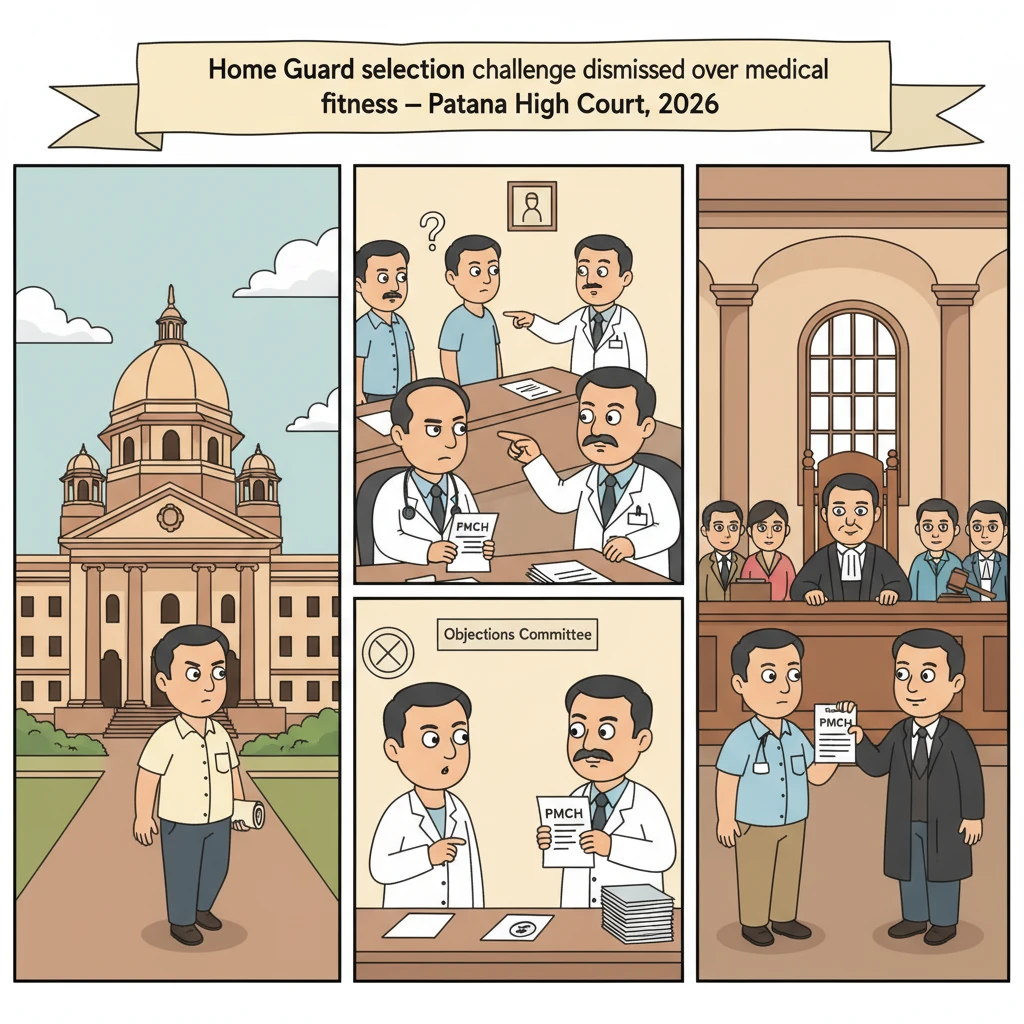
After the physical test, all candidates were subjected to medical examination by a team of specialized doctors constituted by the authorities. In this medical examination, the petitioner was diagnosed with “knock knee” and was declared medically unfit. On this basis, he was not selected.
Feeling aggrieved, the petitioner went on his own to Patna Medical College Hospital (PMCH). There, on 25 July 2015, his medical examination was conducted and a report was issued certifying that he did not suffer from knock knee. This report became the foundation of his grievance.
The petitioner then filed this writ petition (Civil Writ Jurisdiction Case No. 2316 of 2017) before the Patna High Court. He sought directions for his nomination as a Home Guard against five posts for Khodabandpur Block and for acceptance of the PMCH report dated 25.07.2015, contending that the earlier Medical Board report was erroneous.
What the Court Examined and Decided
The Patna High Court, through Hon’ble Mr. Justice Partha Sarthy, heard both sides and examined the materials on record. The central dispute was whether the Court should interfere with the recruitment Medical Board’s finding that the petitioner had knock knee and was medically unfit for Home Guard service.
The petitioner’s case was that he had been wrongly declared unfit during the recruitment process. His counsel argued that the recruitment Medical Board’s remark of “knee knock” was incorrect because, as per the PMCH report dated 25.07.2015 (Annexure-5), he did not suffer from knock knee. The petitioner wanted the Court to rely on this later report and to direct the authorities to appoint him as a Home Guard.
On the other side, the State and the Home Guard authorities opposed the writ petition. Their counsel relied on the counter affidavit and placed the selection process before the Court in some detail.
They submitted that after the initial stages of selection, all candidates underwent medical examination. Out of these, 107 candidates, including the petitioner, were disqualified on medical grounds or other reasons. Out of those disqualified, 59 candidates filed objections seeking a re-medical test.
The petitioner was among these objectors and requested re-examination on the basis of the PMCH medical report. The respondents stated that all such objections were placed before a duly constituted committee. This committee scrutinized and examined the objections and found them unsustainable.
It was further stated that there was no provision in the recruitment rules for a re-medical test. Therefore, the authorities rejected the petitioner’s request. On this basis, the State argued that there was no ground for the Court to interfere or to grant any relief.
After hearing the parties, the Court noted the sequence: advertisement, physical test, medical examination by a board of specialized doctors, diagnosis of knock knee, and non-selection of the petitioner. It also noted the petitioner’s reliance on the later PMCH report.
To decide whether a later medical report can override the recruitment Medical Board’s finding, the Court referred to a judgment of the Delhi High Court in KM. Priyanka v. Union of India & Ors., W.P.(C) 10783 of 2020.
The Patna High Court extracted paragraph 8 of KM. Priyanka, where the Delhi High Court had summarized earlier decisions in Priti Yadav v. Union of India, Jonu Tiwari v. Union of India, Nishant Kumar v. Union of India and Sharvan Kumar Rai v. Union of India.
Those cases laid down an important principle. In recruitments to Armed Forces and Police Forces, medical fitness standards are more stringent than for civilian jobs. Once no mala fides are alleged and doctors of the Forces, who understand the job demands and terrain, form an opinion that a candidate is medically unfit, their opinion cannot be displaced merely by contrary opinions from private or other government doctors.
The logic is that the recruited personnel will work for the Forces, not for those outside doctors. Private or government hospital doctors may not be aware of the exact physical demands and conditions of service in the Forces.
In KM. Priyanka, the Delhi High Court had therefore refused to accept conflicting opinions of other specialists against the medical board formed by the recruiting Forces.
Relying on this reasoning, the Patna High Court held that the same principle applied to the petitioner’s case. The Home Guard recruitment medical board, comprised of specialized doctors, had diagnosed the petitioner with knock knee and declared him unfit. There was no allegation of mala fides against these doctors.
The Court emphasized that once a candidate is found medically unfit for recruitment to the forces, any later medical examination by some other private or government doctor giving a different opinion cannot be accepted.
This is because the candidate is required to work in the Force, where physical demands, duties and field conditions are specific and known only to the doctors associated with that Force. Doctors at PMCH or other hospitals, even though government doctors, may not have the same insight into these service demands.
Therefore, even though the petitioner had obtained a PMCH report stating that he did not suffer from knock knee, the Court held that this report could not override the recruitment board’s decision.
The Court also took note of the fact that a committee had considered the objections of all 59 disqualified candidates who sought re-medical examination, including the petitioner, and had rejected those objections. Additionally, there was no provision in the recruitment framework for conducting a re-medical test.
Considering these factors, the Court concluded that the petitioner had failed to make out any case for interference. It held that the re-examination by a government doctor at PMCH, who is not aware of the specific nature of work that a Home Guard is expected to perform, would “not be of much assistance” to the petitioner.
In the final analysis, the Court found that there was no illegality in the decision of the recruitment authorities. Consequently, the writ application was dismissed and no direction was issued for appointment or for reconsideration of the petitioner’s case.
Why This Judgment Matters
This judgment is significant for anyone aspiring to join disciplined forces like Home Guards, Police, or Armed Forces in Bihar. It makes clear that medical fitness decisions taken by the recruitment Medical Board will generally be final, unless specific bad faith or serious irregularity is shown.
Candidates cannot expect courts to substitute these specialized opinions with certificates obtained later from private hospitals or even other government hospitals such as PMCH. The Court stressed that external doctors may not fully understand the physical demands of service in the forces.
Practically, this means that candidates should take the recruitment medical examination very seriously. If they have any doubts about their health, they should get themselves checked beforehand. Once they are declared unfit by the selection Medical Board, it will be very difficult to overturn that decision through litigation.
The judgment also underlines that where recruitment rules do not provide for a re-medical test, courts are unlikely to create such a remedy by judicial order. For government departments and recruiting bodies, the ruling supports the finality of decisions made by properly constituted medical boards in force-related recruitments.
Legal Issues and Answers
- Issue: Can a rejected Home Guard candidate rely on a later PMCH medical report to overturn the recruitment Medical Board’s finding of unfitness due to knock knee and seek appointment through a writ of mandamus?
Answer: No. The Patna High Court held that once the recruitment Medical Board of specialized doctors, against whom no mala fides are alleged, finds a candidate medically unfit, contrary opinions from other private or government doctors, including PMCH, cannot be accepted for recruitment to the forces. - Issue: Was the petitioner entitled to a re-medical test or reconsideration of his candidature on the basis of his objection?
Answer: No. The Court noted that there was no provision for a re-medical test, and that a duly constituted committee had already examined and rejected the objections of disqualified candidates, including the petitioner. Hence, no case for interference was made out.
Cases Cited by the Court
- KM. Priyanka v. Union of India & Ors., W.P.(C) 10783 of 2020 (Delhi High Court), paragraph 8 extracted and relied upon.
- Within KM. Priyanka, the Delhi High Court referred to:
- Priti Yadav v. Union of India, 2020 SCC OnLine Del 951
- Jonu Tiwari v. Union of India, 2020 SCC OnLine Del 855
- Nishant Kumar v. Union of India, 2020 SCC OnLine Del 808
- Sharvan Kumar Rai v. Union of India, 2020 SCC OnLine Del 924
These supporting precedents were noted in the quoted passage.
Case Details
Case Number: Civil Writ Jurisdiction Case No. 2316 of 2017
Case Title: Raju Kumar v. The State of Bihar & Ors.
Citation: 2026 (2) PLJR 204
Court: High Court of Judicature at Patna
Coram: Hon’ble Mr. Justice Partha Sarthy
Date of Judgment: 20-01-2026
Advocates:
- For the Petitioner: Mr. Manoj Kumar Singh, Advocate; Mr. Sikandar Kumar Yadav, Advocate
- For the Respondents: Mr. Md. Irshad, AC to SC-1
Nature of the Case: Writ petition under civil writ jurisdiction seeking mandamus regarding selection and appointment as Home Guard pursuant to Advertisement no. 2 of 2011.
Link to Judgment: View full judgment on Patna High Court website
If you found this explanation helpful and wish to stay informed about how legal developments may affect your rights in Bihar, you may consider following Samvida Law Associates for more updates.







