

Case Background
The petitioner is a private company registered under the Goods and Services Tax law in Bihar. For the tax period November 2018, proceedings were initiated under Section 74 of the Bihar Goods and Service Tax Act, 2017 by the Deputy Commissioner of State Tax, Patna South, Patna West.
These proceedings culminated in an order dated 04.03.2020 and a consequential order/demand/communication dated 05.03.2020 bearing reference number ZA100320005146L, raising GST dues against the petitioner.
The petitioner preferred a statutory appeal before the Additional Commissioner of State Tax (Appeal) / Appellate Authority, Patna West Division. The appeal was registered with acknowledgment no. AD100221001440E.
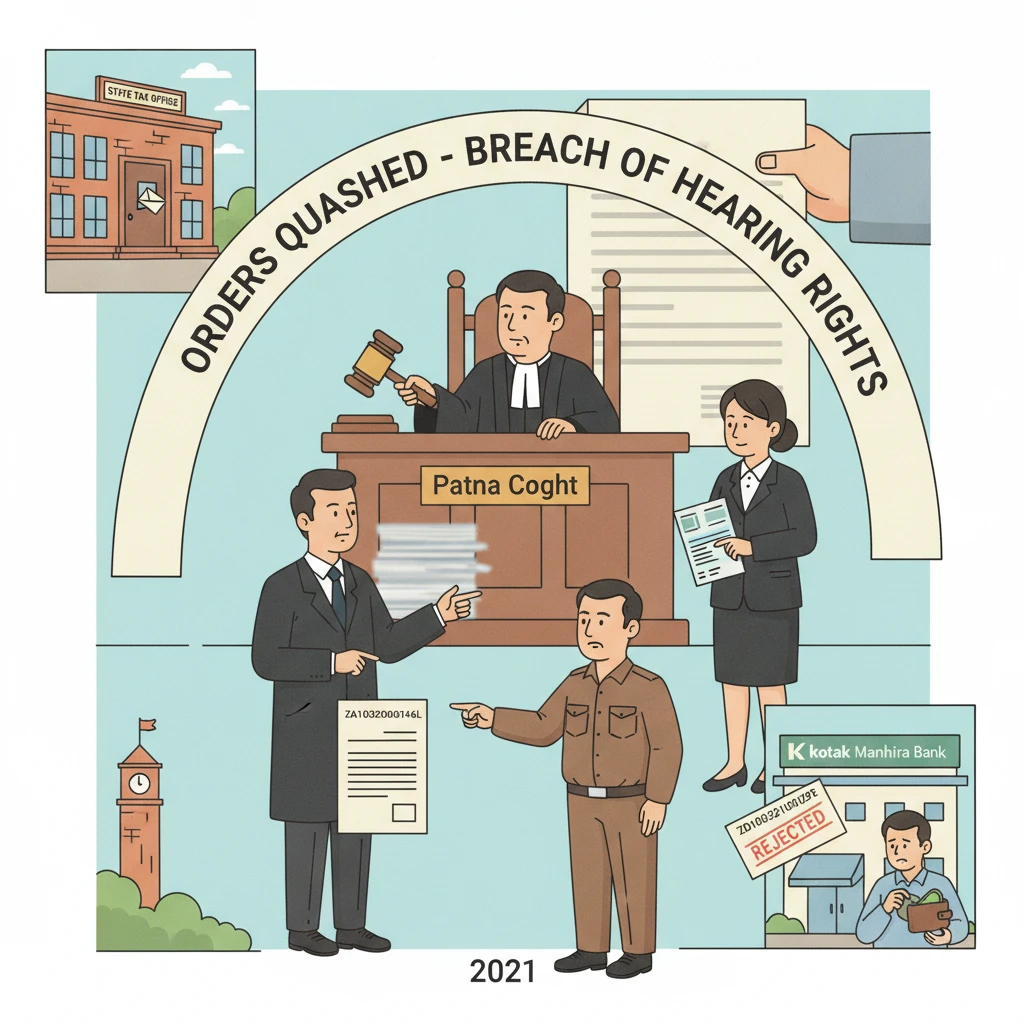
On 01.03.2021, the Appellate Authority rejected this appeal by an order bearing reference no. ZD100321000129E. The petitioner described this as a non-speaking order and complained that it was rejected without proper hearing and without considering the impact of the Supreme Court’s orders in the suo motu case on extension of limitation during the COVID-19 pandemic.
Meanwhile, the tax department moved to recover the disputed dues. The Branch Manager of Kotak Mahindra Bank Ltd., Exhibition Road Branch, Patna (arrayed as respondent no. 4) received a letter dated 02.03.2021 for recovery from the petitioner’s bank account. Amounts were stated to have been deducted and deposited with respondent no. 3, the Deputy Commissioner of State Tax.
Aggrieved, the company invoked the writ jurisdiction of the Patna High Court in Civil Writ Jurisdiction Case No. 11071 of 2021. It sought quashing of the appellate rejection order, protection from coercive recovery, de-freezing of its bank account, and an opportunity to prosecute its appeal without having to re-deposit the pre-deposit amount already paid.
What the Court Examined and Decided
The Division Bench, comprising Hon’ble the Chief Justice and Hon’ble Mr. Justice S. Kumar, heard the matter through video conferencing on 29.07.2021. The Court carefully considered the sequence of events: the original Section 74 order in March 2020, the demand communication, the appeal filed by the petitioner, and the impugned appellate order dated 01.03.2021.
The core grievance before the Court was that the appellate order was passed as a non-speaking order and that the petitioner did not get an effective opportunity to be heard. It was also urged that the delay in filing or pursuing the appeal was occasioned by COVID-19 restrictions and covered by directions of the Hon’ble Supreme Court in the matter relating to extension of limitation.
The Court first noted that the appeal had indeed been rejected by what the petitioner described as a “non-speaking” order. From the record, the Bench found that there was substance in the complaint that the order was ex parte and lacked reasons.
The Bench then addressed the preliminary question: whether it should interfere in writ jurisdiction when a statutory appeal remedy already exists. The Court held that, notwithstanding the statutory remedy, the High Court is not precluded from interfering where, on the face of the record, the impugned order is bad in law.
The Bench identified two important defects. First, there was violation of the principles of natural justice. According to the Court, no sufficient time had been afforded to the petitioner to represent its case. In simple terms, the taxpayer had not been given a fair opportunity to put forward its side before the authority made up its mind.
Second, the ex parte order did not assign sufficient reasons. The Court observed that even from the record it was not clear how the officer had determined the amount allegedly due and payable. An order that affects civil rights and financial liabilities must specify the basis and reasoning. Otherwise, the person affected cannot understand or challenge it properly.
The Court stressed that such ex parte orders, passed in violation of natural justice, entail civil consequences. Because of this, the Bench held that interference was justified on this short ground alone.
On the question of delay, the Court observed that in its considered view the delay stood sufficiently explained on account of COVID-19 restrictions. This was significant because, during the pandemic, many taxpayers and authorities faced difficulties in adhering to statutory timelines. The Court, therefore, took a liberal view consistent with the broader approach adopted during this period.
During the hearing, counsel for the Revenue stated that he had no objection if the matter was remanded to the Appellate Authority for a fresh decision on merits. He further indicated that while deciding the appeal, the issue of delay would not be pressed, and that no coercive steps would be taken during the pendency of the appeal.
The Court accepted this statement and recorded it. Thereafter, it framed mutually agreeable terms to finally dispose of the writ petition.
First, the Court quashed and set aside three orders: the appellate order dated 01.03.2021 passed by the Additional Commissioner of State Tax (Appeal), Patna West Division in appeal no. AD100221001440E; the original order dated 04.03.2020; and the demand/communication dated 05.03.2020 bearing reference no. ZA100320005146L issued by the Deputy Commissioner of State Tax under Section 74 of the Bihar GST Act.
Second, the Bench dealt with the statutory pre-deposit. The petitioner’s counsel stated that 10% of the total amount, being the mandatory pre-deposit for hearing of the appeal, had already been deposited. The Court recorded that if this statement was correct, the appeal shall be decided on merits without insisting on a fresh deposit. If, for any reason, the required amount had not been deposited, the petitioner was directed to do so before the next date of hearing before the Appellate Authority.
The Court clarified that any such deposit would be without prejudice to the rights and contentions of the parties and would remain subject to the final order of the Appellate Authority. If it were ultimately found that the petitioner had deposited an excess amount, the surplus would have to be refunded within two months from the date of the appellate order.
Third, considering that recovery steps had already been initiated through the petitioner’s bank, the Court ordered immediate de-freezing or de-attaching of the petitioner’s bank account(s) if they had been attached in connection with the disputed proceedings. This ensured that the company’s routine banking operations would not remain blocked while the dispute was being reconsidered.
Fourth, the Court fixed a specific date for appearance before the Appellate Authority. The petitioner undertook to appear on 29.09.2021 at 10:30 A.M., preferably through digital mode. This was meant to avoid any further delay or confusion about the progress of the appeal.
The Court then issued detailed directions to guide the fresh appellate proceedings. The Appellate Authority was directed to condone the delay in filing the appeal and to decide it on merits after complying with the principles of natural justice. Adequate opportunity of hearing was to be given, including time for both sides to place on record all essential documents and materials.
During the pendency of the appeal, the Court ordered that no coercive steps would be taken against the petitioner. Thus, no further recovery action could be initiated until the appeal was finally decided.
The Appellate Authority was instructed to pass a fresh order only after granting sufficient opportunity to all concerned, including the petitioner. The petitioner, through learned counsel, undertook to fully cooperate with the proceedings and not to seek unnecessary adjournments.
The Court requested that the appeal be decided expeditiously and, preferably, within two months from the date the petitioner appeared before the Appellate Authority.
Finally, the Bench clarified that it had expressed no opinion on the merits of the tax dispute. All issues of fact and law were left open for the Appellate Authority to decide independently. Liberty was reserved to the petitioner to challenge the eventual appellate order, if required, and both sides were free to use any other remedies available in law. The Court also observed that, during the ongoing COVID-19 pandemic, proceedings should be conducted through digital mode wherever possible.
With these directions, the writ petition and any pending interlocutory applications were disposed of. Counsel for the respondents undertook to communicate the High Court’s order to the appropriate authorities electronically.
Why This Judgment Matters
This decision of the Patna High Court is important for taxpayers and officials dealing with GST disputes in Bihar.
First, it reinforces that tax authorities must follow basic fairness. Orders that fix tax liability or confirm demands cannot be ex parte, vague, or unreasoned. Where opportunities of hearing are not genuinely given, such orders are liable to be set aside.
Second, during times like the COVID-19 pandemic, the Court recognised that delays caused by restrictions can be a valid explanation. Taxpayers who could not meet limitation periods due to lockdowns are entitled to have this taken into account.
Third, the judgment shows that even when a statutory appellate remedy exists, the High Court under Article 226 can step in to protect fundamental procedural rights, especially when the defect is clear on the face of the record.
Fourth, by directing de-freezing of bank accounts and staying coercive recovery during the pendency of a proper appeal, the Court provided practical relief. This prevents taxpayers from being pushed into financial crisis before their appeals are fairly heard.
For businesses and individuals facing similar GST proceedings, the case underlines the importance of insisting on a reasoned order and a real opportunity to be heard. It also indicates that where these safeguards are missing, the Patna High Court is prepared to intervene and send the matter back for a lawful reconsideration.
Legal Issues and Answers
Issue: Can the Patna High Court interfere in GST assessment and appellate orders where a statutory remedy exists, if the orders are ex parte and unreasoned?
Answer: Yes. The Court held that it can intervene where, on the face of the record, the orders are bad in law due to violation of natural justice and lack of reasons, and accordingly quashed the orders and remanded the matter.
Issue: How should delay caused by COVID-19 restrictions be treated in GST appeals?
Answer: The Court found that the delay was sufficiently explained by COVID restrictions and directed the Appellate Authority to condone the delay and decide the appeal on merits.
Issue: What interim protection is appropriate while a GST appeal is reconsidered?
Answer: The Court ordered de-freezing of the petitioner’s bank account, directed that no coercive steps be taken during the appeal’s pendency, and clarified that pre-deposit already made would suffice, subject to verification and refund of any excess.
Cases Cited by the Court
- The judgment refers to the directions of the Hon’ble Supreme Court in “RE: Cognizance for Extension of Limitation, Suo Motu Writ Petition (Civil) No. 3 of 2020”. No other cases are expressly cited or relied upon in the text provided.
Case Details
Case Number: Civil Writ Jurisdiction Case No. 11071 of 2021
Case Title: Aadhar Stumbh Township Private Limited v. The State of Bihar & Ors.
Coram: Hon’ble the Chief Justice; Hon’ble Mr. Justice S. Kumar
Date of Judgment: 29.07.2021
Citation: 2022 (3) PLJR 47
Advocates: Mr. Kumar Shanu, Advocate and Mr. Amrit Kumar, Advocate for the petitioner; Mr. Vikash Kumar, Standing Counsel 11, for the respondents
Nature of the Case: Writ petition under Article 226 challenging GST demand and appellate rejection order, seeking quashing of orders under Section 74 of the Bihar Goods and Service Tax Act, 2017, protection from coercive recovery, and restoration of appeal proceedings.
Link to Judgment: Click here to access the official Patna High Court judgment
If you found this explanation helpful and wish to stay informed about
how legal developments may affect your rights in Bihar,
you may consider following Samvida Law Associates for more updates.







