

Case Background
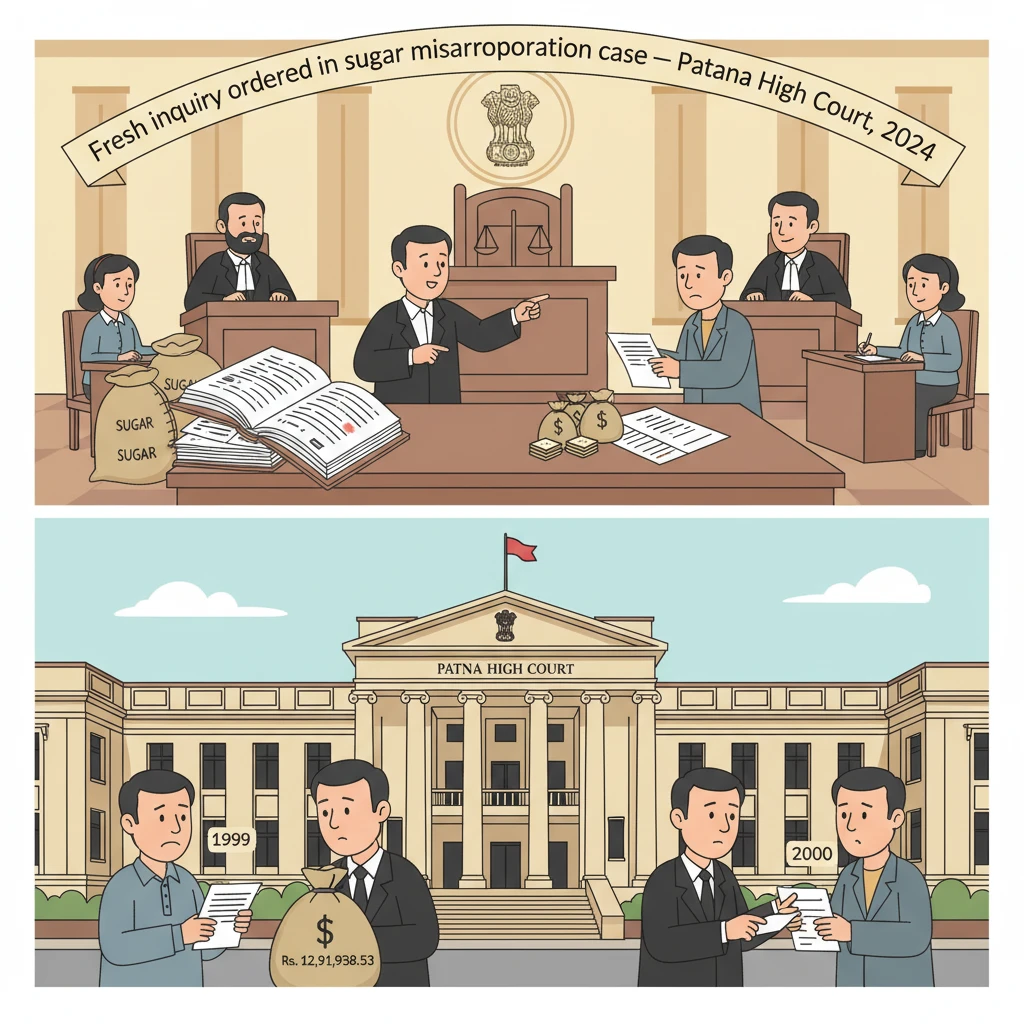
This case arises from departmental proceedings against an employee of the Bihar State Food and Civil Supplies Corporation Limited. The employee was accused of misappropriating sugar, leading to an alleged defalcation of Rs. 10.75 lakhs.
On completion of the disciplinary proceedings, the corporation imposed the penalty of dismissal from service. The employee challenged this dismissal order in a review, but he also suffered adverse orders in review on 29.03.2004 and 08.07.2004.
These orders, including the dismissal, became the subject matter of Civil Writ Jurisdiction Case No. 4713 of 2006 before a learned Single Judge of the Patna High Court. On 31.08.2018, the Single Judge allowed the writ petition.
The Bihar State Food and Civil Supplies Corporation Limited and its officials then filed Letters Patent Appeal No. 66 of 2020 before a Division Bench of the Patna High Court, challenging the Single Judge’s order.
What the Court Examined and Decided
The Division Bench, comprising Hon’ble Mr. Justice P. B. Bajanthri and Hon’ble Mr. Justice Ramesh Chand Malviya, heard the appeal and delivered an oral judgment on 03.01.2024.
The core allegation against the respondent employee was misappropriation of sugar resulting in a financial loss of Rs. 10.75 lakhs to the corporation. The Court described this as a serious charge.
The learned Single Judge had allowed the writ petition mainly on technical grounds. He recorded a finding that the departmental inquiry was a case of “no evidence” and that the inquiry officer’s findings were perverse. The Single Judge relied on the Supreme Court decisions in Roop Singh Negi v. Punjab National Bank, (2009) 2 SCC 570, and State of U.P. v. Saroj Kumar Sinha, (2010) 2 SCC 772.
Before the Division Bench, the appellants (the corporation and its officers) argued that the charges were serious and that the employee had earlier been subjected to disciplinary proceedings on similar allegations around 1997, which had ended in a punishment of recovery. In view of repeated misconduct, they contended that the penalty of dismissal was justified.
On the other hand, counsel for the respondent employee supported the Single Judge’s decision. He submitted that the employee had already been punished on 17.08.1999 on identical charges, with an order for recovery of Rs. 12,91,938.53/-. According to him, the employee could not be punished twice for the same offence, and doing so violated Article 20 of the Constitution of India. He therefore argued that the Single Judge’s interference should not be disturbed.
The Division Bench examined the record, especially the earlier punishment order dated 17.08.1999. It noted that the earlier allegation of misappropriation of sugar, resulting in recovery of Rs. 12,91,938.53/-, related to events in the year 1997. In contrast, the dismissal now under challenge was based on allegations from the year 2000.
On this basis, the Court held that the respondent’s contention that he was being punished twice for the same offence or same allegations could not be accepted. The Court found a clear factual difference: the earlier recovery order related to alleged misappropriation in 1997, whereas the present dismissal order concerned alleged misappropriation in 2000. Therefore, the plea of double punishment for the same offence was rejected.
The Division Bench then turned to the manner in which the Single Judge had set aside the dismissal. The Court accepted that, in the departmental proceedings, sufficient material had not been placed on record before the inquiry authority and that the material had not been proved in the manner known to law. In that sense, there was a lacuna in the disciplinary proceedings.
The Court observed that when a punishment order in a departmental matter, particularly one involving financial irregularities, is set aside on technical grounds such as lack of material or a perverse inquiry report, a question arises whether the matter should end there or be sent back for a fresh inquiry.
The Division Bench held that, in such situations, especially where allegations involve misappropriation of substantial sums (here, Rs. 10.75 lakhs), the proper course is remand for a fresh inquiry rather than simply quashing the punishment and closing the matter.
To support this view, the Court relied on several Supreme Court decisions. It quoted paragraph numbers 48 to 50 from Chairman-cum-Managing Director, Coal India Ltd. and Others v. Ananta Saha and Others, (2011) 5 SCC 142, which in turn referred to Managing Director, ECIL, Hyderabad and Others v. B. Karunakar and Others, (1993) 4 SCC 727, and Union of India v. Y.S. Sadhu, (2008) 12 SCC 30.
The extracted passages laid down the principle that when a court or tribunal quashes a punishment on some technical ground, the disciplinary authority must normally be given an opportunity to conduct the inquiry afresh from the stage where the defect arose. For a fresh inquiry, the delinquent employee is to be reinstated and may be placed under suspension, with subsistence allowance payable during the suspension.
The Supreme Court decisions further clarified that entitlement to back wages, even after quashing of the punishment, is not automatic but discretionary, depending on the facts, principles of justice, equity and good conscience. The Division Bench also noted that this principle of remand in cases involving financial irregularities was reiterated in State of Uttar Pradesh and Others v. Prabhat Kumar, 2022 Live Law SC 736.
Applying these principles, the Patna High Court held that the learned Single Judge committed an error in not remanding the matter. Given that the allegation was of misappropriation of Rs. 10.75 lakhs, and that the dismissal had been set aside on technical grounds relating to evidence and the inquiry report, the correct approach was to send the case back to the disciplinary authority to hold a fresh inquiry.
Accordingly, the Division Bench modified the Single Judge’s order dated 31.08.2018. It directed the disciplinary authority to initiate a fresh inquiry and to conclude it within six months from the date of receipt of a copy of the Division Bench’s judgment.
To ensure timely action, the Court further ordered that if the disciplinary authority failed to complete the inquiry within the stipulated six months, the respondent employee would be entitled to costs of Rs. 1 lakh. This cost would become payable only if the proceedings went beyond the time limit fixed by the Court.
The Court also directed the respondent employee to cooperate with the disciplinary authority or inquiry officer so that the fresh inquiry could proceed. It added that if the employee did not cooperate, the authority or inquiry officer would be free to proceed ex parte, after taking into account all relevant materials, documents and evidence produced by the corporation.
With these directions, the Letters Patent Appeal was disposed of. The Division Bench thus neither fully upheld the dismissal nor fully accepted the employee’s claim to final relief; instead, it balanced both sides by ordering a time-bound fresh inquiry with a financial consequence for delay.
Why This Judgment Matters
This judgment is important for employees and government bodies in Bihar and beyond, especially where disciplinary cases involve allegations of financial loss.
First, the Patna High Court made it clear that if a departmental inquiry suffers from legal or procedural defects, the court will not always set aside the punishment and close the case. When serious financial irregularities are alleged, the usual course is to send the matter back for a fresh, legally correct inquiry.
Second, the Court clarified that being punished earlier for one set of allegations does not automatically protect an employee from action on another, later set of allegations, even if the type of misconduct is similar. Whether it amounts to double punishment depends on the facts and years involved, not merely on the nature of the charge.
Third, by fixing a six-month deadline and linking delay to payment of Rs. 1 lakh as cost, the Court sought to prevent endless departmental proceedings. This benefits employees, who often suffer uncertainty for years, while still allowing employers to properly investigate serious charges.
Finally, the judgment reinforces that employees must cooperate with lawful inquiries. If they do not, authorities may proceed ex parte based on available records.
Legal Issues and Answers
- Issue: Could the employee claim that he was being punished twice for the same offence because he had already faced recovery proceedings for similar misappropriation earlier?
Answer: No. The Court held that the earlier punishment order of 17.08.1999 related to alleged misappropriation in 1997, whereas the present dismissal concerned alleged misappropriation in 2000. They were factually distinct, so the plea of double punishment was rejected. - Issue: After finding legal and evidentiary defects in the disciplinary inquiry, should the Court simply set aside the dismissal, or remand the case for a fresh inquiry?
Answer: The Court held that, given the serious allegation of misappropriation of Rs. 10.75 lakhs, the proper course was to remand the matter to the disciplinary authority for a fresh inquiry, to be completed within six months. - Issue: What consequence should follow if the disciplinary authority fails to complete the fresh inquiry within the stipulated period?
Answer: The Court directed that if the inquiry is not completed within six months, the respondent employee will be entitled to costs of Rs. 1 lakh.
Cases Cited by the Court
- Roop Singh Negi v. Punjab National Bank, (2009) 2 SCC 570 (relied upon by the learned Single Judge).
- State of U.P. v. Saroj Kumar Sinha, (2010) 2 SCC 772 (relied upon by the learned Single Judge).
- Managing Director, ECIL, Hyderabad and Others v. B. Karunakar and Others, (1993) 4 SCC 727.
- Union of India v. Y.S. Sadhu, (2008) 12 SCC 30.
- U.P. SRTC v. Mitthu Singh, (2006) 7 SCC 180.
- Akola Taluka Education Society v. Shivaji, (2007) 9 SCC 564.
- Balasaheb Desai Sahakari S.K. Ltd. v. Kashinath Ganapati Kambale, (2009) 2 SCC 288.
- Chairman-cum-Managing Director, Coal India Ltd. and Others v. Ananta Saha and Others, (2011) 5 SCC 142.
- State of Uttar Pradesh and Others v. Prabhat Kumar, 2022 Live Law SC 736.
Case Details
Case Number: Letters Patent Appeal No. 66 of 2020 in Civil Writ Jurisdiction Case No. 4713 of 2006
Case Title: The Bihar State Food and Civil Supplies Corporation Limited & Others v. Ravi Kishore Sahay
Citation: 2024 (1) PLJR 472
Court: High Court of Judicature at Patna
Coram: Hon’ble Mr. Justice P. B. Bajanthri and Hon’ble Mr. Justice Ramesh Chand Malviya
Date of Judgment: 03.01.2024
Advocates: Mr. Anjani Kumar, Senior Advocate, assisted by Mr. Shailendra Kumar Singh, Advocate, for the appellants; Mr. Mukeshwar Dayal, Advocate, and Mr. Vikash Mohan, Advocate, for the respondent.
Nature of the Case: Letters Patent Appeal against a Single Judge order in a writ petition (service and disciplinary matter).
Link to the Judgment: Click here to read the full judgment of the Patna High Court
If you found this explanation helpful and wish to stay informed about how legal developments may affect your rights in Bihar, you may consider following Samvida Law Associates for more updates.







