
Case Background
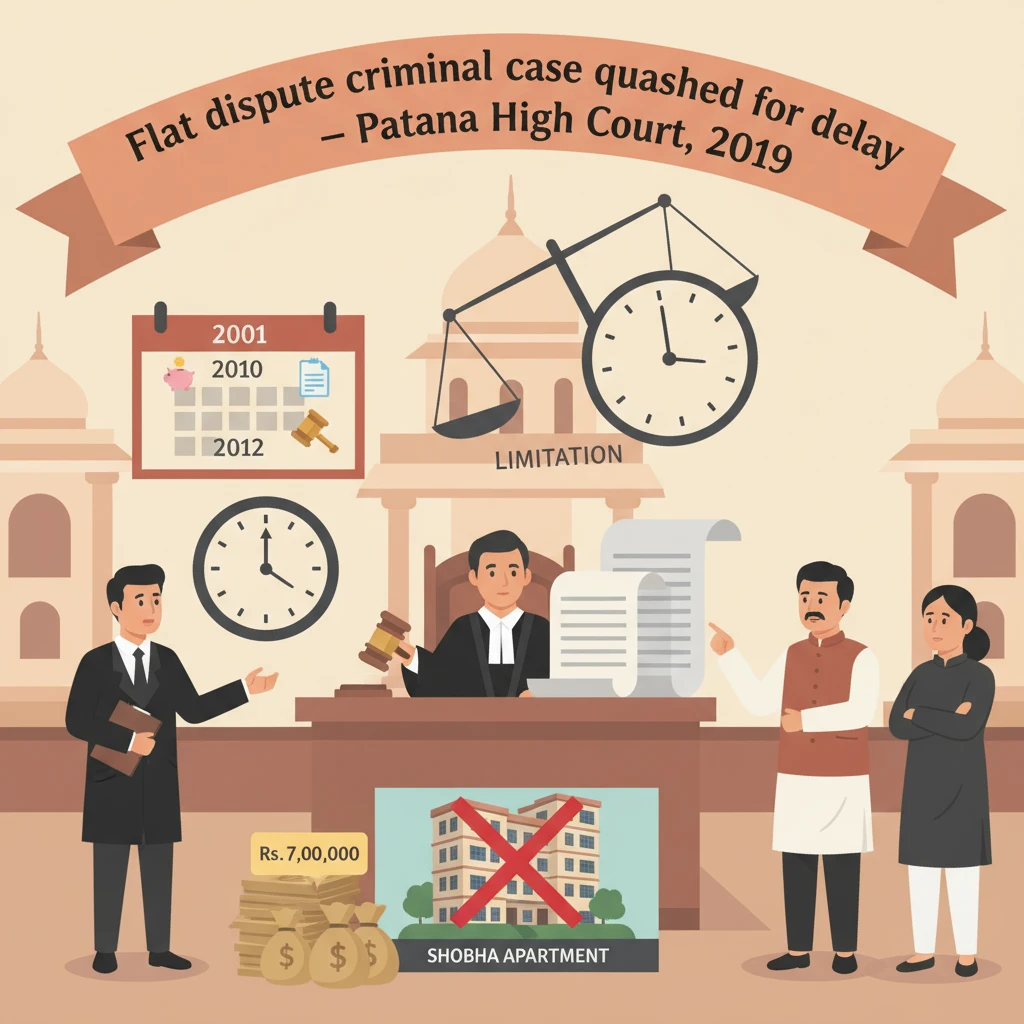
This case arose from a flat purchase dispute in Patna. According to the complaint, the buyer paid a total of Rs. 7,00,000/- for transfer of a flat in “Shobha Apartment” being built by Haweli Construction Private Limited. The allegation was that the petitioner and three others received this amount for transfer of the flat but did not complete the transfer.
From the complaint itself, it was admitted that the last payment by the complainant was made sometime in the year 2001. No further payment or specific act after 2001 was mentioned in the judgment.
Despite this, the complainant filed Complaint Case No. 2737(C) of 2010 in the year 2010 before the Judicial Magistrate, 1st Class, Patna. On 04.03.2012, the Magistrate took cognizance under Section 406 of the Indian Penal Code (criminal breach of trust) against the petitioner and others and issued summons to face trial.
Feeling aggrieved, the petitioner approached the Patna High Court by filing Criminal Miscellaneous No. 3541 of 2015 under Section 482 of the Code of Criminal Procedure, 1973. He sought quashing of the order dated 04.03.2012 taking cognizance, and all further criminal proceedings against him in the complaint case.
What the Court Examined and Decided
The Patna High Court heard learned counsel for the petitioner, learned APP for the State, and learned counsel for opposite party no. 2 (the complainant).
The main allegations, as recorded, were that the petitioner along with three others had received Rs. 7,00,000/- for transfer of a flat in Shobha Apartment and, despite receiving the money, had not transferred the flat. The offence alleged was criminal breach of trust under Section 406 of the Indian Penal Code, which is punishable with imprisonment up to three years.
The petitioner’s counsel raised two broad lines of argument, one on facts and the other on law. On facts, he submitted that the petitioner had been unnecessarily implicated. According to him, the petitioner had not taken any money from the complainant at all. He was only a witness to the agreement and whatever payment was made by the complainant was paid to Haweli Construction Private Limited. This part of the argument went to the role of the petitioner, suggesting that he should not face criminal proceedings.
However, the High Court chose to decide the matter mainly on a pure question of law, without entering deeply into disputed factual aspects.
The legal argument of the petitioner centred on limitation under the Code of Criminal Procedure. Counsel pointed to Section 468 CrPC, which lays down that the Court cannot take cognizance of certain offences after a prescribed period has expired. For offences punishable with imprisonment exceeding one year but not exceeding three years, like Section 406 IPC, the limitation period is three years.
The petitioner’s counsel submitted that the cause of action, as per the complaint itself, ended in 2001 when the last payment was made. Yet, the complaint was filed only on 29.09.2010, almost nine years later, and cognizance was taken even later on 04.03.2012, almost eleven years after the last alleged act. Thus, according to the petitioner, the complaint was hopelessly barred by limitation.
The Court was told that there was no order of the Magistrate under Section 473 CrPC extending the period of limitation. Section 473 allows a criminal court to take cognizance after the prescribed period only if the court is satisfied, by a specific order, that the delay has been properly explained or that it is necessary to do so in the interests of justice. Here, the petitioner argued, the Magistrate had not passed any such order, yet had taken cognizance.
For support, learned counsel relied on a decision of the Karnataka High Court in Wockhardt Hospital and Heart Institute v. G. R. Parthasarathi, reported in 2008 Cri. L. J. 2198. The specific reasoning of that case is not reproduced in the Patna High Court judgment, but it was cited to highlight the mandatory nature of limitation in criminal cases and the need for a proper order if limitation is to be extended.
On the other hand, learned APP and counsel for opposite party no. 2 argued that the Magistrate had correctly taken cognizance under Section 406 IPC because there were materials on record showing that the petitioner had committed criminal breach of trust by taking money and failing to transfer the flat.
However, when the High Court directly asked the State and the complainant’s counsel how the complaint remained maintainable in the face of the bar contained in Section 468 CrPC, they were unable to answer this legal objection. They could not show any order extending limitation or any legal basis to ignore the time bar.
After considering the materials and submissions, the Patna High Court found that this was a fit case for interference under Section 482 CrPC.
The Court first reproduced Section 468 CrPC in full and noted that where the punishment prescribed is three years, the court cannot take cognizance after three years from the date of the offence, unless the case falls within exceptions elsewhere in the Code.
The High Court then referred to the judgment of the Supreme Court in Japani Sahoo v. Chandra Sekhar Mohanty, (2007) 7 SCC 394. In paragraph 52 of that decision, the Supreme Court held that, for computing limitation in criminal cases, the relevant date is the date of filing of the complaint or initiating criminal proceedings, and not the date on which the Magistrate takes cognizance or issues process.
Next, the Court relied on the Constitution Bench judgment of the Supreme Court in Sarah Mathew v. Institute of Cardio Vascular Diseases, (2014) 2 SCC 62. In paragraph 51 of that case, the Supreme Court confirmed that the correct law is that the date of filing the complaint or institution of prosecution is the relevant date for limitation under Section 468 CrPC. The Court clarified that earlier contrary views, including Krishna Pillai, were confined to their own facts.
Applying these binding Supreme Court decisions, the Patna High Court held that in the present case the crucial date for limitation was 29.09.2010, the date of filing the complaint, and not 04.03.2012, the date of cognizance.
From the complaint petition itself, the High Court noted the admitted position that the last payment was made in the year 2001. Therefore, even assuming the offence of criminal breach of trust, the complaint could not have been filed beyond the year 2004 because the limitation period of three years expired by then.
Since the complaint was in fact filed on 29.09.2010, it was clearly beyond the permissible period by several years. There was also no order of the Magistrate under Section 473 CrPC extending limitation after recording satisfaction about the delay.
In these circumstances, the Court held that the complaint was impermissible both because of the express bar in Section 468 CrPC and in light of the law laid down by the Supreme Court in Japani Sahoo and Sarah Mathew. The Court, therefore, did not need to enter into the disputed facts about whether the petitioner had actually taken money or only signed as a witness.
On this basis, the Patna High Court allowed the application under Section 482 CrPC. It quashed the entire criminal proceeding arising out of Complaint Case No. 2737(C) of 2010, pending before the court below at Patna, including the order dated 04.03.2012 taking cognizance, insofar as it related to the petitioner.
The judgment does not state that the proceedings were quashed for the other accused; it expressly confines relief “as far as it relates to the petitioner.”
Why This Judgment Matters
This decision is important for people who file criminal cases after a long delay in property or money disputes. The Patna High Court has clearly applied the rule that criminal complaints for offences punishable up to three years cannot be filed after three years from the last alleged act, unless the court specifically condones the delay under Section 473 CrPC.
For ordinary buyers, this judgment underlines that if they feel cheated in a flat or property deal and wish to file a criminal case for offences like criminal breach of trust under Section 406 IPC, they should act without delay. Waiting many years can make the criminal case legally barred, even if their grievance is genuine.
For those accused in very old criminal complaints, the judgment shows that limitation is a strong defence. If the alleged acts happened more than three years before the complaint and there is no proper order extending limitation, the proceedings can be challenged before the High Court under Section 482 CrPC.
The decision also reinforces that trial courts must be careful while taking cognizance in old matters. They must examine limitation and, where necessary, pass a reasoned order if they choose to extend time under Section 473 CrPC. Simply ignoring limitation and issuing summons is not permissible.
Legal Issues and Answers
-
Issue: Can a Magistrate validly take cognizance of an offence under Section 406 IPC when the complaint is filed nearly nine years after the last alleged payment, without any order extending the limitation period under Section 473 CrPC?
Answer: No. The Patna High Court held that, for an offence punishable up to three years, the complaint must be filed within three years from the date of the alleged offence. Since the last payment was in 2001 and the complaint was filed on 29.09.2010, the case was barred by Section 468 CrPC, and there was no order condoning the delay. The criminal proceedings and the cognizance order were therefore quashed as against the petitioner. -
Issue: For calculating limitation under Section 468 CrPC, is the relevant date the date of complaint or the date of cognizance?
Answer: The relevant date is the date of filing of the complaint or institution of prosecution, not the date when cognizance is taken. The Court followed the Supreme Court rulings in Japani Sahoo v. Chandra Sekhar Mohanty and Sarah Mathew v. Institute of Cardio Vascular Diseases.
Cases Cited by the Court
- Japani Sahoo v. Chandra Sekhar Mohanty, (2007) 7 SCC 394.
- Sarah Mathew v. Institute of Cardio Vascular Diseases, (2014) 2 SCC 62.
- Wockhardt Hospital and Heart Institute v. G. R. Parthasarathi, 2008 Cri. L. J. 2198 (Karnataka High Court) – cited by the petitioner’s counsel.
Case Details
Case Number: Criminal Miscellaneous No. 3541 of 2015 (arising out of Complaint Case No. 2737(C) of 2010)
Case Title: Syed Azim Akhtar @ Syed Anim Akhtar v. The State of Bihar & Anr.
Coram: Hon’ble Mr. Justice Ahsanuddin Amanullah
Date of Judgment: 01.05.2019
Citation: 2019(2) PLJR 1015
Advocates:
- For the petitioner: Mr. Raj Dular Sah and Mr. Aminuddin Ahmad Khan, Advocates
- For opposite party no. 2: Mr. Dhivendra Nath Jha and Mr. Ahmad Ali, APP
- For the State: Mr. Jharkhandi Upadhyay, APP
Nature of the case: Petition under Section 482 of the Code of Criminal Procedure, 1973 seeking quashing of cognizance order in a complaint case alleging offence under Section 406 IPC.
Link to the judgment: View original judgment on Patna High Court website
If you found this explanation helpful and wish to stay informed about
how legal developments may affect your rights in Bihar,
you may consider following Samvida Law Associates for more updates.







