
Case Background
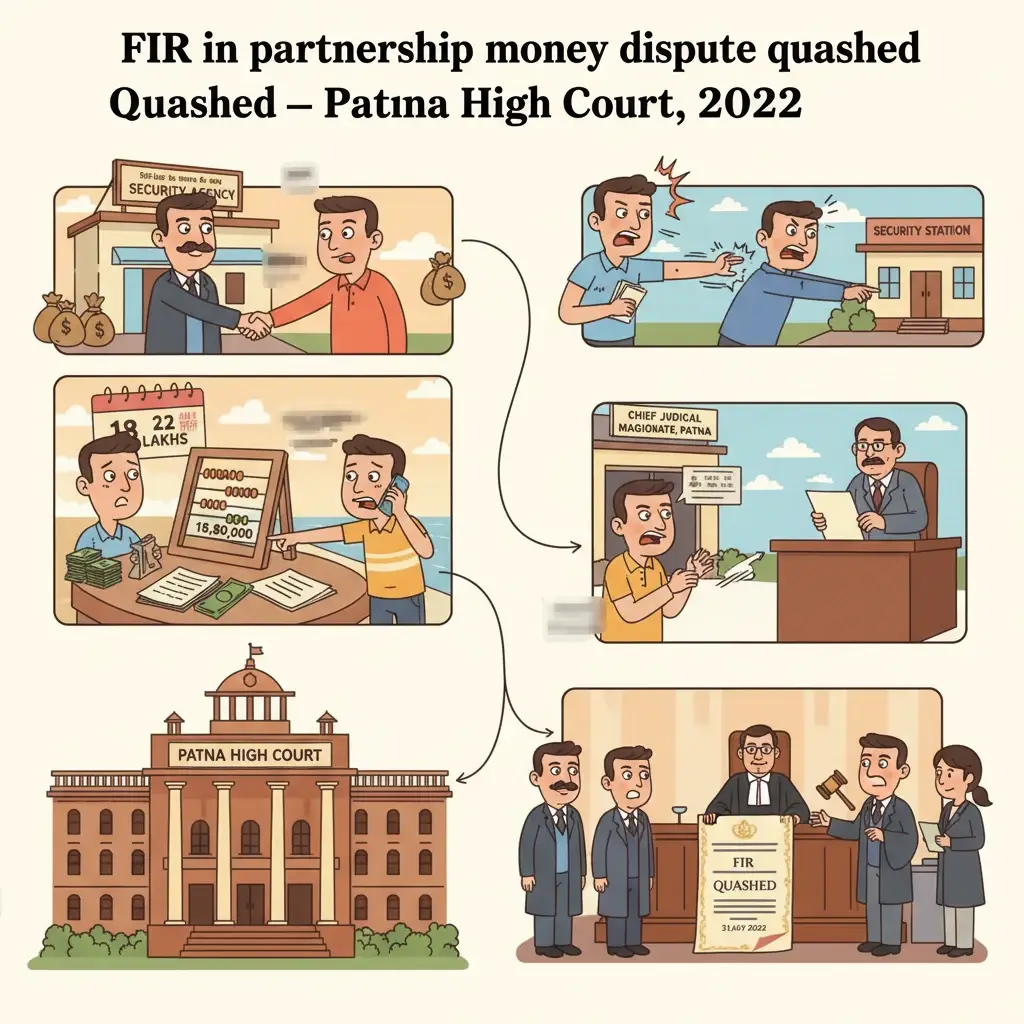
The case arose from a business relationship between the petitioner, a retired Lt. Colonel, and respondent no. 4. Both were running a security agency as partners.
According to the complaint, the petitioner had represented to respondent no. 4 that they would work together in the security agency business and earn good income. On this basis, respondent no. 4 agreed to start the business and, at the instance of the petitioner, invested Rs. 12 lakhs as capital.
The complaint further stated that during the continuance of the business, respondent no. 4 was allegedly not given his due share of profit, while the petitioner was allegedly withdrawing more than his due share. It was said that respondent no. 4 requested the petitioner on many occasions to settle accounts and pay his share, but no heed was paid.
It was then alleged that on 28.07.2014, the accounts of the security agency were prepared and, on that basis, respondent no. 4 was found entitled to receive Rs. 18,80,000/-. The petitioner allegedly promised to return this amount and liquidate the security agency. However, even after three months and repeated telephonic contacts, the amount was allegedly not paid.
The complaint also stated that when respondent no. 4 contacted the petitioner, he was abused and beaten. This formed the basis for adding Sections 323 and 324 of the Indian Penal Code (IPC), along with Sections 420 and 406 IPC for cheating and criminal breach of trust.
Instead of first going to the police station, respondent no. 4 directly filed Complaint Case No. 222 of 2015 before the Chief Judicial Magistrate (CJM), Patna. There was no statement in the complaint that he had earlier approached the jurisdictional police station or had followed the procedure under Section 154(3) of the Code of Criminal Procedure (Cr.P.C.).
The complaint petition was not supported by an affidavit. Despite this, on an oral prayer by the advocate for respondent no. 4, the learned CJM forwarded the complaint to the Station House Officer (SHO) of Shastri Nagar Police Station, Patna for investigation. On that basis, Shastri Nagar P.S. Case No. 379 of 2015 was registered under Sections 420, 406, 323 and 324 IPC.
The petitioner, feeling aggrieved, approached the Patna High Court by filing Criminal Writ Jurisdiction Case No. 1227 of 2017, seeking quashing of the FIR and all subsequent proceedings arising from it.
What the Court Examined and Decided
The Patna High Court, through Hon’ble Mr. Justice Rajeev Ranjan Prasad, heard counsel for the petitioner, counsel for respondent no. 4 (the informant), and counsel for the State.
The petitioner’s counsel first attacked the very manner in which the FIR came to be lodged. He pointed out that:
- The complainant had directly moved the CJM, Patna, by filing a complaint petition.
- There was no statement in the complaint that respondent no. 4 had first approached the police station or followed Section 154(3) Cr.P.C. procedure.
- The complaint petition was not supported by any affidavit.
- Despite this, on a mere oral prayer, the CJM forwarded the complaint to the SHO, leading to registration of an FIR.
Relying on the Supreme Court judgment in Priyanka Srivastava and Anr. v. State of Uttar Pradesh and Ors. (2015) 6 SCC 287, the petitioner argued that this process directly violated the mandatory requirements laid down by the Supreme Court for invoking the Magistrate’s power under Section 156(3) Cr.P.C.
The petitioner also stressed that the entire dispute was about a partnership business and sharing of profits. The complaint itself stated that both parties were running a security agency as partners and that respondent no. 4 had invested capital of Rs. 12 lakhs.
On the complainant’s own version, the main grievance was that he was not given his “due share” and that the petitioner was withdrawing more than his own share. Even after allegedly not getting his full share, respondent no. 4 continued in the business; he did not initially treat this as a crime but as a financial dispute.
Regarding the allegations of abuse and beating, the petitioner’s counsel submitted that these were merely “ornamental” allegations added to support a criminal case. It was pointed out that no separate information about any assault had ever been given to any police station.
For support, the petitioner relied on:
- State of Haryana v. Bhajan Lal, 1992 Supp (1) SCC 335 = AIR 1992 SC 604, where the Supreme Court laid down categories of cases in which FIRs can be quashed to prevent abuse of process.
- Inder Mohan Goswami & Another v. State of Uttaranchal, (2007) 12 SCC 1, where the Supreme Court discussed when the High Court can use its inherent powers under Section 482 Cr.P.C. to quash criminal proceedings, especially where a purely civil dispute is converted into a criminal case.
On the other side, counsel for respondent no. 4 opposed the writ. He argued that right from the beginning, the petitioner had no intention to pay the complainant’s due amount, and that he acted with an intention to cheat, which finally led to misappropriation of a large sum due to respondent no. 4.
Regarding the procedural objection based on Priyanka Srivastava, it was argued that the petitioner had not specifically raised these grounds in the writ petition itself, and therefore could not rely upon that judgment.
The State supported the lodging of the FIR, stating that it had been registered in light of the CJM’s order forwarding the complaint for investigation.
The Court then closely examined both the complaint petition and the legal position.
First, on the procedure, the Court held that the FIR had been lodged “without following the mandatory requirements of law” laid down by the Supreme Court in Priyanka Srivastava and Anr. The absence of an affidavit and the lack of any statement about approaching the police station or invoking Section 154(3) Cr.P.C. were significant defects.
On the argument that no specific plea about this was raised in the writ petition, the Court rejected that objection. It held that any party can always cite a Supreme Court judgment and point out mandatory requirements which must be followed by informants and by the Magistrate. The Court further noted that this procedural point had in fact been taken much earlier, on 07.11.2017, when an interim order was passed.
Second, on the nature of the dispute, the Court carefully read the complaint and found:
- Both parties were partners running a security agency business.
- It was not the complainant’s case that he was never paid anything; his grievance was that he was not paid his “due share” according to his capital and labour.
- Despite his allegation of underpayment, he did not promptly take legal steps to recover money but continued in the partnership.
The Court observed that if the only allegation is that the petitioner was not paying the complainant his due share, then the matter is “a pure and simple commercial dispute” to be governed by the civil law applicable to partnerships and commercial dealings. “By no stretch of imagination” could such a dispute, on these facts, give rise to a genuine criminal proceeding.
To support its view, the Court cited in detail the Supreme Court’s observations in Inder Mohan Goswami, emphasising that:
- Inherent powers under Section 482 Cr.P.C. are wide but must be used sparingly to prevent injustice and to stop abuse of process.
- Courts must use this power where proceedings are oppressive, vexatious, or constitute an abuse of process.
- In R.P. Kapur v. State of Punjab, the Supreme Court identified categories where proceedings can be quashed, including where allegations, even taken at face value, do not constitute an offence.
- In Chandrapal Singh v. Maharaj Singh, the Supreme Court described how frustrated litigants sometimes drag their opponents into frivolous criminal cases when they fail in civil courts.
The Court also referred to the landmark decision in State of Haryana v. Bhajan Lal, particularly paragraph 102, where the Supreme Court set out illustrative categories of cases in which FIRs can be quashed, such as:
- Where allegations, even if taken at face value, do not constitute any offence.
- Where the uncontroverted allegations and accompanying material do not disclose the commission of any offence.
- Where allegations are absurd or inherently improbable.
- Where criminal proceedings are manifestly attended with mala fide or are maliciously instituted to wreak vengeance.
Applying these principles, the Patna High Court held that, in the totality of the circumstances and based on the materials on record, the continuance of the criminal proceeding against the petitioner would be an abuse of the process of the court.
Accordingly, in the interests of justice, the Court quashed the First Information Report (Shastri Nagar P.S. Case No. 379 of 2015) as well as all subsequent proceedings, if any, against the petitioner. The criminal writ application was allowed.
Why This Judgment Matters
This judgment is important for people involved in business partnerships and money disputes in Bihar and elsewhere.
The Patna High Court has made it clear that:
- Not every dispute over profit share or settlement of accounts in a partnership can be converted into a criminal case.
- If the core issue is about money, profit sharing, or alleged underpayment in a business, the proper remedy is usually through civil or commercial proceedings, not by lodging an FIR for cheating or criminal breach of trust.
- Court procedures laid down by the Supreme Court, such as in Priyanka Srivastava, must be followed before a Magistrate forwards a complaint for FIR and investigation.
For ordinary people and small business partners, this ruling shows that criminal law cannot be misused as a pressure tactic in what are essentially civil disputes. It also reassures accused persons that the High Court can step in and quash such FIRs when they are filed in violation of legal requirements or are clearly abusive.
Legal Issues and Answers
- Issue: Can a partnership dispute over alleged non-payment of due share be treated as cheating and criminal breach of trust, justifying an FIR and criminal prosecution?
Answer: On the facts of this case, no. The Court held it was a pure and simple commercial dispute, not a criminal offence, and quashed the FIR. - Issue: Was the FIR validly lodged when the complainant directly approached the Magistrate without following the procedure and without an affidavit, and the Magistrate forwarded the complaint on an oral request?
Answer: The Court held that the FIR was lodged without following the mandatory requirements laid down by the Supreme Court in Priyanka Srivastava, and on this ground also, continuation of the case would be an abuse of process. - Issue: When can the High Court use its powers to quash an FIR under its criminal writ jurisdiction?
Answer: Relying on Bhajan Lal and Inder Mohan Goswami, the Court held that where allegations, even taken at face value, disclose only a civil/commercial dispute and criminal proceedings appear abusive, the High Court can and should quash the FIR to secure the ends of justice.
Cases Cited by the Court
- Priyanka Srivastava and Anr. v. State of Uttar Pradesh and Ors., (2015) 6 SCC 287
- State of Haryana v. Bhajan Lal, 1992 Supp. (1) SCC 335 = AIR 1992 SC 604
- Inder Mohan Goswami & Another v. State of Uttaranchal, (2007) 12 SCC 1
- R.P. Kapur v. State of Punjab, AIR 1960 SC 866 (referred within Inder Mohan Goswami)
- Chandrapal Singh v. Maharaj Singh, (1982) 2 SCC 466 : 1982 SCC (Cri) 249 (quoted in Inder Mohan Goswami)
Case Details
Case Number: Criminal Writ Jurisdiction Case No. 1227 of 2017
Related Police Case: Shastri Nagar P.S. Case No. 379 of 2015, District Patna
Case Title: Lt. Col. Akshaya Kumar Yadav (Rtd.) @ Akshaya Kumar Yadav v. The State of Bihar & Ors.
Citation: 2023 (1) PLJR 714
Court: High Court of Judicature at Patna
Coram: Hon’ble Mr. Justice Rajeev Ranjan Prasad
Date of Order: 21-07-2022
For the Petitioner: Mr. Rajesh Ranjan, Advocate; Mr. Maria Nazir, Advocate
For the State: Mr. Ajay Kumar Sharma, AC to AG
For Respondent No. 4: Mr. Sanjay Kumar Ghosarvey, Advocate; Mr. Ramesh Gupta, Advocate
Nature of the Case: Criminal writ petition seeking quashing of FIR and subsequent criminal proceedings
Link to Judgment: https://patnahighcourt.gov.in/vieworder/MTYjMTIyNyMyMDE3IzcjTg==-gklDeShTuA8=
If you found this explanation helpful and wish to stay informed about
how legal developments may affect your rights in Bihar,
you may consider following Samvida Law Associates for more updates.







