

Case Background
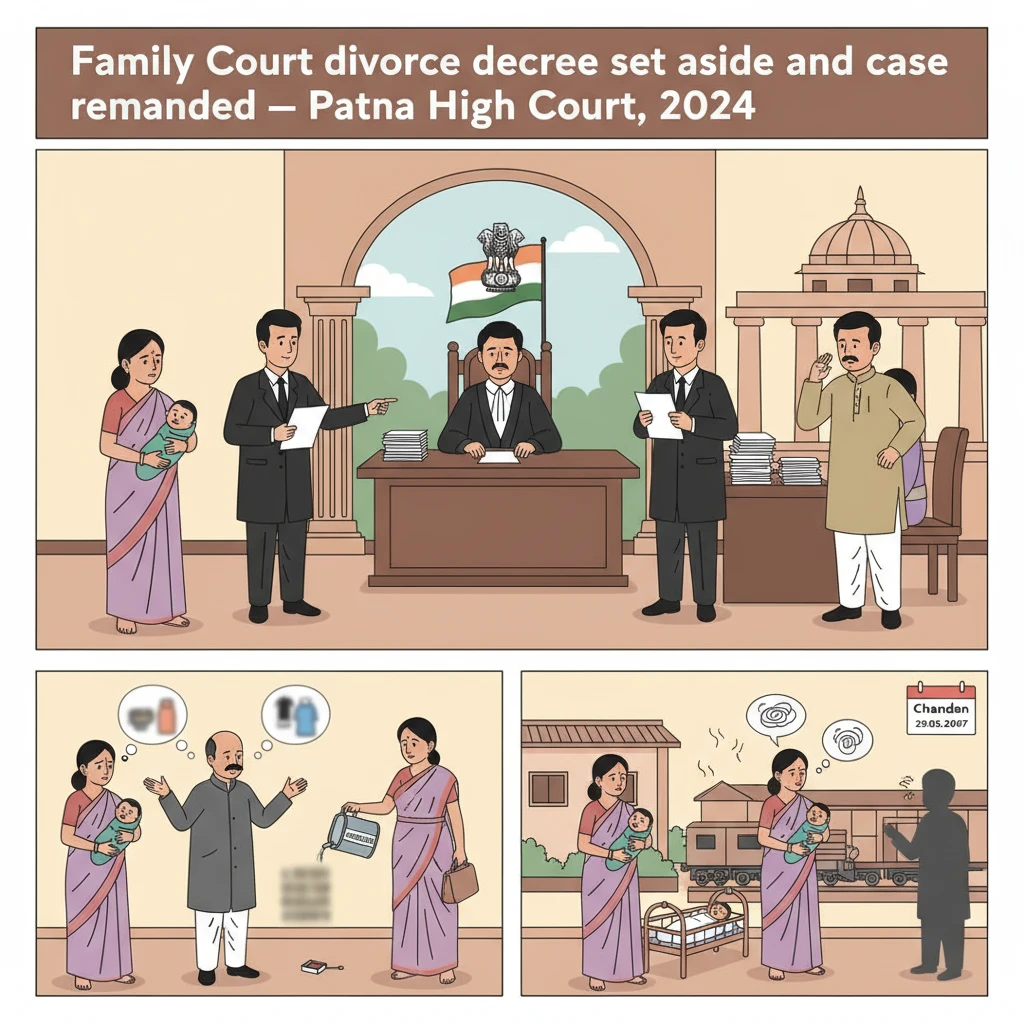
The marriage between the appellant wife and the respondent husband was solemnised on 24.06.2005. After the marriage, they lived together in the husband’s family home. A female child was born out of the wedlock on 31.07.2006 at Bhikhanpur.
The husband later filed Matrimonial (Divorce) Case No. 102 of 2007 before the Principal Judge, Family Court, Bhagalpur under Section 13(1)(ib) of the Hindu Marriage Act, 1955. He alleged adultery, cruelty and desertion by the wife. He also sought denial of maintenance to the wife and custody of the minor daughter.
By order dated 19.01.2016 and decree dated 04.02.2016, the Family Court dissolved the marriage. It held that the wife was not entitled to permanent alimony or maintenance and directed her to hand over the minor daughter to the husband.
Aggrieved, the wife filed Miscellaneous Appeal No. 259 of 2016 before the Patna High Court challenging the divorce decree, the findings on adultery, cruelty and desertion, the denial of maintenance and the direction regarding custody of the child.
What the Court Examined and Decided
The Patna High Court, through Hon’ble Mr. Justice P. B. Bajanthri and Hon’ble Mr. Justice Alok Kumar Pandey (authoring the judgment), examined the pleadings, evidence and the Family Court’s reasoning.
The Court first noted that the husband’s divorce petition ran into 35 pages and contained several “stories and sub-stories”. To keep the focus, the High Court confined itself to the material aspects relevant for adjudication.
Allegations by the husband
In his divorce petition, the husband alleged that soon after the marriage, the wife misbehaved at the instigation of her mother, brother and maternal uncle. He stated that she did not cook or clean, left the house without permission in search of employment, and allegedly attempted to terminate her pregnancy but ultimately did not do so.
He also alleged that her relatives frequently interfered in the matrimonial home, conspired against his family and threatened to implicate them in false cases. According to him, the wife persistently demanded costly clothes, food items and luxury goods beyond his means, creating quarrels.
The husband narrated a series of incidents: that she left for her mother’s home without consent on 23.09.2005; that her maternal uncle threatened him on 07.07.2006; that she behaved ferociously after child-birth and did not care for the child; that she poured kerosene on herself on the night of 29/30.08.2006 but could not carry out the alleged plan because she forgot the matchbox; and that she left the matrimonial home on the morning of 30.08.2006 with ornaments and clothes, leaving behind the infant.
He further alleged that she re-entered the house forcibly on 07.09.2006 with the help of her maternal uncle, created disputes on several occasions, and again went to her parental home at their instance. The husband claimed that she had illicit relations with one Chandan Mishra, that she stayed with him at Hajipur with the consent of her relatives and wanted to marry him, and that she resumed this “illicit connection” after leaving the matrimonial home on 29.03.2007.
According to the husband, after the birth of the child on 31.07.2006 there was no cohabitation between the spouses and the wife had broken the marital tie by repeatedly leaving the matrimonial home without his consent, behaving cruelly with him and his family, and neglecting the child.
Defence of the wife
The wife, in her written statement, admitted the marriage and the birth of the child but denied all the allegations of adultery, cruelty and desertion. She stated that instead she was subjected to dowry demands, assault and abuse by the husband’s family.
According to her, she lived at the matrimonial home with her husband, father-in-law, brother-in-law and baby till 28.08.2007. She said that the husband proposed that she should go to her mother’s home for Raksha Bandhan, and she went there trusting him and the in-laws.
She alleged that on 30.08.2007, the husband came to her village Rampur, took the baby in his lap, and while she went inside to change her saree, he left with the child. When she called him, he informed her that he was at Kailashpuri with the child. She immediately went there with her younger brother but was not allowed to enter the house. She claimed that the husband’s parents bluntly said that they would soon marry their son to another girl with a huge dowry.
Before the Family Court, the wife also expressed her desire to continue the marriage. In cross-examination, she stated that she wanted to live with her husband and child and did not want a divorce. She even said that if she had done anything wrong, she apologised for it.
Earlier High Court order on maintenance and custody
The wife’s counsel relied on an earlier order dated 17.12.2008 passed by a learned Single Judge of the Patna High Court in Criminal Revision No. 87 of 2008 along with Criminal Revision No. 479 of 2008. In that order, revisions filed by the husband were dismissed and he was directed to pay Rs. 2,000 per month as maintenance to the wife, including arrears and current maintenance within one month.
By the same order, the husband was also directed to hand over custody of the minor child to the wife within 15 days of receiving the order. The wife argued that the Family Court had ignored this earlier High Court direction while passing the divorce decree and deciding custody and maintenance issues.
Evidence before the Family Court
The husband examined nine witnesses including himself and relied upon several documents such as informatory petitions, FIR and final form in Nathnagar P.S. Case No. 157 of 2008, the wife’s fardbeyan, the earlier High Court order in the criminal revisions, and the wife’s pay slip. The wife examined herself and one Kiran Thakur.
On the basis of the pleadings, the Family Court framed issues regarding maintainability, cause of action, entitlement to divorce on grounds of desertion, adultery and cruelty, entitlement of the wife to permanent alimony and maintenance, guardianship and maintenance of the minor child, and other reliefs.
High Court’s analysis of desertion
The Patna High Court examined Section 13(1)(ib) of the Hindu Marriage Act and the statutory requirement that desertion must be for a continuous period of not less than two years immediately preceding the presentation of the petition. It quoted and relied on Supreme Court decisions in Bipin Chandra JaiSinghBai Shah v. Prabhavati, Lachman Utamchand Kirpalani v. Meena alias Mota, Debananda Tamuli v. Kakumoni Kataky, and Adhyatma Bhattar Alwar v. Adhyatma Bhattar Sri Devi.
The Court emphasised that four essential conditions must be proved for desertion: the fact of separation, intention to end cohabitation permanently (animus deserendi), absence of consent of the deserted spouse, and absence of conduct giving reasonable cause to the deserting spouse to leave.
Looking at the record, the High Court found that the Family Court’s finding on desertion was “perverse, sketchy and without assessing the material available on record”. The marriage took place in 2005, and the child was born on 31.07.2006. The divorce petition was filed in 2007. Even on the husband’s own version that there was no cohabitation after 31.07.2006, the statutory minimum period of two years had not elapsed by the filing date (23.07.2007). The High Court held that in these circumstances, desertion could not be made out and the petition was premature on this ground.
The Court also noted that the Family Court had strangely recorded that there was continuous desertion of more than eight years, despite no such pleadings or basis in the record. The High Court held that a court cannot go beyond the pleadings, and there was nothing to show that the wife had been living separately for eight years.
High Court’s analysis of adultery
The High Court next examined the Family Court’s finding that adultery was proved. It noted that the person with whom the wife was alleged to have an illicit relationship (Chandan Mishra) had not been made a party to the divorce proceedings, leaving him undefended. There was also “dearth of material information” to prove adultery.
In cross-examination, the husband himself admitted that he had not seen the wife with any other person. Despite this, the Family Court had concluded that adultery was established. The High Court held that even basic foundational facts were not proved and that there was no cogent material to support the allegation. Given the serious stigma attached to such a finding, the Court held that the Family Court had erred in law.
High Court’s view on cruelty and overall conduct
The wife’s statement that she wanted to live with her husband and child and was willing to apologise was specifically noticed by the High Court. It contrasted this with the husband’s conduct in pressing for divorce “at one pretext or another” without showing a positive attitude to secure his wife’s return to the matrimonial home.
The Court observed that the husband had not even filed a petition under Section 9 of the Hindu Marriage Act (restitution of conjugal rights) to bring his wife back. It noted that in matrimonial disputes, parties sometimes try to cover their own faults by levelling allegations against the other side to take advantage of their financial or social position.
The High Court stressed that the court must weigh “quality material” while deciding such sensitive matters, especially where findings like adultery can permanently stigmatise a spouse. It held that the Family Court had failed to properly assess the evidence and had reached wrong and perverse findings.
Decision to remit the case
Without going into every minute detail of merit, the High Court concluded that the Family Court had committed errors both on facts and law. Rather than finally deciding all issues itself, the High Court chose to remit the matter back to the Family Court.
While doing so, it directed the Family Court to consider the case afresh in the light of the Supreme Court’s guidelines in Rajnesh v. Neha and another, (2021) 2 SCC 324, read with Aditi alias Mithi v. Jitesh Sharma, 2023 SCC OnLine SC 1451, as well as the observations made in the High Court’s judgment.
The Family Court, Bhagalpur has been directed to decide Matrimonial (Divorce) Case No. 102 of 2007 on the basis of the material on record within six months from the date of receipt or production of the Patna High Court’s judgment. Both parties have been directed to cooperate with the expeditious disposal of the case.
All pending interlocutory applications in the High Court appeal were disposed of, and the trial court records ordered to be sent back forthwith.
Why This Judgment Matters
This judgment is important for families involved in contested divorces based on allegations like adultery and desertion. The Patna High Court has sent a clear message that such serious allegations must be proved with solid evidence. Courts cannot base divorce on bald statements or contradictions in the pleadings.
The decision also underlines that for desertion under Section 13(1)(ib) of the Hindu Marriage Act, the minimum period of two years’ separation before filing the petition is mandatory. A petition filed before that period is premature and cannot be entertained on that ground.
For women facing stigma due to unproven allegations of adultery, the judgment shows that higher courts can intervene when trial courts act without proper basis. The High Court has reminded Family Courts that they must not go beyond the pleadings and cannot casually write findings that tarnish a spouse’s reputation.
The case also highlights that where there are previous High Court orders on maintenance and custody, lower courts should consider them. While the final outcome of the divorce, maintenance and custody is still to be decided, the judgment ensures that the wife gets a fair reconsideration of her case.
Legal Issues and Answers
- Issue: Whether the husband had proved desertion for the statutory period required under Section 13(1)(ib) of the Hindu Marriage Act, 1955.
Answer: No. The Patna High Court held that the marriage took place in 2005, the child was born on 31.07.2006, and the divorce petition was filed on 23.07.2007, so the minimum two-year period of continuous desertion had not elapsed. The Family Court’s finding of more than eight years’ desertion was perverse and unsupported by the pleadings. - Issue: Whether adultery on the part of the wife was proved so as to justify a decree of divorce and denial of maintenance.
Answer: No. The High Court found that foundational facts of adultery were not proved, the alleged partner was not impleaded, and the husband admitted in cross-examination that he had not seen the wife with any other man. The Family Court’s conclusion that adultery was proved was held to be wrong and stigmatizing. - Issue: Whether the Family Court’s overall findings on cruelty, desertion, adultery, maintenance and custody could be sustained.
Answer: No. The High Court held that the findings were perverse, sketchy and not based on proper assessment of evidence. It therefore remitted Matrimonial (Divorce) Case No. 102 of 2007 back to the Family Court for fresh decision in light of Supreme Court guidelines and the High Court’s observations, to be concluded within six months.
Cases Cited by the Court
- Bipin Chandra JaiSinghBai Shah v. Prabhavati, AIR 1957 SC 176
- Lachman UtamChand Kirpalani v. Meena alias Mota, AIR 1964 SC 40
- Debananda Tamuli v. Kakumoni Kataky, (2022) 5 SCC 459
- Adhyatma Bhattar Alwar v. Adhyatma Bhattar Sri Devi, AIR 2002 SC 88
- Rajnesh v. Neha and another, (2021) 2 SCC 324
- Aditi alias Mithi v. Jitesh Sharma, 2023 SCC OnLine SC 1451
- Sivasankaran v. Santhimeenal, (2022) 15 SCC 742 (relied on by respondent, distinguished)
Case Details
Case Number: Miscellaneous Appeal No. 259 of 2016; arising out of Matrimonial (Divorce) Case No. 102 of 2007
Case Title: Prem Lata Thakur @ Prem Lata Kumari @ Pinki v. Kumar Achyuta Nand Jha
Citation: 2024 (4) PLJR 270
Court: High Court of Judicature at Patna
Coram: Hon’ble Mr. Justice P. B. Bajanthri and Hon’ble Mr. Justice Alok Kumar Pandey
Date of Judgment: 05.09.2024
Advocates:
- For the Appellant (wife): Dr. Manoj Kumar, Advocate
- For the Respondent (husband): Mr. Ashutosh Jha, Advocate; Mr. Bijoy Kant Mishra, Advocate; Mr. Avinav Kumar, Advocate
Nature of the Case: Miscellaneous appeal against a decree of divorce passed by the Family Court, including issues of adultery, cruelty, desertion, permanent alimony/maintenance and custody of minor child.
Link to Judgment: Patna High Court Judgment in MA No. 259 of 2016
If you found this explanation helpful and wish to stay informed about how legal developments may affect your rights in Bihar, you may consider following Samvida Law Associates for more updates.







