
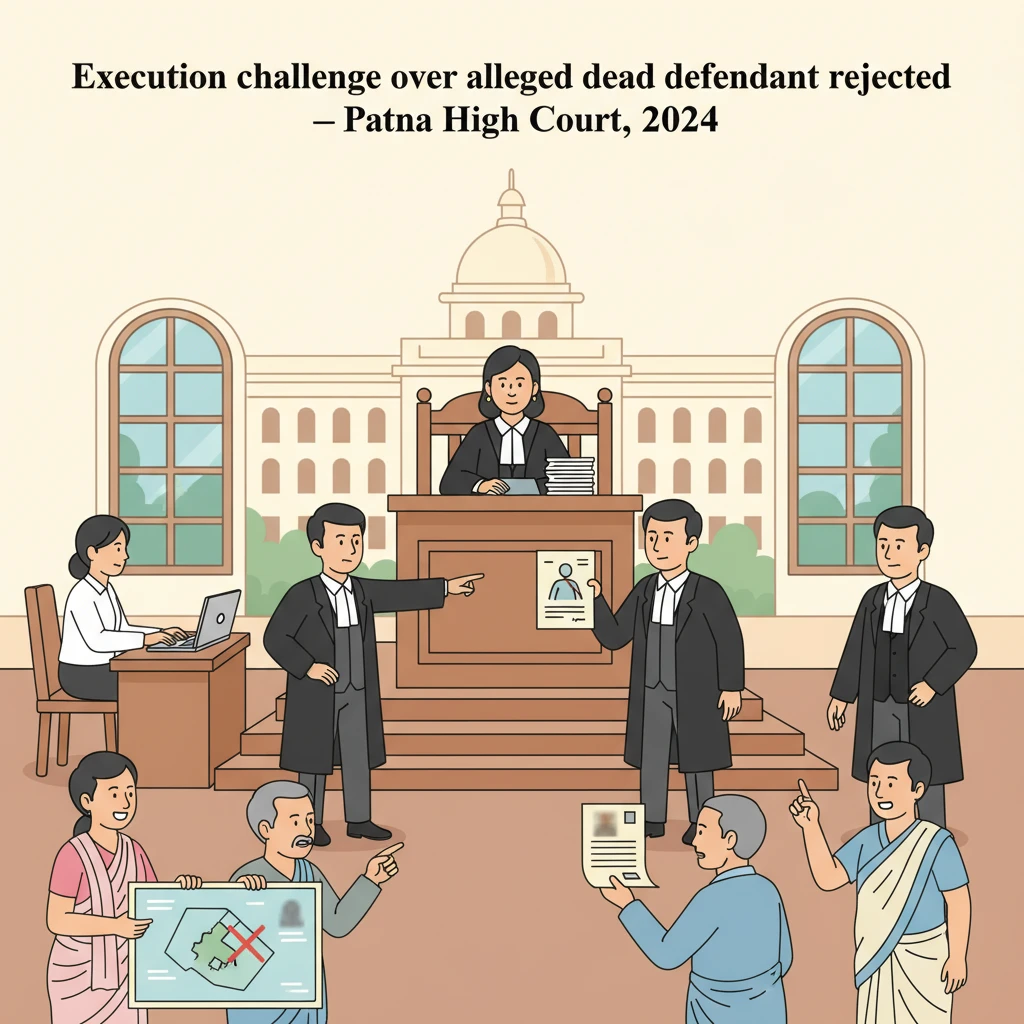
Case Background
This case arises from a long-standing land dispute relating to Schedule-A property in village Hasanpur, P.S. Teghra, District Begusarai. The respondents in this civil miscellaneous petition are the decree-holders. They had earlier filed Title Suit No. 171 of 2007 before the Sub Judge, Begusarai.
In that title suit, they sued the grandfather, father and uncle of the present petitioner. The reliefs sought were declaration of title over Schedule-A land, recovery of possession by demolishing construction raised by the defendants, mesne profits, and injunction.
The defendants appeared in the suit and filed a written statement denying the plaintiffs’ claim. After contest, the trial court delivered judgment and decree on 08.09.2016 in favour of the plaintiffs, granting them the reliefs sought.
Members of the defendants’ first set, who belong to the petitioner’s joint family, challenged that decree through Title Appeal No. 14 of 2016 before the District Judge, Begusarai. That title appeal is still pending for final hearing.
During pendency of the appeal, the decree-holders started execution of the 2016 decree by filing Title Execution Case No. 01 of 2016 in the court of Sub Judge-1, Begusarai. The case later came to be pending before Sub Judge-VI, Begusarai.
In the execution proceedings, the present petitioner (a judgment-debtor and described as judgment-debtor no. 2 in the High Court petition) and other defendants appeared and questioned the very maintainability of the execution. They filed a petition dated 03.02.2018 before the executing court raising objections. The decree-holders filed their rejoinder/objection on 17.02.2018.
After hearing both sides, the executing court, by order dated 04.12.2018 in Execution Case No. 1 of 2016, rejected the petitioner’s objection.
Aggrieved, the petitioner approached the Patna High Court under Article 227 of the Constitution of India in Civil Miscellaneous Jurisdiction No. 1709 of 2019, seeking to set aside the executing court’s order and to halt execution of the decree.
What the Court Examined and Decided
Justice Arun Kumar Jha of the Patna High Court examined two main objections raised by the judgment-debtor against execution:
First, that the decree in Title Suit No. 171 of 2007 was passed against a dead person, namely defendant no. 7(f) Sangeeta Devi, who was said to have died on 13.03.2015, i.e., before the judgment dated 08.09.2016. According to the petitioner, since no substitution of her legal heirs was done and her name was not removed from the plaint, the entire decree became a “nullity” and could not be executed.
Second, that the suit property described in Schedule-A of the plaint did not exist or could not be properly identified, so any decree for that land was incapable of execution. The petitioner argued that the plot had been amalgamated with his residential house and that the boundaries in the plaint were vague or false.
On the first point, the petitioner relied on the Supreme Court judgment in Gurnam Singh (D) through L.Rs & Ors. vs. Gurbachan Kaur (D) by L.Rs & Ors., reported in 2017 (2) PLJR 414 (SC). He argued that any decree passed against a dead person is a nullity in law and cannot be given effect through execution.
The respondents/decree-holders contested this strongly. They pointed out that the petitioner himself had produced a death certificate showing that Sangeeta Devi died on 13.03.2015, but that document was obtained only on 27.02.2018, long after the decree. In the memorandum of Title Appeal No. 14 of 2016, however, the same petitioner had pleaded that Sangeeta Devi had died “10 years prior” to the judgment and decree dated 08.09.2016. Both versions about the timing of death could not be correct.
The decree-holders further stated that a substitution petition for defendant no. 7 had already been filed on 10.01.2012 in the title suit and allowed on 03.02.2012. Even at that time, the defendants did not object that Sangeeta Devi was wrongly described or that there was an error in substitution. Nor did the defendants object during the rest of the trial that the suit was continuing against a dead person.
On law, the decree-holders argued that when a court is unaware of a party’s death and passes a decree, that decree is at best irregular but not void ab initio. Such a decree is executable unless it is set aside on appeal or revision. For this, they relied on several decisions:
They cited the Calcutta High Court decision in Himangshu Bhusan Kar and others vs. Manindra Mohan Saha, AIR 1954 Cal 205, where it was held that a decree in favour of a dead person is not, by itself, a nullity.
They also referred to the Bombay High Court decision in Raddulal Bhurmal and others vs. Mahabirprasad Bisesar Kalwar and others, AIR 1959 Bombay 384, which held that if a court proceeds in ignorance of a party’s death and passes a decree, the decree cannot be treated as a nullity and must be challenged through proper proceedings.
Similarly, they relied on the Madras High Court judgment in Abdul Azeez Sahib vs. Dhanabagiam-mal and others, AIR 1983 Madras 5, reiterating that passing a decree without knowledge of a party’s death is only an irregularity and does not make the decree void ab initio.
The decree-holders also reminded the High Court of a basic principle: an executing court cannot “go behind” the decree. It must execute the decree as it stands, without re-examining its correctness on facts or law. For this they cited the Supreme Court’s decision in Vasudev Dhanjibhai Modi vs. Rajabhai Abdul Rehman and others, AIR 1970 SC 1475, which clearly states that a decree, even if erroneous, is binding until set aside in appeal or revision.
The Supreme Court decision in Bhawarlal Bhandari vs. M/s Universal Heavy Mechanical Lifting Enterprises, AIR 1999 SC 246, which followed Vasudev Dhanjibhai Modi, was also invoked to stress that the executing court has no jurisdiction to reopen the merits of the decree.
Additionally, the decree-holders relied on N. Jayaram Reddy and another vs. Revenue Divisional Officer and Land Acquisition Officer, Kurnool, (1979) 3 SCC 578, to argue that a party cannot later revive a defence point that was deliberately or wilfully abandoned at an earlier stage.
On the second objection—non-existence or non-identifiability of the suit land—the decree-holders submitted that the property is clearly specified as 3 katha 10 dhur in Plot No. 356, with detailed boundaries given in Schedule-A of the plaint. According to them, the judgment-debtors had forcibly dispossessed the decree-holders and constructed their own house over the entire plot, thereby changing its physical condition and amalgamating it with their own land.
They argued that any confusion over the current state of the property was the result of the defendants’ own actions. They further pointed out that the same defendants had earlier filed Title Suit No. 129 of 2002 against “defendants 3rd party” and the State of Bihar to set aside a gift deed dated 12.06.2000 regarding 1 katha 10 dhur out of Plot No. 356 of Khata No. 4142, which forms part of the same Schedule-A property.
In that earlier suit, the defendants had admitted in paragraph 13 of the plaint that they had 2 katha 10 dhur of land in Plot No. 356, on which defendant no. 1 had constructed a pucca house and was living with his family. On that basis, they themselves accepted that they could not claim any title beyond the western wall of their house. The decree-holders argued that, given such admissions, it was not open to the petitioner now to describe Schedule-A land as “false, imaginary, or non-existent”.
After considering all submissions, the Patna High Court rejected both grounds advanced by the petitioner.
On the “dead defendant” argument, the Court observed that it was also the duty of the defendants to inform the trial court about the death of any co-defendant. Since they failed to do so and even gave conflicting versions about when Sangeeta Devi died, they could not now blame the plaintiffs for not bringing that fact to the court’s notice.
The Court emphasised that there was no allegation that the plaintiffs knowingly concealed the death of Sangeeta Devi. The trial court had proceeded in ignorance of her death. In such a situation, the decree does not become a nullity. At most, it might be irregular, but it remains executable unless and until annulled by a competent appellate or revisional court.
The High Court further noted that even if the suit had abated against Sangeeta Devi or her legal heirs, the right to sue survived against the other defendants, who remained on record. Therefore, the suit would not abate as a whole, and the decree would continue to bind the remaining defendants, including the petitioner.
The Court also pointed out that the petitioner had participated in the trial without raising this objection at the appropriate time. Having abandoned this defence then, he could not revive it conveniently at the stage of execution. Moreover, he already has a title appeal pending (Title Appeal No. 14 of 2016), where all such questions, including alleged irregularity due to Sangeeta Devi’s death, can be raised and examined fully.
On the question of property identification, the High Court held that there was no real ambiguity in Schedule-A of the plaint. The land is described with definite boundaries, and changes in the physical condition of the land due to construction or amalgamation by the defendants cannot erase its legal identity.
The Court accepted the decree-holders’ case that the defendants had dispossessed them and merged the suit land with their own. In such circumstances, identification of the land would be done by reference to the boundaries specified in Schedule-A. It rejected the petitioner’s attempt to claim that the land is unidentifiable merely because his residential house now occupies the space.
Taking note of the admissions in earlier Title Suit No. 129 of 2002 regarding land in Plot No. 356, the Court observed that the petitioner appeared to be taking unfair advantage of the dispossession of the decree-holders and the amalgamation of the suit land with his own plot.
Reiterating the settled rule that an executing court cannot go behind the decree, the High Court concluded that the executing court was right in rejecting the objection petition dated 03.02.2018. There was no jurisdictional error in the order dated 04.12.2018 of the Sub Judge-7, Begusarai.
Accordingly, the Patna High Court dismissed Civil Miscellaneous No. 1709 of 2019 and affirmed the impugned order. The execution of the decree in Execution Case No. 1 of 2016 is now free to proceed to enforce the decree-holder’s rights over the suit land.
Why This Judgment Matters
This judgment has important practical implications for land and house owners facing execution of civil court decrees in Bihar and elsewhere.
First, it clarifies that if a decree is passed when the court did not know that a party had died, that decree does not automatically become void. Judgment-debtors cannot block execution simply by later producing a death certificate, especially if they themselves failed to inform the trial court in time.
Second, it reinforces that an executing court cannot re-open the merits of the original decree or treat it as invalid on grounds that should have been argued at trial or in appeal. Challenges to the correctness of the decree must be taken before the appellate court, not in execution.
Third, the judgment protects decree-holders where judgment-debtors try to change the physical nature of the property—such as by constructing houses or amalgamating plots—and then argue that the land cannot be identified. Courts will look to the boundaries and description in the plaint and decree, not merely the current state created by a wrongdoer.
For villagers and landholders in Bihar, the decision shows that delaying tactics in execution—like raising late objections about alleged dead parties or “non-existent” land—are unlikely to succeed where an effective decree already exists and an appeal remedy is available.
Legal Issues and Answers
- Issue: Does a civil court decree become a nullity, and therefore inexecutable, if it is passed against a defendant who had died before judgment, when the court was not informed of the death?
Answer: No. The Patna High Court held that such a decree may be irregular but is not a nullity. It remains executable unless set aside by a competent appellate or revisional court, especially where the defendants themselves did not disclose the death and other defendants continued to represent the interest in the suit. - Issue: Can execution be blocked on the ground that the suit property mentioned in the decree is non-existent or unidentifiable because it has been amalgamated with the judgment-debtor’s house?
Answer: No. The Court found that where the property is clearly described with boundaries in Schedule-A, its identity does not disappear merely because the judgment-debtor has changed its physical condition. The executing court can and should execute the decree to the extent of the land described. - Issue: Can an executing court examine the correctness or validity of the underlying decree on factual or legal grounds?
Answer: No. Relying on Supreme Court precedents, the Court reiterated that an executing court cannot go behind the decree. It must execute the decree as it stands, until it is modified or set aside in proper appellate or revisional proceedings.
Cases Cited by the Court
- Vasudev Dhanjibhai Modi vs. Rajabhai Abdul Rehman and others, AIR 1970 SC 1475 – on the principle that an executing court cannot go behind the decree and must treat it as binding until set aside.
- Bhawarlal Bhandari vs. M/s Universal Heavy Mechanical Lifting Enterprises, AIR 1999 SC 246 – reaffirming limits on the executing court’s power to question the decree.
- N. Jayaram Reddy and another vs. Revenue Divisional Officer and Land Acquisition Officer, Kurnool, (1979) 3 SCC 578 – on abandonment of defence and inability to raise such points later at will.
- Himangshu Bhusan Kar and others vs. Manindra Mohan Saha, AIR 1954 Cal 205 – holding that a decree in favour of a dead person is not necessarily a nullity.
- Raddulal Bhurmal and others vs. Mahabirprasad Bisesar Kalwar and others, AIR 1959 Bombay 384 – holding that passing a decree in ignorance of a person’s death is an irregularity but does not make the decree void.
- Abdul Azeez Sahib vs. Dhanabagiam-mal and others, AIR 1983 Madras 5 – reiterating that failure to bring death of a party to the court’s notice does not render the decree void ab initio.
- Gurnam Singh (D) through L.Rs & others vs. Gurbachan Kaur (D) by L.Rs & others, 2017 (2) PLJR 414 (SC), and Kiran Singh & others vs. Chaman Paswan & others, AIR 1954 SC 340 – cited by the petitioner, but found inapplicable as they deal with decrees passed without jurisdiction.
Case Details
Case Number: Civil Miscellaneous Jurisdiction No. 1709 of 2019 (arising out of Execution Case No. 1 of 2016 and Title Suit No. 171 of 2007; related appeal Title Appeal No. 14 of 2016)
Case Title: Satyasheel Kumar (wrongly named as Munna Kumar in Execution Case) vs. Navin Kumar Singh and another
Coram: Hon’ble Mr. Justice Arun Kumar Jha
Date of Judgment: 16.05.2024
Citation: 2024 (2) PLJR 815
Advocates:
- For the petitioner/judgment-debtor: Mr. R.K.P. Singh, Advocate; Mr. Bal Bhushan Choudhary, Advocate; Mrs. Nutan Kumari Sharma, Advocate
- For the respondents/plaintiffs/decree-holders: Mr. Prashant Kashyap, Advocate; Mr. Amit Ranjan, Advocate
Nature of the Case: Petition under Article 227 of the Constitution of India challenging an order of the executing court in a decree execution proceeding (civil miscellaneous against rejection of objection in execution).
Outcome: Petition dismissed; order of Sub Judge-7, Begusarai dated 04.12.2018 in Execution Case No. 1 of 2016 affirmed; execution of decree to proceed.
Link to judgement; file:///C:/Users/Adity/OneDrive/Documents/Vaktrita%20Final/case%201595.pdf
If you found this explanation helpful and wish to stay informed about
how legal developments may affect your rights in Bihar,
you may consider following Samvida Law Associates for more updates.







