

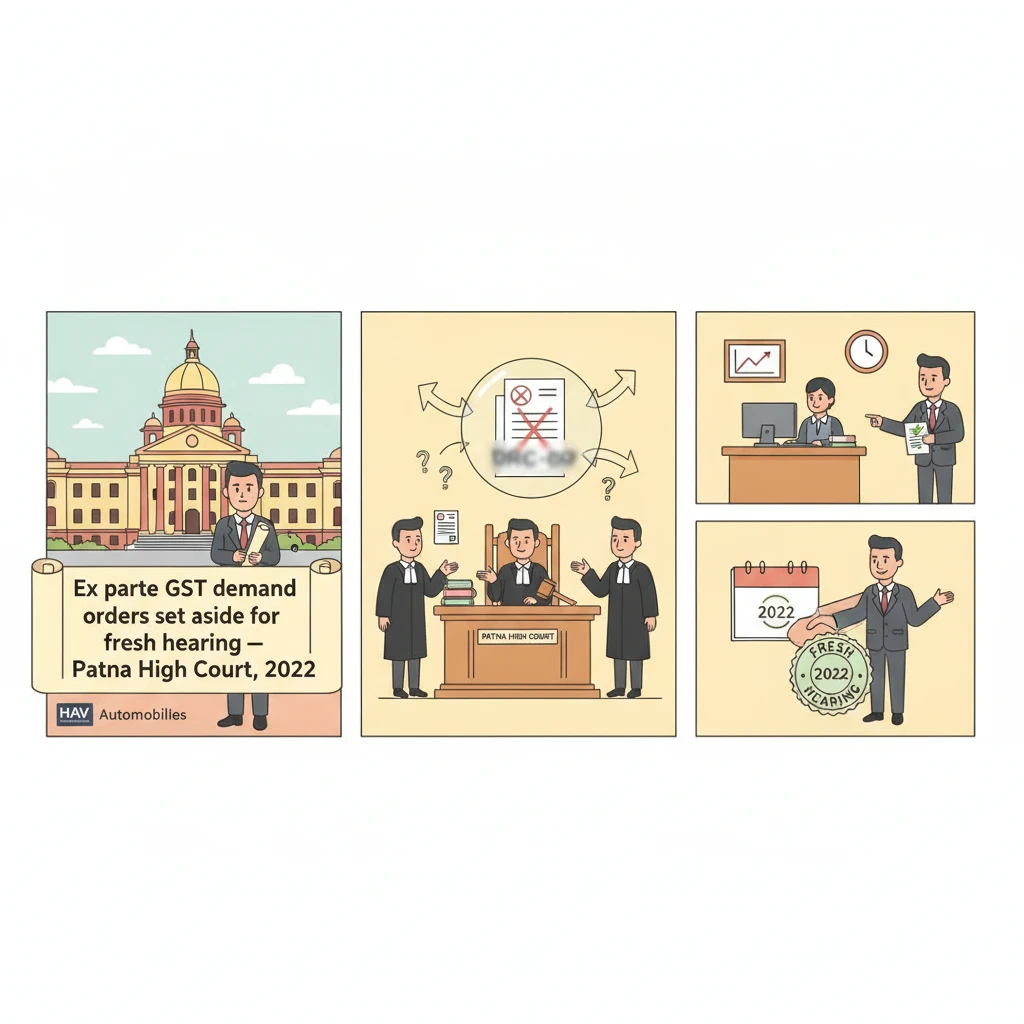
Case Background
The case arose from a tax dispute under the Central Goods and Services Tax Act, 2017 and the Bihar Goods and Services Tax Act, 2017 for the period April 2018 to March 2019.
The petitioner, HAV Automobiles Pvt. Ltd., was proceeded against by the Deputy Commissioner of State Taxes, Patna Central Circle, Patna under Section 73 of the BGST Act, 2017. This provision deals with determination of tax not paid or short paid, among other things.
An ex parte order was passed against the petitioner on 08.08.2019, followed by a summary of the order in Form GST DRC-07 dated 14.08.2019. These orders related to GSTIN 10AACCH5613D1ZD and Reference No. ZA100819000646P for the tax period April 2018 to March 2019.
The petitioner filed a statutory appeal under Section 107 of the Central Act, 2017 and the Bihar Act, 2017 before the Additional Commissioner of State Taxes (Appeals), Patna West, Patna. This appeal was registered as Appeal No. (ARN) AD1011190008688.
On 13.01.2021, the appellate authority rejected the appeal by Memo No. 46. The petitioner complained that the appellate order was ex parte, cryptic, misconceived and non-speaking, and that the principles of natural justice had been violated.
Aggrieved, the petitioner moved the Patna High Court by filing Civil Writ Jurisdiction Case No. 4171 of 2022, seeking quashing of the appellate order, the original ex parte assessment order and the DRC-07 summary, as well as protection from coercive recovery during the writ proceedings.
What the Court Examined and Decided
The Division Bench, consisting of Hon’ble the Chief Justice and Hon’ble Mr. Justice S. Kumar, heard both sides on 22.03.2022.
The petitioner’s main grievance was that the appeal against the assessment order had been dismissed by a non-speaking and ex parte order, without proper consideration and without following the principles of natural justice. The petitioner also challenged the underlying ex parte assessment and the DRC-07 summary.
It was brought to the notice of the Court that the appellate order dated 13.01.2021 in Appeal No. (ARN) AD1011190008688 had rejected the appeal in a cryptic, misconceived and non-speaking manner. This order had affirmed the assessment order dated 08.08.2019 and the DRC-07 summary dated 14.08.2019.
During the hearing, learned counsel appearing for the Revenue took a fair stand. He stated that he had no objection if the matter was remanded to the Assessing Authority for deciding the case afresh on merits. He further stated that during the pendency of the remanded proceedings, no coercive steps would be taken against the petitioner.
The Court accepted this statement and took it on record. However, it still examined whether it could interfere in writ jurisdiction despite the availability of statutory remedies under the GST laws.
After hearing counsel and perusing the available record, the Bench recorded its considered view. It held that the High Court, notwithstanding the existence of a statutory remedy, is not precluded from interfering where, on the face of the record, the order appears to be bad in law.
The Court gave two specific reasons for this conclusion.
First, it found violation of the principles of natural justice relating to fair opportunity of hearing. According to the Court, no sufficient time was afforded to the petitioner to represent its case.
Second, it noted that the order was ex parte in nature and did not assign sufficient reasons, even as could be deciphered from the record, as to how the Assessing Officer determined the amount due and payable by the assessee.
The Court observed that an ex parte order passed in violation of the principles of natural justice entails civil consequences. This alone was sufficient ground for interference in writ jurisdiction.
On this short ground, and based on terms that were mutually agreeable to both sides, the Court disposed of the writ petition with a series of directions.
First, the Court quashed and set aside three orders: the appellate order dated 13.01.2021 (Memo No. 46) passed by the Additional Commissioner of State Taxes (Appeals), Patna West, Patna in Appeal No. (ARN) AD1011190008688; the original order dated 08.08.2019 passed by the Deputy Commissioner of State Taxes, Patna Central Circle, Patna under Section 73 of the BGST Act, 2017 in respect of GSTIN 10AACCH5613D1ZD; and the summary of order dated 14.08.2019 in Form GST DRC-07, Reference No. ZA100819000646P.
Second, on the issue of pre-deposit, the Court accepted the petitioner’s statement that ten per cent of the total amount, which is a precondition for hearing an appeal, had already been deposited. The Court noted that if this was indeed so, nothing further was needed on that count. However, it directed that if, for any reason, the amount had not been deposited, it must be deposited before the next date.
Third, the petitioner undertook to additionally deposit ten per cent of the amount of the demand directly before the Assessing Officer. The Court directed that this additional deposit must be made within four weeks.
The Bench clarified that these deposits would be without prejudice to the respective rights and contentions of the parties and would remain subject to the final order of the Assessing Officer. If it was ultimately found that the petitioner’s deposit was in excess, the excess was to be refunded within two months from the date of the final order.
Fourth, the Court protected the petitioner from immediate financial hardship. It directed that the bank accounts of the petitioner, if frozen or attached in reference to the proceedings forming the subject matter of the writ petition, must be de-frozen or de-attached immediately.
Fifth, the Court laid down the future course of proceedings. The petitioner undertook to appear before the Assessing Authority on 11.04.2022 at 10:30 A.M., if possible through digital mode. The Court directed the Assessing Authority to decide the case afresh on merits, strictly after complying with the principles of natural justice.
The Bench further ordered that opportunity of hearing must be given to the parties to place on record all essential documents and materials, if required and desired. During the pendency of the reassessment proceedings, no coercive steps were to be taken against the petitioner.
The Court mandated that the Assessing Authority should pass a fresh order only after affording adequate opportunity to all concerned, including the petitioner. The petitioner, through counsel, undertook to fully cooperate in such proceedings and not to seek unnecessary adjournments.
To avoid undue delay, the Court directed the Assessing Authority to decide the case on merits expeditiously, preferably within two months from the date of the petitioner’s appearance.
The Assessing Authority was also instructed to pass a speaking order, assigning reasons, and to supply a copy of that order to the parties.
The Court reserved liberty to the petitioner to challenge the fresh order, if required and desired, and equally reserved liberty to all parties to take recourse to other remedies available in law. It expressed hope that if such remedies were invoked before an appropriate forum, they would be dealt with in accordance with law and with reasonable dispatch.
Importantly, the Bench clarified that it had not expressed any opinion on the merits of the tax dispute and that all issues were left open for decision by the Assessing Authority.
With these directions, the writ petition and any interlocutory applications were disposed of. Counsel for the respondents undertook to communicate the High Court’s order to the appropriate authority through electronic mode.
Why This Judgment Matters
This judgment is significant for taxpayers facing ex parte GST assessment or demand orders in Bihar.
The Patna High Court has clearly held that even when a statutory remedy like appeal exists, the Court can intervene where there is clear violation of natural justice and the orders are non-speaking.
For businesses, this means that if they receive orders without proper notice, without sufficient time to present their case, or without reasons explaining how the tax demand was computed, they may challenge such orders directly before the High Court in appropriate cases.
The judgment also provides practical relief: it directs de-freezing of bank accounts and stops coercive recovery during the fresh assessment, provided the taxpayer makes specified deposits. This helps in avoiding sudden financial hardship due to ex parte GST actions.
At the same time, the decision reminds taxpayers that cooperation with tax authorities is necessary. The petitioner was required to appear on a fixed date, deposit certain amounts, and avoid unnecessary adjournments.
Overall, the case reinforces that GST authorities must follow fair procedure, give adequate opportunity of hearing, and pass detailed speaking orders. Failure to do so can result in their orders being set aside.
Legal Issues and Answers
-
Issue: Can the Patna High Court interfere in GST assessment and appellate orders despite the existence of a statutory remedy, where the orders are ex parte and non-speaking?
Answer: Yes. The Court held that it can interfere in writ jurisdiction where there is clear violation of principles of natural justice and the orders, passed ex parte, do not disclose reasons for determining the tax liability. -
Issue: What relief should be granted when GST demand and appellate orders are found to violate natural justice?
Answer: The Court quashed both the assessment and appellate orders, remanded the matter to the Assessing Authority for a fresh decision on merits with full opportunity of hearing, directed de-freezing of bank accounts, restrained coercive recovery, and prescribed conditions regarding partial deposit.
Cases Cited by the Court
- No prior judgments are expressly cited or relied upon in this decision.
Case Details
Case Number: Civil Writ Jurisdiction Case No. 4171 of 2022
Case Title: HAV Automobiles Pvt. Ltd. vs. The State of Bihar & Ors.
Coram: Hon’ble the Chief Justice; Hon’ble Mr. Justice S. Kumar
Citation: 2022(2) PLJR 126
Date of Judgment: 22.03.2022
Advocates: Mr. Gautam Kumar Kejriwal, Advocate for the petitioner; Mr. Vivek Prasad, GP 7 for the respondents
Nature of the Case: Writ petition under Article 226 challenging GST assessment order, DRC-07 summary, and appellate order under Section 73 and Section 107 of GST laws
Key Statutory Provisions Involved: Section 73 of the Bihar Goods and Services Tax Act, 2017; Section 107 of the Central Goods and Services Tax Act, 2017 and the Bihar Goods and Services Tax Act, 2017
Link to the Judgment: Official Patna High Court judgment
If you found this explanation helpful and wish to stay informed about
how legal developments may affect your rights in Bihar,
you may consider following Samvida Law Associates for more updates.







