

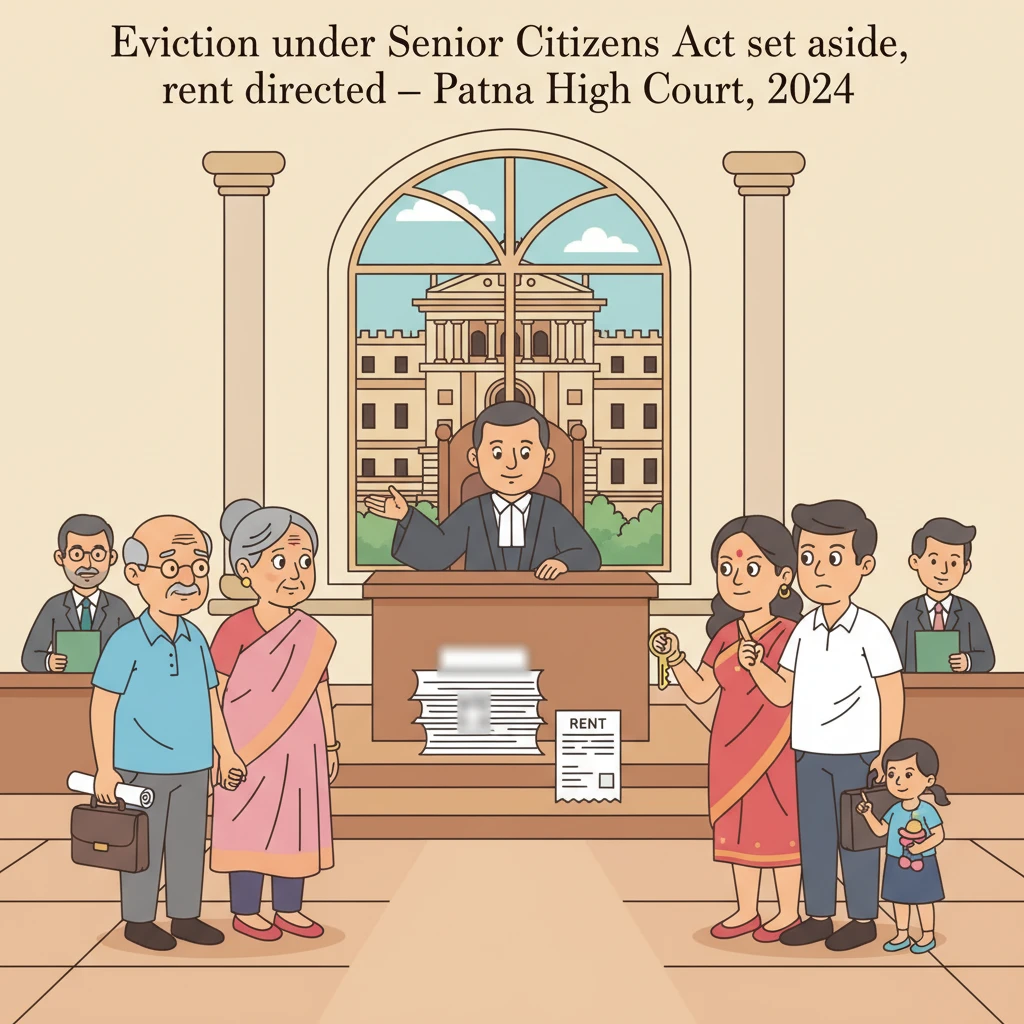
Case Background
This case arose out of a family dispute between aged parents and their youngest son and daughter-in-law over a rest house at Kankarbagh, Patna, known as Priti Rest House.
The father, a retired employee and senior citizen, is the owner and coordinator of the rest house. The property was allotted to him by the Bihar State Housing Board through a perpetual lease dated 20.07.1992. He and his wife live in a rented flat allotted during his service, while the income from the rest house forms an important part of their financial support.
The youngest son’s marriage with the second appellant on 14.06.2018 was described as a love marriage, initially not liked by the parents but later grudgingly accepted. According to the father, the daughter-in-law’s behaviour caused continuous harassment. There were also several criminal complaints filed by her, including against her own mother and against the in-laws, and a case under the Protection of Women from Domestic Violence Act, 2005.
The father stated that all his three children are well settled. The eldest son lives with and looks after the parents. The second son works at Bengaluru. The youngest son (first appellant) was initially living at his in-laws’ house. The parents wanted him not to live there and offered even to provide a rented accommodation for him and his wife, despite both of them being earning members.
At the son’s request, he was allowed to stay alone in one room of the rest house for some time, till he could arrange separate accommodation. Instead, he brought his wife and child there and occupied two more rooms by breaking the locks, according to the father. The parents alleged that the couple created nuisance for the public and other tenants in the building.
On these grounds, the father approached the Tribunal under the Maintenance and Welfare of Parents and Senior Citizens Act, 2007 seeking eviction of his son and daughter-in-law from three rooms of the rest house.
The Tribunal ordered eviction. A writ petition under Article 226 was filed by the son and daughter-in-law before a single judge of the Patna High Court. The single judge dismissed the writ petition and upheld the eviction order, holding that the Senior Citizens Act is meant to provide speedy and inexpensive protection of life and property to senior citizens and that an eviction power can be read into the Act.
Against this, the son and daughter-in-law filed the present Letters Patent Appeal (LPA No. 907 of 2023) before a Division Bench of the Patna High Court.
What the Court Examined and Decided
The Division Bench, speaking through the Hon’ble Chief Justice, began by noting that law and morality both shape human behaviour. Parents deserve care, but courts must still work strictly within statutory powers, especially when deciding property rights.
The key question was whether, under the Senior Citizens Act and the Bihar Maintenance and Welfare of Parents and Senior Citizens Rules, 2012, the Tribunal had power to order eviction of the appellants from the rest house, when there was no claim for maintenance and no challenge to any transfer of property under Section 23(1) of the Act.
The appellants argued that:
• The Senior Citizens Act does not confer any express power of eviction on the Tribunal, and the Bihar Rules of 2012 also contain no such provision.
• Many Delhi High Court judgments upholding eviction were based on Delhi-specific rules framed under Section 32 of the Act, which expressly provide for eviction. Bihar has no similar rule.
• The father himself stated before the Tribunal that he did not seek maintenance from his son, and that he was not claiming maintenance under Section 5 of the Act.
• There was no transfer of property by the father to the son with any condition of care, so Section 23(1) did not apply. Nor was there any transfer of an estate from which the father had a right to maintenance, so Section 23(2) could not be used to justify eviction.
• The son was originally a permissive occupant in the rest house and claims that the property was purchased out of joint Hindu family funds, for which he has already filed a partition suit. This made him, according to him, a co-owner entitled to residence. The merits of that civil suit could not be prejudged in summary proceedings under the Senior Citizens Act.
The father, supported by the State’s counsel, contended that:
• He and his wife, both senior citizens, had been harassed by the son and daughter-in-law, who were also filing multiple criminal cases against family members.
• He drew only a small pension of Rs. 4089/- and depended on rent from the rest house for survival. By occupying three rooms without paying rent, the son and daughter-in-law were depriving him of important income.
• Both appellants are earning — the son is employed and the daughter-in-law is a practising advocate. They can afford separate accommodation and have no right to continue in his self-acquired property.
• Even if there is no express eviction power, courts should read such power into the Tribunal’s jurisdiction to give effect to the object of protecting life and property of senior citizens under Sections 22 and 32 of the Act.
The Division Bench carefully analysed the Senior Citizens Act and the scheme of the statute. It noted that Chapter II of the Act deals with maintenance, while Chapter V deals with protection of life and property. Section 23 has two distinct parts:
• Section 23(1) covers a situation where a senior citizen transfers his property subject to a condition that the transferee will provide basic amenities and physical needs, but the transferee fails to do so. In such a case, at the senior citizen’s option, the transfer can be declared void by the Tribunal as having been made by fraud, coercion or undue influence.
• Section 23(2) deals with a senior citizen’s right to receive maintenance from an estate. If that estate is transferred, the right to maintenance can be enforced against the transferee if the transfer was gratuitous or made with notice of such right. However, the transfer itself is not declared void under Section 23(2).
The Court then considered the Supreme Court’s judgment in S. Vanitha v. Deputy Commissioner, Bengaluru Urban District & Others, (2021) 15 SCC 730. In that case, the Supreme Court held that a Tribunal under the Senior Citizens Act may have authority to order eviction if it is necessary and expedient to ensure maintenance and protection of a senior citizen, but such eviction is an “incident” of enforcing the right to maintenance and protection, and must take into account competing claims, including rights under the Domestic Violence Act.
The Patna High Court emphasised that the observation in S. Vanitha was in the context of a case under Section 23(1), where a transfer by the senior citizen could be declared void, and where rules in some States (like Delhi) specifically provide for eviction. The Court clearly stated that S. Vanitha does not support an eviction remedy under Section 23(2), where the statute speaks only of enforcing a right to maintenance from the transferred estate, not of cancelling the transfer or removing the occupier.
The Bench examined numerous High Court decisions from Delhi, Maharashtra, Haryana and Punjab, where eviction had been ordered under the Senior Citizens Act. It noted that many of those judgments were:
• Based on State-specific rules or “Action Plans” framed under Section 32, which explicitly authorise eviction.
• Largely concerned with cases where the children or in-laws were staying in the same house as the senior citizens, and were causing actual or imminent physical violence and harassment.
The Division Bench contrasted these with the Punjab and Haryana High Court judgment in Simrat Randhawa v. State of Punjab and Others (CWP No. 4744 of 2018). There, the Court held that:
• The Maintenance Tribunal is not an eviction tribunal.
• Eviction can only be ordered according to procedure established by law and cannot be introduced by executive action without clear statutory backing.
• The Senior Citizens Act does not provide for eviction simpliciter, except possibly as a consequential relief when a transfer is declared void under Section 23(1).
The Patna High Court agreed with this reasoning and held that measures like eviction, not mentioned in the Act or the Bihar Rules of 2012, cannot be added merely by relying on the Preamble or the Statement of Objects and Reasons.
Applying the law to the facts, the Court noted several critical points:
• The father’s application before the Tribunal did not claim maintenance from the son under Section 5. He expressly stated that he did not require maintenance from him.
• There was no allegation that any property had been transferred by the father to the son on condition of care, so Section 23(1) was not triggered.
• There was also no case that an estate from which the father had a right to maintenance had been transferred, so Section 23(2) was not truly in play.
• The father admitted that he had permitted the son to reside in one room of the rest house for a short period. The dispute now related to the son and his family continuing to occupy three rooms in that building.
The Court took note that:
• The parents and the son’s family no longer live in the same building. The parents live in a rented flat, while the appellants live separately in the rest house.
• There was no allegation of real and imminent physical violence by the appellants against the parents, though there were allegations of nuisance and criminal complaints.
• There are other tenants in the rest house, and there was no allegation that the son was collecting their rent or obstructing the father from receiving that income.
The Bench even attempted to facilitate reconciliation through an Advocate Commissioner, arranging a meeting between father and son. The report showed no rapprochement. The parents remained bitter about past conduct, and mediation failed.
In these circumstances, the Court held that the Senior Citizens Act, as applicable in Bihar, did not empower the Tribunal to order eviction in this case. At best, where an occupation of rooms deprives the senior citizen of rental income, the only relief available under the Act would be enforcement of a right to maintenance from that property, not eviction.
The Court further clarified that, although the son claims co-ownership based on a pending title suit, there is presently no injunction restraining the father’s exclusive possession. Therefore, the son cannot insist on residing in the father’s building purely as a co-owner or by virtue of the parent–child relationship. Likewise, the father cannot secure eviction under the Senior Citizens Act and must resort to civil court if he wants full possession.
The Division Bench therefore:
• Set aside the eviction order passed by the Tribunal and the judgment of the single judge affirming it.
• Held that, as of now, the appellants have no right to claim income from the other rooms of the rest house, nor can they harass or obstruct other occupants. If such harassment occurs, the District Magistrate, Patna or the local Station House Officer must act on complaints.
• Directed that the matter be remanded to the District Magistrate, Patna to conduct an inquiry into what would be reasonable rent for the three rooms occupied by the appellants, and to order the appellants to pay that rent regularly into the father’s account.
Finally, the Court clarified that the father remains free to file an eviction suit in a civil court. Any such civil or Domestic Violence Act proceedings must be decided independently, unaffected by observations in this judgment, which are confined to the scope of the Senior Citizens Act.
Why This Judgment Matters
This decision is important for senior citizens, adult children, and lawyers in Bihar who deal with family property disputes.
First, it makes clear that in Bihar the Tribunal under the Maintenance and Welfare of Parents and Senior Citizens Act, 2007 cannot be treated as an eviction court unless the case fits squarely within Section 23(1) and there are proper rules supporting such a step.
Parents cannot automatically evict a son, daughter, or daughter-in-law from property merely by filing an application under the Senior Citizens Act, especially when there is no transfer of property with a condition of care, and no claim of maintenance. For eviction, they may still have to go to the civil court.
Second, the judgment shows a middle path. Even if eviction is not permitted under the Act in a given case, the Tribunal can still protect the financial security of senior citizens by ensuring they get fair rental income from property that someone else is using. Here, the Court ensured that the father receives rent for the three rooms occupied by the son and daughter-in-law.
Third, the Court took care not to pre-judge other pending cases such as the partition suit and the Domestic Violence Act proceedings. It reminded all that each legal forum has its own role, and the Senior Citizens Act cannot be overstretched to override property law or women’s rights under other statutes.
Practically, the ruling guides families and lawyers in Bihar: if parents want eviction from self-acquired property where no conditional transfer has been made, they should normally file a civil suit; the Senior Citizens Act is mainly for maintenance and, in limited transfer-related cases, cancellation of such transfers.
Legal Issues and Answers
- Issue: Does the Maintenance Tribunal under the Senior Citizens Act, 2007 in Bihar have power to evict a son and daughter-in-law from a senior citizen’s property when there is no transfer under Section 23(1) and no claim of maintenance?
Answer: No. The Patna High Court held that, under the Act and Bihar Rules of 2012, the Tribunal cannot order eviction in such circumstances. Eviction, if at all, can arise only as a consequence of declaring a transfer void under Section 23(1). Otherwise, the Tribunal may only enforce a right to maintenance from the property, such as by directing payment of reasonable rent. - Issue: What relief can be granted where a son occupies part of a rest house owned by his father, thereby depriving the father of rent from those rooms?
Answer: The Court held that the proper relief under the Senior Citizens Act is to treat the situation as affecting the senior citizen’s maintenance from that property. The District Magistrate can fix reasonable rent for the occupied rooms and direct the son and daughter-in-law to pay that rent regularly to the senior citizen, but cannot evict them under the Act in this fact situation.
Cases Cited by the Court
- S. Vanitha v. Deputy Commissioner, Bengaluru Urban District & Others, (2021) 15 SCC 730.
- Sunny Paul v. State of NCT of Delhi, 2018 SCC Online Del 11640.
- Smt. Darshna v. Govt. of NCT of Delhi, W.P.(C) No. 6592 of 2018, judgment dated 18.07.2018 (Delhi High Court).
- Sandeep Gulati v. Divisional Commissioner & Others, 2020 SCC Online Del 2517.
- Aarshya Gulati v. Govt. of NCT of Delhi & Others, 2019 SCC Online Del 8801.
- Shadab Khairi & Another v. State & Others, 2018 SCC Online Del 7626.
- Saraswati Devi v. Ganga Ram Sharma & Another, 2023 SCC Online Del 2093.
- Namdeo and Another v. State of Maharashtra, W.P. No. 2035 of 2020 (Bombay High Court).
- Neeraj Shivkumar Maholay & Another v. State of Maharashtra, CRWP No. 5508 of 2018 and connected cases (Bombay High Court).
- Anil Kumar Dhiman & Another v. State of Haryana and Others, CRWP No. 1357 of 2019 (Punjab and Haryana High Court).
- Simrat Randhawa v. State of Punjab and Others, CWP No. 4744 of 2018 (Punjab and Haryana High Court).
Case Details
Case Number: Letters Patent Appeal No. 907 of 2023 in Civil Writ Jurisdiction Case No. 7851 of 2022
Case Title: Ravi Shankar & Another v. State of Bihar & Others
Coram: Hon’ble the Chief Justice (K. Vinod Chandran, C.J.) and Hon’ble Mr. Justice Partha Sarthy
Date of Judgment: 03.01.2024
Citation: 2024(1) PLJR 502
Advocates:
- For the appellants: Mr. Syed Alamdar Hussain, Advocate; Ms. Surya Nilambari, Advocate
- For the State: Mr. P.K. Verma, AAG-3; Mr. Sanjay Kumar Ghosarvey, AC to AAG-3
- For respondent no. 8 (father/senior citizen): Mr. Bindhyachal Singh, Senior Advocate; Ms. Smriti Singh, Advocate; Mr. Vipin Kr. Singh, Advocate
Nature of the Case: Letters Patent Appeal against dismissal of writ petition challenging an eviction order passed by the Tribunal under the Maintenance and Welfare of Parents and Senior Citizens Act, 2007.
Link to Judgment: Click here to read the full Patna High Court judgment
If you found this explanation helpful and wish to stay informed about
how legal developments may affect your rights in Bihar,
you may consider following Samvida Law Associates for more updates.







