

Case Background
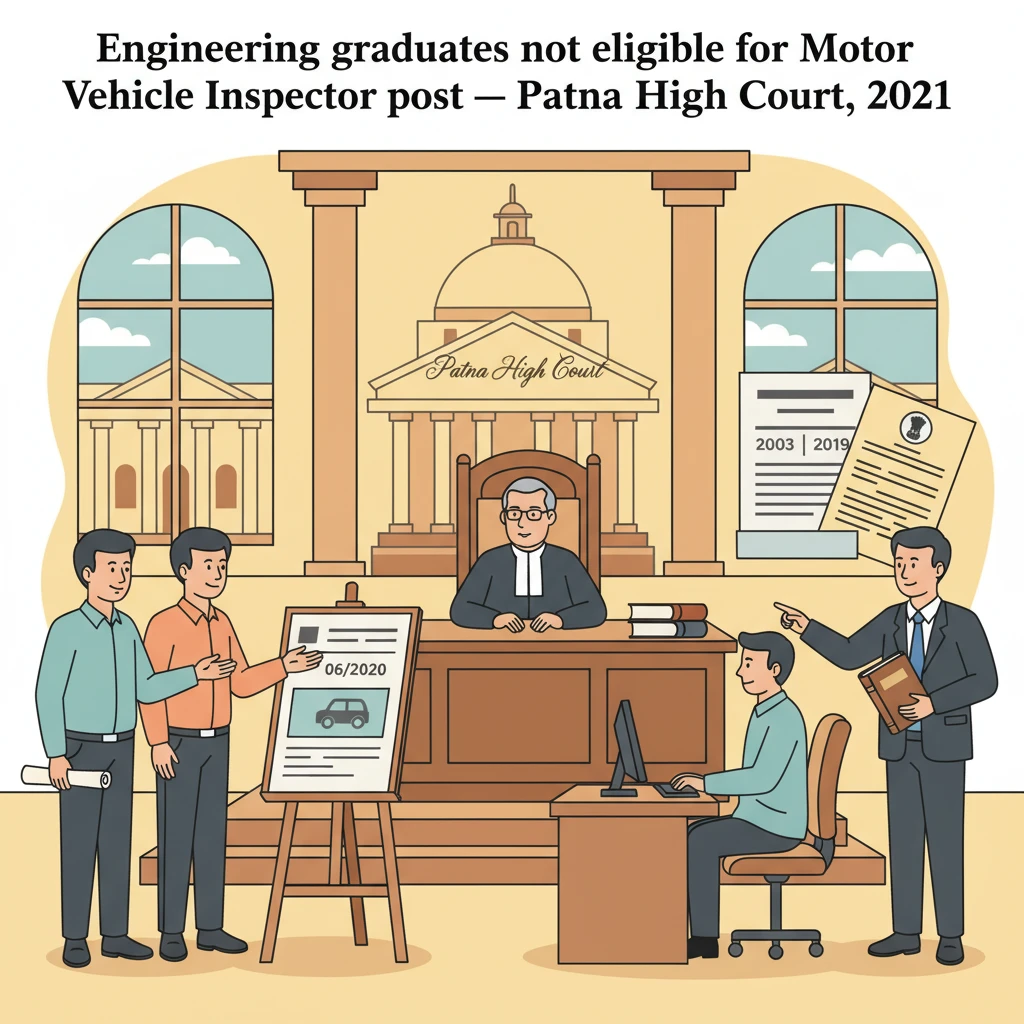
The case arose from Advertisement No. 06/2020 issued by the Bihar Public Service Commission (BPSC) for direct recruitment to the post of Motor Vehicle Inspector (MVI) in the State of Bihar.
The Bihar Transport (Technical) Cadre Rules, 2003, as amended by the Bihar State Transport (Technical) Cadre Amendment Rules, 2019, laid down the eligibility criteria for this post. The amended Rule 5 prescribed that a candidate must have passed 10th standard and must possess either a three-year Diploma in Automobile Engineering or a three-year Diploma in Mechanical Engineering, along with a valid driving licence for motorcycle with gear and light motor vehicles.
The petitioners in this writ case were B.Tech degree holders in engineering. They did not possess the prescribed three-year diploma in Automobile Engineering or Mechanical Engineering. When the advertisement was issued, they found themselves ineligible to apply despite holding what they considered a higher qualification.
Feeling aggrieved, they approached the Patna High Court under its civil writ jurisdiction, challenging the interpretation and application of the eligibility clause in the advertisement and the underlying Rules. The matter came up before Hon’ble Mr. Justice P. B. Bajanthri, who delivered an oral judgment on 23.11.2021.
What the Court Examined and Decided
The petitioners filed the writ petition seeking a set of mandamus directions against the State of Bihar and BPSC. Their prayer had three connected parts.
First, they asked the Court to direct the respondents to clarify that, in terms of clause 3 of the advertisement, the stipulated diploma in Mechanical Engineering/Automobile Engineering was only the minimum qualification and that a degree in Mechanical or Automobile Engineering should be treated as included within that minimum. In simpler words, they wanted the Court to declare that degree holders were also eligible because they allegedly possessed a higher qualification.
Second, they sought a direction to the respondents to accept applications from candidates possessing degrees in Mechanical or Automobile Engineering for the MVI post.
Third, they asked the Court to order issuance of a fresh advertisement after amending the educational qualification clause so as to include degree holders in Mechanical or Automobile Engineering in the pool of eligible candidates.
The petitioners’ core argument was that the eligibility criteria under amended Rule 5 of the Bihar Transport (Technical) Cadre Rules, 2003 laid down only a minimum standard. According to them, since they held B.Tech degrees, which were higher than a three-year diploma, they should automatically be treated as fulfilling the minimum requirement.
They urged the Court to “read into” the Rules that graduate engineers were also eligible, even though the Rule did not expressly say so. They sought to rely on certain Supreme Court decisions to support this plea.
The petitioners cited the judgment in Jyoti K.K. and Others vs. Kerala Public Service Commission and Others, reported in 2010 (15) SCC 596, particularly paragraph 9. They also relied on Puneet Sharma and Others etc. vs. Himachal Pradesh State Electricity Board Limited and Another (Civil Appeal Nos. 1318-1322 of 2021) decided on 07.04.2021, especially paragraphs 3, 29 and 30. Based on these decisions, they submitted that when a candidate possesses a higher qualification in the same line, he or she should not be treated as ineligible where a lower qualification is prescribed.
On the other hand, learned counsel for the respondent Commission argued that the advertisement strictly followed the Bihar State Transport (Technical) Cadre Amendment Rules, 2019. Since the amended Rule 5 clearly set out the requirement of a three-year diploma in either Mechanical or Automobile Engineering, and did not mention any degree qualification, BPSC was bound to recruit only those who satisfied this prescribed minimum.
The Commission pointed out that the petitioners did not possess the specific diploma qualifications and therefore did not meet the minimum prescribed standard. It was emphasised that the Court could not read into the Rule what the rule-making authority had not provided. The case law cited by the petitioners, it was argued, would not override a clear statutory rule specific to the post of Motor Vehicle Inspector in Bihar.
After hearing both sides, the Court identified the central questions: whether the petitioners, as B.Tech holders, could be considered eligible despite not possessing the prescribed diplomas, and whether the Court could, through judicial interpretation, effectively re-write or supplement the minimum educational qualification prescribed in the 2019 Amendment Rules.
The Court first noted that it was undisputed that the petitioners did not hold the stipulated three-year Diploma in Automobile Engineering or Mechanical Engineering. They held only B.Tech degrees. The amended Rule 5 set out the minimum eligibility criteria for direct recruitment to the MVI post: 10th pass along with the specific three-year diplomas and a valid driving licence.
The Court emphasised that merely because a candidate holds what appears to be a “higher” qualification does not automatically mean that he or she satisfies the prescribed minimum qualification. The key question is whether the candidate possesses the qualification specifically mentioned in the rules, not whether he or she has some other, arguably higher, degree.
The Court held that the 2019 Amendment Rules did not stipulate a degree in engineering such as B.Tech as one of the minimum eligibility qualifications. Therefore, a person who lacks the specified diploma, even if he or she is a graduate engineer, cannot be treated as eligible for the MVI post under the current statutory framework.
To fortify this view, the Court referred to several Supreme Court decisions. It relied on Nair Service Society vs. T. Beermasthan and others, reported in (2009) 5 SCC 545, particularly paragraph 48. In that passage, the Supreme Court had stressed that judgments in service matters must be read in the context of the specific service rules governing the field. Service rules are enabling provisions and can differ from State to State. Where the rules themselves are not under challenge, the Court’s task is to apply them as they stand.
Drawing from this principle, the Patna High Court held that weightage had to be given to the statutory rule governing the Motor Vehicle Inspector post. Since the amended Rules of 2019 did not include B.Tech as a qualification, the Court could not introduce it judicially.
The Court also referred to Union of India vs. Harjeet Singh Sandhu, reported in (2001) 5 SCC 593, and to the English decision in Duport Steels Ltd. vs. Sirs, (1980) 1 All ER 529. These decisions caution courts against usurping the legislative function under the guise of interpretation. They warn that judges must not impose their own ideas about policy or fairness by re-writing statutory provisions, particularly where the legislature has used clear language.
The judgment cites the observation that a correct construction of an Act “can only be attained if its whole scope and object together with an analysis of its wording and the circumstances in which it is enacted are taken into consideration.” However, this process cannot justify adding words that the legislature has not chosen.
Further, the Court referred to a recent Supreme Court decision: Devendra Bhaskar vs. State of Haryana, LL 2021 SC 680 (Case No. 7031/2021 decided on 24.11.2021). In that case, the Supreme Court held that the power of judicial review cannot be used to decide equivalence between a prescribed qualification and some other qualification. Equivalence is a matter for the rule-making or expert bodies, not for the Court.
Relying on this principle, the Patna High Court observed that it could not declare that a B.Tech degree was equivalent or superior to the prescribed three-year diploma for the purpose of eligibility, because that would amount to stepping into the shoes of the rule-making authority.
In light of these authorities, the Court held that there was no ambiguity in Rule 5 of the amended Rules of 2019. The qualification was clearly prescribed and did not include B.Tech. Consequently, there was no scope for judicial intervention to incorporate or infer an additional qualification.
Having distinguished the Supreme Court decisions relied on by the petitioners, the Court concluded that the petitioners had not made out any case for clarification of the minimum qualification or for reading B.Tech as a valid eligibility criterion under Rule 5. The reliefs sought by them, including directions to accept their applications or to issue a fresh advertisement, were therefore rejected.
Ultimately, the writ petition was dismissed. The Court made no order as to costs.
Why This Judgment Matters
This judgment is important for candidates in Bihar aspiring to posts like Motor Vehicle Inspector. It makes clear that only those who possess the exact qualification mentioned in the recruitment rules will be treated as eligible.
Even if a candidate believes that a different or higher degree is better than the listed qualification, that belief does not matter in law unless the rules themselves recognise it. The Court will not step in to change or expand the qualification criteria unless the rule is under challenge for being unconstitutional or ambiguous, which was not the case here.
For engineering graduates, this decision shows that they cannot rely on their degree to bypass a specific diploma requirement in government recruitment. If the rule says “diploma,” they must have that diploma, unless the government amends the rule.
More broadly, the judgment reinforces that courts will respect the separation of powers. The Patna High Court has refused to act like a rule-making body. Instead, it has insisted that any change in eligibility norms for public posts must come from the government or legislature, not from judicial orders.
Legal Issues and Answers
-
Issue: Can holders of a B.Tech degree in Mechanical or Automobile Engineering be treated as eligible for the Motor Vehicle Inspector post when the rules prescribe a three-year diploma in those disciplines as the minimum qualification?
Answer: No. The Court held that since the amended Rules of 2019 specifically prescribe a three-year diploma and do not mention B.Tech, engineering graduates without the diploma are not eligible. -
Issue: Can the Patna High Court, in exercise of its writ jurisdiction, read an additional qualification like B.Tech into the eligibility rule or treat it as equivalent to the prescribed diploma?
Answer: No. The Court held that judicial review cannot be used to re-write or supplement clear statutory rules or to decide equivalence of qualifications. Such matters lie within the domain of the rule-making authority.
Cases Cited by the Court
- Jyoti K.K. and Others vs. Kerala Public Service Commission and Others, 2010 (15) SCC 596 (relied on by petitioners; distinguished).
- Puneet Sharma and Others etc. vs. Himachal Pradesh State Electricity Board Limited and Another, Civil Appeal Nos. 1318-1322 of 2021, decided on 07.04.2021 (relied on by petitioners; distinguished).
- Nair Service Society vs. T. Beermasthan and others, (2009) 5 SCC 545.
- Union of India vs. Harjeet Singh Sandhu, (2001) 5 SCC 593.
- Duport Steels Ltd. vs. Sirs, (1980) 1 All ER 529.
- Devendra Bhaskar vs. State of Haryana, LL 2021 SC 680, Case No. 7031/2021 decided on 24.11.2021.
Case Details
Case Number: Civil Writ Jurisdiction Case No. 9748 of 2020
Case Title: Nishant Kumar and another vs. The State of Bihar and others
Citation: 2022(1) PLJR 64
Court: High Court of Judicature at Patna
Coram: Hon’ble Mr. Justice P. B. Bajanthri
Date of Judgment: 23-11-2021
Nature of the Case: Civil writ petition challenging eligibility criteria in recruitment for Motor Vehicle Inspector.
Advocates for Petitioners: Mr. Y.V. Giri, Senior Advocate; Mr. Pranav Kumar, Advocate; Mr. Shrishti Singh, Advocate.
Advocates for State Respondents: Mr. Ajay Kumar Rastogi, AAG 10; Mr. Sushil Kumar Singh, AC to AAG 10.
Advocate for BPSC: Mr. Rajni Kant Jha, Advocate.
Link to Judgment: Official Patna High Court judgment
If you found this explanation helpful and wish to stay informed about how legal developments may affect your rights in Bihar, you may consider following Samvida Law Associates for more updates.







