
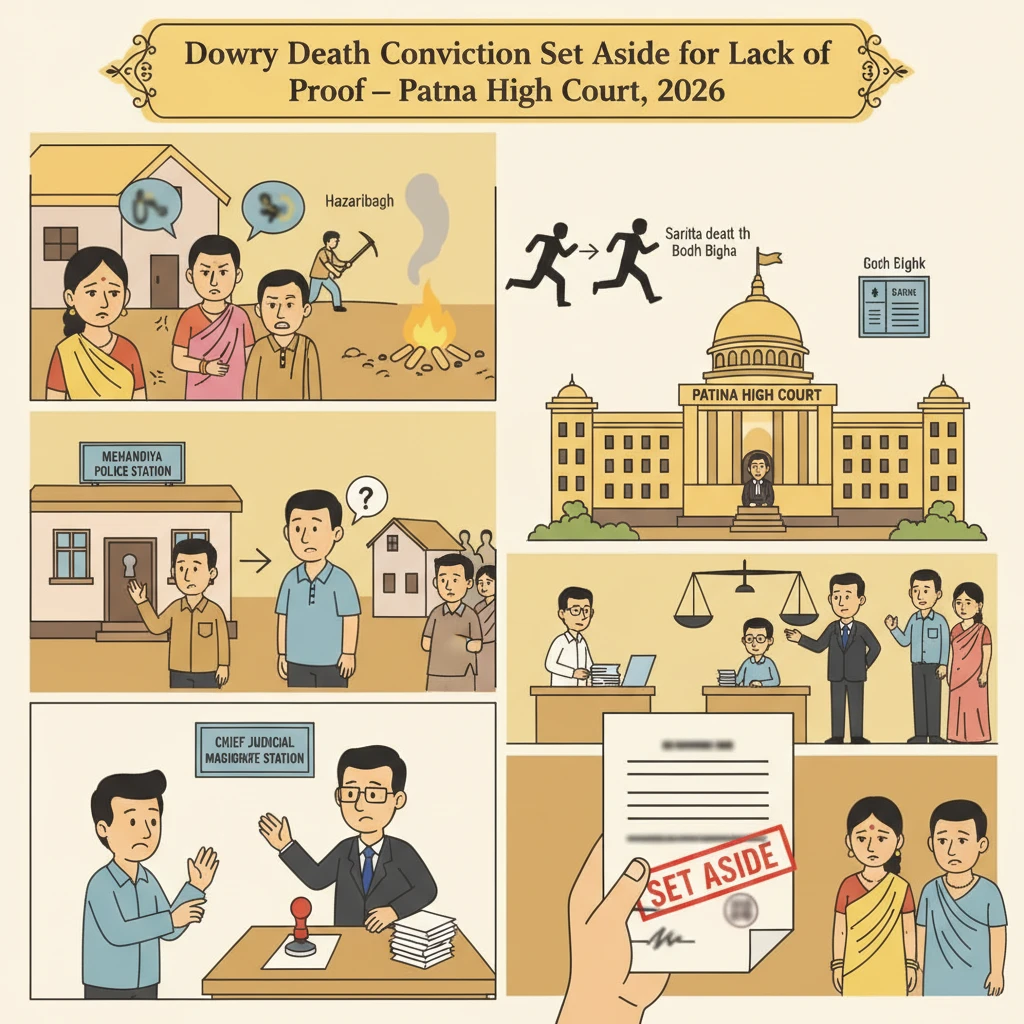
Case Background
The case arose from the death of a young married woman, Sarita Devi, from village Bodh Bigha in Jehanabad district.
She had married Ashok Paswan in the month of Vaishakh, 2000. After the marriage, she stayed at her matrimonial home for about ten days, then went back to her parental house.
According to her father, Ram Swaroop Paswan (P.W. 6), she told the family that her husband and in-laws were demanding a gold chain of two tolas and threatening her.
Nearly ten months later, in Falgun 2001, Ashok came again to take Sarita back after “ruksati” (bidai). There is dispute in the evidence whether a proper ruksati ceremony was arranged or whether Ashok took her away forcibly without fixing a date.
Within two days of this ruksati, Sarita died.
On 01.03.2001 at about 8:00 a.m., family members of Sarita received information from persons of Bodh Bigha that she had died and her dead body had been burnt. Some relatives went to the village and say they found the house of the in-laws locked and only ashes at the cremation site.
Ram Swaroop Paswan was working at Hazaribagh at that time. He returned home after learning of the death. On 04.03.2001 he went to Mehandiya Police Station to lodge a complaint. He says the Sub-Inspector told him to go to court instead of registering an FIR.
On 05.03.2001, he filed Complaint Case No. 108 of 2001 before the Chief Judicial Magistrate, Jehanabad, alleging that his daughter had been murdered for dowry. The complaint was registered on 07.03.2001. The Magistrate did not examine the complainant under Section 200 Cr.P.C. but forwarded the complaint to Mehandiya Police Station under Section 156(3) Cr.P.C. for investigation.
On this direction, Mehandiya P.S. Case No. 18 of 2001 was registered on 08.03.2001 under Sections 304-B and 201/34 IPC against the husband and his parents.
After investigation, the police filed charge-sheet only against the husband, Ashok Paswan. They submitted a final form in favour of his parents, Bijli Paswan and Kalawati Devi, saying there was no material against them.
The informant then filed a protest petition on 08.06.2001. Without passing any clear order on this protest, the Judicial Magistrate 1st Class took cognizance on 26.06.2002 against all three accused for offences under Sections 304-B and 201/34 IPC and later committed the case to the Court of Sessions.
The 1st Additional Sessions Judge, Jehanabad, conducted Sessions Trial No. 111 of 2001/56 of 2004. Charges under Sections 304-B and 201 IPC were framed against all three. No separate charge under Section 34 IPC was framed against the in-laws.
By judgment dated 01.04.2004, the trial court convicted all three under Sections 304-B and 201 IPC, sentencing them to 10 years’ rigorous imprisonment for dowry death and 3 years with fine for causing disappearance of evidence.
All three appealed to the Patna High Court through Criminal Appeal (SJ) No. 323 of 2004 (in-laws) and Criminal Appeal (SJ) No. 398 of 2004 (husband). During pendency of the appeals, the father-in-law, Bijli Paswan, died and proceedings against him were abated on 18.03.2026.
What the Court Examined and Decided
The Patna High Court, through Hon’ble Justice Smt. G. Anupama Chakravarthy, examined the entire evidence afresh. The Court appointed amicus curiae to assist because the appellants were not in touch with their counsel.
The core questions were whether the prosecution had proved a dowry death under Section 304-B IPC and whether any offence under Section 201 IPC was made out, beyond reasonable doubt.
Evidence of the Prosecution
The prosecution examined seven witnesses. P.Ws. 1 to 6 were all close relatives of the deceased: uncles, aunt, cousin, mother, and father. P.W. 7 was the Investigating Officer.
P.Ws. 1 to 4 and 6 repeated the allegation that the appellants demanded a gold chain of two tolas and threatened Sarita. They further stated that after ruksati, within two or three days, Sarita was murdered by Ashok, sometimes adding that poison was administered.
P.W. 2 said that on going to the in-laws’ village after getting the news, he found the house locked. Villagers told him the dead body had already been cremated in a garden. He claimed to have seen ashes.
P.W. 5, the mother, spoke of Ashok taking her daughter in Falgun without a fixed date for ruksati and using abusive language. She, however, admitted there was no quarrel at the time of marriage, that no articles were given during ruksati because they were very poor, and that she did not inform either her husband or the police that Ashok had forcibly taken her daughter.
P.W. 6, the father and complainant, largely followed the complaint version. However, in cross-examination he admitted that at the time of ruksati he was at Hazaribagh, not present in the village. He said he travelled past the office of the Superintendent of Police while going to Mehandiya P.S. but did not lodge any written report there, even after the local police allegedly refused to register the case.
The Court noted several serious inconsistencies:
- On ruksati: P.W. 1 said it was arranged in Falgun with food and no quarrel; P.Ws. 5 and 6 said Ashok forcibly took Sarita without fixing a date, and P.W. 5 said no food was arranged.
- On information and cremation: P.W. 2 said he reached the in-laws’ village at 4:00 p.m. and only one unknown person told him the cremation had already happened; P.W. 6 spoke of different timings.
- On dowry demand: Some witnesses admitted that the deceased never personally told them about the demand; their knowledge was only through what they heard from others, which is hearsay.
- On presence at important events: several witnesses admitted they were not present at ruksati, yet spoke as if they knew what happened there.
The Investigating Officer (P.W. 7) gave crucial evidence that weakened the prosecution. He stated that:
- He initially charge-sheeted only Ashok Paswan because there was no evidence against the parents.
- Ashok and other villagers told him that Sarita suddenly fell ill on 28.02.2001 with sweating and bleeding from nose and mouth. She was taken first to a private doctor at Arwal (Dr. Shankar Prasad), then towards P.M.C.H. Patna, and finally to Kurji Hospital due to strike at P.M.C.H., where she died during treatment in the early hours of 01.03.2001.
- He went to Kurji Hospital, checked the records and collected a photocopy of the death certificate, which showed Sarita was admitted at about 2:15 a.m. on 01.03.2001 and died at 3:07 a.m.
- He recorded the statement of Dr. Gautam Modi of Kurji Hospital, who confirmed that Sarita died during treatment.
- Importantly, P.W. 7 admitted that P.W. 5 (mother) had not told him that the appellants murdered her daughter, nor spoken about demand of a gold chain, nor that poison was given. P.W. 4 too had not spoken of murder or dowry demand in his Section 161 statement.
Evidence of the Defence
The defence examined four witnesses and produced documents.
D.Ws. 1 and 2 were villagers. They supported the version that Sarita fell seriously ill, became unconscious, shivered, and bled from nose and mouth. They said she was taken from Arwal to Patna, admitted first at P.M.C.H. and then at Kurji Hospital due to strike. She died during treatment, and her body was brought back to the village where the last rites were performed in presence of her brother and sister.
D.W. 3, Awadh Paswan, said he travelled with Ashok and Sarita to the hospital and described the treatment and death at Kurji Hospital. He also stated that he, along with Arun Paswan, went to inform the deceased’s family about her death, after which P.W. 5 and P.W. 4 came to the village.
D.W. 4, an advocate’s clerk, produced the original death certificate (marked Ext. A) and two Kurji Hospital receipts (Exts. B and B/1), showing payments made by Ashok towards medical expenses. The death certificate recorded the cause of death as cardio-respiratory failure.
The Court noted that the statements of D.Ws. 1 and 2 under Section 161 Cr.P.C., recorded earlier by the Investigating Officer, were consistent with their testimony in court and supported the defence story.
Application of Dowry Death Law
The High Court carefully listed the legal ingredients of Section 304-B IPC: death of a woman by burns, bodily injury or otherwise than under normal circumstances; within seven years of marriage; subjected to cruelty or harassment by husband or his relatives; such cruelty or harassment linked to dowry demand; and that it occurred “soon before” her death.
The Court accepted that the death took place within seven years of marriage. It also accepted that “otherwise than under normal circumstances” can be broadly read.
However, it found no reliable evidence that Sarita was subjected to cruelty or harassment during her lifetime for dowry, much less “soon before” her death:
- No complaint was ever filed during her life under Section 498-A IPC or otherwise, despite the alleged threats.
- All allegations of harassment came only after five days of her death, when the complaint was drafted after discussion in the family.
- There were no independent witnesses from the matrimonial village.
- The evidence of relatives was inconsistent and, in many parts, clearly hearsay.
- Medical records and defence witnesses showed consistent story of sudden illness, treatment and death due to cardio-respiratory failure. The prosecution produced no post-mortem report nor examined the doctor as a prosecution witness.
The Court also referred to the Supreme Court decision in Satbir Singh v. State of Haryana, which explains that “soon before” does not mean “immediately before”, but there must be a live and proximate link between dowry harassment and death. Here, the Court found no such link established.
Section 201 IPC and Procedural Lapses
For Section 201 IPC, the Court underlined that there must be proof that the accused caused disappearance of evidence to shield an offender. There was no such evidence.
Instead, defence material showed that the body was taken to the village only after hospital death and that family members of the deceased were informed and attended the last rites.
The Court also criticised two procedural aspects:
- The Magistrate’s manner of taking cognizance: relying on Rubi Khatoon v. State of Bihar, the Court noted that once police filed charge-sheet only against Ashok and final form for his parents, the Magistrate could either proceed on the protest petition alone or on the charge-sheet alone, but could not mix the two without a clear order. Here he took cognizance against all accused “without passing any appropriate order”, which the High Court found illegal.
- The examination of the accused under Section 313 Cr.P.C.: following Satbir Singh, the Court observed that questions were put to the accused in a very general and omnibus manner and key incriminating materials were not fairly put to them. This denied them a proper opportunity to explain.
Final Decision
After weighing both sides, the Court applied the principle that in criminal law, the prosecution must prove guilt beyond reasonable doubt, and when two reasonable views are possible, the one favouring the accused must be adopted. It relied on Supreme Court rulings such as Dharnidhar v. State of U.P. and Sanjiv Kumar v. State of Punjab on assessment of interested witnesses and benefit of doubt.
The Court concluded that:
- The prosecution had “miserably failed” to prove the essential ingredients of Sections 304-B and 201 IPC.
- The trial court erred in convicting and sentencing the appellants.
- The complaint appeared to have been filed after delay and as an afterthought.
Therefore, the Patna High Court set aside the judgment of conviction dated 01.04.2004 and the order of sentence dated 05.04.2004 of the 1st Additional Sessions Judge, Jehanabad, and acquitted the surviving appellants Ashok Paswan and Kalawati Devi of all charges. Proceedings against deceased appellant Bijli Paswan had already abated.
As both surviving appellants were already on bail since 2004 and 2005, the High Court cancelled their bail bonds and discharged the sureties. The trial court record was ordered to be sent back.
Why This Judgment Matters
This Patna High Court judgment has important practical lessons for families, police, and trial courts dealing with dowry death allegations.
First, it shows that courts will not automatically uphold a dowry death conviction just because a young woman died within seven years of marriage. The law requires clear proof that she was actually harassed for dowry and that this harassment happened close in time to her death.
Second, the judgment warns that late complaints, with no independent support and with contradictions, may be treated as afterthoughts. Delay must be properly explained.
Third, it stresses the value of medical records and neutral witnesses. Where hospital records and death certificates show a natural cause of death and there is no post-mortem or direct proof of violence or poisoning, courts will be slow to presume murder or dowry death.
Fourth, it underlines that Magistrates and Sessions Courts must strictly follow procedure: taking proper cognizance, framing correct charges, and putting specific questions to the accused under Section 313 Cr.P.C. Failure on these fronts can seriously affect the fairness of the trial.
For families of married women, the case highlights the need to complain promptly, document harassment, inform neighbours or local authorities, and seek legal help early, rather than waiting until after a tragedy. For accused persons, it shows that consistent defence, supported by records and witness testimony, can successfully rebut legal presumptions.
Legal Issues and Answers
- Issue: Did the evidence prove that the deceased suffered dowry-related cruelty “soon before” her death so as to constitute a dowry death under Section 304-B IPC?
Answer: No. The Court held that there was no reliable evidence of cruelty or dowry harassment during the deceased’s lifetime or soon before her death. Allegations were inconsistent, largely hearsay, raised only after her death, and contradicted by medical records and defence evidence. - Issue: Did the appellants cause disappearance of evidence of an offence to attract Section 201 IPC?
Answer: No. There was no proof that the appellants concealed or destroyed evidence. On the contrary, material showed the deceased died in hospital and her body was brought back and cremated after informing her family. - Issue: Was the procedure of taking cognizance and examining the accused under Section 313 Cr.P.C. proper?
Answer: No. The Magistrate improperly took cognizance against all accused without dealing with the protest petition as required by law, and the trial court asked only general questions under Section 313 Cr.P.C., failing to put key incriminating circumstances to the accused.
Cases Cited by the Court
- Satbir Singh v. State of Haryana, (2021) 6 SCC 1 – on interpretation of “soon before” in Section 304-B IPC and proper Section 313 Cr.P.C. examination.
- Dharnidhar v. State of U.P., (2010) 7 SCC 759 – on appreciation of evidence of interested witnesses.
- Jayabalan v. Union Territory of Pondicherry, (2010) 1 SCC 199 – referred within Dharnidhar for approach to related witnesses.
- Ram Bharosey v. State of U.P., (2010) 1 SCC 722 – on when related witnesses can be relied upon.
- Sanjiv Kumar v. State of Punjab, (2009) 16 SCC 487 – on burden of proof, defence on touchstone of probability, and benefit of doubt.
- Rubi Khatoon v. State of Bihar, 2006 SCC OnLine Pat 560 – on how Magistrates should deal with charge-sheets and protest petitions while taking cognizance.
Case Details
Case Number: Criminal Appeal (SJ) No. 323 of 2004 with Criminal Appeal (SJ) No. 398 of 2004; arising out of Mehandiya P.S. Case No. 18 of 2001; Sessions Trial No. 111 of 2001/56 of 2004.
Case Title: Bijli Paswan (since deceased) and Kalawati Devi v. State of Bihar; Ashok Paswan v. State of Bihar.
Court: High Court of Judicature at Patna.
Coram: Hon’ble Justice Smt. G. Anupama Chakravarthy.
Date of High Court Judgment: 02.04.2026.
Citation: 2026 PLJR
Advocates:
- For appellant in Cr. Appeal (SJ) No. 398 of 2004: Mr. Ansh Prasad, Amicus Curiae.
- For appellants in Cr. Appeal (SJ) No. 323 of 2004: Mr. Sahil Kumar, Amicus Curiae.
- For the State in both appeals: Mrs. Anita Kumari Singh, Additional Public Prosecutor.
Nature of the Case: Criminal appeals (single judge) against conviction and sentence for offences under Sections 304-B and 201 IPC.
Final Outcome: Appeals allowed; conviction and sentences set aside; appellants acquitted; bail bonds cancelled and sureties discharged; proceedings abated against deceased appellant.
Link to Full Judgment: https://patnahighcourt.gov.in/viewjudgment/MjQjMzIzIzIwMDQjMSNO-V1Wi1QO3KpY=
If you found this explanation helpful and wish to stay informed about
how legal developments may affect your rights in Bihar,
you may consider following Samvida Law Associates for more updates.







