

Case Background
This criminal appeal was filed by three family members from village Baisakhwa, P.S. Kesariya, District East Champaran. They had been convicted by the Court of the Additional Sessions Judge-VIII, East Champaran at Motihari in Sessions Trial No. 125 of 2000/79 of 2000.
The trial court had convicted them under Section 304B/34 of the Indian Penal Code, treating the incident as a “dowry death”. For this offence, it sentenced them to rigorous imprisonment for life by judgment dated 21.12.2000 and order of sentence dated 22.12.2000.
The case arose from Kesariya P.S. Case No. 040 of 1999, registered on 10.05.1999. The FIR was lodged by the uncle of the deceased woman, who later appeared as Prosecution Witness 5 (P.W. 5).
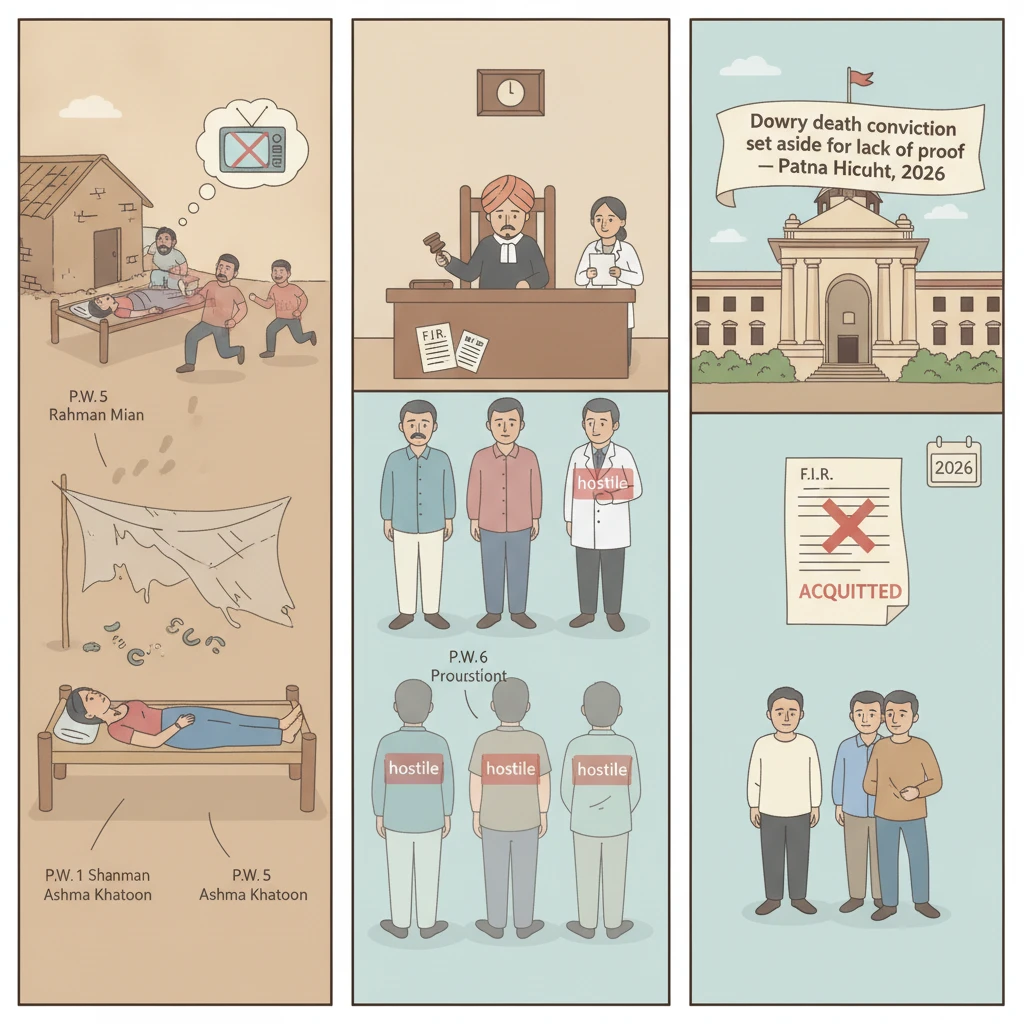
According to the FIR, the informant’s niece, Ashma Khatoon, had been married to one of the appellants, and her in-laws allegedly used to torture her and threaten to kill her over demands including a television (TV). On 09.05.1995 at about 5 p.m., the informant and another maternal uncle, P.W. 1, went to her matrimonial home, where they found her dead with a black mark around her neck, broken bangles on the bed, and a torn mosquito net. Neighbours allegedly told them the three accused had killed her and fled.
After investigation, the police submitted charge-sheet under Section 304B IPC. Cognizance was taken, and charges under Section 304B IPC were framed against all appellants, which they denied, leading to the Sessions trial and the conviction now challenged before the Patna High Court.
What the Court Examined and Decided
The Division Bench of Hon’ble Mr. Justice Nani Tagia and Hon’ble Mr. Justice Ansul heard the appeal. The judgment has been authored by Hon’ble Mr. Justice Ansul.
On behalf of the appellants, it was argued that the prosecution failed to prove essential ingredients of Section 304B IPC—especially cruelty, harassment and demand of dowry in connection with the death of the deceased. The appellants also stated in their statements under Section 313 of the Code of Criminal Procedure that they were innocent and had been falsely implicated.
The State, through the learned Additional Public Prosecutor, supported the trial court’s decision and contended that the appellants were responsible for the death of the deceased, describing it as commission of suicide of Ashma Khatoon, and therefore the conviction and sentence should be upheld.
During the trial, the prosecution examined nine witnesses in all, though the judgment text specifically records six of them:
- P.W. 1 – Shamsuddin
- P.W. 2 – Md. Yunus
- P.W. 3 – Ful Yunus
- P.W. 4 – Ibrahim Mian
- P.W. 5 – Rahman Mian (informant)
- P.W. 6 – Dr. Brajesh Kumar Singh (doctor who conducted the post-mortem)
Two documents were exhibited: the signature of P.W. 5 on the fardbeyan as Exhibit 1, and the post-mortem report of the deceased as Exhibit 2.
The High Court noted that P.W. 1, P.W. 2, P.W. 3 and P.W. 4 were declared hostile. This meant they did not support the prosecution version as expected. The only prosecution witness who was not declared hostile and who spoke about the alleged dowry demand was P.W. 5, the informant.
However, the Court carefully analysed his evidence and found it to be self-contradictory. In his chief-examination, P.W. 5 first stated that there was a demand for TV and that non-fulfilment of this demand led to his niece being killed. But in paragraph 3 of the same chief-examination, he clearly stated that there was no demand of dowry, that the deceased used to live happily with her husband, and that she had never complained against him.
The High Court observed that these mutually contradictory and incompatible statements from the same witness, given in chief-examination on the same date, made his evidence unreliable. Because of this, the Court held that reliance could not be placed on any part of his statement to prove a consistent story of dowry demand or harassment.
Regarding the medical evidence, P.W. 6, Dr. Brajesh Kumar Singh, deposed that the cause of death was asphyxia due to strangulation. This pointed to an unnatural death. But the Court stressed that there was no witness who connected this medical finding with any act of the accused. There was “absolutely no co-operation” between the medical evidence and the other witness statements, which failed to explain how and by whom the strangulation occurred.
The investigating officer (I.O.) of the case was not examined at trial. The High Court noted that non-examination of the I.O. usually deprives the defence of the chance to bring on record materials about the mode, manner and genesis of the occurrence and their possible innocence. However, in this case, the Court felt that since the prosecution evidence itself did not set up a clear case that needed to be countered, the absence of the I.O. did not by itself cause grave prejudice to the defence. The more fundamental problem was the failure of the prosecution to prove basic facts.
The High Court then turned to the way the trial court had applied the law. It held that the learned Sessions Judge had proceeded on a wrong assumption. Seeing that the woman’s death was unnatural as per the post-mortem, the trial court appeared to think that it was for the accused to prove that they had not killed her, invoking the presumption under Section 113B of the Indian Evidence Act, which deals with dowry death.
According to the Patna High Court, this approach was legally incorrect. Before any reverse burden or presumption under Section 113B can apply, the prosecution must first prove certain “foundational facts”: (i) that the woman died within seven years of marriage; (ii) that there was a demand for dowry; and (iii) that the death occurred otherwise than under normal circumstances and was connected with that dowry demand or cruelty.
On examining the record, the Court found that the prosecution had not even proved the date of marriage. The FIR mentioned that the marriage of the deceased with one appellant had taken place in 1998, but the informant, P.W. 5, did not say anything about the date of marriage in his deposition. The Court stressed that an FIR is not a substantive piece of evidence; what is said in the FIR has to be proved through testimony in court. Since this was not done, the Court held that the prosecution failed to establish that the death had occurred within seven years of marriage.
On the issue of dowry demand, as noted earlier, the only non-hostile witness, P.W. 5, gave two opposite versions in his own chief-examination—one claiming demand of TV as dowry, the other denying any dowry demand and asserting that the couple lived happily. With all other primary witnesses declared hostile, these contradictions made the prosecution’s claim of dowry demand entirely unreliable.
Because the prosecution failed to establish both the date of marriage and a clear, consistent case of dowry demand or harassment, the Court held that the essential foundational facts for a dowry death case under Section 304B IPC were missing. As a result, the presumption under Section 113B of the Evidence Act could not be invoked at all, and there was no question of shifting the burden of proof to the accused.
To reinforce this principle of law, the Court referred to the Supreme Court judgment in Noor Aga vs. State of Punjab and Another, reported in (2008) 16 SCC 417. Though that case related to the NDPS Act, the Patna High Court relied on its discussion regarding reverse burden provisions and the presumption of innocence. The Supreme Court had held that such presumptions do not absolve the prosecution of its initial duty to prove a prima facie case by establishing foundational facts beyond reasonable doubt. Only after that stage can any legal presumption against the accused operate.
Quoting extensively from Noor Aga, the Patna High Court highlighted that presumption of innocence is a human right, that reverse burdens must be strictly construed, and that the more serious the offence and heavier the punishment, the stricter should be the standard of proof required from the prosecution.
Applying these principles, the Patna High Court concluded that in the present case neither the date of death in relation to the date of marriage, nor the demand of dowry, nor even the link between the unnatural death and any alleged cruelty had been successfully proved. Therefore, the prosecution had not met its basic burden. In such a situation, maintaining a conviction under Section 304B/34 IPC and a sentence of life imprisonment would not be legally sustainable.
The Court held that the evidence on record was not sufficient to prove the foundational facts of the prosecution case. It found the trial court’s judgment to be “not well considered” and held that the conviction and sentence could not stand scrutiny.
Consequently, the Division Bench allowed the appeal. It set aside the judgment of conviction dated 21.12.2000 and order of sentence dated 22.12.2000 passed by the Additional Sessions Judge-VIII, East Champaran at Motihari in Sessions Trial No. 125 of 2000/79 of 2000, arising out of Kesariya P.S. Case No. 040 of 1999.
The appellants were acquitted of the charges under Section 304B/34 IPC. The Court directed that if they were in jail, they should be released forthwith, if not required in any other case, and that they were discharged from the liabilities of their bail bonds. The trial court records were ordered to be sent back along with a copy of the High Court judgment.
Why This Judgment Matters
This decision is important for families and lawyers dealing with dowry death cases in Bihar and beyond. It shows that even in sensitive cases involving the death of a young married woman, courts cannot convict simply on suspicion or general allegations.
The Patna High Court has made it clear that, before using the special presumption of dowry death, the prosecution must first firmly prove basic facts like the date of marriage, a clear and consistent demand for dowry, and a clear connection between that demand and the woman’s unnatural death.
For accused persons, the judgment reinforces that they are not required to prove their innocence until the prosecution first makes out a proper prima facie case. For complainants and investigating agencies, it underlines the need for careful collection of evidence, reliable witness statements, and proper presentation of those facts in court.
In short, the ruling protects the principle that the more serious the offence and punishment, the stronger and clearer the evidence must be before a conviction can be upheld.
Legal Issues and Answers
Issue: Whether the prosecution had proved the essential ingredients of dowry death under Section 304B IPC, so as to justify the conviction of the appellants and application of the presumption under Section 113B of the Evidence Act.
Answer: No. The Patna High Court held that the prosecution failed to prove foundational facts such as date of marriage, consistent evidence of dowry demand, and a reliable link between the alleged demand and the unnatural death, so the conviction under Section 304B/34 IPC could not stand and the presumption under Section 113B was not attracted.
Issue: Whether contradictory testimony of the main prosecution witness and hostile witnesses could support the conviction for dowry death.
Answer: No. The Court found that the sole non-hostile witness (the informant) made mutually contradictory statements and that other key witnesses were hostile, making the prosecution evidence unreliable and insufficient for conviction.
Issue: Whether the trial court was right in effectively shifting the burden to the accused solely because the death was unnatural.
Answer: No. The High Court held that the trial court erred in assuming that mere proof of unnatural death justified placing a reverse burden on the accused, reiterating that the prosecution must first prove foundational facts before any reverse burden applies.
Cases Cited by the Court
Noor Aga vs. State of Punjab and Another, (2008) 16 SCC 417 – cited for the principle that reverse burden provisions and statutory presumptions do not remove the prosecution’s duty to first prove foundational facts beyond reasonable doubt.
Seema Silk & Sarees v. Directorate of Enforcement, (2008) 5 SCC 580 – referred to in the quoted discussion from Noor Aga regarding reverse burden and statutory presumptions.
Hiten P. Dalal v. Bratindranath Banerjee, (2001) 6 SCC 16 – referred to in the quoted passages, on the nature of presumptions and burden of proof.
M.S. Narayana Menon v. State of Kerala, (2006) 6 SCC 39 – referred to in the discussion on reverse burden under the Negotiable Instruments Act.
State of Punjab v. Baldev Singh, (1999) 6 SCC 172 – cited within Noor Aga and reproduced by the Court for the principle that stricter proof is needed when punishment is severe.
Case Details
Case Number: Criminal Appeal (DB) No. 34 of 2001
Case Title: Saheb Jan Mian & Ors. vs. State of Bihar
Citation: 2026 (3) PLJR 649
Court: High Court of Judicature at Patna
Coram: Hon’ble Mr. Justice Nani Tagia; Hon’ble Mr. Justice Ansul
Date of Judgment: 13.05.2026
Trial Court: Court of the Additional Sessions Judge-VIII, East Champaran at Motihari, Sessions Trial No. 125 of 2000/79 of 2000, arising out of Kesariya P.S. Case No. 040 of 1999 dated 10.05.1999
Advocates: Mr. Rajesh Ranjan, Advocate, and Ms. Maria Nazir, Advocate for the appellants; Mr. Abhimanyu Singh, Additional Public Prosecutor for the State
Nature of the Case: Criminal appeal (Division Bench) against conviction and sentence under Section 304B/34 of the Indian Penal Code (dowry death)
Final Outcome: Appeal allowed; conviction and life sentence set aside; appellants acquitted and to be released if not required in any other case; bail bonds discharged.
Link to Judgment: Click here to read the full judgment of the Patna High Court
If you found this explanation helpful and wish to stay informed about
how legal developments may affect your rights in Bihar,
you may consider following Samvida Law Associates for more updates.







