

Case Background
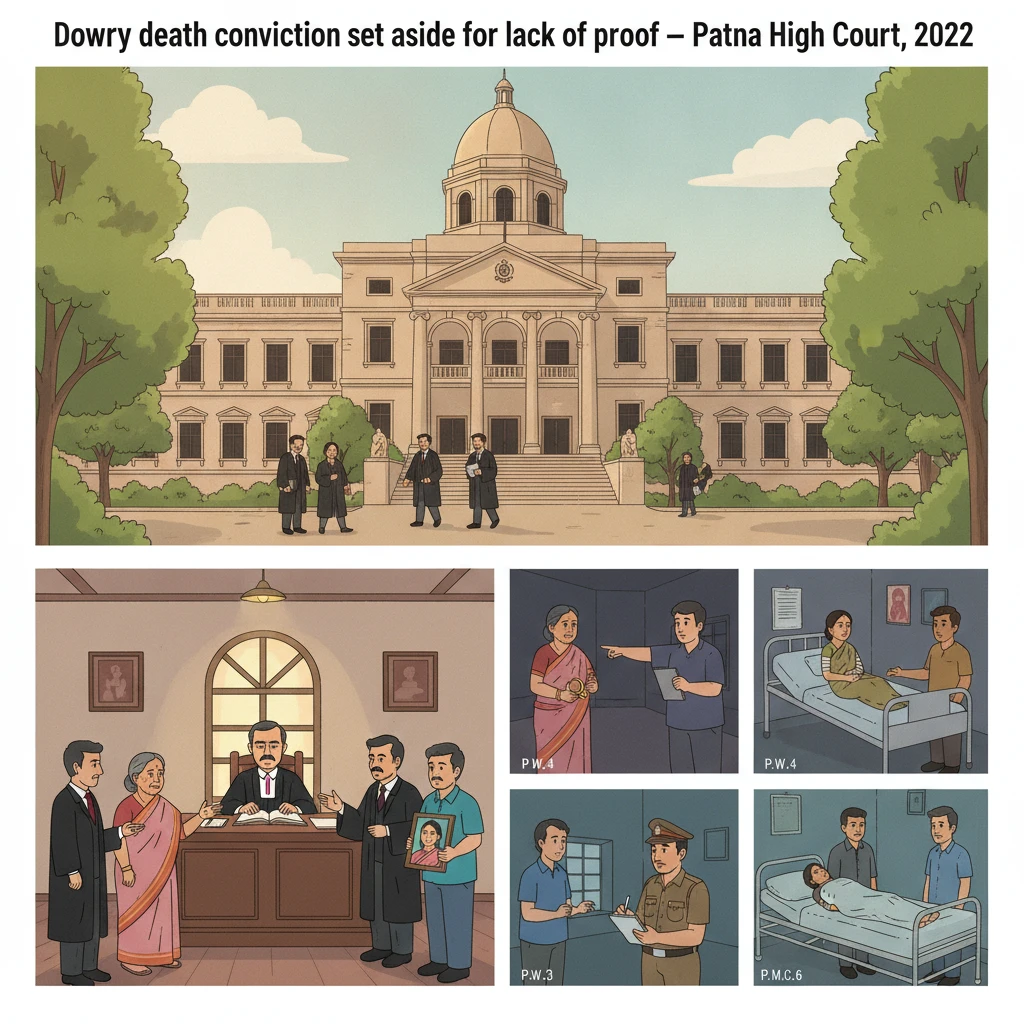
This case arose from the death of Lalita Devi, a married woman who had been living in her matrimonial home at village Chakradaha, Bari Khagaul, under Khagaul Police Station, District Patna.
Lalita Devi had married Madan Prasad, who was later acquitted in the case. The appellant in this appeal, Navlakho Devi, is the mother of Madan Prasad and therefore the mother-in-law of Lalita Devi.
According to the police report, on the night of 15.02.1993 at around midnight, Lalita Devi suffered burn injuries in her matrimonial house. She was first taken to the private hospital of Dr. Shushil Kumar Singh at Khagaul. After treatment there for some days, she was discharged and taken to her parental home.
Her condition later worsened and on 05.03.1993 her brother Binod Kumar (P.W.3) admitted her to P.M.C.H. Hospital, Patna. During her treatment at P.M.C.H., on 13.03.1993, Court Witness No.1 Rajnath Singh, a police officer from Pirbahore Police Station, recorded her statement in the presence of her brother. On the basis of this statement, Crime No.21 of 1993 was registered on 14.03.1993.
Lalita Devi ultimately succumbed to her burn injuries, and post-mortem was conducted on 28.03.1993 at P.M.C.H. by Dr. Awadheshwari Prasad Narain Deo (P.W.6). He opined that she had died due to antimortem burn injuries.
After investigation, a charge-sheet was filed against the appellant and other family members under Section 304B of the Indian Penal Code, alleging dowry death. The case was committed to the Sessions Court and registered as Sessions Trial No.205 of 1994.
The Additional Sessions Judge-VIII, Patna, convicted only the mother-in-law, Navlakho Devi, for the offence under Section 304B IPC and sentenced her to rigorous imprisonment for life by judgment dated 18.04.1995. The husband and other accused were acquitted. The mother-in-law then filed this criminal appeal before the Patna High Court.
What the Court Examined and Decided
The Division Bench of the Patna High Court, comprising Hon’ble Mr. Justice A. M. Badar and Hon’ble Mr. Justice Sunil Kumar Panwar, heard the appeal. The appellant was represented by an amicus curiae, Mr. Prince Kumar Mishra, and the State was represented by Dr. Mayanand Jha, A.P.P.
The Court began by noting that the conviction was under Section 304B IPC, which deals with “dowry death”. The Bench carefully set out the essential ingredients that the prosecution must prove for such a conviction:
(a) the death of a woman must be caused by burns, bodily injury or occur otherwise than under normal circumstances;
(b) such death must occur within seven years of her marriage;
(c) she must have been subjected to cruelty or harassment by her husband or his relatives;
(d) such cruelty or harassment must be for, or in connection with, any demand for dowry; and
(e) such cruelty or harassment must have taken place “soon before her death”.
The main question for the Court was whether these conditions, especially clauses (c), (d) and (e), were proved against the mother-in-law.
The defence argued that there was no acceptable evidence that Lalita Devi had been mistreated for dowry soon before her death. They pointed out that the mother of the deceased and neighbours from both sides had supported the appellant, and that the prosecution’s own witnesses did not speak about dowry demands.
The State, however, argued that the evidence showed that Lalita Devi had died due to burns and that she was subjected to cruelty and harassment on account of a demand for a gold “Nathuni” (nose ring) soon before her death.
The Bench then examined the evidence witness by witness.
First, the Court looked at the medical evidence from the initial treating doctor, P.W.4 Dr. Shushil Kumar Singh, who ran “Sushil Nursing Home” at Khagaul. He deposed that Lalita Devi was admitted in his hospital on 16.02.1993. According to him, relatives from both sides were present with her.
Importantly, Dr. Singh stated that Lalita Devi told him she had sustained burn injuries when a burning lamp fell on her body while she was wearing a synthetic saree. He further stated that her condition improved, and she became capable of taking her own care. Due to a dacoity at his own house, he became busy and she was then discharged. He clearly opined that her injuries were caused by accidental fire.
Next, the Court considered the post-mortem evidence from P.W.6, Dr. Awadheshwari Prasad Narain Deo of P.M.C.H. He confirmed that she had died due to antimortem burn injuries, consistent with his post-mortem report (Ext.4). From this, the Court concluded that there was no dispute that Lalita Devi, a married woman, died due to burn injuries sustained at her matrimonial home on the night between 15.02.1993 and 16.02.1993.
However, to sustain a dowry death conviction, the prosecution also had to show cruelty or harassment for dowry soon before her death.
P.W.1 Laxman Das and P.W.2 Dev Prasad, neighbours residing near the matrimonial house, were key witnesses for the prosecution. But both proved to be favourable to the defence.
P.W.1 Laxman Das stated that he rushed to the spot after hearing of the incident and saw that Lalita Devi had been burnt due to the fall of a kerosene lamp. He specifically stated that there was no quarrel between Lalita Devi and her mother-in-law, the appellant. In cross-examination, he added that Lalita Devi had good relations with her in-laws, who immediately took her to the hospital for treatment.
P.W.2 Dev Prasad gave a similar account. He stated that Lalita Devi had married the son of the appellant in 1990 and that there was no quarrel between the appellant and the deceased. His evidence, like that of P.W.1, did not show any cruelty or harassment for dowry.
P.W.3 Binod Kumar, the brother of the deceased, was expected to support the prosecution regarding dowry demand and harassment. However, his evidence was limited. He merely confirmed that he had put his signature on the statement of Lalita Devi (Ext.1), which later became the First Information Report. He did not state that the appellant had treated his sister with cruelty or had demanded dowry from her.
The remaining prosecution witnesses were the doctors and the Investigating Officer (P.W.5), whose evidence did not speak of any cruel treatment or dowry demand by the appellant.
The defence further strengthened its case by examining D.W.1 Lalmani, the mother of the deceased, and D.W.2 Lalan Kumar, neighbour of the parents of the deceased.
D.W.1 Lalmani gave a detailed account. She said that on receiving information about the burns from the brother-in-law of Lalita Devi, she went with him to Dr. Shushil Kumar Singh’s hospital, where her daughter was treated for about 15 days. Thereafter, she took her daughter to her own house and admitted her to P.M.C.H. on 05.03.1993.
Crucially, the mother stated that most of the expenses for Lalita Devi’s treatment were borne by her in-laws. She also confirmed that her daughter had not made any complaint against her in-laws, and that they had not demanded anything, including a gold Nathuni. Thus, the mother’s testimony completely demolished the prosecution case about dowry demand and cruelty.
D.W.2 Lalan Kumar, a neighbour of the parents of the deceased, supported this version. He stated that Lalita Devi had good relations with her in-laws and that there was no dowry demand at any time.
The trial court had summoned Rajnath Singh, the police officer, as Court Witness No.1. He had recorded the statement of Lalita Devi (Ext.1) at P.M.C.H. on 13.03.1993, treating it as the FIR. This statement was used as a kind of dying declaration accusing the in-laws.
The High Court, however, noted that the version in this statement was not corroborated by any of the prosecution witnesses. It was also contradicted by the mother of the deceased and not supported by her brother. In such a situation, the Bench held that this dying declaration was “of no consequence”.
After considering all the evidence, the Court concluded that while the death due to burns within seven years of marriage was established, the essential ingredients of cruelty or harassment for dowry “soon before death” were not proved against the appellant.
Therefore, the conviction under Section 304B IPC could not be sustained. The Court allowed the appeal, quashed and set aside the judgment and order of conviction and sentence dated 18.04.1995 in Sessions Trial No.205 of 1994, and acquitted Navlakho Devi of the offence. It directed that she be set at liberty forthwith and that any fine paid be refunded.
The Court also recorded its appreciation for the efforts of the amicus curiae, Mr. Prince Kumar Mishra, and directed the High Court Legal Services Authority to pay him fees of Rs.5,000/-.
Why This Judgment Matters
This judgment is significant for dowry death cases under Section 304B IPC in Bihar and beyond. The Patna High Court emphasised that mere death of a married woman by burns within seven years of marriage is not enough to convict a relative for dowry death.
The Court insisted that there must be clear and reliable evidence of cruelty or harassment linked with a dowry demand, occurring soon before the death. If neighbours, close relatives and even the mother of the deceased do not support the allegation of dowry demand, a conviction cannot stand only on an uncorroborated statement recorded by the police.
For families facing similar accusations, this decision shows that the Court will examine all sides carefully, including defence evidence, and will not hesitate to overturn a conviction if the legal requirements are not met.
For victims of harassment, it also underlines the importance of making timely, consistent complaints that can be supported by witnesses and circumstances. Without such supporting evidence, serious charges like dowry death may fail in court.
Legal Issues and Answers
Issue: Did the prosecution prove that Lalita Devi was subjected to cruelty or harassment by her mother-in-law for or in connection with dowry, soon before her death, so as to attract Section 304B IPC?
Answer: No. The Patna High Court held that the evidence of neighbours, the brother and especially the mother of the deceased did not support any allegation of dowry demand or cruelty, and the uncorroborated dying declaration could not sustain the conviction.
Issue: Could the conviction for dowry death be maintained solely on the basis of the statement (Ext.1) recorded by the police officer as a dying declaration?
Answer: No. The Court found that this statement was contradicted by the mother and unsupported by other witnesses, making it unreliable and insufficient to uphold the conviction.
Cases Cited by the Court
- The judgment text does not mention or rely on any other reported cases by name or citation.
Case Details
Case Number: Criminal Appeal (DB) No.137 of 1995
Case Title: Navlakho Devi v. The State of Bihar
Citation: 2022 (1) PLJR 802
Court: High Court of Judicature at Patna
Coram: Hon’ble Mr. Justice A. M. Badar and Hon’ble Mr. Justice Sunil Kumar Panwar
Date of Judgment: 24.02.2022
Nature of the Case: Criminal appeal (Division Bench) against conviction and sentence under Section 304B of the Indian Penal Code in Sessions Trial No.205 of 1994.
Trial Court: Court of the Additional Sessions Judge-VIII, Patna
Offence Alleged: Section 304B of the Indian Penal Code (dowry death)
Trial Court Result: Conviction of mother-in-law under Section 304B IPC and sentence of rigorous imprisonment for life; other accused including husband acquitted.
High Court Result: Appeal allowed; conviction and sentence under Section 304B IPC quashed and set aside; appellant acquitted and directed to be released; fine, if any, to be refunded.
Advocates:
For the Appellant: Mr. Prince Kumar Mishra, Amicus Curiae
For the State: Dr. Mayanand Jha, A.P.P.
Link to Judgment: Click here to read the full Patna High Court judgment
If you found this explanation helpful and wish to stay informed about
how legal developments may affect your rights in Bihar,
you may consider following Samvida Law Associates for more updates.







