

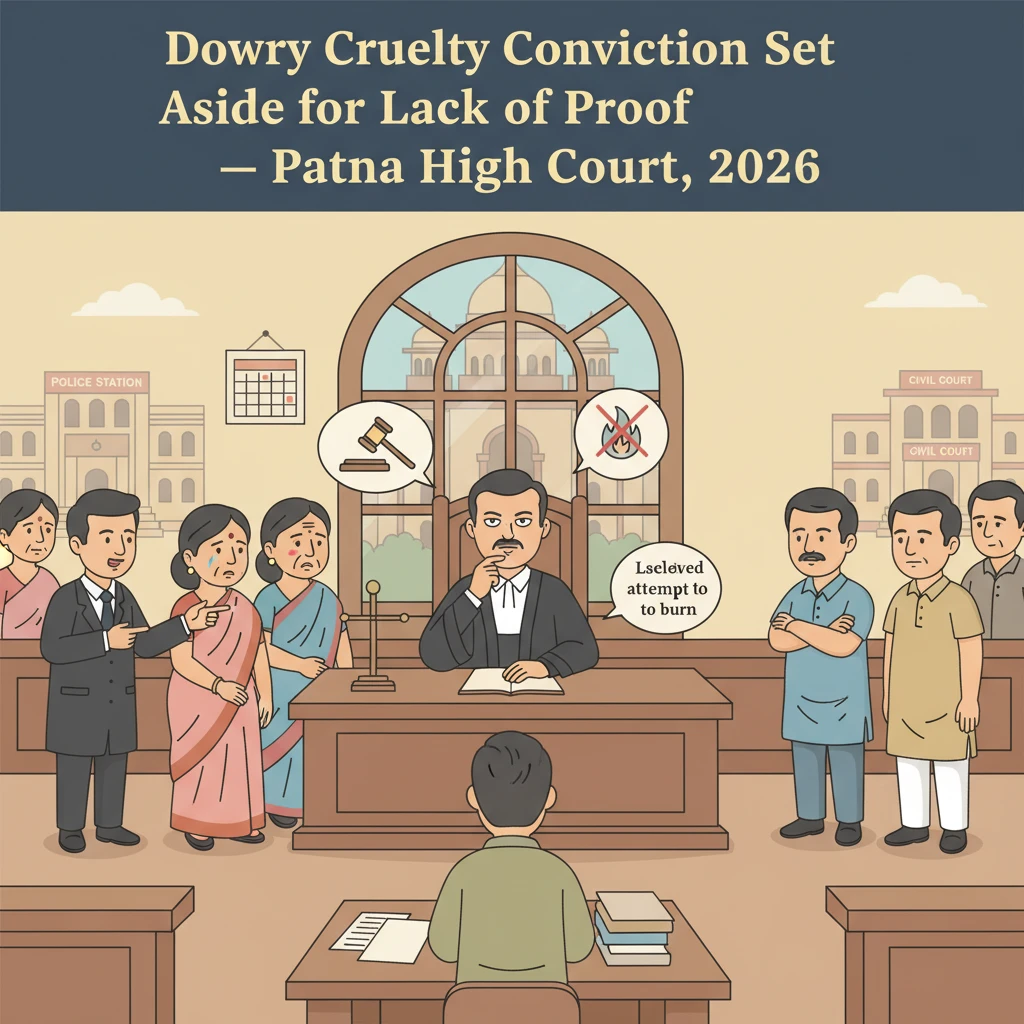
Case Background
This case arose out of a matrimonial dispute that turned into a criminal prosecution for dowry-related cruelty and attempt to murder.
The complainant married the appellant on 16.07.2010. At the time of marriage, her parents allegedly gave ornaments and Rs. 1,00,000 in cash. After marriage, she stayed in her matrimonial home for about one month, then went back to her parental home. She later returned to her matrimonial home in January 2011 and began living there again.
According to the complaint, after she resumed living in her matrimonial home, the appellant and his family members started demanding Rs. 2,00,000 and a refrigerator. It was alleged that they assaulted her, stopped giving her food and confined her in a room. On 18.06.2011, at about 7:00 A.M., all accused allegedly tried to set her on fire. She claimed she raised an alarm, neighbours gathered, and she escaped.
She went to Sheikhpura Civil Court, where her father was working, and narrated the incident. Her father then went alone to the house of the accused to protest, but, as per the complaint, the in-laws remained firm on their demand and said she would be kept only if the demand was met. Her father was allegedly abused and driven out.
The complainant was taken back to her parental home, and the incident was shared with relatives. On 27.06.2011, her father allegedly revisited the in-laws’ house with some persons to persuade them, but they again refused and did not even allow them to sit. On 28.06.2011, they went to Sheikhpura Police Station to lodge an FIR, but the S.H.O. allegedly did not take action and advised them to approach the Court. The complainant then filed a complaint case, which the Magistrate forwarded to the police for investigation.
On this complaint, Sheikhpura P.S. Case No. 180 of 2011 was registered under Sections 341, 498-A, 307, 504 IPC and Sections 3 and 4 of the Dowry Prohibition Act against the appellant and five others.
After investigation, police submitted charge sheet only against the appellant and three of his family members (Sonu Sao, Subodh Sao and Rajendra Sao). Other named accused were exonerated. The appellant was also separately charged for offences under Sections 498-A and 307 IPC and Sections 3 and 4 of the Dowry Prohibition Act.
Because Section 307 IPC is triable by the Court of Sessions, the case was committed to the Sessions Court. The appellant and three co-accused were jointly charged under Sections 498-A and 307 read with Section 34 IPC. All pleaded not guilty.
During trial, the prosecution examined twelve witnesses, including the complainant, her parents, her uncle, several independent witnesses, and the Investigating Officer. Only the FIR was exhibited as a document.
The trial court acquitted all co-accused of all charges. It also acquitted the appellant of the attempt to murder charge under Section 307 IPC. However, it convicted the appellant under Section 498-A IPC and sentenced him to six months’ simple imprisonment. The main reasoning was that he had failed to resume matrimonial relations or take steps through court to bring his wife back between 2011 and 2013 and that she was compelled to live away due to his ill-treatment.
Aggrieved by this conviction and sentence, the appellant filed Criminal Appeal (SJ) No. 35 of 2014 before the Patna High Court.
What the Court Examined and Decided
Hon’ble Mr. Justice Shailendra Singh heard the appeal. The key question was whether the evidence on record proved cruelty by the husband under Section 498-A IPC beyond reasonable doubt.
Counsel for the appellant argued that the complaint contained only general allegations against the husband. It did not attribute any specific act of demand or torture to him alone. The dowry demand and cruelty allegations were omnibus and clubbed against all accused.
He stressed that during trial the complainant improved her version and that there were major contradictions between her evidence and that of her parents. According to the complaint, the parents knew of the dowry demand and torture. But in the witness box, both parents stated that the case was filed due to misunderstanding between husband and wife and that their daughter had never complained to them about torture or dowry demand.
The defence also pointed to the delay: the alleged attempt to burn the complainant occurred on 18.06.2011, but the complaint was filed on 29.06.2011. There was no convincing explanation for these 11 days. This, according to the defence, cast doubt on the prosecution version.
Further, it was argued that there was no evidence apart from the bare claim of the complainant to support the allegation of attempt to kill her.
On the other side, the Additional Public Prosecutor submitted that the parents’ evidence was affected because there had been a compromise between the parties. He argued that they admitted some ill-treatment in their examination-in-chief, and that the complainant’s testimony, along with her uncle’s, sufficiently proved demand of dowry and cruelty. The State supported the trial court’s conviction under Section 498-A IPC.
The High Court carefully examined the complaint, the oral testimonies, and the trial court’s findings.
First, the Court looked at how the complainant described her stay in her matrimonial home. In the complaint she said she lived there for about one month and then returned to her parental home, and later went back in January 2011. In her examination-in-chief before the trial court she said she stayed about one month, went back to her parental home, continued to live there, and after six months again went to her matrimonial home. This variation showed inconsistency even on basic facts like duration of stay.
Next, the Court compared her statements on who made the dowry demand. In the complaint, the allegation was made jointly against all the accused. In her deposition, she first stated that her brother-in-law and mother-in-law demanded Rs. 2,00,000 and a refrigerator. Only later did she say that the appellant also made this demand. This change in attribution raised doubt.
There were further contradictions regarding the alleged attempt to kill her. In the complaint she alleged an attempt to burn her by all accused. But in examination-in-chief she only said that on 17.06.2011 she was assaulted, ousted and that the accused attempted to kill her, without specifics. It was only in cross-examination that she first said kerosene oil was poured on her by the accused, including the appellant, in an attempt to burn her.
The Court also noted her admission that several of the accused lived in Patna for work and residence, even before her marriage. One sister-in-law named as an accused was married and mostly resided at her own matrimonial home. These statements showed that some persons, though equally named in the complaint, hardly had opportunity to regularly ill-treat her. The trial court, for this reason, disbelieved the general allegations against them and acquitted them.
Regarding physical cruelty, the complainant claimed that she went to her parental home twice before filing the complaint and had injury marks, for which a doctor treated her. However, she produced no medical prescription or document to support this. Her parents also remained silent about having seen any such injuries. Thus there was no corroboration.
On the serious allegation of attempt to burn her, the complainant had said that neighbours came and saved her. Yet, the Investigating Officer did not examine any neighbour, and the prosecution did not produce any such witness at trial. The Court highlighted that apart from the “bald statement” of the complainant, there was no supporting evidence. The trial court had already found this allegation unreliable and acquitted the appellant under Section 307 IPC. The High Court said this false or unproved allegation further weakened the reliability of her remaining claims.
The allegation of confinement in a room and continuous torture was also examined. The complainant admitted that her in-laws’ house was on the main road and that voices inside could be heard outside. Her father testified that he used to pass that road regularly to go to office and met his daughter every one or two weeks. Yet, she never told him about any confinement or torture, and he never mentioned seeing or suspecting anything wrong. This again undercut the prosecution story.
On the question of delay in filing the case, the Court noted that the complainant’s father, being an employee of Sheikhpura Civil Court, had sufficient opportunity to quickly take legal steps. The last incident was on 18.06.2011; the complaint was filed on 29.06.2011. To explain this 11-day gap, the complainant said that on 27.06.2011 her father went to the in-laws’ house with some persons to persuade them. But those accompanying persons, when examined as prosecution witnesses, turned hostile and did not support this claim. Therefore, the explanation for delay did not stand proved.
The Court emphasised that in Section 498-A cases, the victim’s testimony is very important. But usually such cruelty becomes known to parents only when the victim tells them. Here, according to the complainant, her father knew all incidents. However, in cross-examination, her father (PW-1) said clearly that the case was lodged due to misunderstanding between the spouses, that his daughter had never complained of torture, and that no dowry demand had been made. Her mother (PW-2) gave similar evidence.
These contradictions between the complainant and her own parents were considered serious. Coupled with lack of medical evidence, lack of neighbour witnesses, unproved explanation for delay, and the earlier acquittal on Section 307 IPC, the High Court held that it was not safe to uphold the conviction under Section 498-A IPC.
The Court also noted that the trial court’s reasoning for convicting the appellant mainly rested on the fact that he did not try to resume matrimonial relations or move court to bring his wife back. The High Court felt this approach did not inspire confidence, particularly when the trial court itself had not clearly tied the witnesses’ testimonies to the finding of cruelty.
Accordingly, the Patna High Court set aside the judgment of conviction and sentence dated 17.12.2013 in Sessions Trial Case No. 338 of 2012 / G.R. No. 543 of 2011. The criminal appeal was allowed.
The appellant was already on bail. In view of the acquittal, the High Court cancelled his bail bonds and discharged him and his sureties from their liabilities. The Court directed that the trial court records, along with a copy of this judgment, be sent back for necessary compliance.
Why This Judgment Matters
This judgment is significant for dowry and cruelty cases under Section 498-A IPC. It shows that even in sensitive matrimonial disputes, courts insist on reliable and consistent evidence.
The Patna High Court underlined that general, omnibus allegations against many family members are not enough. Where key witnesses, especially parents of the complainant, contradict her or do not support her, and there is no independent or documentary corroboration, a conviction cannot stand.
For victims, the decision highlights the importance of timely legal steps, truthful and consistent statements, and supporting evidence such as medical records or neutral witnesses. For accused persons, it shows that appellate courts will carefully scrutinise trial court findings, particularly where the trial court convicts on a weak evidentiary basis.
The ruling also clarifies that a husband’s mere failure to bring back his wife or to file a case to resume cohabitation, without solid proof of cruelty and dowry harassment, cannot by itself justify conviction under Section 498-A IPC.
Legal Issues and Answers
- Issue: Did the prosecution prove beyond reasonable doubt that the appellant subjected his wife to cruelty for dowry demand, attracting Section 498-A IPC?
Answer: No. The Patna High Court found the allegations general and inconsistent, unsupported by parents’ testimony, neighbours, or medical records, and held that it was unsafe to uphold the conviction. - Issue: Was the trial court justified in relying mainly on the appellant’s failure to resume matrimonial relations as proof of cruelty?
Answer: No. The High Court held that such reasoning, without firm evidentiary support for cruelty, did not inspire confidence and could not sustain a criminal conviction.
Cases Cited by the Court
- No previous judgments are cited or relied upon in the text of this judgment.
Case Details
Case Number: Criminal Appeal (SJ) No. 35 of 2014, arising out of Sheikhpura P.S. Case No. 180 of 2011; Sessions Trial Case No. 338 of 2012 / G.R. No. 543 of 2011
Case Title: Pramod Sao v. State of Bihar
Coram: Hon’ble Mr. Justice Shailendra Singh
Citation: 2024(2) PLJR 556
Advocates: Mr. Md. Khalid Anwar, Advocate for the appellant; Mr. Zeyaul Hoda, Additional Public Prosecutor for the State
Nature of the Case: Criminal appeal (against conviction and sentence under Section 498-A IPC)
Date of High Court Judgment: 22.01.2026
Result: Appeal allowed; conviction and sentence set aside; appellant acquitted; bail bonds cancelled and sureties discharged.
Link to the Judgment: View full judgment on Patna High Court website
If you found this explanation helpful and wish to stay informed about
how legal developments may affect your rights in Bihar,
you may consider following Samvida Law Associates for more updates.







