
Case Background
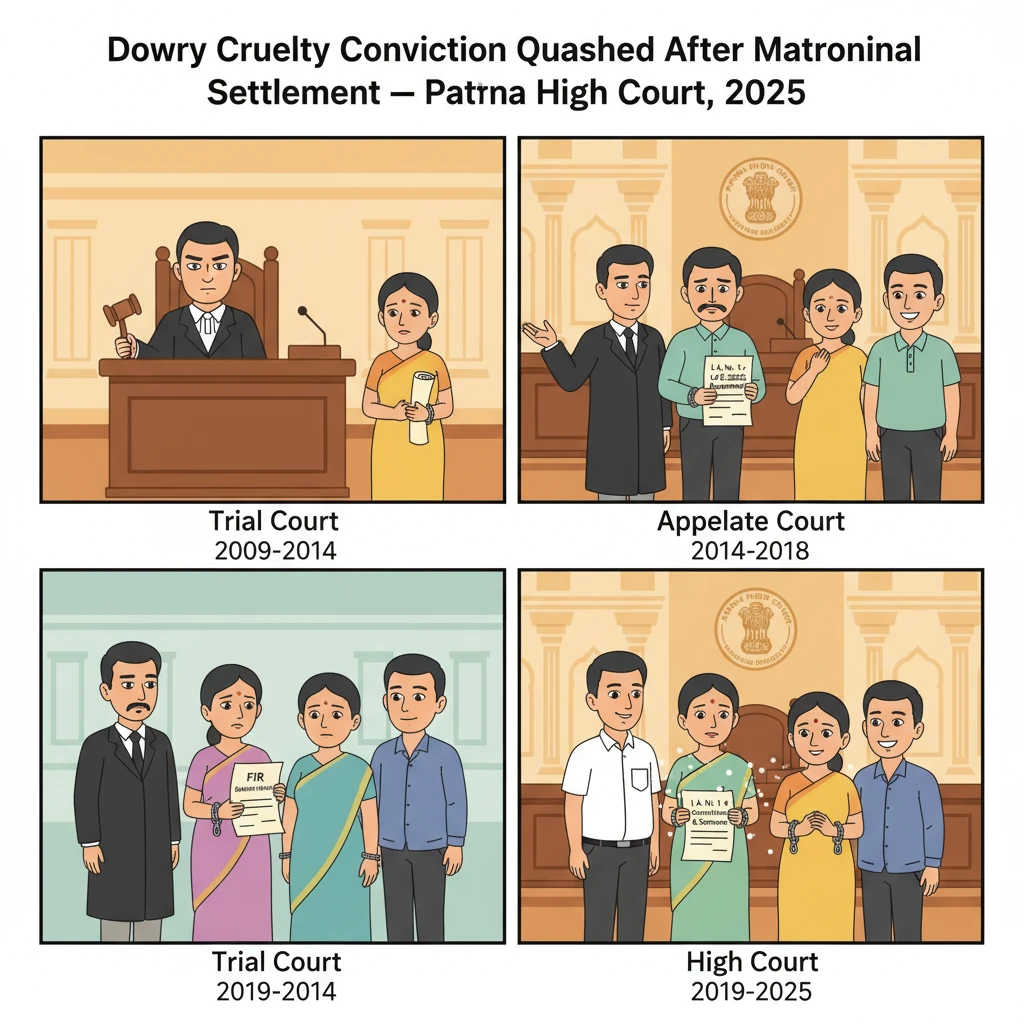
The case started with Parsa Bazar P.S. Case No. 152 of 2009 in District Patna. The police registered the case for offences punishable under Section 498A and Section 34 of the Indian Penal Code against the husband and his family members.
The informant in the case was the wife, and the accused persons were her husband, his parents, and his brother. They were later tried before the court of the learned Sub-Divisional Judicial Magistrate (S.D.J.M.), Patna.
After the trial, all four accused — the husband, his mother, his father, and his brother — were convicted under Section 498A of the Indian Penal Code and Section 4 of the Dowry Prohibition Act. They were sentenced accordingly. The precise sentence details are not mentioned in the judgment, but the fact of conviction and sentence is recorded.
Feeling aggrieved by the judgment of conviction and the order of sentence, all four convicts filed a criminal appeal, being Criminal Appeal No. 2219 of 2014. This appeal was heard by the appellate court, but the appeal was dismissed. The convictions and sentences were upheld.
After losing the appeal, the convicts approached the Patna High Court by filing criminal revision petitions. Two separate revisions were filed, though both arose from the same police case.
Criminal Revision No. 29 of 2019 was filed by the father-in-law and mother-in-law of the informant, namely Prabhu Niranjan Kumar Gupta and Sushma Devi. Criminal Revision No. 1413 of 2018 was filed by the husband, Gautam Kumar, and his brother, Pawan Kumar. Together, these revisions brought the entire family’s challenge to the High Court.
What the Court Examined and Decided
The Patna High Court, presided over by Hon’ble Mr. Justice Jitendra Kumar, heard both revision petitions together. The Court noted at the outset that both revisions arose from the same Parsa Bazar P.S. Case No. 152 of 2009, involving offences under Section 498A and Section 34 of the Indian Penal Code.
The Court recorded that the learned S.D.J.M., Patna, had convicted all four petitioners under Section 498A of the Indian Penal Code and Section 4 of the Dowry Prohibition Act. It also recorded that their appeal, Criminal Appeal No. 2219 of 2014, had been dismissed. Thus, at the time the revisions were filed, there was a standing conviction and sentence affirmed by the appellate court.
However, while these revision petitions were pending, an important development took place between the husband and the wife. The petitioners filed Interlocutory Applications in both revisions, each numbered I.A. No. 1 of 2025. These applications were supported by affidavits of the petitioners.
In these Interlocutory Applications, the petitioners placed on record that all matrimonial disputes between the parties had been settled and compromised. This included not only their personal and matrimonial disputes but also the criminal case arising from the dowry cruelty allegations. The petitioners also stated that a compromise or settlement had already been filed before the appellate court earlier.
A copy of the settlement or compromise was annexed with the Interlocutory Applications. The High Court specifically referred to this compromise to understand what had been agreed between the parties.
As per the compromise or settlement, the husband, Gautam Kumar, and the wife, Sita Devi, had obtained a divorce by mutual consent. Under this mutual consent divorce, the husband paid a permanent alimony of Rs. 1,30,000/- to the wife. The settlement further recorded that one girl child would remain with her father. These terms reflect that the parties had fully addressed their matrimonial relationship, financial claims, and custody of the child.
Importantly, both the husband and the wife stated that they did not want to pursue the criminal case filed by the wife against the husband and his family members any further. This meant that the informant herself no longer wished to carry on with the criminal prosecution, in view of the complete settlement.
On the basis of this holistic settlement, learned counsel for the petitioners and learned counsel for Opposite Party No. 2 (the informant-wife) jointly submitted that the criminal case should be quashed at this stage. They requested the High Court to invoke its inherent jurisdiction, in the interest of justice, and to do so without entering into the merits of the evidence or the correctness of the earlier findings.
The judgment notes that although the settlement or compromise had been filed before the appellate court, that court did not have inherent jurisdiction under Section 482 of the Code of Criminal Procedure. Therefore, the appellate court could not act on the compromise and still went on to decide the appeal on merits, upholding the convictions.
The petitioners and the informant’s counsel submitted that, in light of the subsequent settlement, there was no point in continuing the criminal case. Since the matrimonial relationship had already ended by mutual consent and both parties were living peacefully after the compromise, they argued that the continuance of criminal proceedings would serve no useful purpose. Instead, it would only prolong litigation and disturb the peace achieved between the parties.
The High Court also took note of the fact that learned counsel for Opposite Party No. 2 (informant-wife) had filed his vakalatnama and was present. He confirmed before the Court that the matter had been compromised and settled and that both parties were living peacefully.
After considering these submissions and the materials placed on record, the Patna High Court found that the case was a fit one for exercising its inherent powers under Section 482 Cr.P.C. The Court emphasised that in view of the compromise and settlement, and in the interest of justice, the criminal proceedings should not be allowed to continue.
Without going into the merits of the original allegations or the correctness of the evidence appreciated by the trial and appellate courts, the High Court chose to give effect to the settlement. It held that, at this stage, the criminal proceedings arising out of Parsa Bazar P.S. Case No. 152 of 2009 ought to be quashed.
Accordingly, the Court quashed the criminal proceeding under Section 482 Cr.P.C. It also set aside the impugned judgment of conviction and the order of sentence passed by the learned trial court, as well as the judgment of the appellate court below. In simple terms, the earlier convictions of the husband, his parents, and his brother were wiped out, and the criminal case was brought to an end.
Why This Judgment Matters
This judgment is important for people involved in matrimonial and dowry-related criminal cases where the husband and wife later settle their disputes. It shows that the Patna High Court is prepared to consider genuine settlements between spouses, even at a late stage, to put an end to long-running criminal proceedings.
Here, the husband and wife had already taken mutual divorce, agreed on permanent alimony, and settled the custody of their child. Both were clear that they did not want to continue the criminal case. The Court recognised that forcing the criminal case to continue, despite this, would harm rather than help justice.
The judgment also clarifies a practical point: while an appellate court may not have inherent powers under Section 482 Cr.P.C. to quash proceedings on the basis of compromise, the High Court can use this power in appropriate cases. For victims and accused persons in similar cases, this shows that a fully settled matrimonial dispute can be a ground for seeking quashing of criminal proceedings, subject to the Court’s satisfaction.
Legal Issues and Answers
- Issue: Whether criminal proceedings for offences under Section 498A IPC and Section 4 of the Dowry Prohibition Act, where convictions have already been affirmed in appeal, can be quashed by the Patna High Court on the basis of a subsequent settlement between the husband and wife.
Answer: Yes. The Patna High Court held that, in view of a holistic settlement, mutual consent divorce, payment of permanent alimony, and the clear stand of the informant-wife that she did not want to pursue the case, the criminal proceedings could be quashed and the convictions and sentences set aside under Section 482 Cr.P.C., in the interest of justice.
Cases Cited by the Court
- No previous cases are cited or relied upon in the text of this judgment.
Case Details
Case Number: Criminal Revision No. 29 of 2019 with Criminal Revision No. 1413 of 2018; arising out of Parsa Bazar P.S. Case No. 152 of 2009, District Patna.
Case Title: Prabhu Niranjan Kumar Gupta and another vs. State of Bihar and another (Criminal Revision No. 29 of 2019); Gautam Kumar and another vs. Sita Devi and another (Criminal Revision No. 1413 of 2018).
Coram: Hon’ble Mr. Justice Jitendra Kumar.
Citation: 2025(3) PLJR 435
Advocates: For the petitioners in both revisions: Mr. Y.C. Verma, Senior Advocate, assisted by Mr. Rabish Kumar, Advocate. For the State: Mr. Upendra Kumar. For Opposite Party No. 2 / informant: Mr. Rajeev Ranjan Singh, Advocate.
Nature of the Case: Criminal revision petitions challenging conviction and sentence under Section 498A IPC and Section 4 of the Dowry Prohibition Act; criminal proceedings quashed under Section 482 Cr.P.C. on the basis of matrimonial settlement.
Date of Judgment: 04.02.2025.
Link to Judgment: Click here to read the full judgment of the Patna High Court
If you found this explanation helpful and wish to stay informed about
how legal developments may affect your rights in Bihar,
you may consider following Samvida Law Associates for more updates.







