

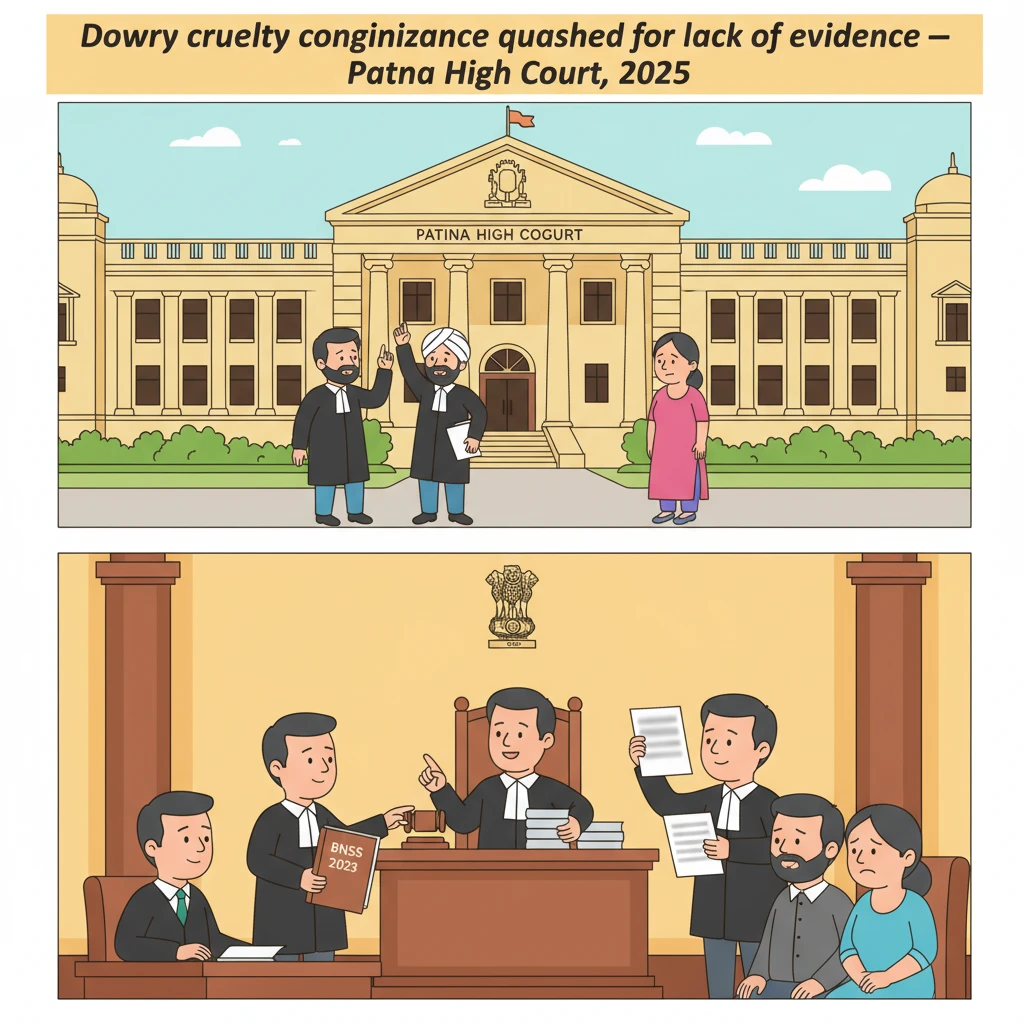
Case Background
This case arose from Mahila P.S. Case No.09 of 2024 in the district of Samastipur. The informant, a woman, alleged cruelty and dowry demand by her husband and his family members after her marriage on 28.06.2023 at Azad Chowk, Dharampur, Samastipur, solemnized as per Muslim customs.
According to her First Information Report (FIR), she and her husband initially lived happily as husband and wife. After about two months, she alleged that her husband’s behaviour changed. She claimed he started demanding a motorcycle and Rs. 2 lakh in cash. When this demand was not met, she stated he left her. She said she then went to her matrimonial home at Darbhanga, where she was allegedly assaulted and driven out by her in-laws.
She further alleged that her husband stopped answering her phone calls and that he had mentally and physically harassed her. On her information, Mahila P.S. Case No.09 of 2024 was registered under Sections 498A, 341, 323, 504 and 34 of the Indian Penal Code (IPC) and Sections ¾ of the Dowry Prohibition Act against eight accused persons, including the husband (petitioner).
After investigation, the police submitted Charge-Sheet No.95/24 dated 13.08.2024 under Sections 498A, 341, 323, 504 and 506 of IPC and Sections ¾ of the Dowry Prohibition Act against the petitioner and other co-accused. On the basis of this police report, the learned Sub-Divisional Judicial Magistrate (SDJM), Samastipur took cognizance vide order dated 29.08.2024 under Sections 341, 323, 504, 506 and 498A of IPC and Sections ¾ of the Dowry Prohibition Act.
Aggrieved by this cognizance order and continuation of criminal proceedings against him, the husband filed Criminal Miscellaneous No.39688 of 2025 before the Patna High Court under Section 528 of the Bharatiya Nagarik Suraksha Sanhita, 2023 (BNSS, 2023).
What the Court Examined and Decided
The Patna High Court heard the petitioner’s counsel, the counsel for the informant (OP No.2), and the Additional Public Prosecutor for the State of Bihar.
The petitioner’s counsel argued that the petitioner was innocent and no case was made out against him. It was urged that the alleged offences were said to have taken place between 28.08.2021 and 05.02.2024, but the FIR was lodged on 11.02.2024, and there was no satisfactory explanation for this delay. According to the petitioner, this delay cast serious doubt on the genuineness of the case.
The petitioner further stated that he had already divorced OP No.2 under the Muslim form of divorce known as “Talaq-e-Ahsan”. He denied having tortured or assaulted her at any point of time.
On behalf of the petitioner, it was also denied that OP No.2 had ever visited his matrimonial home at Darbhanga. Therefore, the allegation of cruelty and assault by his family members was termed a “cooked up story”. It was submitted that even the allegation about the petitioner’s “second marriage” would not amount to cruelty. On these grounds, he prayed that the entire criminal proceeding be quashed.
The Court recorded that counsel representing the petitioner’s first wife showed no interest in the dispute between the petitioner and OP No.2.
The Court then turned to the FIR allegations. It noted that the complainant and petitioner were married on 28.06.2023. According to the informant, after one month of marriage the petitioner’s behaviour changed and he assaulted her. After two months of marriage, on 28.08.2023, he allegedly demanded Rs. 2 lakh and a motorcycle and, on non-fulfilment, kicked her out of the matrimonial home on 05.02.2025. She also alleged that he assaulted her at her parental home and harassed her both mentally and physically.
However, the High Court pointed out a crucial gap. It observed that OP No.2 had not supported the allegation of harassment with specific details. She had not given any specific date, place, or manner in which the alleged incidents of cruelty or harassment had taken place. The allegations remained general and vague.
The Court then explained the law on “cruelty” under Section 498A of IPC. It reproduced the statutory definition, which covers:
(a) wilful conduct likely to drive a woman to commit suicide or cause grave injury or danger to life, limb or health (mental or physical); or
(b) harassment with a view to coercing the woman or her relatives to meet unlawful demand for any property or valuable security, or on account of failure to meet such demand.
To show how courts interpret this, the Patna High Court relied on recent and previous decisions of the Supreme Court.
First, it cited the judgment in Shobit Kumar Mittal vs. State of U.P. & Anr., 2025 INSC 1152. There, the Supreme Court held that merely stating that the accused mentally harassed the complainant for dowry, without any specific instance or supporting material, does not meet the requirement of Section 498A. The Supreme Court had clearly said that:
– The term “cruelty” cannot be established without specific instances.
– Vague and general allegations of harassment, without details of particular incidents, weaken the prosecution case.
– Courts cannot ignore missing specifics in the FIR, because the FIR is the basic document to start criminal machinery.
– In such cases of alleged cruelty and harassment, there is usually a series of offending acts which must be spelt out in specific terms.
Secondly, the Patna High Court referred to the earlier judgment of the Supreme Court in Manju Ram Kalita v. State of Assam, (2009) 13 SCC 330. That judgment clarified that “cruelty” has to be understood in the context of Section 498A IPC. It held that:
– The conduct of the husband and the seriousness of his acts must be weighed against the likelihood of the woman being driven to suicide or serious harm.
– It must be shown that the woman faced cruelty continuously or at least near the time of lodging the complaint.
– Petty quarrels do not amount to cruelty under Section 498A.
On this basis, the Supreme Court in that case had set aside a conviction under Section 498A. The Patna High Court used this reasoning to examine whether the allegations in the present case showed continuous or grave cruelty, or only broad, unspecific claims.
The Patna High Court then discussed the concept of “taking cognizance” by a Magistrate. Relying on Supreme Court decisions in State of West Bengal vs. Mohd. Khalid, 1995 1 SCC 684 and Manharibhai Muljibhai Kakadia vs. Shaileshbhai Mohanbhai Patel, 2012 10 SCC 517, the Court noted that a Magistrate must apply his judicial mind and see whether there is material to initiate judicial proceedings against an offender.
The Court further referred to the Supreme Court decision in Tula Ram v. Kishore Singh, (1977) 4 SCC 459. There, the Supreme Court explained that “taking cognizance” means judicial application of mind to the facts mentioned in the complaint or police report with a view to take further action. It also clarified how and when a Magistrate can order investigation under Section 156(3), or proceed under Sections 190, 200, 202 of the procedural law.
Having laid down this legal backdrop, the Patna High Court examined the record of the present case. It noted that the Investigating Officer had actually closed the investigation and submitted a final form to the Magistrate in absence of any material or evidence against the petitioner. This was specifically mentioned in paragraph 9 of the petitioner’s application, which the Court reproduced.
Paragraph 9 described the informant’s earlier personal history: her first marriage in 2011 to one Md. Suleman, her daughter from that marriage, her husband’s death, her subsequent work in IMC Company, and her relationship with another man, leading to Warisnagar P.S. Case No.260 of 2020 under various IPC sections and Dowry Prohibition Act, in which a final form had been submitted on 12.07.2022. The Court highlighted this not to judge her character, but to show that the police in this present case found no supporting material during investigation.
The High Court emphasised that when investigation fails to uncover any evidence, there is no sufficient basis for taking cognizance. Cognizance should not be taken “in want of any material on record”.
In paragraph 18 of the judgment, the Court clearly stated that, after examining the FIR and the evidence collected in investigation, it appeared that the Investigating Officer “has not even collected material evidence against the petitioner.” Despite this, the learned Magistrate had taken cognizance under Sections 341, 323, 504, 506, 498A of IPC and Sections ¾ of the Dowry Prohibition Act.
In paragraph 19, the Court concluded that, considering the allegations in the FIR and the absence of any material collected during investigation, and the absence of any complaint by OP No.2 at any earlier point, the Magistrate had taken cognizance “without applying his judicial mind.” Such an order, the Court held, is legally unsustainable and deserves to be quashed.
Finally, in paragraph 20, the Court allowed the application. It quashed and set aside the entire proceedings and the cognizance order dated 29.08.2024 in Mahila P.S. Case No.09 of 2024 (Sup. G.R. Case No.6 of 2024) (G.R. Case No.375/24) passed by the SDJM, Samastipur, so far as the petitioner is concerned. With these observations, the criminal miscellaneous application was disposed of.
Why This Judgment Matters
This judgment is important for both complainants and accused persons in matrimonial and dowry cases in Bihar. The Patna High Court has underlined that criminal law cannot be used on the basis of vague, general allegations without specific incidents and supporting material.
For women facing real cruelty and dowry harassment, it shows the need to record and report specific acts—dates, places, what exactly happened, and who was involved. Without such detail, their cases may not stand in court.
For accused persons, including husbands and in-laws, the judgment shows that the Court will intervene if a Magistrate takes cognizance mechanically, ignoring the fact that investigation has not produced material evidence.
Overall, the decision reinforces that Magistrates must carefully apply their judicial mind before starting a criminal trial, especially in sensitive family disputes. This helps prevent misuse of Section 498A IPC and the Dowry Prohibition Act, while still keeping the door open for genuine cases backed by concrete evidence.
Legal Issues and Answers
Issue: Whether the Magistrate at Samastipur was justified in taking cognizance against the petitioner under Sections 341, 323, 504, 506, 498A IPC and Sections ¾ of the Dowry Prohibition Act on the basis of the FIR and police report.
Answer: No. The Patna High Court held that the Magistrate took cognizance without any material or evidence collected during investigation and without specific allegations of cruelty, so the cognizance order and proceedings against the petitioner were quashed.
Cases Cited by the Court
- Shobit Kumar Mittal vs. State of U.P. & Anr., 2025 INSC 1152.
- Manju Ram Kalita v. State of Assam, (2009) 13 SCC 330.
- State of West Bengal vs. Mohd. Khalid, 1995 1 SCC 684.
- Manharibhai Muljibhai Kakadia vs. Shaileshbhai Mohanbhai Patel, 2012 10 SCC 517.
- Tula Ram v. Kishore Singh, (1977) 4 SCC 459.
- R.R. Chari v. State of Uttar Pradesh, 1951 SCC 250 : AIR 1951 SC 207 : 1951 SCR 312 (as quoted in Tula Ram).
- Superintendent and Remembrancer of Legal Affairs, West Bengal v. Abani Kumar Banerjee, AIR 1950 Cal 437 (as quoted in Tula Ram).
- Narayandas Bhagwandas Madhavdas v. State of West Bengal, AIR 1959 SC 1118 : (1960) 1 SCR 93 : 1959 Cri LJ 1368 (as quoted in Tula Ram).
Case Details
Case Number: Criminal Miscellaneous No.39688 of 2025; arising out of Mahila P.S. Case No.09 of 2024 (Sup. G.R. Case No.6 of 2024) (G.R. Case No.375/24), District Samastipur.
Case Title: Sarfe Alam versus The State of Bihar & Sajda Khatoon.
Coram: Hon’ble Mr. Justice Purnendu Singh.
Date of Judgment: 08.12.2025 (Uploading/Transmission Date: 24.12.2025).
Citation: 2026 (2) PLJR 54.
Advocates:
- For the Petitioner: Md. Irfanul Haque, Advocate.
- For Opposite Party No.2: Ms. Rekha Ranjan Prasad, Advocate.
- For the State of Bihar: Mr. Damodar Prasad Tiwary, Additional Public Prosecutor.
Nature of the Case: Criminal miscellaneous application under Section 528 of BNSS, 2023 seeking quashing of cognizance order in a dowry cruelty and assault case.
Link to Judgment: Click here to view the official Patna High Court judgment
If you found this explanation helpful and wish to stay informed about
how legal developments may affect your rights in Bihar,
you may consider following Samvida Law Associates for more updates.







