
Case Background
This case comes from a matrimonial dispute between a woman from Nalanda district and her husband’s family from Patna district. The wife (opposite party no. 2) married petitioner no. 1 on 07.05.2017. She later filed Complaint Case No. 1318C of 2018 at Nalanda, alleging cruelty and dowry demand by her husband and in-laws.
According to her complaint, her father spent about Rs. 6 lakhs at the time of marriage, including cash, ornaments and household goods. She also stated that the father of petitioner no. 1 (now deceased) had represented that his son was working in the Railways and would secure permanent employment.
After the marriage, she lived for a short time at her matrimonial home in village Shahbegpur. She again went there on 13.06.2018. She alleged that during this stay her father-in-law, mother-in-law, husband and two brothers-in-law started subjecting her to cruelty. Petitioner no. 1 allegedly demanded Rs. 1 lakh for purchasing land, at the instigation of other family members.
She claimed she was abused, assaulted, denied food and finally had to inform her father. Her parents and brother then took her to Mokama Police Station and later to the Women’s Counselling Centre, where a reconciliation took place and she was sent back to the matrimonial home.
The wife further alleged that on 12.07.2018 her husband again assaulted her in the presence of other in-laws when the demand for money was not met. She said that despite being unwell, she was not given medical treatment. On 13.10.2018, her parents came, took her away for treatment, and she continued her teacher-training course at Noorsarai in Nalanda.
She also alleged that her ornaments and articles given at the time of marriage were unlawfully retained by her husband and in-laws, and because of this she was unwilling to return to her matrimonial home.
On 25.10.2018, she filed the complaint before the Chief Judicial Magistrate, Nalanda at Bihar Sharif. The learned Sub-Divisional Judicial Magistrate, Nalanda at Bihar Sharif took cognizance of offences under Section 498A/34 of the Indian Penal Code and Section 4 of the Dowry Prohibition Act by order dated 25.07.2019.
Against this order of cognizance, the husband (petitioner no. 1), his mother (petitioner no. 2) and his younger brother/dewar (petitioner no. 3) approached the Patna High Court in Criminal Miscellaneous No. 58439 of 2025 under Section 528 of the Bharatiya Nagarik Suraksha Sanhita (BNSS), seeking quashing of the criminal proceedings.
What the Court Examined and Decided
Justice Purnendu Singh heard the matter on 09.12.2025. The petitioners’ lawyer argued that the allegations were false and concocted. He pointed out that petitioner no. 1 was the husband, petitioner no. 2 the mother-in-law and petitioner no. 3 the dewar of the complainant.
He submitted that the allegations against all petitioners were not specific but general and omnibus. He stressed that marriage is a sacred institution, that small quarrels can escalate, and that parties should be encouraged to settle their disputes outside court. He requested that the matter be referred to mediation.
The counsel for the wife (opposite party no. 2) and the learned Additional Public Prosecutor (APP) for the State agreed that an opportunity should be given to the parties to reconcile their dispute amicably.
The Patna High Court noted a pattern seen in society and in courts: in matrimonial disputes, often the entire family of the husband and even distant relatives are made accused along with the husband. The Court observed that the Supreme Court has already laid down how such complaints should be handled by trial courts and has repeatedly warned against dragging every relative into criminal cases without proper basis.
The Court then carefully read the complaint filed by the wife. It found that there was no specific allegation against petitioner no. 3, the dewar. The complaint did mention “two brothers-in-law” but did not attribute any clear, individual act of cruelty or dowry demand to petitioner no. 3.
Relying on the recent Supreme Court judgment in Navneesh Aggarwal & Ors. v. State of Haryana & Anr., reported in 2025 INSC 963, the High Court held that no case was made out against petitioner no. 3 under Section 498A/34 IPC or Section 4 of the Dowry Prohibition Act. Therefore, the entire criminal proceeding and the order taking cognizance dated 25.07.2019 in Complaint Case No. 1318C of 2018 were quashed “to the extent it relates to petitioner no. 3.”
For the husband and mother-in-law (petitioners nos. 1 and 2), the Court took a different view. It noted that there were specific allegations against them in the complaint that they had subjected the wife to various kinds of torture connected with dowry demand and ill-treatment. At the same time, the Court recorded that they were ready to resolve the dispute along with other family members “to buy peace of mind.”
The Court emphasized that matrimonial disputes between husband and wife are generally private conflicts and not offences against society at large. In support, it referred to the Supreme Court judgment in B.S. Joshi v. State of Haryana, (2003) 4 SCC 675, particularly paragraphs 12 and 13. Those paragraphs state that courts must encourage genuine settlement in matrimonial matters and that criminal proceedings should not unnecessarily prolong matrimonial conflicts, which can ruin the “young days” of the parties.
The High Court also relied on the Supreme Court’s recent decision in Mange Ram v. State of Madhya Pradesh & Another, Special Leave Petition (Criminal) No. 10817 of 2024. In that case, the Supreme Court cited earlier judgments like Dara Lakshmi Narayana v. State of Telangana, (2025) 3 SCC 735 and Gian Singh v. State of Punjab, (2012) 10 SCC 303.
From these decisions, the key principles highlighted by the Patna High Court were:
- Family members of the husband should not be unnecessarily roped into criminal proceedings arising out of matrimonial discord, especially when allegations lack specific details or they live separately.
- Criminal law should not be used as a tool for harassment.
- In offences arising out of matrimony, particularly dowry-related, if the parties settle their disputes and there is little chance of conviction, continuation of criminal proceedings may amount to abuse of process.
The Court further referred to Naushey Ali & Ors. v. State of Uttar Pradesh & Anr., (2025) 4 SCC 78, where the Supreme Court again recognized that offences flowing from matrimonial disputes and dowry issues can be settled amicably between the parties.
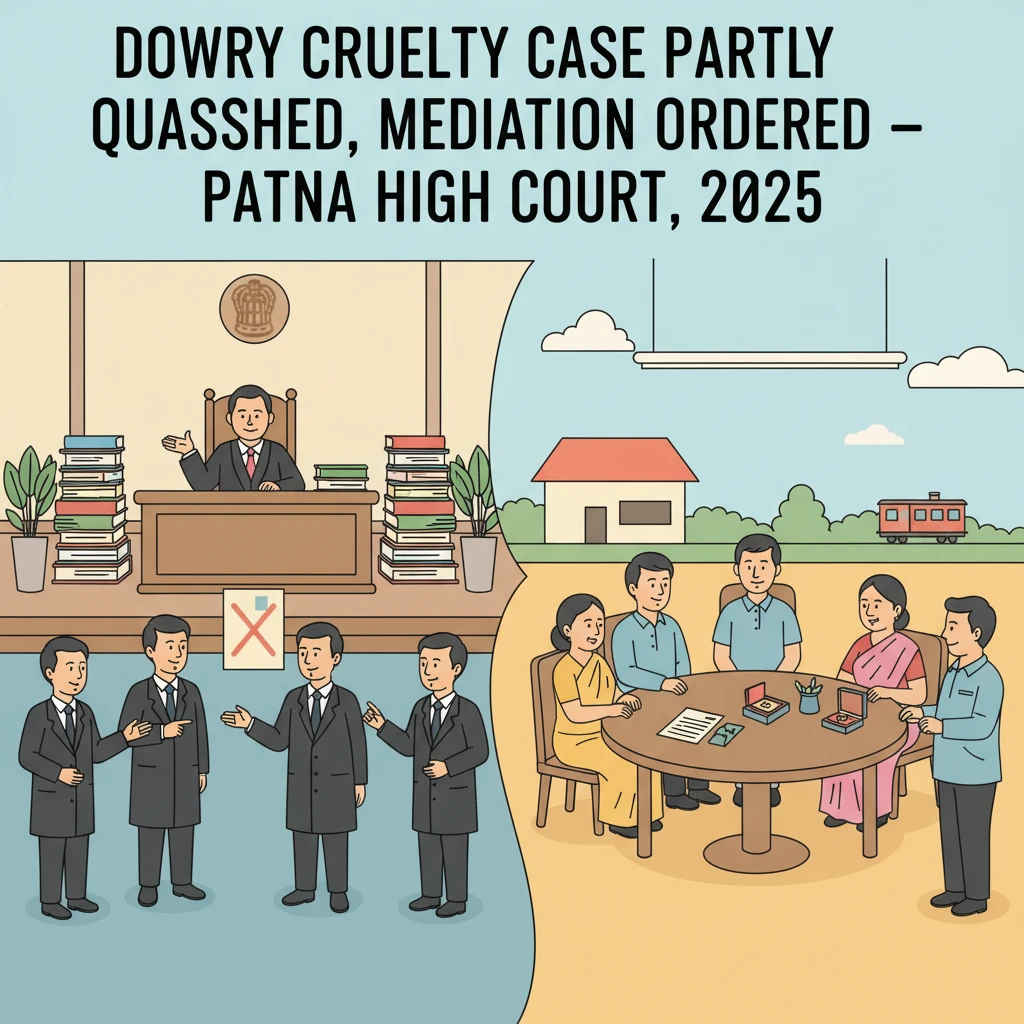
Keeping these principles in mind, and noting that petitioners nos. 1 and 2 were willing to explore settlement, the Patna High Court chose a balanced path. It did not completely quash the case against them. Instead, it ordered a structured mediation process with certain safeguards and time limits.
The Court recorded that petitioners nos. 1 and 2, along with other family members, agreed to appear before the learned District Court on 23.12.2025 at 10:30 AM. The District Court was directed to “strive till last” to settle the dispute outside court.
The High Court directed the District Court, upon appearance of the parties, to take necessary steps to refer the matter to the District Mediation Center and fix a date for appearance before a mediator. The mediator was asked to make his or her best efforts to settle the dispute amicably and to submit a report to the District Court within four months.
Importantly, the High Court granted interim protection to petitioners nos. 1 and 2. It ordered that until the mediator’s report is filed within the four-month period, no coercive action shall be taken against them in connection with the case. This means that during this time, they cannot be subjected to arrest or similar coercive steps, provided they cooperate.
The Court also clarified what should happen after mediation:
- If the parties resolve their dispute amicably or reach a mutual settlement, the criminal proceedings are required to be dropped in light of the Supreme Court judgments cited.
- If petitioners nos. 1 and 2 deliberately fail to appear before the District Court on 23.12.2025 or on any date fixed by the mediator, the interim protection automatically ends and the District Court shall proceed with the trial.
- If it is deliberate on the part of opposite party no. 2 (the wife) not to reconcile, then continuing the criminal proceeding would amount to abuse of process. In that event, the interim protection in favour of petitioners nos. 1 and 2 shall continue and the proceeding against them is required to be dropped in accordance with law.
Finally, the High Court modified the cognizance order only to the extent explained: full quashing for petitioner no. 3, and conditional continuation plus mediation and interim protection for petitioners nos. 1 and 2. The quashing application was then disposed of.
Why This Judgment Matters
This judgment is important for families in Bihar facing dowry and cruelty cases. It shows how the Patna High Court is trying to protect genuine victims while also preventing misuse of criminal law against every in-law.
For women who have truly faced dowry harassment, the Court has not closed the door: the case against the husband and mother-in-law continues, but with an opportunity for settlement if they wish. For relatives like younger brothers-in-law, the judgment makes clear that they cannot be forced into trial when the complaint has no specific allegation against them.
The decision also highlights that courts now strongly encourage mediation in matrimonial cases. Instead of pushing parties directly into long criminal trials, the Court prefers that couples and their families first attempt reconciliation in a formal, court-supervised mediation centre.
The clear time frame of four months and the protection from coercive action during this period gives both sides breathing space to think calmly and decide whether they want to continue the fight or settle the dispute.
Legal Issues and Answers
-
Issue: Should the criminal proceedings for dowry cruelty under Section 498A/34 IPC and Section 4 of the Dowry Prohibition Act continue against the younger brother-in-law (petitioner no. 3)?
Answer: No. The Patna High Court found no specific allegation against petitioner no. 3 in the complaint and, following the Supreme Court’s guidance in Navneesh Aggarwal, quashed the proceedings against him. -
Issue: How should the criminal case proceed against the husband and mother-in-law when there are specific allegations but both sides indicate willingness to reconcile?
Answer: The Court did not quash proceedings against them. Instead, it directed compulsory mediation before the District Mediation Center, granted interim protection from coercive action for four months, and laid down that if the dispute is settled, proceedings should be dropped; if not, the trial may continue depending on which party is unwilling to reconcile. -
Issue: Can matrimonial disputes and dowry-related offences be settled through compromise despite being non-compoundable?
Answer: Yes, in appropriate cases. Relying on Supreme Court precedents like B.S. Joshi, Gian Singh, Mange Ram and Naushey Ali, the Patna High Court held that in matrimonial and dowry-related disputes, once parties amicably settle and chances of conviction are low, continuation of proceedings would be futile and they may be dropped using inherent powers.
Cases Cited by the Court
- Navneesh Aggarwal & Ors. v. State of Haryana & Anr., 2025 INSC 963
- B.S. Joshi v. State of Haryana, (2003) 4 SCC 675
- Mange Ram v. State of Madhya Pradesh & Another, SLP (Criminal) No.10817 of 2024
- Dara Lakshmi Narayana v. State of Telangana, (2025) 3 SCC 735 (referred in Mange Ram)
- Gian Singh v. State of Punjab, (2012) 10 SCC 303 (referred in Mange Ram)
- Naushey Ali & Ors. v. State of Uttar Pradesh & Anr., (2025) 4 SCC 78
Case Details
Case Number: Criminal Miscellaneous No. 58439 of 2025, arising out of Complaint Case No. 1318C of 2018, P.S. Case No. 1318 of 2018, Nalanda
Case Title: Vinay Kumar & Ors. v. The State of Bihar & Anr.
Citation: 2026(1) PLJR 543
Court: High Court of Judicature at Patna
Coram: Hon’ble Mr. Justice Purnendu Singh
Date of Judgment: 09.12.2025
Advocates:
- Mr. Arun Kumar Arun, Advocate – for the petitioners
- Mrs. Meena Singh, APP – for the State
- Mr. Mukesh Kumar Singh, Advocate – for opposite party no. 2
- Mr. Shiopujan Singh, Advocate – for opposite party no. 2
Nature of the Case: Petition under Section 528 BNSS for quashing of order taking cognizance in a complaint case under Section 498A/34 IPC and Section 4 of the Dowry Prohibition Act.
Link to Judgment: Click here to read the full judgment on the Patna High Court website
If you found this explanation helpful and wish to stay informed about
how legal developments may affect your rights in Bihar,
you may consider following Samvida Law Associates for more updates.







