
Case Background
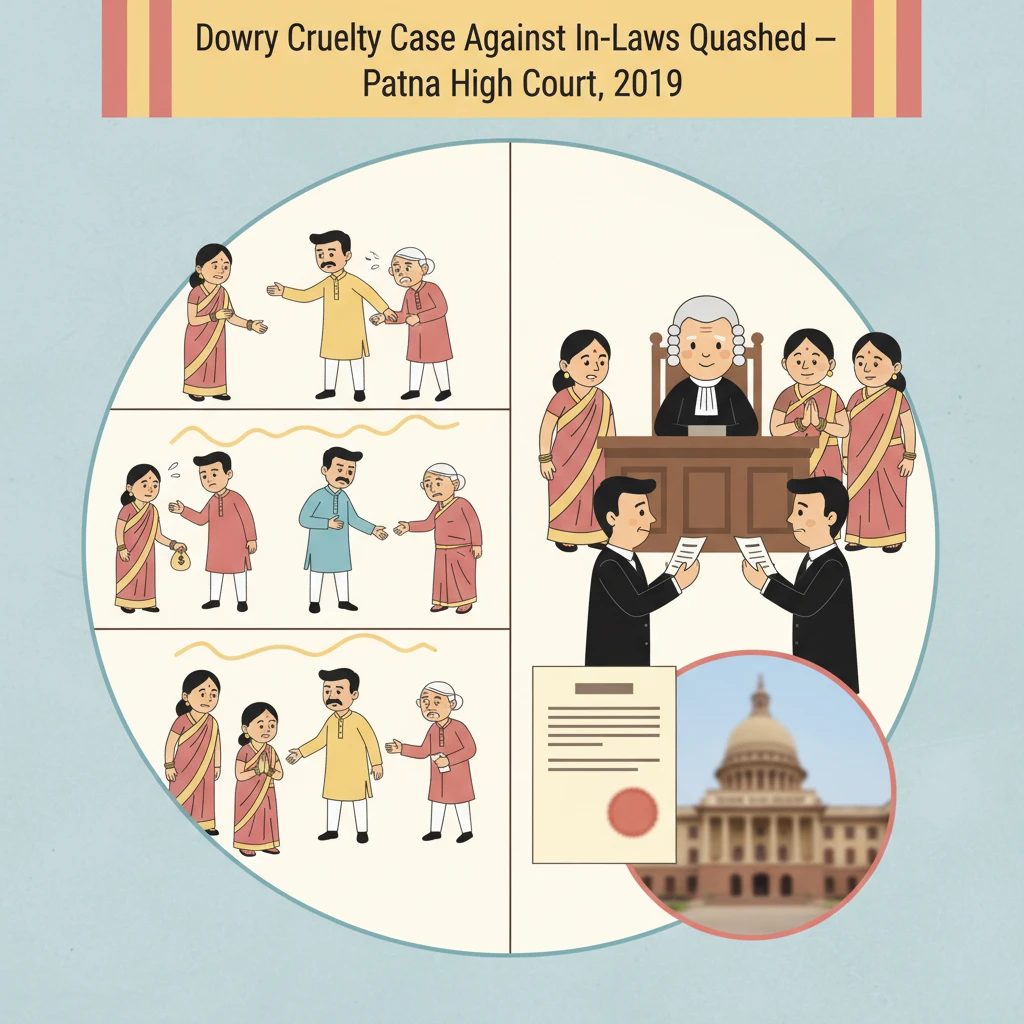
The case began with a complaint filed by Radha Devi before the court at Masaurhi, Patna. She lodged Complaint Case No. 69(C) of 2018 against her husband Dilip Kumar, his parents and his sisters.
In the complaint, she alleged offences under Sections 498-A, 323, 504 and 379/34 of the Indian Penal Code and Sections 3 and 4 of the Dowry Prohibition Act. She stated that her marriage with Dilip Kumar took place on 16.07.2013.
After the wedding and bidai, she went to live at her matrimonial home and stayed there for about six months. Thereafter, according to her complaint, her husband started demanding Rs. 2 lakhs to start a medicine business. When this demand was not met, she alleged that all the accused persons began to torment her.
On getting information about this alleged ill‑treatment, her parental family came to her matrimonial house and tried to persuade the accused persons, but they allegedly did not listen. Her family then took her back to her parental home.
After about six months, according to the complaint, her husband came to her parental home, repeated the demand of Rs. 2 lakhs and abused and tormented her. Later, her father took her back to the matrimonial home, where she claimed the accused again started torturing her in various ways.
Her father then allegedly paid Rs. 30,000 to Dilip Kumar, but she said the harassment on the same demand continued. On learning of this, her father went to the matrimonial home and informed the matter to P.S. Masaurhi, Patna and P.S. Parsa, but according to her, no action was taken. She also alleged that her husband never established conjugal life with her.
On this complaint, the Magistrate recorded her solemn affirmation. After considering the complaint and her statement, the Sub-Divisional Judicial Magistrate, Masaurhi, Patna took cognizance on 12.02.2018 and issued summons against the petitioners and the husband for the offences under Sections 498-A, 323, 504 and 379/34 IPC.
Aggrieved by this order of cognizance and summons, the husband’s mother, father and two sisters approached the Patna High Court by filing Criminal Miscellaneous No. 24052 of 2019 under Section 482 of the Code of Criminal Procedure, seeking to quash the order as an abuse of the process of court.
What the Court Examined and Decided
The petition before the Patna High Court was argued by counsel for the four petitioners, who are the in‑laws of the complainant, and by the learned APP for the State of Bihar. The petitioners did not challenge the case against the husband; they only sought relief for themselves.
The petitioners’ counsel pointed out that:
Petitioner No. 1 is the mother‑in‑law, Petitioner No. 2 is the father‑in‑law, and Petitioners Nos. 3 and 4 are the sisters‑in‑law (nanad) of the complainant. They argued that the complaint contained a specific allegation of dowry demand only against the husband, Dilip Kumar.
As per the petitioners, the only allegation against them was that “all the accused persons” tormented the complainant over the dowry demand. They submitted that this allegation was not specific but general and omnibus in nature, without any clear description of what each petitioner did.
They further contended that the petitioners had never demanded dowry nor subjected the complainant to any specific act of torture. Therefore, the order of cognizance against them, based on such vague allegations, amounted to misuse of the criminal process.
On the other hand, the learned APP for the State opposed the prayer and supported the Magistrate’s order taking cognizance. However, the judgment does not record any detailed argument from the State beyond opposing the prayer.
Justice Prakash Chandra Jaiswal carefully examined the complaint petition and the materials before the Magistrate. The Court noted that there was no specific allegation of demanding dowry against the petitioners. The clear and direct allegation of demand for Rs. 2 lakhs was only against the husband, Dilip Kumar.
The Court found that the only accusation against the petitioners was that they, along with other accused persons, “tormented” the complainant over the dowry demand. This was described as vague and omnibus in nature. In the Court’s considered opinion, such general allegations were not sufficient to put the petitioners on trial.
To support this conclusion, the Patna High Court relied on several important Supreme Court precedents. These decisions cautioned against casually involving all relatives of a husband in dowry and matrimonial cases without clear and specific allegations.
First, the Court referred to Geeta Mehrotra and another vs. State of U.P. and another, (2012) 10 SCC 741, and Preeti Gupta and another vs. State of Jharkhand and another, (2010) 7 SCC 667. In these cases, the Supreme Court held that there must be clear allegations against the husband’s relatives. Vague and omnibus allegations are not enough to compel them to face the agony of a criminal trial.
Next, the Court cited Monju Roy and others vs. State of West Bengal, (2015) 13 SCC 693. There, the Supreme Court observed that even where harassment for dowry is established, there is still a real possibility that all family members are named by way of exaggeration, and courts must be cautious.
The High Court then relied on the landmark judgment in Kans Raj vs. State of Punjab, (2000) 5 SCC 207. The Supreme Court in that case had warned that a tendency had developed to rope in all relations of the in‑laws in dowry death cases. If this tendency is not discouraged, it can weaken the prosecution case against the real culprits. In their enthusiasm to secure conviction of as many people as possible, complainants sometimes implicate distant relatives, which ultimately harms the case.
The Court also quoted from Arnesh Kumar vs. State of Bihar and another, (2014) 8 SCC 273. In that case, the Supreme Court noted the phenomenal increase in matrimonial disputes in recent years and commented that Section 498-A IPC, though enacted to combat harassment of women, had sometimes been misused. It observed that the cognizable and non‑bailable nature of the offence made it a “weapon rather than a shield” in the hands of some disgruntled wives, leading to arrests even of bedridden grandparents and relatives living abroad. The Supreme Court therefore cautioned courts and police to act carefully before proceeding against in‑laws and distant relatives.
The Patna High Court further referred to its own earlier decision in Brijesh Das @ Brijesh Kumar Das and others vs. The State of Bihar and another, 2012 (2) PLJR 545. In that case, this Court had set aside cognizance against in‑laws where there was a specific allegation only against the husband and no statement that other relatives assaulted or specifically ill‑treated the complainant. It had held that vague and omnibus allegations against relatives of the husband are not sufficient to put them on trial.
Applying these principles, Justice Jaiswal concluded that the present case showed a similar pattern. The complaint specifically targeted the husband for the dowry demand, while the allegations against the mother‑in‑law, father‑in‑law and sisters‑in‑law were general, without any clear incident, date or role assigned to each.
The Court held that allowing the criminal proceedings to continue against these petitioners on such vague material would be an abuse of the process of court. Section 482 of the Code of Criminal Procedure empowers the High Court to intervene in such cases to prevent injustice and misuse of criminal law.
Consequently, in the facts and circumstances of the case and in light of the discussions and precedents cited, the Patna High Court quashed the cognizance order dated 12.02.2018 to the extent it related to the four petitioners. The criminal miscellaneous application was allowed.
The judgment does not record any order regarding the husband’s case, which indicates that the proceedings against the husband, Dilip Kumar, were not quashed and may continue as per law.
Why This Judgment Matters
This judgment is significant for families caught in matrimonial disputes and dowry cases. It reinforces that criminal law cannot be used to drag every relative of the husband into court without clear, individual allegations.
For genuine victims of dowry harassment, it sends a clear message: complaints must be specific. Courts will carefully examine whether each accused person is clearly linked to acts of cruelty or dowry demand.
For in‑laws who feel falsely implicated, especially parents‑in‑law and sisters‑in‑law living in the same house, the decision shows that the Patna High Court is willing to use its powers under Section 482 CrPC to stop unnecessary trials based only on vague, omnibus accusations.
At the same time, the judgment does not dilute the seriousness of real dowry offences. The specific allegations against the husband remain untouched. The Court’s approach attempts to strike a balance between protecting women from cruelty and preventing misuse of criminal provisions against innocent relatives.
Legal Issues and Answers
-
Issue: Can a Magistrate’s order taking cognizance against in‑laws in a dowry cruelty case stand when the complaint contains only vague and general allegations against them, while specific dowry demand is alleged only against the husband?
Answer: No. The Patna High Court held that such vague and omnibus allegations are not sufficient to put the in‑laws on trial. It quashed the cognizance order against the mother‑in‑law, father‑in‑law and sisters‑in‑law under Section 482 CrPC.
Cases Cited by the Court
- Geeta Mehrotra and another vs. State of U.P. and another, (2012) 10 SCC 741
- Preeti Gupta and another vs. State of Jharkhand and another, (2010) 7 SCC 667
- Monju Roy and others vs. State of West Bengal, (2015) 13 SCC 693
- Kans Raj vs. State of Punjab, (2000) 5 SCC 207
- Arnesh Kumar vs. State of Bihar and another, (2014) 8 SCC 273
- Brijesh Das @ Brijesh Kumar Das and others vs. The State of Bihar and another, 2012 (2) PLJR 545
Case Details
Case Number: Criminal Miscellaneous No. 24052 of 2019 (arising out of Complaint Case No. 69(C) of 2018)
Case Title: Nirmala Devi & Ors. vs. The State of Bihar & Anr.
Coram: Hon’ble Mr. Justice Prakash Chandra Jaiswal
Date of Judgment: 25.04.2019
Citation: 2019(2) PLJR 1017
Advocates:
- For the Petitioners: Mr. Dhirendra Kumar Sinha, Advocate; Mr. Arun Kumar, Advocate
- For the State (Opposite Party): Mr. Suresh Prasad Singh, APP
Nature of the Case: Petition under Section 482 of the Code of Criminal Procedure seeking quashing of cognizance order in a dowry cruelty complaint case.
Link to Judgment: Click here to view the full judgment of the Patna High Court
If you found this explanation helpful and wish to stay informed about
how legal developments may affect your rights in Bihar,
you may consider following Samvida Law Associates for more updates.







