

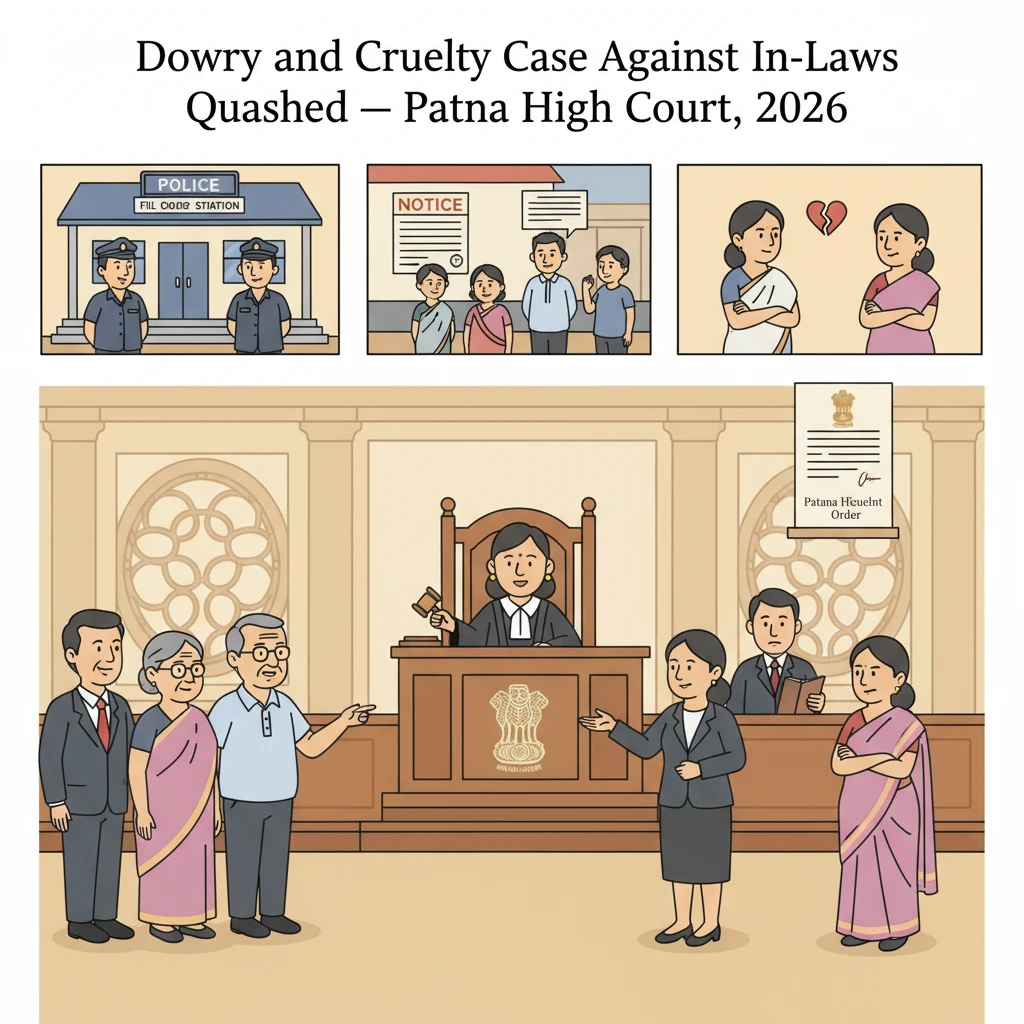
Case Background
A criminal case was registered as Agamkuan P.S. Case No. 476 of 2018 (G.R. No. 3404 of 2018) in Patna. In this case, the woman (opposite party no. 2) lodged a first information report (FIR) alleging dowry demand, torture, physical assault and that her husband had contracted a second marriage.
On the basis of this FIR, the learned A.C.J.M., Patna City, by order dated 19.06.2019, took cognizance of offences under Sections 498A, 494, 341, 323, 504 and 34 of the Indian Penal Code and Section 3/4 of the Dowry Prohibition Act against several accused, including the woman’s in-laws. Summons were issued to them to face trial.
The present petitioners are the father-in-law, mother-in-law, brother-in-law and married sister-in-law of the informant. They approached the Patna High Court in Criminal Miscellaneous No. 12841 of 2020. They asked the Court to quash the cognizance order dated 19.06.2019, so far as it related to them.
The matter was heard by Hon’ble Justice Smt. Soni Shrivastava. Arguments were advanced by counsel for the petitioners, counsel for the informant (opposite party no. 2), and the Additional Public Prosecutor for the State. The oral judgment was delivered on 12.01.2026.
What the Court Examined and Decided
The core question before the Patna High Court was whether the criminal case against the in-laws should continue, or whether it should be stopped at the threshold because of lack of specific allegations.
The petitioners’ counsel argued that the FIR itself showed only general and omnibus allegations against them. According to them, there were no clear statements in the FIR describing any specific act of cruelty, assault or dowry demand by the in-laws.
They also pointed out that the husband of the informant, namely Ranjit Rahul, had taken steps to save the marriage. He had filed Matrimonial Case No. 5481 of 2018 under Section 9 of the Hindu Marriage Act before the Principal Judge, Family Court, Patna for restitution of conjugal rights. Notices were issued to the wife, but she chose not to appear. The family court then proceeded ex parte and passed a decree of restitution of conjugal rights in favour of the husband.
Further, in paragraph 9 of their petition, the in-laws specifically stated that the informant and her husband had been living separately from them. They claimed they had no involvement in the day-to-day affairs of the couple. On this basis, they said the allegations of dowry demand and torture were totally vague and baseless as far as they were concerned. They alleged they had been implicated only because they were relatives of the husband.
On the other side, the State and the counsel for the informant strongly opposed the quashing. They argued that a prima facie case was made out against the accused persons and there was no illegality in the order taking cognizance. Therefore, they said, the High Court should not interfere at this stage.
The High Court closely examined the FIR. It noted that the allegations were general and omnibus in nature. Much of the FIR related to alleged pressure on the informant to apply for a loan for purchasing a house, and to the keeping of some articles belonging to her. A specific allegation about a second marriage was levelled against the husband, Ranjit Rahul.
The informant also alleged that she was a working woman and was ill-treated when she went to her matrimonial house to collect her belongings. However, the Court found that, even taking the FIR at face value, the allegations against the in-laws did not show specific acts of cruelty as required to constitute an offence under Section 498A IPC.
Before applying the law, the Court reproduced Section 498A IPC, which punishes a husband or his relatives who subject a woman to “cruelty”. The provision explains “cruelty” in two parts:
First, any wilful conduct likely to drive the woman to commit suicide or to cause grave injury or danger to her life, limb or health. Second, harassment of the woman with a view to coercing her or her relatives to meet any unlawful demand for property or valuable security, or harassment on account of failure to meet such demand.
The Court observed that the first part covers very serious conduct that can lead to suicide or grave injury. In this case, the FIR did not narrate incidents with such serious and disastrous consequences. Instead, the record showed that it was the informant who had left the matrimonial home and had not participated in the restitution of conjugal rights proceedings. From this, the Court inferred that she did not wish to resume conjugal relations or perform marital obligations.
Regarding the second part of Section 498A, the Court said that harassment for dowry must be shown through a series of acts. These acts must collectively amount to harassment in its real sense. Merely stating that some demands were made, that articles were not returned, and that the wife was asked to take a loan for a house, did not automatically become cruelty and harassment under Section 498A.
Turning specifically to the in-laws, the Court held that the allegations of torture were totally vague, general, omnibus and sweeping. It stressed that when family relationships are dragged into criminal proceedings, courts must be careful and judicious. Criminal law should be used only where there are clear, specific allegations backed by materials that indicate a criminal offence.
The Court emphasised that every act of a dissatisfied or disgruntled wife due to marital discord cannot be treated as cruelty under Section 498A IPC. While protection of genuine victims of domestic violence is important, it does not mean that every family member and relative of the husband can be prosecuted in a general and sweeping manner, without particular accusations.
To support this approach, the Patna High Court relied on several Supreme Court decisions. It referred to the case of Kahkashan Kausar & Ors. v. State of Bihar & Ors., reported in (2022) 6 SCC 599. In that case, the Supreme Court discussed earlier judgments starting from Preeti Gupta & Anr. v. State of Jharkhand & Anr., (2010) 7 SCC 667. The Supreme Court observed that many complaints under Section 498A IPC are filed in the heat of the moment over trivial issues and with oblique motives.
In Kahkashan Kausar, the Supreme Court clearly stated that relatives of the husband should not be forced to face a criminal trial on the basis of general and omnibus allegations. It noted that even an eventual acquittal leaves severe scars on the accused, and therefore such misuse must be discouraged. The Patna High Court quoted paragraph 21 of that judgment, which underlined this concern.
The Patna High Court also relied on the recent Supreme Court decision in Dara Laxmi Narayana v. State of Telangana, (2025) 3 SCC 735. There, the Supreme Court made it clear that family members of the husband should not be unnecessarily roped into criminal proceedings arising from matrimonial disputes, particularly when they live separately. It held that allowing such malicious and motivated prosecutions to continue would be an abuse of the process of court.
This principle was further reiterated by the Supreme Court in Mange Ram v. State of Madhya Pradesh & Anr., (2025) INSC 962. That judgment held that continuing criminal proceedings against family members, especially where specific and proximate allegations are absent, serves no legitimate purpose. In appropriate cases, the power to quash is essential to uphold fairness and bring a quiet end to personal disputes.
The High Court also cited the very recent judgment in Geddam Jhansi & Anr. v. State of Telangana & Anr., 2025 SCC OnLine SC 263. The Supreme Court there discussed the harmful effects of criminalising domestic disputes without specific allegations and credible material. It recognised a growing tendency to implicate relatives who are not truly connected with the alleged harassment, and a tendency to exaggerate domestic disputes by giving them a “criminal colour”.
In Geddam Jhansi, the Supreme Court explained that criminal law, especially in domestic disputes, should be invoked only when particular acts constituting an offence are clearly alleged against each accused. It said that complaints and charges must, as far as possible, be specific against each family member. Merely remaining mute or not helping the victim does not, by itself, make relatives offenders. Implicating every relative without clear allegations and evidence of their active involvement amounts to misuse of the criminal process.
However, the Supreme Court also clarified that genuine cases where relatives have actively participated in cruelty can and should be prosecuted. Courts must assess whether allegations are genuine with specific criminal roles assigned, or whether they are simply a spill-over from matrimonial discord.
Applying all these principles to the present case, the Patna High Court found that the petitioners were in-laws who, according to the record, were living separately from the couple. The allegations against them were non-specific and sweeping. There were no clear instances showing that they subjected the informant to cruelty in the sense required by Section 498A IPC or that they played a definite role in any dowry demand or assault.
Given this factual context and the Supreme Court’s guidance, the High Court concluded that allowing the criminal prosecution against the in-laws to continue would be an abuse of the process of law and would cause grave miscarriage of justice.
Therefore, the Court quashed the impugned order dated 19.06.2019 passed by the A.C.J.M., Patna City in Agamkuan P.S. Case No. 476 of 2018 (G.R. No. 3404 of 2018) so far as it concerned the petitioners. The criminal miscellaneous application filed by the in-laws was allowed.
Why This Judgment Matters
This decision of the Patna High Court is important for families involved in matrimonial disputes where several relatives are named in criminal cases. It underlines that criminal law, especially serious offences like Section 498A IPC and dowry charges, cannot be used casually against every member of the husband’s family.
For genuine victims of domestic violence, the judgment does not take away their protection. It only insists that allegations must be specific and supported by material. Courts will still protect victims where clear, concrete acts of cruelty and dowry harassment are shown.
For in-laws and extended family members, the ruling gives reassurance that if they are living separately and have no specific role in the alleged cruelty, they should not be dragged into criminal trials based only on broad, angry accusations.
More broadly, the judgment reinforces the Supreme Court’s repeated warning that criminalising ordinary domestic disputes without proper basis can damage families and cause deep injustice. It shows that the Patna High Court will step in to prevent misuse of criminal law and to uphold fairness in matrimonial litigation.
Legal Issues and Answers
- Issue: Do the general and omnibus allegations in the FIR make out an offence of cruelty and dowry harassment under Section 498A IPC and Section 3/4 of the Dowry Prohibition Act against the in-laws?
Answer: No. The Court held that the allegations did not show specific acts of cruelty or harassment of the nature required by Section 498A IPC, especially when the informant herself had left the matrimonial home and the in-laws were living separately. - Issue: Should the criminal proceedings against the in-laws be allowed to continue despite the lack of specific allegations?
Answer: No. Relying on Supreme Court precedents, the Court held that continuing the prosecution would be an abuse of the process of law and would cause grave miscarriage of justice, so the cognizance order against the petitioners was quashed.
Cases Cited by the Court
- Kahkashan Kausar & Ors. v. State of Bihar & Ors., (2022) 6 SCC 599
- Preeti Gupta & Anr. v. State of Jharkhand & Anr., (2010) 7 SCC 667
- Dara Laxmi Narayana v. State of Telangana, (2025) 3 SCC 735
- Mange Ram v. State of Madhya Pradesh & Anr., (2025) INSC 962
- Geddam Jhansi & Anr. v. State of Telangana & Anr., 2025 SCC OnLine SC 263
Case Details
Case Number: Criminal Miscellaneous No. 12841 of 2020 (arising out of Agamkuan P.S. Case No. 476 of 2018, G.R. No. 3404 of 2018)
Case Title: Chandra Bhushan Prasad & Ors. v. The State of Bihar & Anr.
Citation: 2026 (3) PLJR 80
Court: High Court of Judicature at Patna
Coram: Hon’ble Justice Smt. Soni Shrivastava
Date of Judgment: 12-01-2026
Advocates:
- For the petitioners: Md. Anisur Rahman, Advocate; Md. Khalid Anwar, Advocate
- For the State: Mr. Ram Priya Sharan Singh, Advocate
- For Opposite Party No. 2: Mr. Radha Mohan Singh, Advocate; Mr. Dewendra Nr. Singh, Advocate; Mr. Utsav Anand, Advocate
Nature of the Case: Petition under criminal miscellaneous jurisdiction seeking quashing of order taking cognizance in a case under Sections 498A, 494, 341, 323, 504, 34 IPC and Section 3/4 of the Dowry Prohibition Act.
Link to Judgment: Click here to read the full Patna High Court judgment
If you found this explanation helpful and wish to stay informed about
how legal developments may affect your rights in Bihar,
you may consider following Samvida Law Associates for more updates.







