
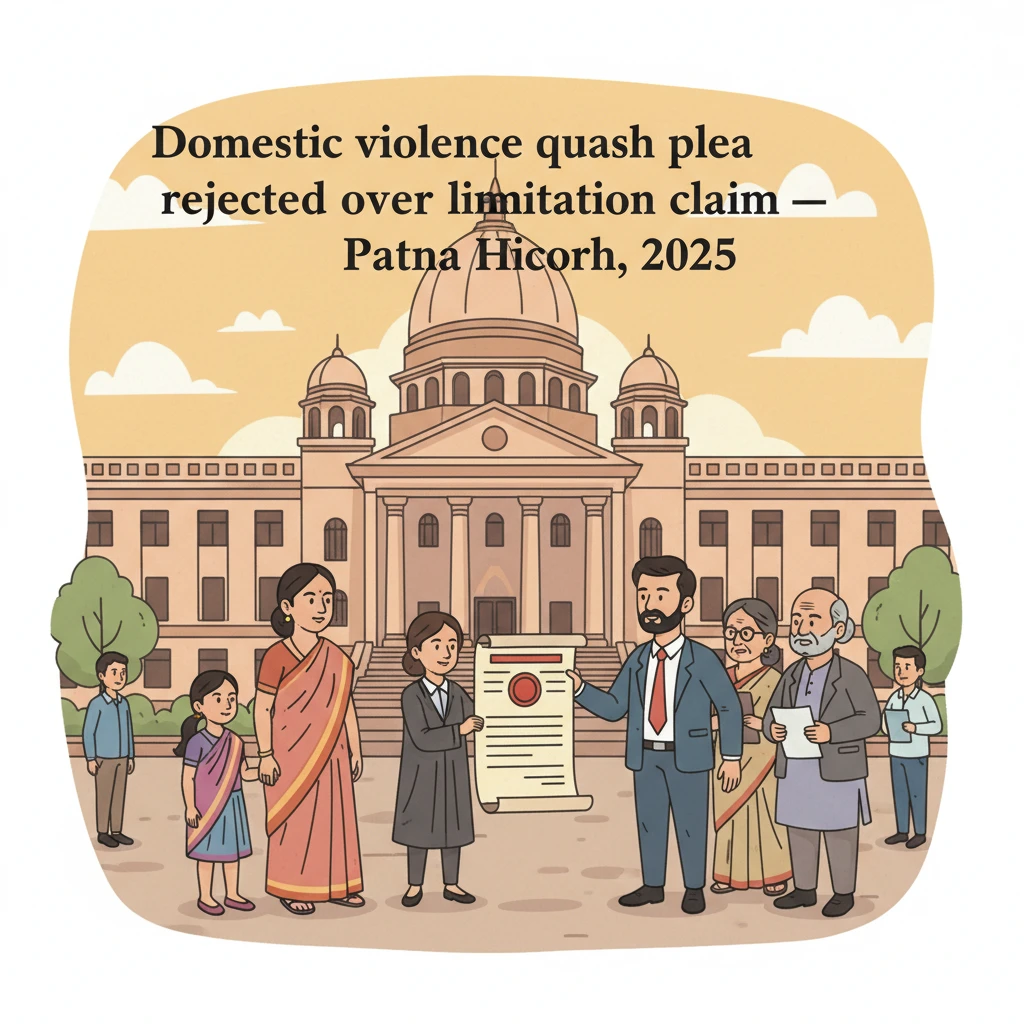
Case Background
The case arises from a matrimonial dispute between a wife (opposite party no. 2) and her husband (petitioner no. 1) under the Protection of Women from Domestic Violence Act, 2005.
The wife alleged that her marriage with the husband was solemnised on 07.12.2009 at Patna as per Hindu rites and rituals. A daughter was born to them on 24.12.2010. According to her complaint, after some time the husband started subjecting her to physical and mental harassment by demanding money from her parents to buy a house in Bengaluru. When this demand was not fulfilled, she alleged that she was ousted from the shared household at Bengaluru.
The wife stated that she has no personal income. She alleged that her husband is a software engineer, earning about Rs. 5 lakhs per month and living a luxurious life while not providing any financial support to her and their daughter.
On these allegations, she filed a case under Section 12 of the Domestic Violence Act, registered as Domestic Violence Case No. 4 of 2023 before the court of the learned A.C.J.M.-II, Danapur. On 31.10.2023, the trial court passed an order granting interim maintenance of Rs. 35,000 per month, cumulatively for the wife and the minor daughter, from the date of the application.
Before this domestic violence case, there were already multiple litigations between the parties. The husband had filed a divorce case being Matrimonial Case No. 1335 of 2015, renumbered as 168 of 2024, before the Principal Family Judge, Bengaluru, which has now been transferred to the Principal Judge, Family Court, Patna by order of the Supreme Court.
In response, the wife had earlier filed Complaint Case No. 1684 of 2016 before the Chief Judicial Magistrate, Patna, alleging offences under Sections 323, 324, 354 and 498-A read with Section 34 of the Indian Penal Code and Sections 3 and 4 of the Dowry Prohibition Act. Cognizance in that case was taken only against the husband for the offence under Section 498-A IPC, and the allegations against the other family members were found to be false.
The wife had also filed Maintenance Case No. 280(M) of 2015 before the Additional Principal Judge, Family Court, Patna. Vide order dated 26.02.2018, she was granted maintenance of Rs. 4,000 per month.
In this background, the husband and his family members (petitioners) approached the Patna High Court in Criminal Miscellaneous No. 46935 of 2024 under Section 482 of the Criminal Procedure Code (CrPC). They sought quashing of the entire proceedings of Domestic Violence Case No. 4 of 2023, primarily on the ground of limitation and alleged misuse of process.
What the Court Examined and Decided
The Patna High Court, through Hon’ble Mr. Justice Chandra Shekhar Jha, heard arguments from both sides. The main question was whether Domestic Violence Case No. 4 of 2023 was barred by limitation under Section 468 of the CrPC, as claimed by the petitioners, and whether the proceedings should be quashed under Section 482 CrPC.
On behalf of the petitioners, senior counsel Mr. Rajendra Narain argued that the complaint was filed “almost with a delay of eight years” from the alleged incident. Therefore, according to him, Section 468 CrPC—which fixes time limits for taking cognizance of certain offences—made the case time-barred.
He also submitted that most of the petitioners are distant relatives, such as married daughters of the family, who had been married long before the complainant’s marriage. They are residing separately in other places and, according to the petitioners, have no connection with the daily or domestic affairs of the complainant and her husband.
Mr. Narain further argued that the domestic violence complaint under Section 12 of the Act was a retaliatory step. He pointed out that:
- the husband had filed the divorce case earlier;
- the wife had responded with Complaint Case No. 1684 of 2016, in which cognizance was taken only against the husband and not the other family members; and
- the wife was already getting Rs. 4,000 per month as maintenance in Maintenance Case No. 280(M) of 2015.
According to the petitioners, after keeping silent for nearly seven years, the wife suddenly filed the domestic violence case in 2023 without any fresh cause of action and without explaining the delay. They alleged that the present case was filed out of “vengeance” and “oblique and ulterior motive” to harass innocent family members, particularly because no cognizance had earlier been taken against them.
The petitioners relied on the Supreme Court decision in Shaurabh Kumar Tripathi vs. Vidhi Rawal [2025 SCC OnLine SC 1158] to submit that proceedings under the Domestic Violence Act can be quashed by the High Court using its inherent powers under Section 482 CrPC.
On the other hand, senior counsel Mr. Ramakant Sharma, appearing for the wife (opposite party no. 2), opposed the petition. He submitted that the entire challenge was centred around limitation under Section 468 CrPC, but this was “misconceived and unfounded” in view of the scheme of the Domestic Violence Act itself.
Mr. Sharma argued that under the Domestic Violence Act, simply filing an application under Section 12 does not itself amount to an offence. The Act creates an offence only when there is a breach of an order for protection or other relief passed by the Magistrate. Section 31 of the Act makes breach of such order a punishable offence.
He submitted that therefore, limitation under Section 468 CrPC applies only from the date of commission of the offence of breach of an order, not from the date of domestic violence itself or the date of filing the Section 12 application. To support this, he relied on the Supreme Court judgment in Kamatchi vs. Lakshmi Narayanan [(2022) 15 SCC 50].
Mr. Sharma also pointed out that the husband had even questioned the legitimacy of the female child and sought a DNA test, which was rejected by the trial court on 23.03.2024 in the pending divorce proceedings. He emphasized that there is no protection order yet in the domestic violence case, and both parties have been directed by the trial court to co-operate for early disposal. He again highlighted that the husband, earning in lakhs per month, was ignoring the needs of the wife and their Class X student daughter, who also suffers from ailments, while the maintenance of Rs. 4,000 per month was too meagre.
The High Court then considered the detailed order of the A.C.J.M.-II, Danapur, dated 31.10.2023, which had granted interim maintenance. In that order, the trial court noted that:
- the marriage and birth of the minor daughter were admitted;
- the wife was currently unemployed and living with her daughter within the jurisdiction of the Danapur court after being denied the right to live at her matrimonial home;
- the opposite parties did not claim to have been maintaining the wife and child after separation, except for the Rs. 4,000 maintenance from the Family Court; and
- the opposite parties had not filed any affidavit regarding income, whereas the wife had filed an affidavit as per the Supreme Court’s directions in Rajnesh vs. Neha.
Based on this material and relying on Rajnesh vs. Neha and Neha Tyagi vs. Lt. Col. Deepak Tyagi, the trial court had directed the husband to pay Rs. 35,000 per month as interim maintenance for the wife and daughter, from the date of the application, till final disposal of the case.
Turning to the legal issue of limitation, the High Court reproduced key paragraphs (17, 18, 19, 28, 29, 30) from the Supreme Court’s decision in Kamatchi vs. Lakshmi Narayanan. The Supreme Court had clarified:
- Section 468 CrPC speaks about limitation for taking cognizance of an offence, but where the complaint is filed within time and cognizance is delayed due to court procedure, the complaint should not fail for reasons beyond the complainant’s control.
- Under the Domestic Violence Act, proceedings start with an application under Section 12. After hearing both sides, the Magistrate may pass an order. Only breach of that order is an offence under Section 31 of the Act.
- Therefore, for cases under the Domestic Violence Act, limitation under Section 468 CrPC begins only when the offence of breach of order is committed, not from the date of domestic violence or the filing of the Section 12 application.
- The Supreme Court held that the High Court in that case had erred in treating the Section 12 application like a criminal complaint requiring filing within a year of the last act of domestic violence.
Applying the above law, the Patna High Court recorded that in the present case, there was no cognizance order under Section 31(1) of the Domestic Violence Act at all. No offence of breach of a protection order or other relief had yet been alleged or taken cognizance of.
In such a situation, the Court held that the limitation under Section 468 CrPC “is not applicable,” and the plea to quash the domestic violence case on the sole ground of delay in filing was “unfounded.”
The High Court thus found no merit in the petition under Section 482 CrPC. It dismissed the petition and refused to interfere with Domestic Violence Case No. 4 of 2023 or with the interim maintenance order.
However, the Court did not leave the matter there. Recognising that the domestic violence case was still pending, the Court directed the trial court to “expedite the proceeding in accordance with law.” It also directed that a copy of the High Court’s judgment be communicated to the trial court forthwith.
Why This Judgment Matters
This judgment of the Patna High Court is important for women facing domestic violence and also for families involved in such disputes.
First, it makes clear that a woman’s right to seek relief under the Domestic Violence Act is not blocked simply because several years have passed since the alleged acts of violence. The Court has followed the Supreme Court’s ruling that limitation under Section 468 CrPC does not apply to the filing of an application under Section 12 of the Act.
Second, the judgment reassures complainants that even if there are parallel proceedings—such as a divorce case, a criminal 498-A case, and a maintenance case—they can still approach the Magistrate under the Domestic Violence Act for protection, residence, or more realistic maintenance.
Third, the decision sends a signal that the High Court will be slow to quash domestic violence proceedings at an early stage purely on technical grounds like limitation, especially where there is no cognizance of any offence of breach of order yet.
For husbands and in-laws, the judgment is a reminder that allegations of delay or multiple cases, by themselves, will not be enough to get a domestic violence case thrown out under Section 482 CrPC. The proper place to test the truth and timing of allegations is before the trial court.
The direction to expedite the trial also aims to ensure that both sides get an early and final decision instead of remaining stuck in long-drawn proceedings.
Legal Issues and Answers
- Issue: Can a domestic violence case filed under Section 12 of the Protection of Women from Domestic Violence Act, 2005 be quashed under Section 482 CrPC on the ground that it is barred by limitation under Section 468 CrPC because it was filed years after the alleged acts of domestic violence?
Answer: No. The Patna High Court held that limitation under Section 468 CrPC does not apply to the filing of an application under Section 12 of the Domestic Violence Act. Under the Act, only breach of an order passed by the Magistrate (under Section 12) constitutes an offence under Section 31, and limitation would run, if at all, from the date of such breach. As there was no cognizance under Section 31(1) in this case, the limitation provision was inapplicable and the quashing plea on that ground was rejected.
Cases Cited by the Court
- Kamatchi vs. Lakshmi Narayanan, (2022) 15 SCC 50 – relied upon to hold that limitation under Section 468 CrPC does not govern the filing of an application under Section 12 of the Domestic Violence Act and that only breach of an order under the Act is an offence for limitation purposes.
- Sarah Mathew vs. Institute of Cardio Vascular Diseases, (2014) 2 SCC 62 – referred to within Kamatchi for interpretation of Section 468 CrPC on when limitation ends.
- Adalat Prasad vs. Rooplal Jindal, (2004) 7 SCC 338 – discussed in Kamatchi to clarify that its ratio on quashing after taking cognizance does not apply at the stage of notice under Section 12 of the Domestic Violence Act.
- Rajnesh vs. Neha, Criminal Appeal No. 730 of 2020 – cited in the trial court’s interim order (reproduced by the High Court) on guidelines for grant of maintenance and requirement of income affidavits.
- Neha Tyagi vs. Lt. Colonel Deepak Taygi, Civil Appeal No. 6332 of 2021 – cited in the trial court’s order for the principle that a husband cannot escape his responsibility to maintain his minor child.
- Shaurabh Kumar Tripathi vs. Vidhi Rawal, 2025 SCC OnLine SC 1158 – relied upon by petitioners to argue that domestic violence proceedings can be quashed under Section 482 CrPC.
Case Details
Case Number: Criminal Miscellaneous No. 46935 of 2024; arising out of Domestic Violence Case No. 4 of 2023 (PS Case No. 4 of 2023, Domestic Violence, District – Patna)
Case Title: Abhishek Kumar Chandan & Ors. vs. The State of Bihar & Anr.
Citation: 2025(3) PLJR 843
Coram: Hon’ble Mr. Justice Chandra Shekhar Jha
Advocates:
- For the Petitioners: Mr. Rajendra Narain, Senior Advocate; Mr. Sanjay Kumar Sharma, Advocate
- For the State of Bihar: Md. Mushtaque Alam, APP
- For Opposite Party No. 2: Mr. Ramakant Sharma, Senior Advocate; Mr. Ranjan Kumar Sinha, Advocate; Ms. Seema Kumari, Advocate; Ms. Jyoti Kumari, Advocate
Nature of the Case: Petition under Section 482 of the Code of Criminal Procedure seeking quashing of proceedings in a domestic violence application (Domestic Violence Case No. 4 of 2023) filed under Section 12 of the Protection of Women from Domestic Violence Act, 2005, including challenge indirectly to an interim maintenance order.
Date of High Court Judgment: 05.08.2025
CAV Date: 16.07.2025
AFR/NAFR: AFR
Link to Judgment: Patna High Court Judgment – Criminal Miscellaneous No. 46935 of 2024
If you found this explanation helpful and wish to stay informed about how legal developments may affect your rights in Bihar, you may consider following Samvida Law Associates for more updates.







