
Case Background
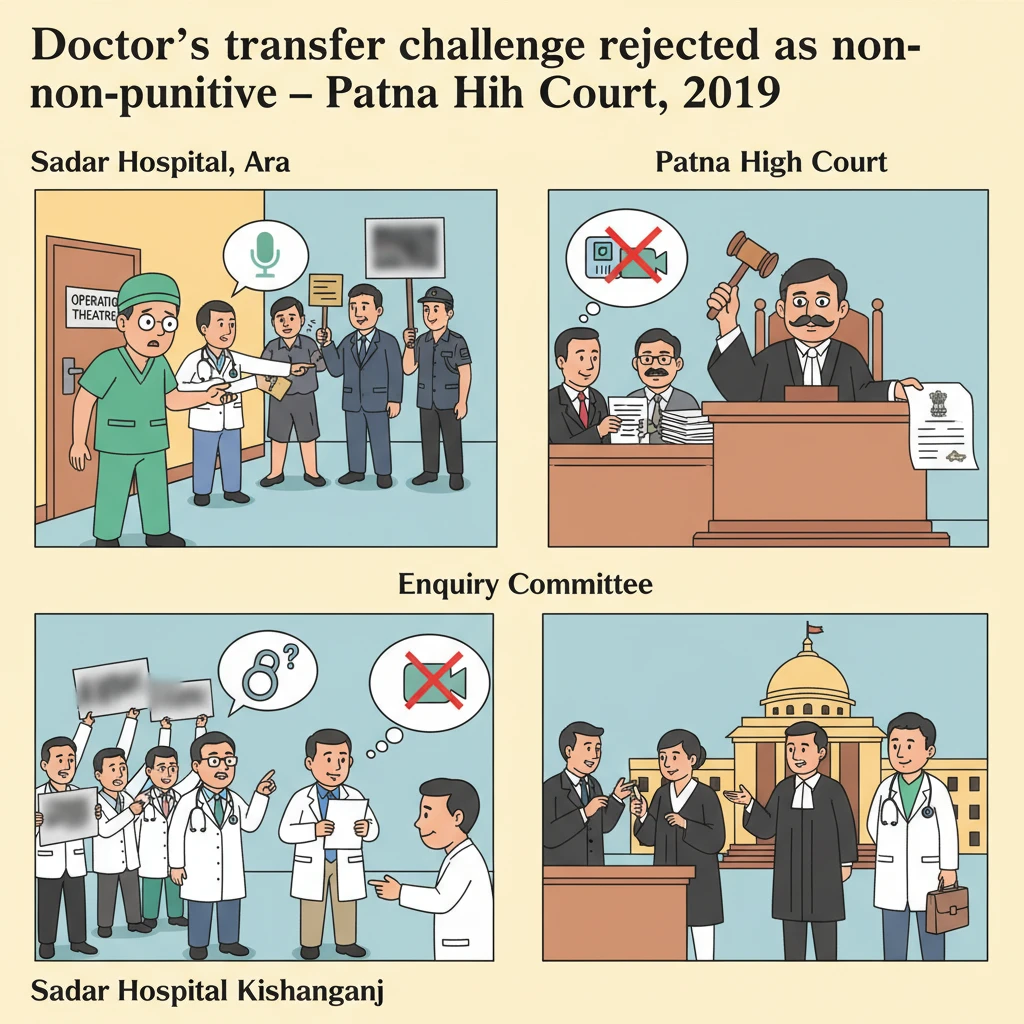
The case arose from a transfer order dated 26.02.2019, issued by the Joint Secretary, Department of Health, Government of Bihar, through Memo No. 775(2). By this order, the petitioner, a Medical Officer posted at Sadar Hospital, Ara (Arah), was transferred to Sadar Hospital, Kishanganj, along with transfers of other doctors.
The petitioner filed a writ petition before the Patna High Court under its civil writ jurisdiction, challenging this transfer order. He claimed that, although the order stated it was passed on “administrative grounds”, the real reason was different and connected with a dispute between doctors and the District Magistrate of Bhojpur at Ara.
The background dispute related to efforts by the District Magistrate to enforce discipline in Sadar Hospital, Ara. The District Magistrate wanted to ensure that government doctors were present during hospital hours and not engaged in private practice. For this, he insisted that the doctors mark their attendance by biometric method and later appear twice in video conference with him. These measures were strongly opposed by the doctors.
On one particular day, when the District Magistrate attempted to summon the doctors, confusion broke out. Some doctors believed, wrongly, that the petitioner, who was then in the operation theatre, had been arrested. This misunderstanding was fuelled by a misleading response from one doctor, Dr. Naresh. As a result, the doctors protested against the District Magistrate and his security personnel, and both sides later made complaints against each other at various fora.
An Enquiry Committee of three members was set up on 27.11.2018, about a week after the hospital incident. After examining doctors and other stakeholders, the Committee submitted its report on 13.12.2018. The Committee concluded that the incident occurred mainly because the doctors were insisting on not marking their presence through video conferencing. The report also held that, although the doctors had not behaved professionally, the District Magistrate was also largely responsible for the chaos in the hospital.
What the Court Examined and Decided
The central question before the Patna High Court was whether the petitioner’s transfer from Sadar Hospital, Ara to Sadar Hospital, Kishanganj was a punitive transfer arising from the November 2018 confrontation, disguised as an administrative transfer.
The petitioner argued that the transfer order was cleverly drafted. On its face, it referred only to administrative grounds. However, according to him, if one “lifted the veil” of language, it would reveal a punitive, “venomous and malevolent” action aimed at punishing him for the dispute with the District Magistrate.
The Court carefully considered this submission. It noted that the transfer order was passed in February 2019, a few months after the November 2018 incident and the December 2018 enquiry report. The petitioner’s counsel tried to link the transfer directly to that incident, suggesting that the District Magistrate was instrumental in having the petitioner shifted out as a form of punishment.
However, the Court found that beyond the background of dispute between the doctors and the District Magistrate, there was no material on record to show any concrete link between the specific hospital incident and the transfer order. The Court observed that the only available facts were the earlier conflict and the subsequent enquiry report, which spoke of both sides being at fault to varying degrees.
Importantly, the enquiry report itself did not recommend or record any specific punitive action such as transfer against the petitioner. It merely narrated how the incident had unfolded, blamed the doctors’ insistence on avoiding video-conference attendance, and also held the District Magistrate partly responsible.
In this context, the Patna High Court considered the well-settled legal position that courts should be very slow to interfere in matters of transfer of government servants. Transfer is normally treated as an incident of service and a matter for the administration, not the courts, unless there is a clear legal or constitutional violation.
The Court declined to restate the entire law on transfer, remarking that it is “too well established” to be recounted in the order. It nevertheless applied the core principle: a transfer order can be interfered with only if it is clearly mala fide, arbitrary, or issued by an authority having no power to do so.
Even if the petitioner’s assumption that the order might have been influenced by the hospital incident was accepted at face value, the Court emphasised that there was no “direct linkage” shown by any material. In the absence of proof that the transfer was designed specifically to punish the petitioner for insubordination or for his role in the November 2018 incident, the Court held that it would be difficult to treat the transfer as punitive.
The Court further noted that the petitioner had been posted at Ara Sadar Hospital for the last fifteen years. In service law, no employee, including a doctor, can claim a right to remain indefinitely at one place. The long tenure at one station actually weakened the petitioner’s challenge, because it supported the Department’s stand that a transfer could also be justified on plain administrative grounds.
Therefore, the Court rejected the petitioner’s primary prayer to quash or forestall the transfer order. The writ petition, as far as it sought cancellation of the transfer, was dismissed.
However, the case did not end there. The petitioner’s counsel, Ms. Nivedita Nirvikar, advanced an alternative plea. She submitted that, prior to the issuance of the transfer order, the petitioner had already made a representation to the authorities. In that representation, the petitioner had stated that he had no particular interest in continuing at Ara, but had requested that the transfer, if any, be reconsidered to some other place, preferably Patna.
In support of this alternative request, counsel produced documents before the Court indicating that the petitioner was suffering from heart disease and his health was deteriorating. These documents were placed on record and accepted by the Court.
On this limited point, the Court showed sympathy. It observed that the prayer for consideration of his representation, in view of his medical condition, was not unreasonable. Rather than deciding where the petitioner should be posted, the Court chose to direct the competent authority to reconsider the issue.
The Court held that while the petitioner must join at his transferred place of posting in Kishanganj within the time specified, it would remain open to him to file a fresh representation. This fresh representation was to be addressed to the Principal Secretary, Department of Health, Government of Bihar, Patna, within two weeks from the date of the judgment. The petitioner was directed to annex a copy of the Court’s order and all documents showing his heart ailment and the need for him to remain in constant touch with his doctor for treatment.
The Court then gave clear directions to the Principal Secretary. Upon receiving such a representation, the Principal Secretary must examine it “in correct perspective”, without being “unduly influenced by the hullabaloo” that occurred at Sadar Hospital, Ara, where some part of the blame had been placed on the petitioner. The Principal Secretary was instructed to dispose of the representation “like a model employer”, by a reasoned order, within a further period of two weeks.
Thus, the Patna High Court balanced two aspects: on the one hand, it refused to interfere with the administrative decision of transfer in the absence of clear proof of malice; on the other, it protected the petitioner’s right to have his genuine medical difficulties fairly considered by the top authority of the Health Department.
With these observations and directions, the writ petition was dismissed on 15.04.2019.
Why This Judgment Matters
This judgment is significant for government employees, especially doctors in Bihar, who feel that a transfer is being used as punishment. The Patna High Court has underlined that without solid, direct proof connecting the transfer to a disputed incident, the Court will not interfere. Mere suspicion or hostile background between the employee and a superior officer is not enough.
At the same time, the judgment shows that employees with serious health problems are not without remedy. The Court recognised the petitioner’s heart disease and ensured that his case for a different posting would be considered quickly and fairly, without bias arising from previous disputes.
For administrators, the judgment reinforces that transfer is a normal tool of management, particularly when an employee has remained in one station for many years. However, the direction to act “like a model employer” is a reminder that decisions on representations, especially when supported by medical evidence, must be reasoned, humane, and free from personal animosity.
Legal Issues and Answers
-
Issue: Was the petitioner’s transfer from Sadar Hospital, Ara to Sadar Hospital, Kishanganj a punitive transfer arising out of the November 2018 hospital incident with the District Magistrate?
Answer: No. The Court found no direct material linking the transfer order to the incident and held that the transfer could not be treated as punitive. -
Issue: Could the Patna High Court quash the transfer order on the ground that it was mala fide or arbitrary?
Answer: No. Applying the settled law that judicial interference in transfer matters is limited, the Court declined to quash the order, particularly as the petitioner had served at Ara for about fifteen years. -
Issue: Was the petitioner entitled to have his health-based representation on posting considered by the State authorities?
Answer: Yes. The Court directed the Principal Secretary, Health Department, to consider a fresh representation with medical documents and to pass a reasoned order within two weeks, acting like a model employer.
Cases Cited by the Court
- No specific earlier judgments are cited or relied upon in the text of this order. The Court only refers generally to the “well established” law on transfer.
Case Details
Case Number: Civil Writ Jurisdiction Case No. 5228 of 2019
Case Title: Dr. Tamseel Ahmad Ansari v. The State of Bihar & Ors.
Coram: Hon’ble Mr. Justice Ashutosh Kumar
Date of Judgment: 15.04.2019
Citation: 2019(2) PLJR 1050
Advocates:
- For the Petitioner: Ms. Nivedita Nirvikar, Advocate
- For the Respondents (State of Bihar and others): Mr. Neeraj Kumar, AC to GA-10
Nature of the Case: Writ petition under civil writ jurisdiction challenging a transfer order of a government doctor.
Impugned Order: Transfer order dated 26.02.2019 issued by the Joint Secretary, Department of Health, Government of Bihar, contained in Memo No. 775(2).
Final Outcome: Writ petition dismissed; transfer not quashed. Liberty given to the petitioner to file a fresh representation on medical grounds before the Principal Secretary, Department of Health, to be decided by a reasoned order within two weeks.
Link to Judgment: Patna High Court Judgment in CWJC No.5228 of 2019
If you found this explanation helpful and wish to stay informed about
how legal developments may affect your rights in Bihar,
you may consider following Samvida Law Associates for more updates.







