

Case Background
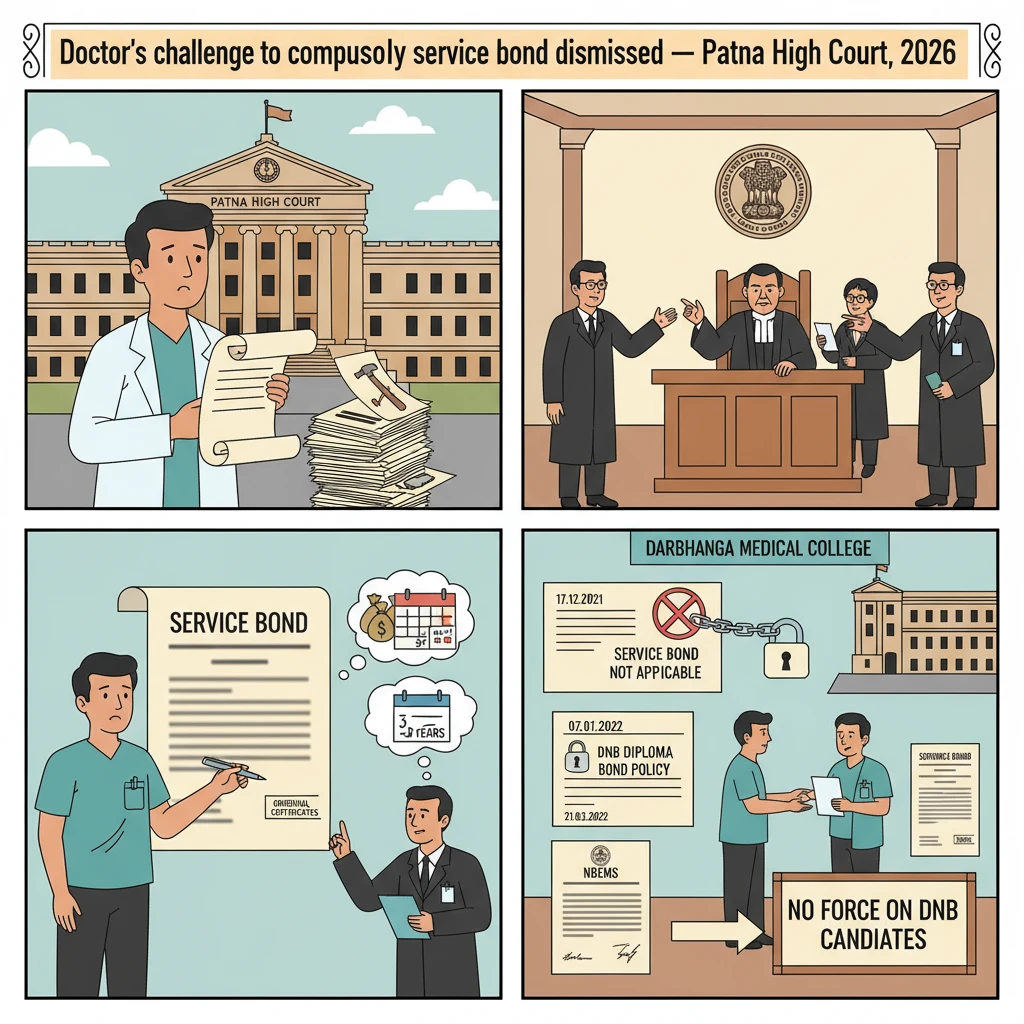
The case concerns a doctor who completed a Post Diploma DNB course in Dermatology at Darbhanga Medical College for the session 2021-23. He had qualified the Post Diploma CET and was allotted Darbhanga Medical College by the National Board of Examination in Medical Sciences (NBEMS). He joined the course on 11.03.2022 and, at the time of admission, submitted his original MBBS degree certificate, diploma certificate, Medical Council registration certificate, diploma mark-sheet and National Medical Council recognition certificate. These originals were retained by the college.
Before admission, there was confusion about whether DNB/Diploma candidates had to sign a service bond with the State Government. The Principal of Darbhanga Medical College, by Memo No. 4759 dated 17.12.2021, informed that a service bond for DNB/Diploma candidates was “not applicable till now” and that any further decision of the Health Department, Government of Bihar, would be communicated. That letter clarified that service bonds were then applicable only to PG Degree and Diploma candidates.
Meanwhile, the Health Department, Government of Bihar, issued Memo No. 03(I) dated 03.01.2022 in response to a query from the Civil Surgeon-cum-Member Secretary, District Health Society, East Champaran. This memo referred to accreditation of the DNB diploma course as per NBEMS and directed that the fixed stipend for DNB diploma students be paid. It also stated that other conditions in Departmental Resolution No. 450(1) dated 15.04.2017, read with Corrigendum Letter No. 479(1) dated 26.04.2017, including requirement of undergoing a service bond, would apply.
The doctor says that despite the earlier clarification from the Principal, he was coerced to sign the service bond at the time of admission in the Post Diploma DNB course. Because there was no time to seek immediate clarification from NBEMS, he made a complaint to NBEMS about the service bond. NBEMS then wrote to the Principal, Darbhanga Medical College, stating that DNB students could not be forced to deposit a bond. This communication dated 21.03.2022 was placed on record in the case.
During the course of training, the doctor also informed the Additional Chief Secretary, Health Department, about the alleged coercion by college authorities to make him sign the bond, but no decision was taken. After completion of the Post Diploma DNB training (session 2021-23), he requested the Principal to release his original certificates. The Principal sought guidelines from the State authorities about release of documents, but no decision came due to absence of a specific guideline. As a result, the certificates remained withheld.
In this situation, the doctor first approached the Patna High Court in C.W.J.C. No. 10663 of 2024. He sought a direction to the Principal to release his original documents and allow him to pursue further studies, and also asked the Court to direct adherence to NBEMS instructions on conditions for admission in Post MBBS DNB and Post Diploma DNB courses in Bihar.
On 08.08.2024, the earlier writ petition was disposed of. The Court directed the doctor to file a detailed representation before the Additional Chief Secretary, Health Department, Bihar, with all supporting documents. The Additional Chief Secretary was told to pass a reasoned and speaking order after giving proper opportunity to the petitioner.
The doctor submitted his representation, but the Health Department rejected his claim by order contained in letter No. 735(17) dated 16.08.2024. This rejection order is the primary order under challenge in the present writ petition, C.W.J.C. No. 15180 of 2024.
In the meantime, the Officer on Special Duty, Health Department, issued Memo No. 848(17) dated 13.09.2024 posting the doctor as Medical Officer for three years at Sub-Divisional Hospital, Mahua, Vaishali, in terms of Departmental Letter No. 3(1) dated 03.01.2022 read with Resolution No. 450(1) dated 15.04.2017 and Corrigendum Letter No. 479(1) dated 26.04.2017. The doctor challenged this posting order as well, as it treated him as bound by the compulsory service bond.
What the Court Examined and Decided
The Patna High Court, through Hon’ble Mr. Justice Harish Kumar, heard arguments from the doctor’s side, the State of Bihar, and NBEMS (respondent nos. 8 and 9). The central question was whether the State’s bond policy under Resolution No. 450(1) dated 15.04.2017 and Corrigendum Letter No. 479(1) dated 26.04.2017 legally applied to a Post Diploma DNB candidate like the petitioner for session 2021-23, and whether the impugned rejection and posting orders were valid.
The doctor’s counsel argued that the Health Department, while rejecting his representation, failed to consider NBEMS directions. NBEMS had clearly instructed that Post Diploma DNB candidates could not be forced to undergo a service bond. Therefore, the State’s insistence on a bond and the rejection of his claim were said to be illegal, arbitrary and violative of Article 14 of the Constitution of India.
It was further argued that Departmental Letter No. 3(1) dated 03.01.2022 had been misread. According to the petitioner, this letter did not support compelling a Post Diploma DNB candidate to do compulsory service. At the time when he took admission, there was no provision requiring such candidates to sign a service bond. Only later, through Notification No. 640(1) dated 24.09.2024, did the Health Department first clarify that courses under the DNB cluster (Post MBBS DNB, Diploma DNB and Post MBBS Diploma) were covered by the bond policy under Resolution dated 15.04.2017, Corrigendum dated 26.04.2017 and Resolution dated 27.08.2019.
Because his admission and course (session 2021-23) were earlier in time, the petitioner argued that the 24.09.2024 notification could not apply to him retrospectively. He also alleged that his original documents were being illegally withheld by the Principal only to force him to accept the bond and service posting.
NBEMS, in its counter affidavit, confirmed that Darbhanga Medical College had informed it that there was no service bond for DNB/Diploma candidates at the time of joining. On that basis, NBEMS instructed the college that candidates could not be forced to deposit a bond. The letter dated 21.03.2022 evidencing this instruction was produced before the Court.
The State of Bihar, however, took a different stand. Through its counsel, the State explained that it had taken a policy decision under Departmental Resolution No. 450(1) dated 15.04.2017 and Corrigendum Letter No. 479(1) dated 26.04.2017 to implement a bond system. Under this system, post graduate candidates from State medical colleges were required to render three years of compulsory service in Bihar. If they did not, they had to pay Rs. 25,00,000 along with refund of the entire salary/stipend paid to them in a lump sum.
The State justified the policy as a response to pressing circumstances. Many students used to leave their PG or Post Diploma courses midway after taking admission, causing vacant seats and a shortage of specialist doctors. According to the State, the petitioner had, with open eyes, signed the bond at the time of admission. Having taken the benefit of subsidised medical education and stipend, he could not later challenge the bond’s conditions. The State also argued that his claim was barred by estoppel because he was fully aware of the bond terms when he executed it.
Before deciding the case, the Court set out the legal background on compulsory medical service bonds, relying on the Supreme Court judgment in Association of Medical Super Speciality Aspirants & Residents & Ors. v. Union of India & Ors., (2019) 8 SCC 607. In that case, compulsory bond conditions issued by State Governments for postgraduate and super speciality medical courses were challenged, including notifications of the Government of West Bengal.
The Supreme Court had upheld the competence of State Governments to introduce such bonds. It held that the States can legislate, and in the absence of legislation can issue executive orders under Article 162 of the Constitution, on topics where the State Legislature has power to legislate. The Court recognised that government hospitals and medical officers have a duty to preserve human life and that the State has a constitutional obligation to secure health under Article 21.
The Supreme Court emphasised that governments spend huge amounts on medical education in government colleges, where students pay low fees and there is a shortage of super specialists. To balance individual interests with the larger community’s right to healthcare, the policy of compulsory service bonds was held not arbitrary or unreasonable, and not in violation of Section 27 of the Contract Act, 1872. The Supreme Court directed that doctors who had executed such bonds were bound by them, though it also urged the Union of India to work towards a uniform national policy.
Applying this legal position, the Patna High Court first clarified the role of NBEMS. NBEMS is an autonomous body under the Ministry of Health and Family Welfare, Government of India, established in 1975 to standardise postgraduate medical education and examinations. It awards the postgraduate degree called Diplomate of National Board (DNB) and Doctorate of National Board. However, the Court held that NBEMS has no concern with the subject of medical bonds. It is the State Government which is free to legislate and issue executive orders on service bonds.
The Court then examined the Bihar Health Department’s Resolution No. 450(1) dated 15.04.2017 and Corrigendum Letter No. 479(1) dated 26.04.2017. On a plain reading, the Court found that any candidate who successfully completes a postgraduate course from a State medical college must undergo a mandatory three-year service bond; failing which they must pay Rs. 25,00,000 and refund the stipend or salary received during training. Until the bond obligation is discharged, their certificates and testimonials deposited at admission are to be kept with the medical college.
The doctor’s key argument was that these resolutions did not mention Post Diploma DNB courses and so should not apply to him. The Court rejected this. It held that Post Diploma DNB is a recognised postgraduate-level medical qualification in India, equivalent to MD/MS for practical and academic purposes. Because the resolutions refer broadly to all candidates who take admission in PG courses in State medical colleges, and are effective from session 2017-18, they necessarily cover Post Diploma DNB courses.
Since the petitioner took admission in Post Diploma DNB (Dermatology) at Darbhanga Medical College for session 2021-23, the Court held that these resolutions were clearly applicable to him. It also noted that he had in fact filled up the bond paper and executed it with an undertaking to serve under Bihar State Health Services/Bihar Government for three years after completion of the course, or else pay Rs. 25,00,000 plus his salary/stipend. The bond copy, Annexure-R-7/C, was on record.
In the Court’s view, once the doctor consciously decided to accept admission in a government medical college, enjoy subsidised education and stipend, and sign the bond, he could not later turn around after completing the course and deny its validity. The Supreme Court’s ruling in Association of Medical Super Speciality Aspirants & Residents made it clear that such bonds are enforceable and do not constitute forced labour or an illegal restraint of trade.
As for the argument based on Notification No. 640(1) dated 24.09.2024, the Court held that this notification was merely clarificatory. It simply clarified that the existing resolutions (No. 450(1) dated 15.04.2017, Corrigendum No. 479(1) dated 26.04.2017 and Resolution No. 278(1) dated 27.02.2019) regarding bond arrangements were applicable to candidates of DNB diploma courses, including Post MBBS DNB, Post Diploma DNB and Post MBBS Diploma, in all government medical colleges, superspeciality and sadar hospitals and other accredited institutions.
Because the Court found that the earlier resolutions already covered Post Diploma DNB courses from session 2017-18, there was no question of the 24.09.2024 notification operating retrospectively. It only clarified an existing position, rather than creating a new obligation.
Before closing, the Court again referred to the Supreme Court’s observations stressing that it is the State’s primary duty to secure health for its citizens, and that compulsory service bonds for doctors trained in government institutions are introduced to protect the fundamental right to health of deprived sections under Article 21. A contract by a postgraduate trainee to serve the government for a few years on reasonable terms cannot be termed arbitrary.
In light of this legal framework and the facts, the Patna High Court concluded that there was no merit in the doctor’s writ petition. The rejection of his representation (letter No. 735(17) dated 16.08.2024) and the posting order (Memo No. 848(17) dated 13.09.2024) stood, and the bond policy applied to him. The petition was dismissed without any order as to costs.
Why This Judgment Matters
This judgment is significant for all doctors who pursue postgraduate or DNB courses in Bihar’s government medical colleges. It confirms that the compulsory three-year service bond policy under the 2017 and related resolutions applies not only to MD/MS and diploma courses, but also to Post Diploma DNB courses.
The Patna High Court has made it clear that even if NBEMS or any national body issues guidance, the final say on compulsory service bonds lies with the State Government. NBEMS cannot prevent the State from enforcing its bond policy for doctors trained in government institutions.
For individual doctors, the ruling underlines that once a bond is signed at admission, courts will treat it as a conscious, informed choice. After taking subsidised education and stipend, a doctor cannot later refuse to serve or claim that the bond is invalid, except in circumstances not shown in this case.
The decision also indirectly explains why colleges hold on to original certificates. Under Bihar’s policy, certificates can be retained until the doctor either completes the three-year service or pays the bond amount and refund of stipend. This serves as a tool to ensure that doctors either honour their service commitment or compensate the State.
Legal Issues and Answers
- Issue: Does Bihar’s Health Department Resolution No. 450(1) dated 15.04.2017, with Corrigendum No. 479(1) dated 26.04.2017 and related resolutions, apply to Post Diploma DNB candidates in government medical colleges?
Answer: Yes. The Court held that Post Diploma DNB is a recognised postgraduate-level medical qualification equivalent to MD/MS. The resolutions cover all PG courses from session 2017-18 and therefore apply to Post Diploma DNB candidates like the petitioner. - Issue: Can NBEMS directions override the State of Bihar’s decision to enforce compulsory service bonds for DNB candidates?
Answer: No. The Court held that NBEMS has no concern with medical bond policy. Under Article 162 and the Supreme Court’s decision in Association of Medical Super Speciality Aspirants & Residents, the State Government is competent to issue and enforce such bond policies. - Issue: Is the petitioner entitled to release of his original certificates without complying with the service bond or paying the bond amount?
Answer: No. Since he signed the bond knowingly and the resolutions permit retention of certificates until completion of service or payment of bond dues, he cannot demand release of documents without fulfilling the bond conditions.
Cases Cited by the Court
- Association of Medical Super Speciality Aspirants & Residents & Ors. v. Union of India & Ors., (2019) 8 SCC 607.
Case Details
Case Number: Civil Writ Jurisdiction Case No. 15180 of 2024
Case Title: Dr. Zigu S. Krishn v. The State of Bihar & Ors.
Citation: 2024(2) PLJR 509
Court: High Court of Judicature at Patna
Coram: Hon’ble Mr. Justice Harish Kumar
Date of Judgment: 08.01.2026
Advocates for Petitioner: Mr. Ali Muqtadir Ahmad, Advocate; Mr. Shailesh Kumar, Advocate
Advocate for the State of Bihar: Ms. Vartika K. Kashyap, AC to AG
Advocates for Respondent Nos. 8 and 9 (NBEMS/Union of India): Mr. Kumar Ravish, CGC; Mr. Rohit Kumar, Advocate; Mr. Ayush Kumar, Advocate
Nature of Case: Writ petition under civil writ jurisdiction challenging rejection of representation against enforcement of compulsory service bond, challenge to posting order as Medical Officer, and seeking release of original educational certificates.
Link to Judgment: Click here to read the full judgment of the Patna High Court
If you found this explanation helpful and wish to stay informed about how legal developments may affect your rights in Bihar, you may consider following Samvida Law Associates for more updates.







