

Case Background
The husband and wife were married on 29.11.2012 according to Hindu rites and customs. A male child was born to them on 09.11.2013.
They lived together till about 04.06.2015. At that time, the husband was working as a Junior Engineer in Maharashtra State Power Generation Company Limited and they stayed for some period in Mumbai.
Disputes arose mainly over where the couple should live. The wife did not want to stay in the husband’s village home at Neem Chowk, Tajpur, District Samastipur, or in a joint family with her in-laws. The husband and his parents wanted her to stay in the village to look after the in-laws.
According to the High Court’s narration, after some time the wife began staying at her parental house, then on her own in Mumbai, and later at her brother’s place in New Delhi, instead of living with the husband.
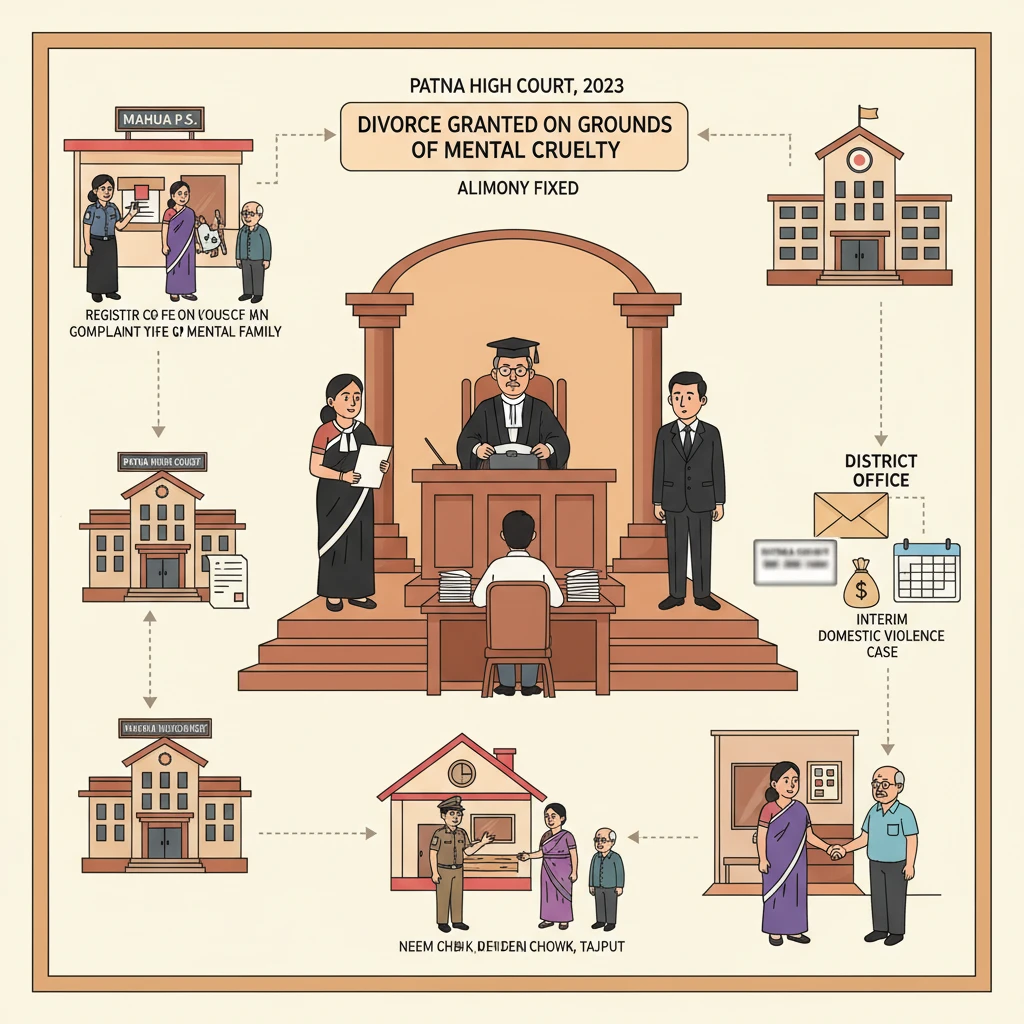
In 2016, the wife initiated Mahua P.S. Case No. 294 of 2016 for offences under Section 498-A of the Indian Penal Code, Sections 3 and 4 of the Dowry Prohibition Act, 1961 and allied sections, against the husband, his parents and several other relatives and well-wishers. During the investigation six names were later dropped, but the case continued against the husband and his parents.
The wife also filed a maintenance case under Section 125 Cr.P.C., which is still pending, and separately filed a domestic violence complaint (Domestic Violence Case No. 95 of 2016) at Patna. Additionally, she made a complaint to the husband’s employer seeking disciplinary action and his removal from service, making serious allegations about his and his mother’s character.
Against this backdrop, the husband filed Matrimonial (Divorce) Case No. 105 of 2019 before the Principal Judge, Family Court, Vaishali at Hajipur under Section 13(1)(ia) and 13(1)(ib) of the Hindu Marriage Act, 1955 seeking divorce on grounds of cruelty and desertion.
On 16.02.2023, the Family Court dismissed the divorce case, holding that cruelty and desertion were not proved. The husband then filed Miscellaneous Appeal No. 205 of 2023 before the Patna High Court.
What the Court Examined and Decided
The Division Bench of Hon’ble Mr. Justice P. B. Bajanthri and Hon’ble Mr. Justice Ramesh Chand Malviya heard the appeal. The High Court noted that the Family Court had framed issues regarding maintainability, cause of action, desertion for more than two years, cruelty, entitlement to divorce and other reliefs.
In the Family Court, the husband produced 26 exhibits and examined four witnesses including himself. The wife produced four exhibits and examined three witnesses including herself. The High Court re-examined this evidence and the findings.
The husband’s main case in appeal was that:
- the wife refused to live in the matrimonial home and joint family, despite his being the only son of his parents;
- she filed criminal proceedings under Section 498-A IPC and allied offences against him, his parents and several others, with six persons later dropped from the case;
- she lodged a domestic violence case invoking multiple sections of the Protection of Women from Domestic Violence Act, 2005, making extreme allegations of adultery, fornication and soliciting prostitution against him and his mother; and
- she complained to his employer with a view to get him removed from service, again using damaging and vague allegations.
The husband argued that these acts caused him humiliation and mental torture in the family, at the workplace and in society, which amounted to cruelty. He relied on the Supreme Court judgment in K. Srinivas Rao vs D.A. Deepa (2013) 5 SCC 226.
The wife’s counsel opposed the appeal, saying that isolated incidents do not amount to cruelty and that the Family Court had rightly dismissed the case. It was submitted that she was willing to rejoin the husband if all pending litigations were withdrawn. Reliance was placed on Ashok Kumar Jain vs Sumati Jain, AIR 2013 SC 2916, to argue that the incidents, taken singly, were not enough to constitute cruelty.
The High Court recounted the history of the relationship after marriage. It noted that parents of both sides had visited when the couple lived in Mumbai, and mutual dislike between the wife and her in-laws led to her insisting on separate residence, while the husband insisted on a joint family.
The Court then detailed how the wife filed the criminal case under Section 498-A IPC and Sections 3 and 4 of the Dowry Act and other allied provisions in 2016. The husband obtained anticipatory bail from the High Court on 30.09.2016, which the wife opposed.
After this, the wife complained to the husband’s employer making “wild allegations” to instigate disciplinary action and dismissal from service. She also filed Domestic Violence Case No. 95 of 2016 at Patna. In that case she accused the husband of adultery and fornication, and alleged that he and his mother were involved in soliciting prostitution. The Court noted that she received interim maintenance of Rs. 10,000/-.
The High Court carefully considered the husband’s exhibits, particularly:
- Exhibit P1: the wife’s complaint to the husband’s employer, where except for the alleged date of dowry demand (29.11.2012), other allegations were vague without specific dates or times;
- Exhibit P2: an order sheet of the Chief Judicial Magistrate, Vaishali at Hajipur, recording incidents and directing parties to appear and attempt restoration of matrimonial life on 16.12.2016;
- Exhibit P3: copy of the domestic violence petition (Case No. 95 of 2016);
- Exhibit P4: notice in Cr. Misc. No. 44135 of 2017 before the High Court.
The High Court emphasised that, standing alone, these exhibits mainly showed existence and pendency of litigation and did not by themselves prove cruelty. However, they were relevant to show the nature of allegations and the pattern of conduct.
An important turning point was the wife’s own admission. The Court recorded that she denied dowry and domestic violence allegations made by the husband, but admitted that certain extreme allegations of character assassination against the husband and her mother-in-law in her complaints were untrue and had been made “at the instigation of her advocate”. Despite this, she had not taken steps to withdraw or correct those allegations.
The High Court referred to several Supreme Court decisions laying down the law on mental cruelty under Section 13(1)(ia) of the Hindu Marriage Act, including:
- V. Bhagat vs D. Bhagat, AIR 1994 SC 710;
- Parveen Mehta vs Inderjit Mehta, AIR 2002 SC 2582;
- A. Jayachandra vs Aneel Kaur, AIR 2005 SC 534;
- Naveen Kohli vs Neelu Kohli, AIR 2006 SC 1675;
- Ramchander vs Ananta, (2015) 11 SCC 539;
- K. Srinivas Rao vs D.A. Deepa, (2013) 5 SCC 226;
- Roopa Soni vs Kamalnarayan Soni, 2023 SCC Online SC 1127.
The Court quoted extensively from these precedents to explain that:
- mental cruelty is conduct causing such mental pain and suffering that it becomes unreasonable to expect the other spouse to live with the person;
- it must be assessed by looking at the cumulative effect of all circumstances and not isolated incidents;
- filing repeated false complaints, making unfounded indecent and defamatory allegations affecting the spouse’s job or reputation can amount to mental cruelty; and
- long periods of separation and irretrievable breakdown are relevant in assessing cruelty.
The High Court also invoked the privacy and dignity principles from K.S. Puttaswamy vs Union of India, (2017) 10 SCC 1, to stress that a person’s dignity, reputation and private life deserve protection. It noted that the wife’s allegations about adultery, fornication and soliciting prostitution against the husband and his mother attacked their dignity and reputation in society and at the workplace.
The Court criticised the wife for straightaway initiating serious criminal and domestic violence proceedings and complaints to the employer, rather than first attempting reconciliation through Panchayat or restitution of conjugal rights, especially when the matrimonial relationship was under threat.
It noted that six accused persons were later dropped from the 498-A case, showing that “unnecessarily she has dragged some of the parties to the lis.” It further recorded that by addressing such allegations to the employer and in court cases, she had caused social and mental torture to the husband.
The Bench also took into account that the parties had been living separately since 04.06.2015, and that even at the time of judgment in December 2023 there was no real chance of normal marital life being restored. Although the wife expressed willingness to withdraw cases if divorce was refused, the husband was not prepared to condone the past conduct.
The High Court concluded that the Family Court had failed to properly appreciate:
- the initiation of multiple criminal and domestic violence proceedings;
- the complaint to the employer with character assassination; and
- the wife’s admission that some serious allegations were false and instigated by her lawyer but not withdrawn.
These, in the High Court’s view, clearly constituted mental cruelty towards the husband. The Court held that the marriage had irretrievably broken down in the light of continuous separation since June 2015 combined with the litigations and defamatory complaints.
Accordingly, the High Court allowed the appeal, set aside the Family Court’s judgment dated 16.02.2023 in Matrimonial (Divorce) Case No. 105 of 2019, and ordered dissolution of the marriage dated 29.11.2012 on ground of cruelty under Section 13(1)(ia) of the Hindu Marriage Act.
On the issue of financial security for the wife, the Court noted that the husband was serving as a Deputy Executive Engineer in Maharashtra State Power Generation Corporation Limited and was a well-paid Class I officer. The wife had to bear her own maintenance as well as educational expenses of their son. Therefore, the Court directed the husband to pay Rs. 10,00,000/- (Rupees Ten Lakhs) to the wife as interim alimony.
This amount is to be deposited in the Registry of the High Court in the wife’s name within three months. The decree of divorce will become effective only from the date this deposit is made. After verifying the wife’s identity, the Registry will disburse the amount to her. The Court clarified that this sum is subject to adjustment in the pending maintenance proceedings before the competent court.
Why This Judgment Matters
This Patna High Court judgment is important for couples caught in bitter matrimonial disputes involving criminal cases and workplace complaints.
First, it shows that filing multiple cases and making false, damaging allegations against the spouse and in-laws, especially in official complaints to an employer, can be treated as mental cruelty. Even if the spouse later expresses willingness to withdraw or says the allegations were made on someone’s advice, the damage already caused may still justify divorce.
Second, the Court emphasised the value of dignity and privacy of an individual. Allegations of adultery, fornication or prostitution made without proof not only affect court cases but can also seriously harm a person’s social standing and employment. Such conduct may help the other spouse get a divorce.
Third, the judgment underlines that long separation combined with hostile litigation can show that a marriage has broken down beyond repair. In such situations, the Court may grant divorce even if one party claims readiness to continue the marriage.
At the same time, the High Court ensured that the wife and child are financially protected by directing a substantial interim alimony of Rs. 10 lakh, linked to the husband’s earning capacity and the child’s educational needs.
Legal Issues and Answers
Issue: Did the wife’s conduct—filing criminal and domestic violence cases, making serious false allegations and complaining to the husband’s employer—amount to cruelty under Section 13(1)(ia) of the Hindu Marriage Act?
Answer: Yes. The Patna High Court held that these acts, especially the untrue character-assassinating allegations and employer complaint, caused mental cruelty to the husband and justified granting divorce.
Issue: Was the Family Court right in dismissing the husband’s divorce petition for failure to prove cruelty and desertion?
Answer: No. The High Court found that the Family Court had failed to properly appreciate the cumulative effect of the wife’s actions and the long separation. It set aside the Family Court’s decision and allowed the divorce petition.
Issue: What financial arrangement should be made for the wife after grant of divorce?
Answer: Considering the husband’s status as a Deputy Executive Engineer and the wife’s responsibility to maintain herself and their son, the Court directed payment of Rs. 10,00,000/- as interim alimony, to be deposited within three months, with the divorce taking effect from the date of such deposit.
Cases Cited by the Court
- V. Bhagat vs D. Bhagat, AIR 1994 SC 710
- Parveen Mehta vs Inderjit Mehta, AIR 2002 SC 2582
- A. Jayachandra vs Aneel Kaur, AIR 2005 SC 534
- Naveen Kohli vs Neelu Kohli, AIR 2006 SC 1675
- Ramchander vs Ananta, (2015) 11 SCC 539
- K. Srinivas Rao vs D.A. Deepa, (2013) 5 SCC 226
- Shailendra Kumar Chandra vs Smt. Bharti Chandra, First Appeal (M) No. 124/2017 (Patna High Court)
- Shobha Rani vs Madhukar Reddi, (1998) 1 SCC 105
- Ashok Kumar Jain vs Sumati Jain, AIR 2013 SC 2916
- K.S. Puttaswamy vs Union of India, (2017) 10 SCC 1
- Roopa Soni vs Kamalnarayan Soni, 2023 SCC Online SC 1127
Case Details
Case Number: Miscellaneous Appeal No. 205 of 2023; arising out of Matrimonial (Divorce) Case No. 105 of 2019
Case Title: Alok Bharti vs Jyoti Raj
Citation: 2024 (1) PLJR 734
Coram: Hon’ble Mr. Justice P. B. Bajanthri and Hon’ble Mr. Justice Ramesh Chand Malviya
Date of Patna High Court Judgment: 18.12.2023 (CAV reserved on 07.12.2023)
Advocates:
- For the Appellant (husband): Mr. Ankit Katriar, Advocate; Mr. Ankit Kumar Singh, Advocate
- For the Respondent (wife): Mr. Nikhil Kumar Agrawal, Advocate; Ms. Aditi Hansaria, Advocate
Nature of the Case: Miscellaneous Appeal against dismissal of a divorce petition by the Family Court (matrimonial appeal under the Hindu Marriage Act)
Link to Judgment: Click here to view the full Patna High Court judgment
If you found this explanation helpful and wish to stay informed about
how legal developments may affect your rights in Bihar,
you may consider following Samvida Law Associates for more updates.







