
Case Background
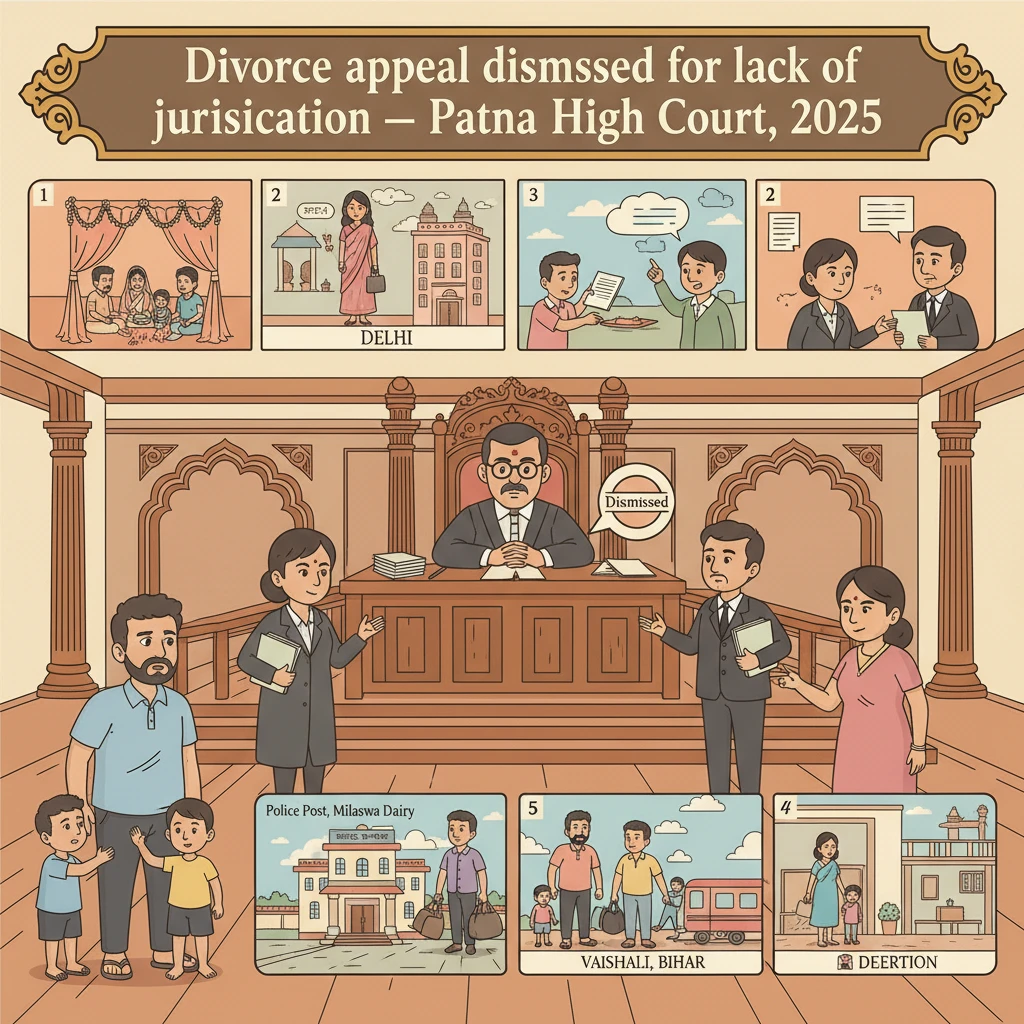
The appellant-husband and the respondent-wife were married on 30.04.2006 according to Hindu rites and customs. The marriage was stated to have been performed in a simple manner and two children were born out of this wedlock.
In 2010, the husband obtained employment as an Assistant Manager in Mail Today Newspaper Pvt. Ltd. at Delhi. He then shifted and settled at Delhi along with his wife and children.
According to the husband, after some time in Delhi, the behaviour of the wife changed. He alleged that she frequently quarreled with him without any good reason and that her conduct disturbed the normal family life of both him and the children.
He further alleged that the wife created nuisance in the matrimonial home, mercilessly beat the children, abused him, and wanted to live without accepting any family discipline. The husband claimed that, despite his efforts to make her understand and to normalize the situation, nothing improved.
On 18.10.2011, the husband sent a legal notice through his advocate to the wife’s father, complaining about the alleged ill-treatment by the wife. Following this, the wife’s father came to Delhi and took her back to Muzaffarpur.
After some time at Muzaffarpur, the husband again brought the wife back to Delhi. He alleged that during the period between 2011 and 2018, her behaviour became worse. According to him, she started threatening to commit suicide, or to implicate him in false cases, avoided caring for the children, and often ran away from the house without informing him.
The husband stated that on 09.04.2018, the wife suddenly left the matrimonial home in Delhi, leaving him and the children, without any intimation. He claims to have lodged an application before the officer-in-charge, Milaswa Dairy, Delhi, in this regard (referred to as Annexure-III).
Subsequently, the husband filed a petition under Section 9 of the Hindu Marriage Act, 1955, for restitution of conjugal rights before the Principal Judge, Family Court, Rohini, New Delhi. Notices were issued to the wife in that case and, later, a dasti notice was issued on 21.01.2019. However, she did not appear to contest the proceedings.
The husband states that he faced increasing difficulty in taking care of the two minor children while continuing his employment at Delhi. Ultimately, he left his job and, in June 2019, returned with the children to his native place in District Vaishali, Bihar.
After he came back to Vaishali, the wife came and stayed with him at his native place for about one month. She again left the matrimonial house in July 2019. According to the husband, from July 2019 onwards, the wife has deserted him.
On these allegations, the husband filed Divorce Case No. 05 of 2021 before the Principal Judge, Family Court, Vaishali at Hajipur under Section 13(1) of the Hindu Marriage Act, 1955, seeking dissolution of marriage by a decree of divorce.
In that divorce case, the husband examined three witnesses in support of his case: P.W. 1 (himself), P.W. 2 Aashish Gaurav and P.W. 3 Om Prakash Das. The wife did not appear in the divorce proceedings and did not examine any witness.
The Family Court, Vaishali, did not go into the merits of the allegations. It dismissed the divorce petition on 09.10.2023 on the ground of lack of territorial jurisdiction. The husband then filed Miscellaneous Appeal No. 766 of 2023 before the Patna High Court challenging that order of dismissal.
What the Court Examined and Decided
The Patna High Court, speaking through Hon’ble Mr. Justice S. B. Pd. Singh, with Hon’ble the Chief Justice on the Bench, heard the appeal filed by the husband against the Family Court’s order dated 09.10.2023.
The central question before the High Court was narrow: whether the Principal Judge, Family Court, Vaishali at Hajipur, had territorial jurisdiction to entertain and decide Divorce Case No. 05 of 2021 filed by the husband.
The High Court recorded that the Family Court had dismissed the divorce petition solely on the issue of jurisdiction. The Family Court noted that:
• The marriage of the parties was solemnized at Muzaffarpur.
• The couple last resided together at Delhi.
• The wife was residing at Muzaffarpur.
On these facts, the Family Court concluded that the court at Vaishali at Hajipur lacked territorial jurisdiction and, therefore, declined to decide the case on merits.
Before the High Court, learned counsel for the appellant-husband repeated the factual allegations about the wife’s behaviour, her leaving the home, the legal notice sent in 2011, the Section 9 restitution petition in Rohini, Delhi, and the final alleged desertion from July 2019. He also emphasized the difficulty faced by the husband in caring for the two minor children, leaving his job and shifting back to Vaishali.
However, the High Court focused on the legal question of where such a divorce petition could legally be filed under the Hindu Marriage Act, 1955. For this, the Court specifically referred to Section 19 of the Act, which deals with the “Court to which petition shall be presented”.
The Court reproduced and relied on Section 19, which states that every petition under the Act shall be presented to the District Court within the local limits of whose ordinary original civil jurisdiction:
(i) the marriage was solemnized, or
(ii) the respondent, at the time of presentation of the petition, resides, or
(iii) the parties to the marriage last resided together, or
(iiia) in case the wife is the petitioner, where she is residing on the date of presentation of the petition, or
(iv) the petitioner is residing at the time of presentation of the petition in a case where the respondent is then residing outside the territories to which the Act extends, or has not been heard of as being alive for seven years or more by those persons who would naturally have heard of him, if he were alive.
The High Court explained that Section 19 lays down specific territorial conditions. Only if one of these conditions is satisfied does a particular District Court get jurisdiction to entertain a matrimonial petition under the 1955 Act.
Applying these conditions to the husband’s case, the Court noted that, as per the Family Court’s findings based on the materials on record, the marriage had been solemnized at Muzaffarpur. The parties last lived together at Delhi. The respondent-wife was residing at Muzaffarpur. There was no finding that the wife resided outside the territories to which the Act extends or that she had not been heard of for seven years or more. Nor was this a case where the wife was the petitioner so as to attract clause (iiia).
On these admitted or undisputed locations, the District Court having jurisdiction under Section 19 could be:
• The court where the marriage was solemnized (Muzaffarpur).
• The court where the respondent (wife) resides at the time of filing (Muzaffarpur).
• The court where the parties last resided together (Delhi).
However, the husband had filed the divorce petition before the Family Court at Vaishali at Hajipur, claiming jurisdiction essentially because he had shifted back to his native place and was residing there with the children.
The High Court agreed with the Family Court that, on the facts found, Vaishali did not fall within any of the jurisdictional clauses of Section 19. The mere fact that the husband had chosen to return to his native village in Vaishali did not, by itself, give jurisdiction to the Family Court at Vaishali under Section 19, since none of the statutory grounds pointed to Vaishali.
The Court then examined whether there was any error in how the Family Court appreciated the evidence and applied Section 19. After going through the entire order of the Family Court, the High Court found that there was no “grave error of law and illegality” in the way the Family Court had assessed the jurisdiction question.
As a result, the High Court concluded that there was no merit in the husband’s miscellenous appeal. It held that the Family Court had rightly dismissed the matrimonial case for want of territorial jurisdiction and that no interference with that order was warranted in appellate jurisdiction.
Accordingly, the Patna High Court dismissed Miscellaneous Appeal No. 766 of 2023 and affirmed the impugned judgment of the Family Court, Vaishali at Hajipur.
At the same time, the High Court preserved the husband’s legal remedy. It expressly granted liberty to the appellant-husband to file a fresh divorce petition “under appropriate provisions of Hindu Marriage Act before the appropriate forum.”
Thus, while his present case stood dismissed, the Court clarified that he was not barred from approaching a court that actually has jurisdiction under Section 19 of the Hindu Marriage Act, namely, a competent court at Muzaffarpur or at the place where the parties last resided together, or any other court that satisfies the statutory conditions.
The order also records that any pending interlocutory applications (I.A.s), if any, stood disposed of with the dismissal of the appeal.
Why This Judgment Matters
This decision is important for couples in Bihar and elsewhere who are considering filing matrimonial cases like divorce or restitution of conjugal rights.
The Patna High Court has clearly reinforced that a divorce petition cannot be filed in just any Family Court that is convenient for one spouse. The law in Section 19 of the Hindu Marriage Act strictly controls where such petitions can be filed.
For lay persons, this means that if a petition is filed in the wrong court, even if all facts and allegations are otherwise strong, the case may be dismissed at the threshold without any decision on the real issues of cruelty, desertion, or other grounds.
In this case, the husband lost time and effort because he filed at Vaishali, where the Family Court had no jurisdiction, even though the marriage, residence of the wife, and last shared residence all pointed to other places.
The judgment also provides a safeguard by clarifying that dismissal for want of jurisdiction does not close the door on the parties. They remain free to approach the correct court under the Hindu Marriage Act.
For advocates and litigants, the ruling underscores the need to carefully verify jurisdiction under Section 19 before drafting and filing any matrimonial petition. Filing in a court without territorial jurisdiction can delay justice and increase both emotional and financial burdens.
Legal Issues and Answers
- Issue: Did the Principal Judge, Family Court, Vaishali at Hajipur have territorial jurisdiction under Section 19 of the Hindu Marriage Act, 1955, to entertain Divorce Case No. 05 of 2021 filed by the husband?
Answer: No. Based on the facts that the marriage was solemnized at Muzaffarpur, the parties last resided together at Delhi, and the wife was residing at Muzaffarpur, the Family Court at Vaishali did not fall within any of the jurisdictional clauses of Section 19. The Patna High Court upheld the dismissal of the divorce petition for want of jurisdiction, while granting liberty to file before the appropriate court.
Cases Cited by the Court
- No prior case law has been cited or relied upon in the judgment. The Court primarily relied on the text of Section 19 of the Hindu Marriage Act, 1955.
Case Details
Case Number: Miscellaneous Appeal No. 766 of 2023
Case Title: Kumar Karunesh Kaithal v. Seema Kaithal
Court: High Court of Judicature at Patna
Bench/Coram: Hon’ble the Chief Justice and Hon’ble Mr. Justice S. B. Pd. Singh (CAV Judgment; Per Hon’ble Mr. Justice S. B. Pd. Singh)
Date of Judgment: 25.09.2025
Citation: 2025 (4) PLJR 496
Trial Court Order Challenged: Order dated 09.10.2023 passed by the Principal Judge, Family Court, Vaishali at Hajipur in Divorce Case No. 05 of 2021
Statute Involved: Hindu Marriage Act, 1955 – Sections 13(1) and 19; reference also to Section 9 proceedings (restitution of conjugal rights) before Family Court, Rohini, New Delhi
Nature of the Case: Miscellaneous Appeal against dismissal of a divorce petition on the ground of lack of territorial jurisdiction
Advocates: For the Appellant: Mr. Prakash Chandra, Advocate; For the Respondent: Not specified / No appearance recorded
Link to Judgment:file:///C:/Users/Adity/OneDrive/Documents/Vaktrita%20Final/case%201257.pdf
If you found this explanation helpful and wish to stay informed about
how legal developments may affect your rights in Bihar,
you may consider following Samvida Law Associates for more updates.







