

Case Background
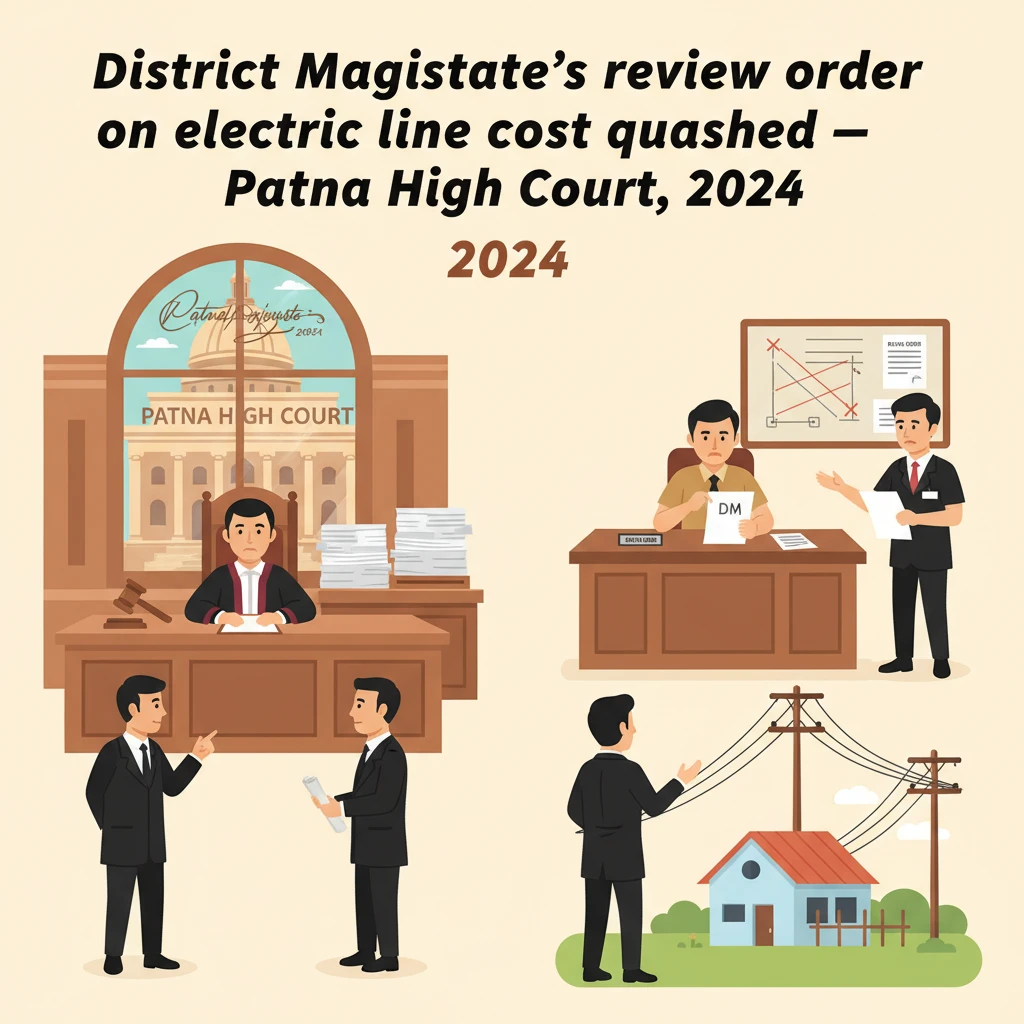
The dispute started with an 11 KVA electricity line running across a private plot in village Balipakar, P.S. Paliganj, District Patna. The plot, identified as Plot No. 30, Khata No. 200, measured one katha and belonged to the petitioner.
The petitioner claimed that this electric line was obstructing development of his land and causing him heavy financial loss. He wanted the line to be shifted away from his plot.
When his request was not acted upon, the petitioner approached the Patna High Court in C.W.J.C. No. 17872 of 2012. On 25.09.2012, the High Court disposed of that earlier writ petition. It directed the District Magistrate, Patna, to pass appropriate orders in light of Section 164 of the Electricity Act, 2003 and the Works of Licensee Rules, 2006, for shifting the 11 KVA line from the petitioner’s plot.
The District Magistrate was also directed to consider the petitioner’s representation and pass suitable orders within two months of receiving it.
Following this direction, the petitioner submitted his representation on 08.10.2012 before the District Magistrate, Patna, as well as before the Executive Electrical Engineer, Bihta. The District Magistrate initiated Miscellaneous Case No. 12 of 2012-13 on this representation.
However, no final order was passed for more than one and a half years. Frustrated by the delay, the petitioner filed a contempt petition before the High Court on 24.06.2014, registered as M.J.C. Case No. 2264 of 2014, complaining of non-compliance with the earlier High Court direction.
In response, on 04.09.2014, the Executive Electrical Engineer, Bihta, filed a show-cause statement. He stated that for shifting the 11 KVA line, the petitioner was required to deposit Rs. 15,603 in the company’s account.
On 27.09.2014, the District Magistrate finally passed an order in Miscellaneous Case No. 12 of 2012-13. He directed the petitioner to deposit Rs. 15,603 for shifting the 11 KVA line and asked the Electricity Department to remove the line from the land within two months.
Subsequently, on 18.10.2014, the Executive Electrical Engineer, Bihta, filed a review petition before the District Magistrate seeking review of the 27.09.2014 order. On 01.11.2014, the petitioner filed a rejoinder, objecting that the District Magistrate had no power to review his own order.
Despite this objection, on 25.11.2014, the District Magistrate passed a fresh order on the review petition. He again asked the petitioner to deposit Rs. 15,603 as supervision charges, but also stated that the line could be shifted only after depositing Rs. 2,39,864 or at the petitioner’s own expenditure.
This new order substantially changed the financial burden. Feeling aggrieved, the petitioner filed the present writ petition, C.W.J.C. No. 1785 of 2016, challenging the District Magistrate’s 25.11.2014 review order.
What the Court Examined and Decided
The Patna High Court examined the entire sequence of events after its earlier order dated 25.09.2012 in C.W.J.C. No. 17872 of 2012. The central question was whether the District Magistrate, Patna, had the legal authority to review and revise his own order in Miscellaneous Case No. 12 of 2012-13.
The petitioner’s senior counsel argued that the District Magistrate had exceeded his powers. According to him, the initial order of 27.09.2014 only required the petitioner to deposit Rs. 15,603, which aligned with the statement made by the Executive Electrical Engineer.
However, in the later review order dated 25.11.2014, the District Magistrate directed that, in addition to Rs. 15,603 as supervision charges, the petitioner must also deposit Rs. 2,39,864 or bear that expenditure himself. This was a significant enhancement and, according to the petitioner, illegal.
The petitioner’s side submitted that there is no provision in the relevant Act permitting a District Magistrate to review his own quasi-judicial order. They argued that if the Electricity authorities were unhappy with the 27.09.2014 order, they should have preferred a revision before the Commissioner rather than seeking review from the same District Magistrate.
To support this stand, the petitioner relied on the Supreme Court judgment in Kalabharati Advertising vs. Hemant Vimalnath Narichania and others, reported in (2010) 9 SCC 437. Paragraphs 12 to 15 of that judgment were specifically cited.
In Kalabharati Advertising, the Supreme Court held that review is not an inherent power. A judicial or quasi-judicial authority can review its earlier order only if there is a specific provision in the statute or rules granting that power expressly or by necessary implication. In the absence of such a provision, any order passed on review is ultra vires, illegal and without jurisdiction.
The Supreme Court further explained that entertaining a review application under the guise of clarification, modification or correction is not permissible when there is no statutory provision for review. Any such exercise would be a nullity.
The Patna High Court noted these principles and applied them to the facts of the present case. It observed that there was no provision under the governing law which authorized the District Magistrate to review his own order regarding shifting of the electricity line.
The Court also examined the counter affidavit filed by Respondent Nos. 3, 5 and 6 (company and engineering officers). In their defence, they stated that the Electricity Department had inspected the site on 24.07.2014 and examined the possibility of shifting the 11 KVA line. A diagram was prepared in the light of Standing Order No. 880 dated 28.03.2012.
They claimed that the petitioner had been informed by letter no. 676 dated 24.07.2014 that he must deposit Rs. 15,603 as supervision charges, and that the entire cost of shifting the line—estimated at Rs. 2,39,864—would have to be borne by the petitioner. The company would only supervise the work, while the petitioner would supply materials and carry out the execution.
Letter No. 676 made it clear that the work was “technically sanctioned for Rs. 2,39,864 only under deposit head,” with Rs. 15,603 chargeable to the party as supervision charges. Dismantled company material was to be returned to the Central Store, Digha, under the supervision of the concerned officers.
The respondents argued that, in the light of this letter, the District Magistrate’s later order requiring deposit of the full estimated amount could not be faulted. They portrayed the earlier 27.09.2014 order, which mentioned only Rs. 15,603, as an error by way of “overlook”. They urged the Court to treat the review as a correction of that oversight and to dismiss the writ petition.
The High Court, however, did not accept this justification. The Court noted that the initial order of the District Magistrate clearly directed the petitioner to deposit only Rs. 15,603 in the account of the Electricity Department. There was no mention of Rs. 2,39,864 in that order.
The Court held that if the respondents were aggrieved by the first order, the proper legal course was to file a revision before the Commissioner. Instead, the respondents chose to file a review petition before the District Magistrate himself, who then revised his order to the detriment of the petitioner.
Crucially, the Court recorded that the District Magistrate has no statutory power to review his own order. There is also no provision under the relevant Act enabling such review by the District Magistrate.
Applying the Supreme Court’s ruling in Kalabharati Advertising, the Patna High Court concluded that the District Magistrate’s act of reviewing his own order and imposing the higher amount of Rs. 2,39,864 along with Rs. 15,603 was beyond his jurisdiction and, therefore, unsustainable in law.
After hearing both sides and perusing the record, the Court held that the impugned order dated 25.11.2014 passed by the District Magistrate in Miscellaneous Case No. 12 of 2012-13 could not stand.
Accordingly, the writ petition was allowed. The Court set aside the District Magistrate’s order dated 25.11.2014. Any interlocutory applications were also disposed of in view of the final decision.
Why This Judgment Matters
This judgment has practical importance for landowners and ordinary citizens affected by public utilities like electricity lines crossing their plots.
First, it confirms that authorities such as the District Magistrate cannot arbitrarily change their own orders to increase financial burdens unless the law clearly gives them power to review. If an order benefits or protects a citizen, it cannot be quietly overturned on a review petition without statutory backing.
Second, the judgment clarifies that when government departments or power companies are unhappy with an order, they must follow the proper appeal or revision route provided in law. They cannot seek shortcuts by asking the same officer to rewrite his earlier decision.
Third, the ruling gives reassurance to citizens that once an order is passed after court directions, it cannot be drastically altered to their disadvantage without legal authority. This is especially relevant where large amounts of money are suddenly demanded for works like shifting electric lines.
For people facing similar issues in Bihar, this Patna High Court decision shows that courts can intervene if lower authorities act beyond their powers and impose unexpected costs by “reviewing” their own orders.
Legal Issues and Answers
- Issue: Could the District Magistrate, Patna, legally review and modify his own order in Miscellaneous Case No. 12 of 2012-13 to increase the amount payable by the petitioner for shifting the 11 KVA line?
Answer: No. The Patna High Court held that the District Magistrate had no power to review his own order in the absence of any statutory provision permitting such review, and therefore the review order dated 25.11.2014 was unsustainable and had to be set aside. - Issue: What was the correct remedy for the Electricity authorities if they were aggrieved by the District Magistrate’s original order dated 27.09.2014?
Answer: The Court indicated that the proper remedy was to file a revision petition before the Commissioner, not to seek a review before the District Magistrate himself. - Issue: What is the applicable principle regarding review powers of authorities like the District Magistrate?
Answer: Relying on the Supreme Court’s judgment in Kalabharati Advertising, the Court reiterated that power of review is not inherent; it must be conferred by statute, and any review order passed without such authority is a nullity.
Cases Cited by the Court
- Kalabharati Advertising vs. Hemant Vimalnath Narichania and others, (2010) 9 SCC 437 (paragraphs 12–15 quoted and relied on).
- The Supreme Court precedents referred to within Kalabharati Advertising (such as Patel Chunibhai Dajibha v. Narayanrao Khanderao Jambekar; Harbhajan Singh v. Karam Singh; Patel Narshi Thakershi v. Pradyuman Singhji Arjunsinghji; Major Chandra Bhan Singh v. Latafat Ullah Khan; Kuntesh Gupta (Dr.) v. Hindu Kanya Mahavidyalaya; State of Orissa v. Commissioner of Land Records and Settlement; Sunita Jain v. Pawan Kumar Jain; and others) are mentioned as part of that discussion.
Case Details
Case Number: Civil Writ Jurisdiction Case No. 1785 of 2016
Case Title: Ajit Kumar vs. The State of Bihar & Others
Coram: Hon’ble Justice Smt. G. Anupama Chakravarthy
Date of Judgment: 04.10.2024
Citation: 2024 (4) PLJR 791
Advocates for the Petitioner: Mr. D.K. Sinha, Senior Advocate; Mr. Yogendra Kumar Sinha, Advocate; Mr. Ratneshwar Prasad, Advocate; Mr. Atul Dayal, Advocate; Mr. Alexender Ashok, Advocate
Advocates for the Respondents: Mr. Gyan Prakash Ojha, GA-7; Mr. Prakash Kumar, Advocate
Nature of the Case: Writ petition under civil writ jurisdiction challenging the legality of a District Magistrate’s review order in a miscellaneous case concerning shifting of an 11 KVA electricity line.
Impugned Order: Order dated 25.11.2014 passed by the District Magistrate, Patna, in Miscellaneous Case No. 12 of 2012-13.
Relief Granted: Writ petition allowed; impugned order dated 25.11.2014 set aside; interlocutory applications, if any, disposed of.
Link to Judgment: Click here to access the full judgment of the Patna High Court
If you found this explanation helpful and wish to stay informed about
how legal developments may affect your rights in Bihar,
you may consider following Samvida Law Associates for more updates.







