

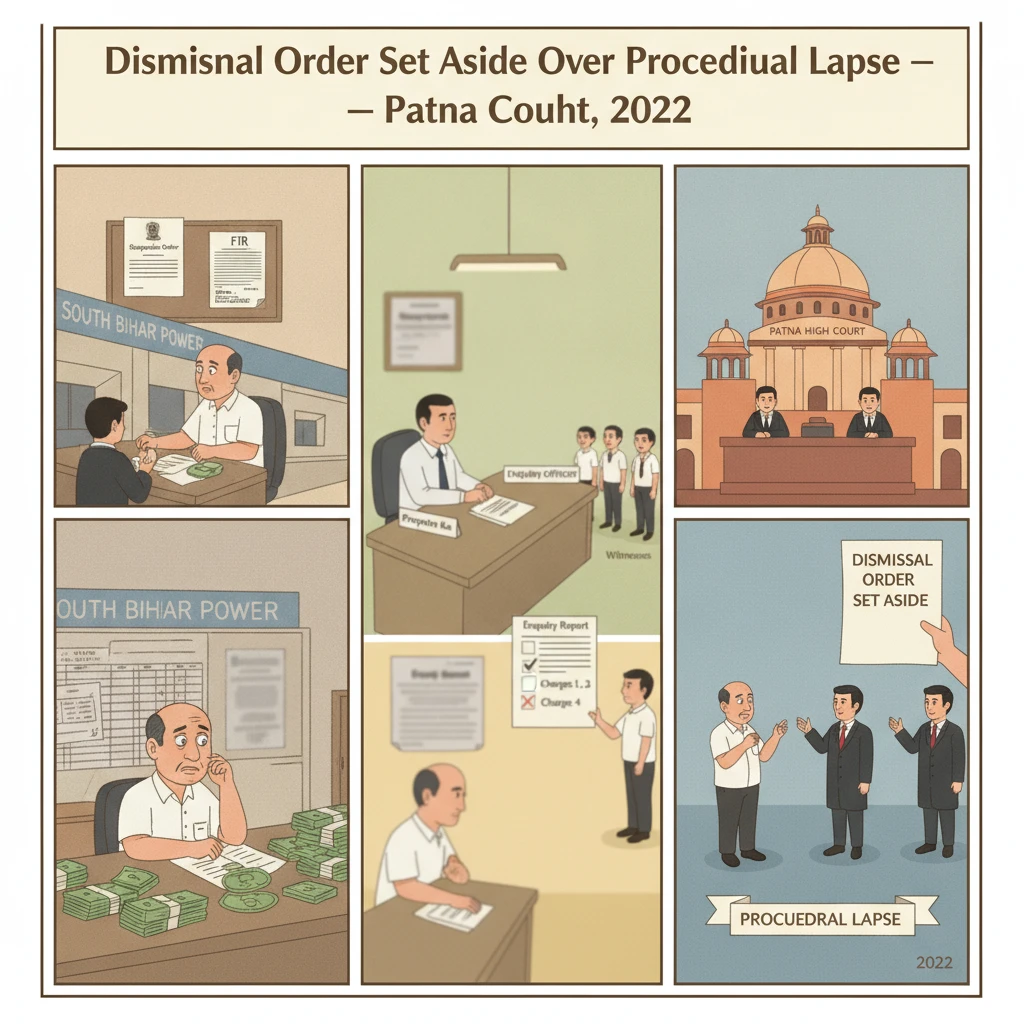
Case Background
The appellant was working with the electricity distribution set-up in Bihar. He started as a daily wager on 17.12.1978. Later he was appointed as an unskilled khalashi by the General Manager-cum-Chief Engineer in the Bhagalpur Area Board.
After passing a departmental examination, he was appointed as Bill Clerk with effect from 01.01.1982 at Bhagalpur. Subsequently, he was transferred to Patna, where he took charge as Bill Clerk on 30.04.2010. From 15.07.2011, he started functioning as Revenue Cashier in the Electric Sub-Division at Bankipore, Patna.
During an internal audit, the Board detected huge financial irregularities and misappropriation of several lakhs of rupees. The appellant was held to be primarily responsible for an embezzlement of Rs. 43,48,296/-. He was placed under suspension by order dated 25.06.2015. An FIR was also lodged against him, being Kotwali P.S. Case No. 283 of 2015.
On 09.06.2016, the General Manager (HR/Adm.), who was the disciplinary authority, decided to start a departmental proceeding. Four charges were framed against the appellant. Sri Rishi Prasad, Chief Engineer, SBPDCL, Patna, was appointed as Enquiry Officer. The memorandum of charge (Prapatra Ka) along with statement of imputations and list of witnesses was served on the appellant.
During the inquiry, Enquiry Officer Sri Rishi Prasad retired on 31.12.2016. Thereafter, by order dated 17.01.2017, the General Manager (HR/Adm.) appointed Sadat Hasan Mintu, Land Acquisition Officer, SBPDCL, Patna, as the new Enquiry Officer.
Four departmental witnesses were examined and cross‑examined by the appellant. One document was also exhibited in support of the charges. Considering all material and the defence, the Enquiry Officer found three charges proved and one charge not proved. He submitted his enquiry report on 14.06.2017.
On 21.09.2017, the Deputy General Manager (HR/Adm.) issued a second show cause notice enclosing the enquiry report and asked the appellant to reply within fifteen days regarding the findings where three charges were held proved. The appellant submitted a detailed reply on 03.10.2017.
The appellant’s writ petition (C.W.J.C. No. 17558 of 2018) challenging the dismissal failed before a learned Single Judge on 08.10.2021. Aggrieved, he filed the present Letters Patent Appeal No. 636 of 2021 before the Patna High Court, which has led to this judgment dated 31.01.2022.
What the Court Examined and Decided
The Division Bench, comprising Hon’ble the Chief Justice and Hon’ble Mr. Justice S. Kumar, focused on how the disciplinary and appellate authorities handled the case after the enquiry report and second show cause reply.
The Court summoned and examined the original departmental records. These records showed what happened inside the file once the appellant submitted his reply on 03.10.2017 to the second show cause notice.
On 03.11.2017, a Section Officer prepared a proposal noting that a decision had to be taken on the appellant’s reply. The Section Officer himself recorded that the reply was not satisfactory. This note, with a proposed course of action, was sent up to the Deputy General Manager (HR/Adm.).
The Deputy General Manager, who was acting for the disciplinary authority, wrote on the file that the conduct of the appellant could not be considered appropriate and that the charges were fully proved. He suggested that, for the proved charges, punishment be fixed under Rule 14 of the CCA Rules. The note further summarised the charges, including:
- Alleged permanent misappropriation of Rs. 43,48,296/- by not depositing revenue collection into the company’s account.
- Loss of Rs. 14,12,403/- as interest due to delayed deposit.
- Loss of Rs. 24,001/- due to showing cheque amounts instead of cash amounts.
- Loss of Rs. 88,88,666/- due to not presenting cheques returned by the bank before the revenue section for recovery from consumers.
The note recorded that in the second show cause reply the appellant had not produced any evidence or document to show he was innocent. It also mentioned that he had earlier challenged departmental proceedings in a writ petition (C.W.J.C. No. 14196 of 2016), where by order dated 18.08.2017, the Patna High Court had directed that departmental proceedings be completed within four months of receipt of the order, and the suspension order be revoked if proceedings were not completed within that period.
On 15.11.2017, the General Manager (HR/Adm.), as disciplinary authority, recommended that major punishment of reduction to the minimum of the present pay scale be imposed. He also recommended that the appellant be released from suspension without any further monetary benefit for the suspension period, except subsistence allowance and service‑length benefits.
However, the disciplinary authority did not himself pass the final order. Instead, on the same noting sheet, the Managing Director of the company made his own endorsement on 06.12.2017. He recorded that, considering the serious financial irregularities established, major punishment of dismissal should be awarded and the status of recovery of the defalcated amount be checked and necessary action taken.
On the basis of this order dated 06.12.2017 of the Managing Director, the DGM (HR/Adm.) issued the final order dated 18.12.2017 dismissing the appellant from service.
The High Court noted that such a practice, where office staff and higher officials effectively decide quasi‑judicial matters based on internal notes, has been deprecated earlier. The Court relied on its earlier decision in Abdul Rauf @ Sri Md. Abdul Rauf & Ors. vs. State of Bihar & Anr., 2009(2) PLJR 784. In that case, the Court held that in quasi‑judicial matters, the authority concerned must himself conduct the proceedings, apply his mind, and pass orders, rather than merely approving office notings.
The Court quoted extensively from Abdul Rauf to stress that a quasi‑judicial proceeding cannot be treated like routine office work. The power has serious civil consequences, and the statutory authority must independently consider the matter. In that earlier case, the Sub‑Divisional Officer had simply written “Yatha Prasthawit” (“as proposed”) on office notes, and such procedure was held impermissible.
The Division Bench then examined the conduct of the General Manager (HR/Adm.) in this case. It observed that he, being the disciplinary authority and punishing authority, did not apply his mind to the appellant’s reply and the enquiry report in an independent way. Instead, he simply agreed with subordinate notings and then placed the file before the Managing Director with a proposed punishment.
The Court stated that it is the disciplinary authority who must, on the basis of the enquiry report and the employee’s reply, decide whether to exonerate or punish the delinquent, and what punishment is appropriate. By placing the file before the Managing Director and letting him decide the punishment of dismissal, the General Manager effectively abdicated his statutory power.
The Bench referred to its earlier judgment in Vinod Kumar Singh vs. State of Bihar, 2008(1) PLJR 547. There, the Court held that an order passed by a statutory authority at the dictates of another, or without independent application of mind, is arbitrary and ultra vires. It also referred to the Supreme Court judgment in Bahadursinh Lakhubhai Gohil vs. Jagdishbhai M. Kamalia & Ors., (2004) 2 SCC 65, where it was held that decisions taken at the behest of a person with no statutory role are invalid.
Applying these principles, the Court held that the Managing Director’s role here was problematic. While he is superior in hierarchy and could act as a disciplinary authority, in this particular case the entire departmental proceeding—from initiation, framing of charges, appointment of Enquiry Officer, and conduct of inquiry—was undertaken by the General Manager (HR/Adm.) as disciplinary authority. Therefore, he alone was required to pass the final order while acting as a quasi‑judicial authority.
Instead of doing so, he prepared a proposal and placed it before the Managing Director. The Managing Director changed the proposed punishment from reduction in pay to dismissal, and on that basis the DGM issued the dismissal order. The Court held that such a process was neither sustainable in law nor on facts.
However, the Court also made it clear that there was no procedural infirmity in the framing of charges, appointment of Enquiry Officer, or the enquiry report itself. The Enquiry Officer had considered all evidence from both sides and correctly recorded which charges were proved and which were not. The flaw arose only at the stage after the second show cause notice, when the authorities failed to discharge their quasi‑judicial function properly.
Because of this specific defect, the High Court set aside the dismissal order dated 18.12.2017 (Annexure P-8) and, as a result, the appellate order dated 13.07.2018 (Annexure P-9), by which the Chairman‑cum‑Managing Director had dismissed the appeal filed on 22.12.2017.
The Court did not reinstate the appellant straightaway. Instead, following the approach adopted by the Supreme Court in Director (Marketing), Indian Oil Corporation Ltd. vs. Santosh Kumar, 2006 (11) SCC 147, it remitted the matter back to the disciplinary authority for fresh decision.
The Court directed that the General Manager (HR/Adm.), as disciplinary authority, must continue the proceeding from the stage of the appellant’s reply to the second show cause notice. He must pass a fresh order based solely on the materials already on record. No fresh material is to be added by the employee. The disciplinary authority must consider the enquiry report and the representation in the correct perspective and decide the matter afresh on merits.
The Division Bench, therefore, allowed the Letters Patent Appeal to this limited extent and set aside the Single Judge’s order dated 08.10.2021 in C.W.J.C. No. 17558 of 2018. No order was made as to costs. The original departmental records were directed to be returned to the department through its counsel.
Why This Judgment Matters
This judgment is important for all government and public sector employees, especially in Bihar, who face departmental proceedings for serious charges like embezzlement or misconduct.
The Patna High Court has made it clear that even when charges are serious and may be proved, the employer must strictly follow proper procedure while deciding punishment. The boss cannot simply rely on office notes or hand over the final decision to someone else if he is the disciplinary authority.
For employees, this means that if the inquiry is proper but the final punishment is fixed mechanically or at the dictation of a higher authority, the courts can still interfere. The departmental authority must apply his own mind, consider the reply, and then pass a reasoned order.
For departments and public sector companies, the judgment is a reminder that disciplinary files are not routine office files. They are quasi‑judicial proceedings with serious consequences, including loss of job and livelihood. Any practice of simply writing “as proposed” on office notes, or of sending files to a higher officer who was not the disciplinary authority to decide punishment, can render the entire punishment order invalid.
Legal Issues and Answers
-
Issue: Whether the dismissal order passed against the appellant, based on the Managing Director’s direction instead of an independent decision by the disciplinary authority, was legally valid.
Answer: No. The Patna High Court held that the disciplinary authority abdicated his statutory power by placing the file before the Managing Director and not independently deciding the punishment. The dismissal order dated 18.12.2017 and the appellate order dated 13.07.2018 were set aside, and the matter was remitted to the disciplinary authority to decide afresh from the stage of the second show cause reply. -
Issue: Whether there was any defect in the initiation of departmental proceedings, framing of charges, appointment of Enquiry Officer, or conduct of the enquiry.
Answer: No. The Court found no procedural infirmity in these stages. The enquiry report was held to be proper, having considered all evidence from both sides, with charges 1 to 3 proved and charge 4 not proved. The defect lay only in the procedure adopted after the second show cause notice while deciding the punishment. -
Issue: What is the proper course when such a procedural defect is found at the punishment stage in a departmental proceeding.
Answer: The Court followed the Supreme Court’s approach in Director (Mkt.), Indian Oil Corp. Ltd. vs. Santosh Kumar, and remitted the matter to the disciplinary authority. The authority must reconsider the case afresh on merits from the stage of reply to the second show cause, based only on existing records, and pass a fresh order after due application of mind.
Cases Cited by the Court
- Abdul Rauf @ Sri Md. Abdul Rauf & Ors. vs. State of Bihar & Anr., 2009(2) PLJR 784 – cited to condemn the practice of quasi‑judicial authorities mechanically approving office notings in place of independent decision‑making.
- Vinod Kumar Singh vs. State of Bihar, 2008(1) PLJR 547 – cited to hold that orders passed by a statutory authority at the dictates of another without independent application of mind are ultra vires.
- Bahadursinh Lakhubhai Gohil vs. Jagdishbhai M. Kamalia & Ors., (2004) 2 SCC 65 – cited for the principle that decisions taken at the behest of a person having no statutory role are ultra vires.
- Director (Mkt.), Indian Oil Corporation Ltd. vs. Santosh Kumar, Civil Appeal No. 6979 of 2004, reported in 2006 (11) SCC 147 – relied upon for the course of remitting the matter back to the disciplinary authority for fresh decision on the existing record.
Case Details
Case Number: Letters Patent Appeal No. 636 of 2021 in Civil Writ Jurisdiction Case No. 17558 of 2018
Case Title: Anil Kumar Singh vs. South Bihar Power Distribution Co. Ltd. & Ors.
Citation: 2022 (2) PLJR 218
Coram: Hon’ble the Chief Justice; Hon’ble Mr. Justice S. Kumar (oral judgment per Hon’ble Mr. Justice S. Kumar)
Date of Judgment: 31.01.2022
Advocates:
- For the appellant: Mr. Umesh Prasad Singh, Senior Advocate; Mr. Rakesh Kumar, Advocate
- For the respondents: Mr. Vinay Kirti Singh, Senior Advocate
Nature of the Case: Letters Patent Appeal against dismissal of writ petition challenging dismissal from service pursuant to departmental proceedings.
Link to the Judgment: View full judgment on Patna High Court website
If you found this explanation helpful and wish to stay informed about
how legal developments may affect your rights in Bihar,
you may consider following Samvida Law Associates for more updates.







