
Case Background
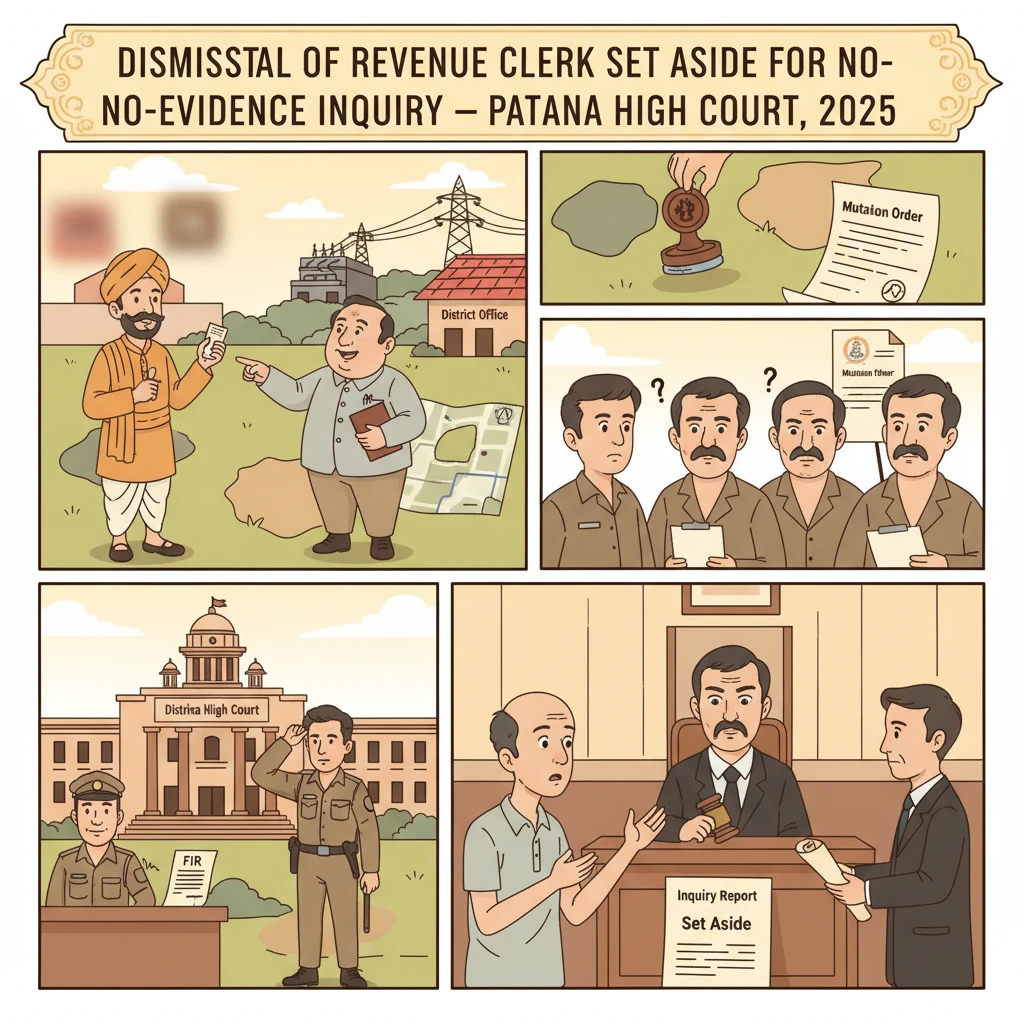
The case arose from a dispute over mutation of land at Mauja Hanuman Nagar in Patna, relating to Khata No. 22, Plot Nos. 63, 64 and 72, measuring 11, 20 and 26 decimals respectively. One Devendra Kumar had applied for mutation and fixation of rent in his favour.
On 13.07.2016, the petitioner, then posted as Revenue Clerk, submitted his inspection report. He recorded that the land was registered in the name of Birbal, son of Roopchand, in the survey khatian. He further reported that Devendra Kumar was in possession of the land and that steps for mutation could be taken.
Based on this, the Circle Officer (C.O.), Patna Sadar, forwarded the records to the Deputy Collector Land Reforms (DCLR) for further action. On 19.08.2016, the DCLR allowed Devendra Kumar’s claim. Then, on 03.09.2016, the C.O. issued the mutation order in favour of Devendra Kumar.
Later, the Bihar State Electricity Board claimed that the same land actually belonged to it and that there was a power substation on that property. Acting on this objection, the Commissioner constituted a three-member committee to inquire into the mutation.
On 22.06.2017, the committee submitted its report. On the very same day, an FIR was lodged against the petitioner based on that report. Also on 22.06.2017, the Anchal Amin, Patna Sadar, submitted a measurement report, recording that the disputed land did not belong to the power substation.
Subsequently, a charge sheet with four charges (Annexure-10) was issued against the petitioner. An inquiry officer was appointed, who later submitted an inquiry report (Annexure-13). In that report, charges 1, 2 and 3 were held proved, while charge 4 was not proved.
Relying on this inquiry report, the disciplinary authority issued a second show-cause notice, obtained a reply from the petitioner, and then, by order dated 13.02.2020 (Annexure-1), dismissed the petitioner from service. The petitioner’s Service Appeal No. 46 of 2020 was dismissed by the Commissioner, Patna Division, on 24.03.2022. These two orders were challenged before the Patna High Court in this writ petition.
What the Court Examined and Decided
The Patna High Court, through Hon’ble Mr. Justice Arvind Singh Chandel, examined the legality of the departmental proceedings that led to the petitioner’s dismissal, as well as the appellate order affirming that dismissal.
The petitioner’s counsel argued that the entire inquiry was fundamentally flawed. First, he pointed out that no list of witnesses was supplied with the charge memo. Secondly, during the inquiry no witnesses were examined by the inquiry officer on behalf of the department to prove the charges.
It was also argued that there was no evidence at all to show that the disputed land belonged to the Government of Bihar. Still, the inquiry officer concluded that charges 1, 2 and 3 were proved. According to the petitioner, this made the findings perverse and amounted to a “no evidence” situation in law.
An important part of the petitioner’s case was the role of the presenting officer. As per Annexure-12 dated 01.01.2018, the presenting officer himself had opined that the land had been rightly recommended for mutation after fulfilling the necessary procedures. He further opined that the petitioner had made his recommendation in accordance with law and that the charges were not true.
Despite this favourable opinion from the presenting officer, the inquiry officer still proceeded to hold that the main charges were proved. The petitioner also highlighted that he was merely a Revenue Clerk, who could only recommend mutation. The actual order of mutation was passed by the C.O. on the directions of the DCLR. He had no power to issue orders of mutation or rent receipts.
The petitioner’s counsel contended that if anyone was aggrieved by the mutation order, that order could be challenged under the Bihar Land Mutation Act / Bihar Land Reforms Act. Instead, the petitioner had been singled out and dismissed from service without proper evidence. The punishment, therefore, was said to be arbitrary and unreasonable.
In support of his submissions on principles of departmental inquiry and requirements of evidence, counsel relied on the Supreme Court decisions in Satyendra Singh vs. State of Uttar Pradesh and Another [2024 SCC Online SC 3325], Roop Singh Negi vs. Punjab National Bank [(2009) 2 SCC 570], and State of Uttar Pradesh and Others vs. Saroj Kumar Sinha [(2010) 2 SCC 772]. These authorities were cited to underline that findings in disciplinary proceedings must be based on some admissible evidence and that fair procedure must be followed.
On the other side, learned counsel for the respondent-State defended the action. He submitted that, based on the material on record, the inquiry officer rightly held charges 1, 2 and 3 proved. Consequently, the disciplinary authority correctly imposed the punishment of dismissal, and the appellate authority rightly affirmed it.
The Court carefully considered the pleadings, annexures to the writ petition, and the State’s counter affidavits. The Court specifically focused on whether mandatory procedural safeguards had been followed and whether there was any evidence to sustain the findings.
First, the Court looked at the charge memo (Annexure-10). It found that no list of witnesses had been prepared or provided to the petitioner along with the charge memo. This fact was not disputed by the respondents. The Court held that this amounted to a clear violation of Rule 17(3) of the Bihar Government Servants’ Conduct Rules, 2005.
Next, the Court considered the four charges and the findings of the inquiry officer. The Court noted that the inquiry officer had held charges 1, 2 and 3 proved and charge 4 not proved. The Court then examined the presenting officer’s written opinion (Annexure-12 dated 01.01.2018). In that opinion, the presenting officer had categorically stated that:
– the land had been rightly recommended for mutation after fulfillment of procedures; and
– the delinquent (the petitioner) had acted in accordance with law; and
– the charges were not true.
Despite this, the inquiry officer still proceeded with the inquiry and ultimately concluded that the main charges were proved.
The Court then examined the inquiry report in detail. It observed that:
– No witness’s statement was recorded by the inquiry officer.
– No departmental document was formally tendered in evidence during the inquiry.
Yet, the inquiry officer concluded that charges 1, 2 and 3 were proved. The Court held that these findings were not based on any evidence on record. Rather, they appeared to have been drawn only from the explanation submitted by the petitioner. In a disciplinary proceeding, this is not sufficient; the burden is on the department to lead evidence to prove the charges.
The Court further noted that the disciplinary authority and the appellate authority, while passing their respective orders, did not consider these serious procedural and evidentiary lapses. They simply accepted the inquiry report and imposed / affirmed the punishment of dismissal.
On this analysis, the Court held that the matter was a clear case of “no evidence”. In other words, the charges against the petitioner had been held proved without any supporting evidence. The inquiry officer’s findings were, therefore, unsustainable in law. As the punishment order was founded on such a faulty inquiry report, the dismissal order, and the appellate order upholding it, could not stand.
Accordingly, the Patna High Court set aside the dismissal order dated 13.02.2020 (Annexure-1) passed by the District Magistrate, Patna, as well as the appellate order dated 24.03.2022 passed by the Commissioner, Patna Division, Patna.
The Court also took note that, during the pendency of the writ petition, the petitioner had already superannuated from service. In that situation, reinstatement in service was no longer relevant. Instead, the Court held that the petitioner would be entitled to all consequential benefits from the date of the dismissal order, i.e., 13.02.2020, up to his date of superannuation.
With these observations and directions, the writ petition was allowed.
Why This Judgment Matters
This judgment of the Patna High Court is significant for government employees, especially lower-level staff like clerks who often act on directions of senior officers. It underlines that they cannot be dismissed from service on the basis of mere suspicion or assumptions without proper evidence.
The Court has made it clear that departmental inquiries must follow the rules strictly, including providing a list of witnesses with the charge memo and recording evidence during the inquiry. If the department fails to do so, the entire inquiry can be struck down as a “no evidence” case.
The judgment also shows that when an internal presenting officer himself says that charges are not proved and that procedures were followed, this opinion cannot simply be ignored without any supporting proof. Authorities must act fairly and cannot treat a junior recommending officer as the main culprit when the final orders are passed by higher officials.
For employees who have been dismissed close to retirement, this decision is important because the Court granted full consequential benefits up to superannuation when the dismissal was found illegal. This includes restoring financial entitlements for the period wrongly treated as dismissal.
Legal Issues and Answers
-
Issue: Whether the departmental inquiry and dismissal of the petitioner were valid when no list of witnesses was supplied and no evidence was recorded to prove the charges.
Answer: No. The Patna High Court held that there was a clear violation of Rule 17(3) of the Bihar Government Servants’ Conduct Rules, 2005 and that the case was one of “no evidence”. The dismissal order and appellate order were set aside. -
Issue: What relief should be granted when the delinquent employee has already superannuated during the pendency of the writ petition.
Answer: The Court held that the petitioner, having superannuated, is entitled to all consequential benefits from the date of dismissal (13.02.2020) up to the date of his superannuation.
Cases Cited by the Court
- The petitioner relied on the following Supreme Court decisions: Satyendra Singh vs. State of Uttar Pradesh and Another [2024 SCC Online SC 3325], Roop Singh Negi vs. Punjab National Bank [(2009) 2 SCC 570], and State of Uttar Pradesh and Others vs. Saroj Kumar Sinha [(2010) 2 SCC 772]. These were cited for principles on departmental inquiries and the need for evidence and fair procedure.
Case Details
Case Number: Civil Writ Jurisdiction Case No. 7118 of 2022
Case Title: Anil Kumar Lal vs. The State of Bihar & Others
Citation: 2025(4) PLJR 212
Coram: Hon’ble Mr. Justice Arvind Singh Chandel
Date of Judgment: 27.08.2025
Advocates:
For the Petitioner: Mr. Kumar Kaushik, Advocate; Mr. Suryakant Kumar, Advocate
For the State-Respondents: Mr. Md. Khurshid Alam, AAG-12
For SBPDCL: Dr. Anand Kumar, Advocate; Mr. Rajan Prakash, Advocate
Nature of the Case: Writ petition (service matter – challenge to dismissal order and appellate order arising from departmental proceedings)
Link to Judgment: Click here to read the full Patna High Court judgment
If you found this explanation helpful and wish to stay informed about
how legal developments may affect your rights in Bihar,
you may consider following Samvida Law Associates for more updates.







