
Case Background
The appellant’s father was working as an Assistant Sub-Inspector of Police in Aurangabad district, Bihar.
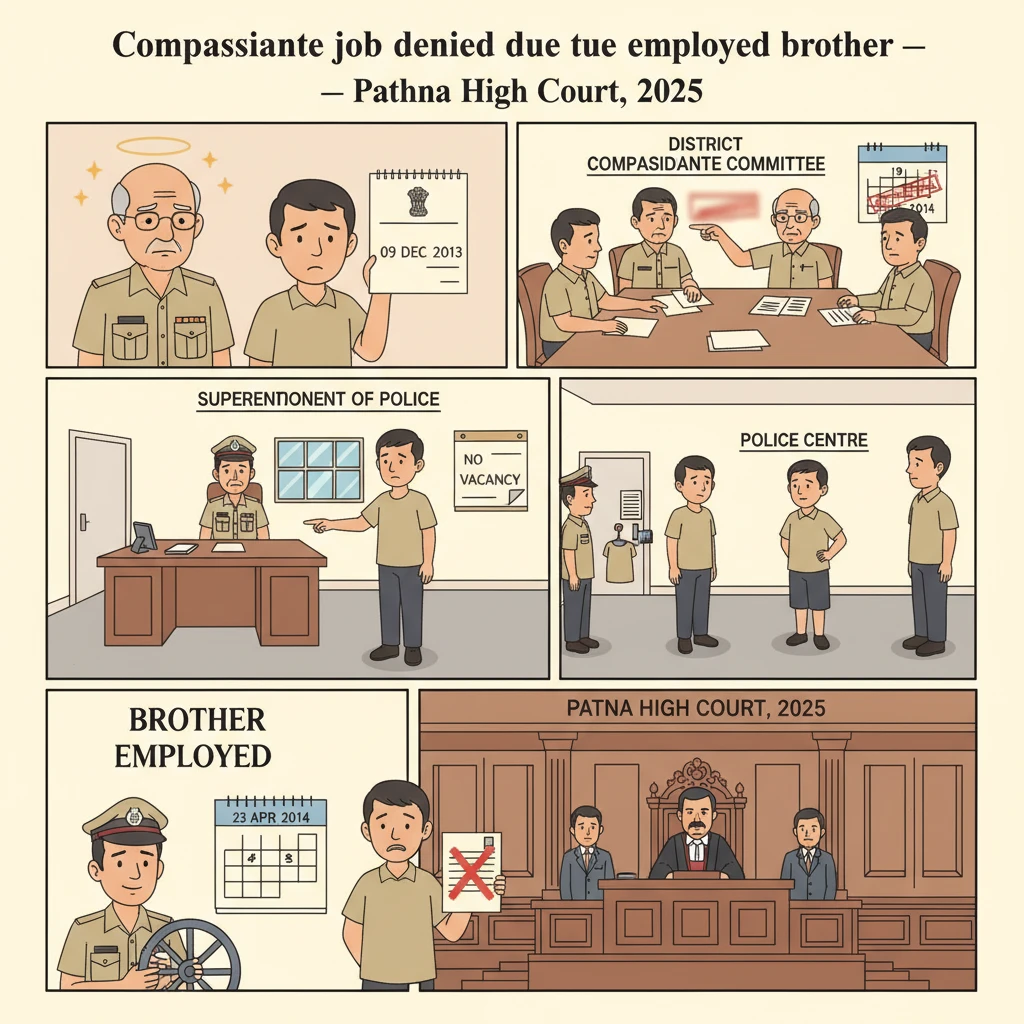
While on duty, he died on 20 May 2013. After his death, one of his sons, the present appellant, applied for a job on compassionate grounds under the State Government scheme. This application was submitted on 09 December 2013.
Under the State’s policy, such applications are considered by a District Compassionate Committee. In this case, the District Compassionate Committee, Aurangabad, considered the request and, in its meeting on 19 September 2014, recommended the appellant’s name for appointment on compassionate ground. The minutes of this meeting were placed before the Court.
Following this recommendation, the appellant was asked to report to the Superintendent of Police, Aurangabad. He went to the office as directed. There he was informed that there was no vacancy available under the fixed quota for compassionate appointments.
He was instead asked to appear at Police Centre, Aurangabad, with all required documents for a physical test for possible appointment on the post of Sepoy on compassionate grounds. Later, by order dated 27 February 2017, his appointment was kept pending.
Ultimately, by order dated 07 February 2018, the appellant was informed that he could not be considered for compassionate appointment because his brother had already been employed as a Driver in the Railways since 23 April 2014.
Aggrieved by this decision, the appellant filed Civil Writ Jurisdiction Case No.10199 of 2018, challenging the rejection order on different grounds. On 13 February 2024, a learned Single Judge of the Patna High Court dismissed the writ petition, relying on the Full Bench decision in Niraj Kumar Mallick v. State of Bihar, reported in 2018(2) PLJR 951 (FB).
The present Letters Patent Appeal No.228 of 2024 was then filed under Clause X of the Letters Patent against the Single Judge’s judgment dated 13 February 2024.
What the Court Examined and Decided
The Division Bench of the Patna High Court, consisting of Hon’ble the Chief Justice and Hon’ble Mr. Justice Nani Tagia, heard arguments from both sides.
On behalf of the appellant, it was argued that when he had applied for compassionate appointment on 09 December 2013, his brother was not in government service. The brother was appointed as a Driver in the Railways later, on 23 April 2014. Therefore, according to the appellant, his case should have been considered as per the situation on the date of his application.
It was also submitted that the brother’s income was not sufficient to maintain the entire family, and that the brother was living separately. Based on these factual claims, counsel for the appellant argued that the learned Single Judge ought to have set aside the rejection order and directed the authorities to give him a compassionate appointment.
On the other hand, counsel for the State opposed the appeal. He pointed out that when the District Compassionate Committee recommended the appellant’s case on 19 September 2014, the committee was not aware that the appellant’s brother had already been appointed as a Driver in the Railways on 23 April 2014.
The State submitted that once the authorities later came to know of this fact, they correctly applied the State Government’s policy on compassionate appointments. Under this policy, if one of the dependents of the deceased employee is already gainfully employed, another dependent is not entitled to appointment on compassionate ground. On this basis, the State argued that the concerned authority rightly rejected the appellant’s claim and that the Single Judge had committed no error.
The Division Bench then examined the undisputed facts:
First, the appellant’s father, a government employee, died on 20 May 2013 while in service.
Second, the appellant applied for compassionate appointment on 09 December 2013.
Third, the District Compassionate Committee recommended his name on 19 September 2014 for appointment on compassionate grounds.
Fourth, before that recommendation, the appellant’s brother had already been employed as a Driver in the Railways on 23 April 2014.
The Court observed that it appeared from the record that the District Committee, when it met on 19 September 2014, was not aware of this gainful employment of the appellant’s brother and therefore proceeded to recommend the appellant’s case. However, the important fact remained that the brother’s employment pre-dated the committee’s recommendation.
The Bench then turned to the relevant government policy on compassionate appointment. It referred to the clause of the State Government’s policy relating to appointment of dependents of deceased employees on compassionate ground. The clause, reproduced in Hindi in the judgment, clarifies that where any of the dependents of a deceased government servant is “gainfully employed”, then other dependents are not entitled to the benefit of compassionate appointment.
The Court noted that “gainfully employed” in the policy refers to such employment where the dependent can adequately bear the financial responsibilities of the deceased employee’s family. The policy clarifies that if one dependent is gainfully employed, the family cannot claim another compassionate appointment.
To interpret and support this policy, the Division Bench relied upon the Full Bench decision in Niraj Kumar Mallick v. State of Bihar, 2018(2) PLJR 951 (FB). The Court specifically referred to paragraphs 45 and 49 of that decision.
In paragraph 45 of the Full Bench judgment, the Court had examined Clause (d) of Annexure-A to a counter affidavit filed by the General Administration Department. The clarification stated that where any dependent of a deceased government servant is gainfully employed, then, irrespective of whether that person lives with or separately from the rest of the family, no other dependent is entitled to compassionate appointment.
The Full Bench held that this clarification, being part of the policy decision governing compassionate appointments, was based on judicial pronouncements and in line with the object of such appointments. It was found to be consistent with several decisions of the Supreme Court and to satisfy the requirements of Articles 14 and 16 of the Constitution of India. The Full Bench concluded that this clarification could not be faulted on constitutional grounds.
In paragraph 49 of the same judgment, the Full Bench agreed with earlier Division Bench and Single Judge decisions which had upheld rejection of compassionate appointments when other siblings were already in service. The Full Bench observed that in those cases, the petitioners had not even pleaded that their employed siblings were unable to earn enough to support them. Thus, rejection of their claims on the ground that another sibling was employed was upheld.
Applying this legal position and the State policy to the present case, the Division Bench held that when the appellant’s brother had been gainfully employed in the Railways since 23 April 2014, the authorities committed no error in rejecting the appellant’s claim for compassionate appointment, despite the earlier recommendation of the District Committee.
The Court did not accept the appellant’s contention that the situation on the date of the application should control the outcome. Instead, it looked at the facts as they stood when the authorities took a final decision, and applied the policy as interpreted by the Full Bench.
The Court also found that the learned Single Judge had correctly relied on the Full Bench judgment and the State’s policy and had not made any legal or factual error in dismissing the writ petition.
Accordingly, the Division Bench held that no case was made out for interference with the Single Judge’s judgment dated 13 February 2024 in CWJC No.10199 of 2018.
The Letters Patent Appeal was therefore dismissed. The Court also ordered that any interlocutory applications would stand disposed of in view of the dismissal of the main appeal.
Why This Judgment Matters
This judgment has important practical consequences for families of deceased government employees in Bihar seeking compassionate appointment.
It reinforces that under the State Government’s policy, if any one dependent is already gainfully employed, other dependents cannot claim another job on compassionate grounds, even if their application was filed earlier and later recommended by a district committee.
The Patna High Court has made it clear, following the Full Bench in Niraj Kumar Mallick, that:
It does not matter whether the employed sibling lives with the rest of the family or separately. It also does not matter that a District Compassionate Committee initially recommended the case without knowing of the sibling’s job. Once the fact of gainful employment emerges, the authorities are entitled to deny compassionate appointment to any other dependent.
This judgment therefore warns applicants that recommendations by committees are not final rights, and that the decisive factor is whether the family already has a gainfully employed dependent as per the State policy.
Legal Issues and Answers
- Issue: Whether a dependent of a deceased government employee is entitled to compassionate appointment when another sibling has already been gainfully employed before the final decision, even if the dependent applied earlier and was recommended by the District Committee.
Answer: No. The Patna High Court held that in view of the State Government’s policy and the Full Bench decision in Niraj Kumar Mallick, once any dependent is gainfully employed, no other dependent can claim compassionate appointment, and rejection of the claim is valid. - Issue: Whether the learned Single Judge erred in dismissing the writ petition challenging the rejection of compassionate appointment.
Answer: No. The Court held that the Single Judge correctly applied the State policy and binding Full Bench precedent, and therefore no interference was warranted in Letters Patent Appeal.
Cases Cited by the Court
- Niraj Kumar Mallick v. State of Bihar, 2018(2) PLJR 951 (Full Bench) – relied upon for interpreting the State’s compassionate appointment policy and the effect of gainful employment of a dependent.
- The Full Bench judgment also referred, in turn, to earlier decisions such as Vishal Kumar, Mahabir Paswan and Jay Prakash Choudhary, as noted in the extracts quoted in the present judgment.
Case Details
Case Number: Letters Patent Appeal No.228 of 2024 in Civil Writ Jurisdiction Case No.10199 of 2018
Case Title: Gautam Kumar v. The State of Bihar & Ors.
Citation: 2025(4) PLJR 210
Court: High Court of Judicature at Patna
Coram: Hon’ble the Chief Justice Vipul M. Pancholi and Hon’ble Mr. Justice Nani Tagia
Date of Judgment: 25-08-2025
Advocates:
- For the Appellant: Mr. Aditya Narain Singh, Advocate; Mr. Ajay Kumar Singh, Advocate
- For the Respondents/State: Mr. Sanjay Kumar Ghosarvey, AC to AAG-3
Respondents: State of Bihar through the Principal Secretary, General Administration Department, and various senior police and district officers of Bihar, including Director General of Police, Inspector General (Welfare), Inspector General, Magadh Range, Deputy Inspector General, Aurangabad, Commissioner, Magadh Division, District Magistrate Aurangabad, Superintendent of Police Aurangabad, and Deputy Superintendent of Police Aurangabad.
Nature of Case: Letters Patent Appeal under Clause X against dismissal of writ petition (CWJC) seeking compassionate appointment after death of a government employee.
Link to Judgment: Click here to read the full Patna High Court judgment
If you found this explanation helpful and wish to stay informed about how legal developments may affect your rights in Bihar, you may consider following Samvida Law Associates for more updates.







