
Case Background
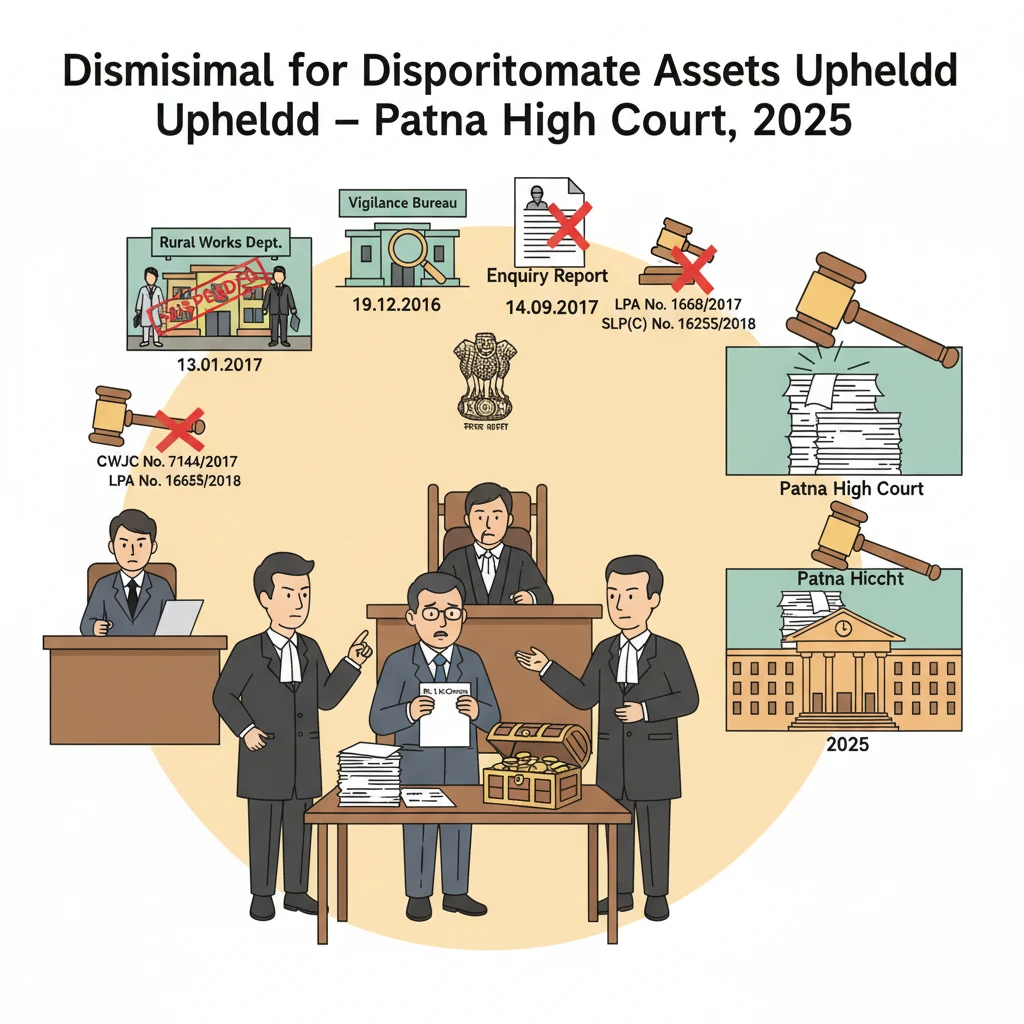
The appellant was a Superintending Engineer in the Rural Works Department, posted in the Work Circle at Siwan. On 19.12.2016, a vigilance FIR, Vigilance P.S. Case No.145 of 2016, was registered against him under sections 13(1)(e) read with 13(2) of the , 1988. He was alleged to have acquired assets disproportionate to his known sources of income.
After the Vigilance Department informed the Rural Works Department about this FIR, the appellant was placed under suspension on 13.01.2017 under the Bihar Government Servants (Classification, Control and Appeal) Rules, 2005. The department decided to start a departmental proceeding against him.
He was served with a chargesheet in Form “ka”. The charges stated that he possessed assets beyond his known sources of income to the tune of around Rs.1.16 crores, leading to the registration of the vigilance case. He was also charged with grave misconduct and violation of the Bihar Government Servant’s Conduct Rules, 1976.
The appellant was provided a copy of the report of the S.P., Vigilance Investigation Bureau, Bihar, dated 27.12.2016. He submitted his defence on 12.06.2017. In parallel, he challenged his suspension in CWJC No.714 of 2017, but later withdrew that case on 05.09.2017.
He then filed CWJC No.1002 of 2017 challenging the very initiation of the departmental proceeding. That writ was dismissed. His Letters Patent Appeal No.1668 of 2017 against that dismissal was also rejected on 19.06.2018. A Special Leave Petition (Civil) No.16255 of 2018 before the Supreme Court was also dismissed. Thus, the departmental proceeding continued.
During the enquiry, the department filed its response on 14.07.2017. Besides the S.P.’s letter dated 27.12.2016, the appellant was also given a copy of his own reply dated 20.06.2017 submitted before the D.S.P.-cum-Investigating Officer, Vigilance Investigation Bureau. He was heard on 12.06.2017 and 29.06.2017.
On 30.08.2017, the appellant again submitted a detailed reply on merits and a response to the departmental comments. He was heard in detail in the presence of the presenting officer. He filed a third reply/defence on 06.09.2017.
The Enquiry Officer submitted his report on 14.09.2017, holding all three charges proved. A second show cause notice, along with a copy of the enquiry report, was served on the appellant. When he initially did not reply, a reminder was issued, and he then submitted his reply. Finally, by order dated 28.02.2020, in exercise of powers under the C.C.A. Rules, the appellant was dismissed from service.
He filed a review petition on 27.04.2020 against the dismissal order. This review was rejected on 12.06.2020.
Thereafter, he filed CWJC No.3397 of 2021 before the Patna High Court. He sought quashing of the dismissal order dated 28.02.2020, reinstatement in service with full salary from the date of suspension, and setting aside of the review rejection order dated 12.06.2020. On 09.08.2024, the learned Single Judge dismissed his writ petition, upholding the dismissal.
The present Letters Patent Appeal No.931 of 2024 was filed against that Single Judge judgment. This appeal was heard by a Division Bench consisting of Hon’ble the Acting Chief Justice and Hon’ble Mr. Justice Partha Sarthy. The judgment was reserved (C.A.V.) and delivered on 28.03.2025.
What the Court Examined and Decided
In the appeal, the central attack by the appellant was on the legality of the departmental enquiry and the sufficiency of evidence. His senior counsel argued that the memorandum of charges (Prapatra “ka”) did not mention any witness. It referred only to the S.P., Vigilance Investigation Bureau’s letter dated 27.12.2016. No witness was named to prove that document. According to him, the Enquiry Officer merely repeated the vigilance case version as contained in that letter.
On this basis, it was argued that this was a classic “no evidence” case. If no witness was examined to prove the documents, the findings could not stand. Therefore, the dismissal order, the review order, and the Single Judge’s judgment were all said to be unsustainable.
To support this, the appellant relied on several decisions of the Patna High Court: Ram Lagan Ram v. State of Bihar (LPA No.389 of 2024), Rajendra Prasad v. State of Bihar (LPA No.366 of 2022), State of Bihar v. Vikash Kumar (LPA No.446 of 2024), and Srikant Singh v. State of Bihar (LPA No.58 of 2024). He also cited Supreme Court decisions in Roop Singh Negi v. Punjab National Bank, State of Uttar Pradesh v. Saroj Kumar Sinha, and Satyendra Singh v. State of Uttar Pradesh, to stress that departmental charges must be proved by legally acceptable evidence, usually through witnesses.
On the other side, the State’s counsel pointed out that the departmental proceeding followed the vigilance FIR of 2016 alleging disproportionate assets. The enquiry ended in a dismissal order dated 28.02.2020, and the review was rejected on 12.06.2020. According to the State, there was no procedural irregularity. The appellant was given full opportunity to reply to the charges, to be heard repeatedly, and to submit detailed defences.
The State argued that once the appellant was served with the S.P.’s letter and the FIR and he chose to respond in detail, he could not later claim absence of evidence. It was further submitted that the punishment order and the Single Judge’s judgment were legal and required no interference.
The Division Bench first noted that the chargesheet clearly mentioned registration of Vigilance P.S. Case No.145 of 2016 on 19.12.2016 under various provisions of the P.C. Act and recorded the allegation that the appellant possessed assets worth Rs.1,16,98,070/- beyond his known sources of income. The S.P.’s letter dated 27.12.2016, along with a copy of the FIR, had been served on the appellant.
The Court also noted that the appellant was supplied with his own reply dated 20.06.2017 given before the D.S.P.-cum-Investigating Officer, Vigilance Investigation Bureau. He filed multiple replies in the departmental proceeding, including a very detailed reply to the second show cause notice on 15.10.2019, spanning about 156 pages (Annexure-21 to the writ petition).
Within these replies, the appellant tried to justify his assets, including by saying that his wife had independent income and filed income tax returns from 2005-06 to 2015-16. The Court noted, however, that in 2005-06 she filed a zero return and in 2015-16 her total income tax was only Rs.50,000/-, with a refund claim of Rs.35,680/-. This detail was significant because he sought to explain part of the assets through her income.
The Bench then turned to Rule 19 of the Bihar Government Servant’s Conduct Rules, 1976. Rule 19(1) requires every government servant, on first appointment and thereafter every 12 months, to submit a return of assets and liabilities, including immovable property held in their own name or in the name of any family member. Rule 2(c) defines “member of family” to include spouse.
Most crucially, Rule 19(6) states that a government servant found in possession of pecuniary resources or property disproportionate to his known sources of income, for which he cannot satisfactorily account, shall, unless the contrary is proved, be presumed guilty of grave misconduct.
The Court emphasised this presumption. Under the Rules of 1976, once disproportionate assets are shown, the burden shifts to the government servant to satisfactorily explain them. If he cannot, the law presumes grave misconduct.
On examining the enquiry report and the documents produced by the appellant himself, the Court concluded that he had “miserably failed” to explain the properties disproportionate to his known income, as set out in the S.P., Vigilance Investigation Bureau’s letter dated 27.12.2016.
The Bench then addressed the legal arguments about evidence and witnesses. It accepted that, in general, evidence in departmental proceedings should be proved by examining witnesses. However, it relied on the Supreme Court’s decision in State Bank of India v. Narendra Kumar Pandey (2013) 2 SCC 740.
Quoting extensively from that judgment, the Bench underlined that:
- A chargesheet does not have to list documents or witnesses unless service rules specifically require it.
- A fair procedure does not necessarily mean supplying all documents or witness lists along with the chargesheet.
- In some cases, proof may be purely documentary; in others, it may be oral. The requirement depends on the facts of each case.
- Uncontroverted documentary evidence can be sufficient to prove charges, especially where the delinquent officer has had a chance to respond.
Applying these principles, the Court noted that the appellant never questioned the genuineness or veracity of the S.P.’s letter dated 27.12.2016 or the FIR enclosed with it. Instead, he chose to respond and attempted to explain the allegations, both at the initial stage and in the detailed second show cause reply of over 150 pages.
Because he engaged with the documents and did not dispute their authenticity, and because he failed to give a satisfactory explanation for the disproportionate assets, the Court held that the enquiry findings were based on evidence and on the presumption under Rule 19(6). It was not a “no evidence” case.
The Bench further found no procedural illegality or breach of natural justice. The appellant was given multiple opportunities to reply, to be heard, and to defend himself. There was no violation of the C.C.A. Rules or the Conduct Rules shown on record.
On this basis, the Division Bench held that there was no ground to interfere with either the dismissal order passed in the departmental proceeding or the Single Judge’s judgment upholding it. Consequently, the Letters Patent Appeal had no merit and was dismissed.
Why This Judgment Matters
This judgment is significant for government servants in Bihar and elsewhere who face departmental proceedings on allegations of disproportionate assets. The Patna High Court has clearly reinforced that, under the Bihar Government Servant’s Conduct Rules, 1976, the legal presumption is against an officer who is found with property beyond his known income.
The decision shows that once the department places documentary material on record showing disproportionate assets, the burden lies on the officer to give a convincing, document-backed explanation. Merely stating that a spouse or family member has income is not enough if the returns or figures do not support the claim.
It also clarifies that departmental enquiries can validly rely on documentary evidence, such as vigilance reports and FIRs, especially when their genuineness is not challenged and the delinquent officer has had full opportunity to respond. The absence of a list of witnesses or oral testimony is not, by itself, fatal.
For employees facing similar proceedings, this case underlines the importance of maintaining accurate asset declarations, filing truthful returns, and keeping proper records. For the administration, it confirms that, if due procedure is followed and opportunities are granted, courts will not lightly interfere with dismissal orders in vigilance-related matters.
Legal Issues and Answers
- Issue: Was the departmental dismissal of the appellant for possessing assets disproportionate to his known sources of income vitiated for want of evidence and procedural fairness?
Answer: No. The Patna High Court held that the enquiry was conducted in accordance with the rules, relied on unchallenged documentary evidence, and that the appellant failed to satisfactorily explain his disproportionate assets. The dismissal was upheld. - Issue: Does failure to mention witnesses in the chargesheet and to examine them in the enquiry render the proceeding a “no evidence” case?
Answer: No. Relying on State Bank of India v. Narendra Kumar Pandey, the Court held that a chargesheet need not list witnesses or documents unless rules so require, and that documentary evidence alone can prove charges where appropriate. - Issue: What is the effect of Rule 19(6) of the Bihar Government Servant’s Conduct Rules, 1976 in a disproportionate assets departmental case?
Answer: Rule 19(6) creates a presumption of grave misconduct if a government servant is found in possession of property disproportionate to known income and cannot satisfactorily account for it. The appellant failed to rebut this presumption.
Cases Cited by the Court
- The Division Bench expressly relied on the Supreme Court judgment in State Bank of India & Ors. v. Narendra Kumar Pandey, (2013) 2 SCC 740, particularly on the nature of chargesheets and the sufficiency of documentary evidence in departmental enquiries.
- The appellant also cited several Patna High Court and Supreme Court decisions (including Roop Singh Negi, Saroj Kumar Sinha, and Satyendra Singh), but the Division Bench distinguished them by applying the principles laid down in Narendra Kumar Pandey to the facts of this case.
Case Details
Case Number: Letters Patent Appeal No.931 of 2024 in Civil Writ Jurisdiction Case No.3397 of 2021
Case Title: Om Prakash Manjhi v. The State of Bihar & Ors.
Citation: 2025 (2) PLJR 805
Court: High Court of Judicature at Patna
Coram: Hon’ble the Acting Chief Justice; Hon’ble Mr. Justice Partha Sarthy (C.A.V. judgment authored by Hon’ble Mr. Justice Partha Sarthy; Hon’ble the Acting Chief Justice agreeing)
Date of Judgment: 28.03.2025
Advocates:
- For the Appellant: Mr. Y.V. Giri, Senior Advocate; Mr. Sumit Kumar Jha, Advocate
- For the Respondents (State of Bihar and officials): Mr. Ajay, G.A.5; Mr. Pratik Kumar Sinha, A.C. to G.A.5
Nature of the Case: Letters Patent Appeal (intra-court appeal) against the dismissal of a writ petition challenging a departmental dismissal order and the rejection of a review petition.
Link to Judgment: https://patnahighcourt.gov.in/viewjudgment/MyM5MzEjMjAyNCMxI04=-ws5uow1JPnU=
If you found this explanation helpful and wish to stay informed about
how legal developments may affect your rights in Bihar,
you may consider following Samvida Law Associates for more updates.







