

Case Background
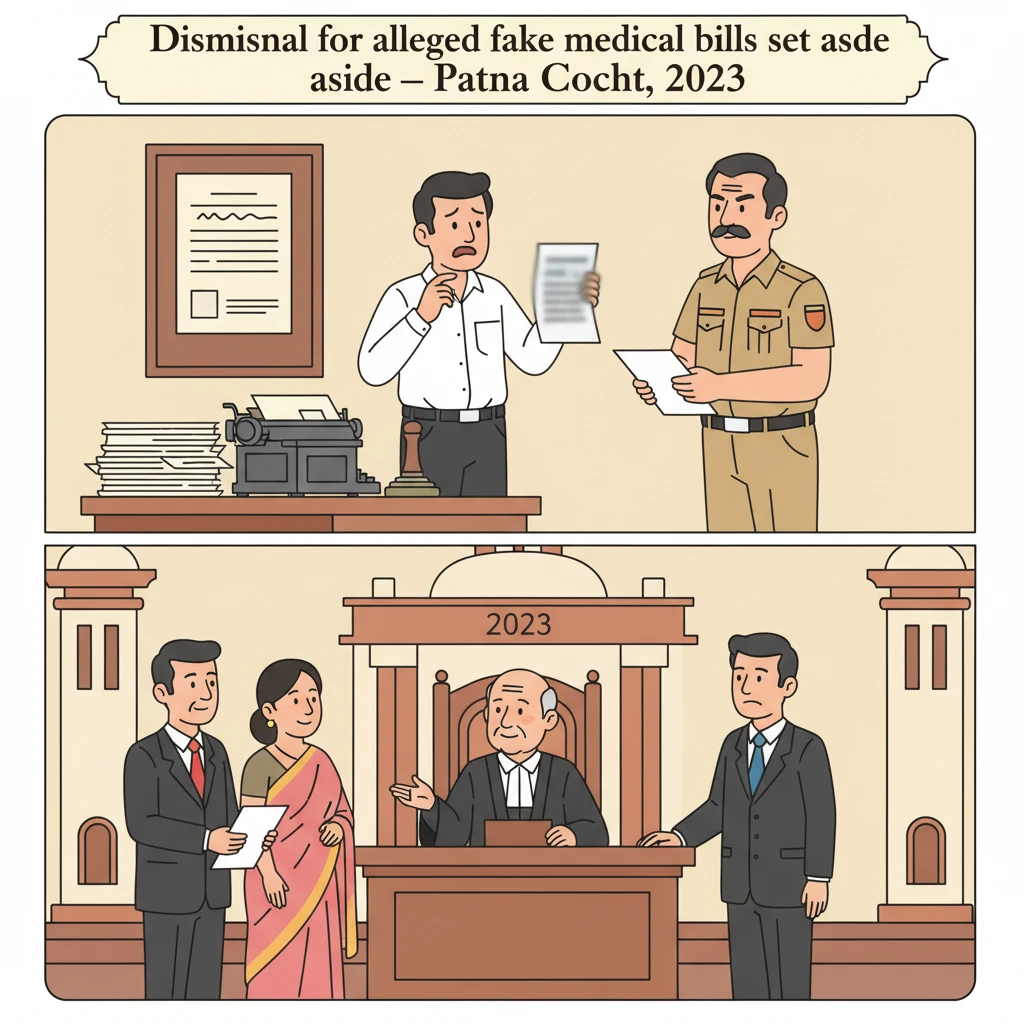
The case concerns a Typist Category-I who was working in the erstwhile Bihar State Electricity Board, Patna, now succeeded by the Bihar Distribution Company Limited.
On 18.06.1995, the Board framed a charge against the employee under Clause 29 of its standing orders. The allegations related to a medical reimbursement claim said to have been made on behalf of his wife.
The charge memo cited two witnesses and two documents, but did not contain any detailed statement of imputation explaining dates, amounts, or specific acts said to be fraudulent.
A departmental enquiry followed. On 04.05.1996, the disciplinary authority imposed the penalty of dismissal from service.
The employee filed a departmental appeal. On 29.01.1998, the appellate authority affirmed the dismissal.
Aggrieved, the employee invoked the writ jurisdiction of the Patna High Court under Article 226 of the Constitution, by filing C.W.J.C. No. 1263 of 1999.
On 21.04.2015, a learned Single Judge dismissed the writ petition and upheld the dismissal order and appellate order.
The employee then filed the present Letters Patent Appeal, L.P.A. No. 1594 of 2015, before a Division Bench of the Patna High Court.
During the pendency of this appeal, the original appellant died. His legal heirs were brought on record to pursue the matter, as the outcome directly affected retiral benefits.
What the Court Examined and Decided
The Division Bench, speaking through Hon’ble Mr. Justice P. B. Bajanthri (for the Bench also comprising Hon’ble Mr. Justice Ramesh Chand Malviya), closely examined the charge memo, the standing orders of the Bihar State Electricity Board, and the way the departmental proceedings were conducted.
The key allegation was that the employee had submitted a medical reimbursement bill in the name of his wife and played fraud in making this claim. It was stated that he had been paid an advance of Rs. 15,000/- for her treatment and had failed to give proper account of this amount.
The appellant’s counsel argued that the very foundation of the proceedings was defective. The charge, they said, ought to have been framed under Clause 29(B)(c) of the standing orders, but was instead referred to Clause 29(B)(q). More importantly, they contended that the charge as framed was vague and lacked the basic details needed to defend oneself.
The Court noted that the charge memo was supported only by two witnesses and two documents. It did not contain a statement of imputation explaining in clear terms what exactly the employee had done, on which date, and for what amount.
The medical reimbursement bill, which was the heart of the allegation, was not even listed as a document to be relied upon in the enquiry. Nor was any document relating to payment of the Rs. 15,000/- advance cited along with the charge.
The Division Bench observed that Clause 30 of the standing orders laid down a structured procedure for holding a domestic enquiry. It involved stages where the explanation of the workman and the comments of the reporting officer, along with documentary evidence, had to be considered by the competent authority.
In such a setting, the crucial document for an allegation of fraudulent medical reimbursement would naturally be the medical bill itself and related records. Yet, these were missing from the list of relied upon documents at the very threshold.
The Court found that this was not a minor lapse. By failing to mention the date of the alleged claim, the amount involved, and by omitting the primary documents, the charge memo did not contain the ingredients necessary to constitute a proper charge.
Because of this, the enquiry that followed rested on a weak and defective foundation. The Court emphasized that time and again courts have held that vagueness in the charge can vitiate the entire disciplinary proceedings.
The respondents’ counsel argued that the employee had, in fact, received Rs. 15,000/- as advance for his wife’s treatment, that he had submitted fake medical bills, and that during enquiry these facts came on record. They also relied on an order dated 06.05.1996 (Annexure-2), passed after the dismissal order of 04.05.1996, which recorded that the employee had sought Rs. 25,000/- for treatment in 1992 and had been paid Rs. 15,000/- as advance.
This order stated that he neither got his wife treated with that amount nor returned the advance, and that he had held a large amount belonging to the Board for about three years, which was treated as misconduct.
The Division Bench noticed that this 06.05.1996 order was meant to support the dismissal order. However, it also noted that the employee had not specifically challenged this order in the writ proceedings.
Still, the Court’s focus remained on whether the disciplinary proceedings had been initiated and conducted in accordance with the standing orders and principles of natural justice.
In assessing judicial review standards, the Court referred to the Supreme Court’s decisions in Union of India v. P. Gunasekaran (2015) 2 SCC 610, B.C. Chaturvedi v. Union of India, Kumaon Mandal Vikas Nigam Ltd. v. Girja Shankar Pant (2001) 1 SCC 182, and Coal India Ltd. v. Ananta Saha (2011) 5 SCC 142.
These judgments collectively lay down that while courts do not normally re-appreciate evidence in disciplinary matters, they can interfere where:
- the enquiry is not conducted according to prescribed procedure,
- principles of natural justice are violated,
- the findings are based on no evidence, or
- the very foundation of the proceedings is illegal, in which case subsequent actions fall.
The Patna High Court applied these principles to the facts at hand. It held that the standing orders, particularly paragraphs 29, 30, and 31, had not been properly followed even at the stage of framing the charge.
The charge and the list of documents, when read together, had no real nexus with the core allegation of fraudulent medical reimbursement. The required details were missing, and the essential documents were not cited.
The Court also observed that the learned Single Judge, while dismissing the writ petition, had relied on materials such as the amount of Rs. 15,000/- advance and a bill of about Rs. 64,000/-. However, these figures were not part of the original article of charge, and therefore were extraneous to the disciplinary foundation.
In other words, the learned Single Judge had taken into account material that was not contained in the charge memo or its annexures, without noticing this mismatch.
Because the basic requirement of a clear and specific charge and proper compliance with standing orders was not satisfied, the Division Bench held that the disciplinary proceedings stood vitiated.
Ordinarily, such a finding might lead to the matter being remanded back to the department for a fresh enquiry.
However, in this case the employee had been dismissed way back on 04.05.1996 and had since died during the pendency of the appeal. The Court held that at this distance of time, and given his demise, it would be impracticable to order a fresh enquiry.
Therefore, the Court chose to grant final relief instead of remanding.
It set aside the order of the learned Single Judge dated 21.04.2015 in C.W.J.C. No. 1263 of 1999, the dismissal order dated 04.05.1996, and the appellate order dated 29.01.1998.
The writ petition was allowed, and consequently, the Letters Patent Appeal was also allowed.
The Division Bench directed the concerned respondent authority to regulate the suspension period and compute and disburse all retiral benefits in favour of the legal heirs or nominee of the deceased employee within eight weeks from the date of receipt of the order.
The Court made it clear that if there was any delay beyond this eight-week period in settling these monetary benefits, the legal heirs would be entitled to litigation costs quantified at Rs. 25,000/-, to be paid on account of belated settlement.
Why This Judgment Matters
This judgment is important for government and public sector employees in Bihar and beyond, especially those working under service rules or standing orders.
It shows that even when serious allegations like fraud are made, the employer must still follow its own rules strictly. Charges must be clear, with dates, amounts, and supporting documents clearly set out. Without this, an employee cannot defend himself properly.
The Patna High Court made it clear that a vague charge and a defective enquiry cannot be cured later by citing additional materials in court. The foundation must be lawful from the beginning.
For families of deceased employees, the decision also shows that legal heirs can continue to pursue service claims where disciplinary actions have affected retiral dues. Here, despite the employee’s death, his heirs secured a direction for payment of retiral benefits.
The judgment reinforces that courts will intervene in departmental proceedings where standing orders and principles of natural justice have not been followed, even though they normally avoid re-assessing evidence.
Legal Issues and Answers
-
Issue: Whether the dismissal of the employee for alleged fraudulent medical reimbursement, based on the charge framed on 18.06.1995, was legally sustainable when the charge and enquiry did not comply with the Bihar State Electricity Board standing orders.
Answer: No. The Patna High Court held that the charge was vague, lacked necessary particulars and relevant documents, and the standing orders (paragraphs 29 to 31) were not followed. The disciplinary proceedings were therefore vitiated, and the dismissal, appellate order, and Single Judge’s order were set aside. -
Issue: Whether the matter should be remanded for a fresh enquiry after setting aside the earlier proceedings.
Answer: No. Considering that the employee had been dismissed in 1996 and had since died, the Court found it impracticable to order a fresh enquiry at such a distance of time and instead granted final relief by restoring his entitlement to retiral benefits.
Cases Cited by the Court
- Union of India v. P. Gunasekaran, (2015) 2 SCC 610 : (2015) 1 SCC (L&S) 554
- B.C. Chaturvedi v. Union of India
- Kumaon Mandal Vikas Nigam Ltd. v. Girja Shankar Pant and Others, (2001) 1 SCC 182
- Coal India Ltd. v. Ananta Saha, (2011) 5 SCC 142
- Badrinath v. Govt. of T.N., (2000) 8 SCC 395 : 2001 SCC (L&S) 13 : AIR 2000 SC 3243
- Sharp v. Wakefield, 1891 AC 173
- Denby (William) and Sons Ltd. v. Minister of Health, (1936) 1 KB 337
- Union of India v. H.C. Goel
Case Details
Case Number: Letters Patent Appeal No. 1594 of 2015 in Civil Writ Jurisdiction Case No. 1263 of 1999
Case Title: Syed Nabi Karim v. Bihar State Electricity Board & Ors.
Coram: Hon’ble Mr. Justice P. B. Bajanthri and Hon’ble Mr. Justice Ramesh Chand Malviya
Date of Judgment: 18.12.2023
Citation: 2024(1) PLJR 592
Advocates: Mr. Ankit Katriar, Advocate for the appellant; Mr. Vinay Kirti Singh, Senior Advocate and Mr. Akhileshwar Singh, Advocate for the respondents
Nature of the Case: Letters Patent Appeal (intra-court appeal) against dismissal of a writ petition challenging departmental dismissal from service
Link to Judgment: https://patnahighcourt.gov.in/viewjudgment/MyMxNTk0IzIwMTUjMSNO-T0j5StRSjqo=
If you found this explanation helpful and wish to stay informed about
how legal developments may affect your rights in Bihar,
you may consider following Samvida Law Associates for more updates.







