

Case Background
The petitioner was appointed as a Sub-Inspector of Police in 2009. According to him, he had been discharging his duties to the full satisfaction of his seniors.
On 25.09.2020, he was posted as the Station House Officer (SHO) of Ganga Bridge Police Station, Vaishali. He claims that he worked diligently during this posting.
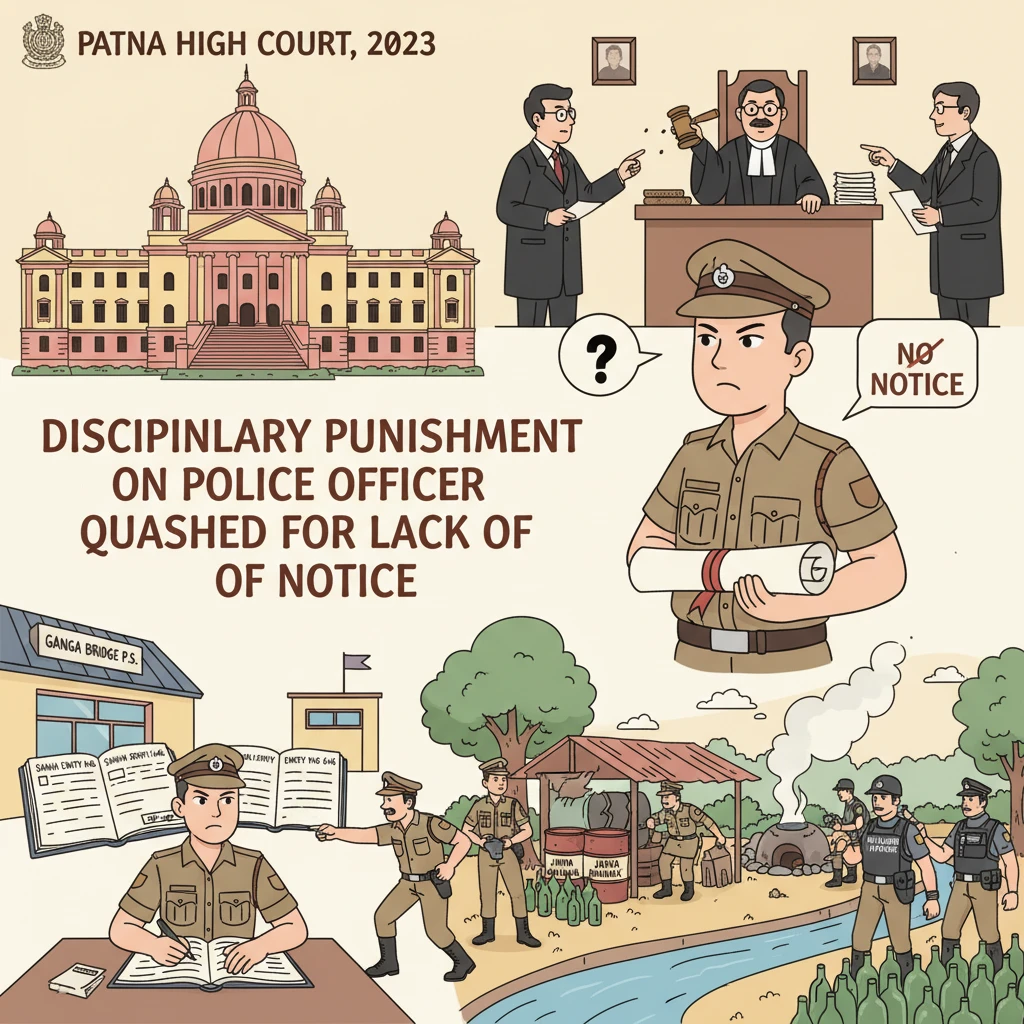
On 25.11.2020, the petitioner received information that some miscreants were involved in manufacturing illicit liquor and had stored a large quantity of such liquor. Based on this information, a sanha entry bearing Entry No. 645 was made in the station diary.
While, as per the petitioner, he was preparing with his force to conduct a raid, the Anti-Liquor Task Force (ALTF) reached the Ganga Bridge Police Station. Thereafter, another sanha entry bearing Entry No. 646 was made, and a joint inspection was carried out at the suspected place.
During this joint operation, a huge quantity of illicit country-made liquor, an illicit liquor manufacturing kiln and ten thousand litres of raw “jawa mahua” mix was recovered.
Soon after, by order dated 29.11.2020 issued by the Director General of Police, Bihar, Patna, the petitioner was placed under suspension. A departmental proceeding was initiated by memo dated 30.11.2020 and a charge-sheet in Praptra ‘Ka’ was served on him.
The charge against the petitioner was based on a letter dated 24.11.2020 issued by Bihar Police Headquarters (Excise & Prohibition Department), Bihar, Patna. That letter stated that if illicit liquor was recovered by the Anti-Liquor Task Force from an area under a particular police station, the Officer-in-Charge of that station would be held responsible and severe legal and administrative action would follow.
On the basis of this policy, it was alleged that the recovery by ALTF on 25.11.2020 within the jurisdiction of Ganga Bridge Police Station showed gross negligence and dereliction of duty on the part of the petitioner, who was then the SHO.
What the Court Examined and Decided
An Enquiry Officer was appointed to conduct the departmental proceedings against the petitioner. After holding the enquiry, the Enquiry Officer submitted a report dated 24.02.2021.
In this report, the Enquiry Officer found the petitioner not guilty of the charges levelled against him. In other words, the departmental enquiry itself exonerated the petitioner.
However, the disciplinary authority, namely the Superintendent of Police, Vaishali, did not accept the findings of the Enquiry Officer. Instead of independently recording tentative reasons for disagreeing, the authority merely issued a letter dated 28.02.2021 to the petitioner.
By this letter, a copy of the enquiry report was enclosed, and the petitioner was asked to submit his defence explanation only on the question of proposed punishment. No reasons for differing from the Enquiry Officer’s exoneration were set out in this communication.
The petitioner submitted his reply on 05.03.2021. In his reply, he highlighted that during his short tenure of about two months at Ganga Bridge Police Station, he had lodged nine FIRs under the Bihar Excise and Prohibition Act, 2016/2018.
He stated that he had recovered 4584.63 litres of country-made and foreign liquor during that period. He also claimed that he had ensured peace during the Vidhan Sabha elections and during the festivals of Dusshera, Deepawali and Chhat, while maintaining overall law and order in the area.
The petitioner further pointed out that before the ALTF reached the police station on 25.11.2020, he had already made a sanha entry regarding the illegal activities of liquor mafia at the spot and was preparing to raid the area. When ALTF arrived, a joint operation was carried out, leading to recovery of illicit liquor.
Despite this reply, the Superintendent of Police, Vaishali, passed the order dated 21.03.2021, contained in memo dated 23.03.2021. By this order, the petitioner was punished by forfeiture of two increments with cumulative effect and was debarred from being posted as Station House Officer/Outpost-in-Charge for ten years.
The petitioner filed an appeal before the Inspector General of Police, Tirhut Range, Muzaffarpur. However, by order dated 26.07.2021, the appeal was rejected. Thus, the punishment remained in force.
The petitioner then approached the Patna High Court through a writ petition, challenging both the original punishment order and the appellate order. He took a limited legal plea.
The main legal submission was that once the Enquiry Officer had exonerated him, it was mandatory for the disciplinary authority to record tentative reasons for disagreement if it wished to differ. The authority then had to give him an opportunity to respond to those reasons before arriving at a final finding of guilt.
In the present case, no such reasons were recorded and no such opportunity was given. The so-called second show cause notice dated 28.02.2021 only asked for an explanation on the issue of punishment. It did not inform him why the disciplinary authority disagreed with the Enquiry Officer or invite his reply on that disagreement.
The petitioner argued that this conduct of the disciplinary authority showed a pre-decided intention to punish him and that it violated the principles of natural justice. To support this, he relied on the Supreme Court judgment in Lav Nigam v. Chairman & MD., ITI Ltd. & Anr., reported in (2006) 9 SCC 440.
The Patna High Court reproduced paragraphs 9, 10, 11 and 13 of that Supreme Court judgment. In Lav Nigam, the Supreme Court clarified that when the disciplinary authority differs with the enquiry officer’s findings, it must issue a notice setting out its tentative conclusions to the employee.
Only after hearing the employee on these tentative conclusions can the disciplinary authority finally record a finding of guilt. Thereafter, a separate notice about the proposed punishment must follow. The Supreme Court held that the principles of natural justice require this two-step opportunity.
The Supreme Court in that case also relied on an earlier decision in Punjab National Bank v. Kunj Behari Misra, where it was held that even if the service regulations are silent, the requirement of giving such notice must be read into them as part of natural justice.
In response, the State counsel tried to support the punishment orders and argued that they did not suffer from any infirmity. However, he was unable to show that any show cause notice had been issued to the petitioner giving the reasons for disagreement with the Enquiry Officer’s report and inviting his response.
After examining the record, the Patna High Court noted that it was an admitted position that no such notice had been given. The Court found that this failure resulted in a clear breach of the principles of natural justice.
The Court held that the case was directly covered by the Supreme Court’s decision in Lav Nigam. Since the petitioner was not given a notice of disagreement with the Enquiry Officer’s report, nor an opportunity to defend himself on that aspect, the entire disciplinary decision-making process stood vitiated.
On this basis, the Court concluded that the order dated 23.03.2021 passed by the Superintendent of Police, Vaishali, and the appellate order dated 26.07.2021 passed by the Inspector General of Police, Tirhut Range, Muzaffarpur, were unfair, unjust and illegal.
The Patna High Court therefore quashed both these orders. As a result, the punishment of forfeiture of two increments with cumulative effect and the ten-year debarment from posting as SHO/Outpost-in-Charge were set aside.
The writ petition was allowed. The judgment was delivered by Hon’ble Mr. Justice Mohit Kumar Shah on 30.11.2023.
Why This Judgment Matters
This judgment is important for government employees, especially members of the police force, who face departmental proceedings.
It makes clear that when an Enquiry Officer gives a clean chit, the higher authority cannot quietly ignore that report and still punish the employee. If the authority wants to disagree, it must explain why and give the employee a fair chance to reply.
For police officials posted as Station House Officers or Outpost-in-Charges, the case shows that even when departmental circulars say they are responsible for what happens in their area, punishment cannot be imposed by skipping basic procedural safeguards.
The ruling reinforces that principles of natural justice are not empty formalities. Not giving a proper show cause notice at the right stage can lead an entire punishment order to be struck down by the Patna High Court.
Legal Issues and Answers
-
Issue: Can the disciplinary authority punish an employee after disagreeing with an Enquiry Officer’s exoneration without first recording reasons for disagreement and giving a specific opportunity to reply to those reasons?
Answer: No. The Patna High Court held that this violates the principles of natural justice as laid down by the Supreme Court, and such punishment orders are unfair, unjust and illegal. -
Issue: Were the punishment order dated 23.03.2021 and the appellate order dated 26.07.2021 sustainable in law in the absence of such a notice of disagreement?
Answer: No. The Court quashed both orders and allowed the writ petition.
Cases Cited by the Court
- Lav Nigam v. Chairman & MD., ITI Ltd. & Anr., (2006) 9 SCC 440
- Punjab National Bank v. Kunj Behari Misra, (1998) 7 SCC 84 : 1998 SCC (L&S) 1783 (referred to within Lav Nigam and quoted by the Court)
Case Details
Case Number: Civil Writ Jurisdiction Case No. 20370 of 2021
Case Title: Santosh Kumar Pankaj v. The State of Bihar & Ors.
Citation: 2024(1) PLJR 636
Court: High Court of Judicature at Patna
Coram: Hon’ble Mr. Justice Mohit Kumar Shah
Date of Judgment: 30.11.2023
Advocates:
- For the petitioner: Mr. Vinay Ranjan, Advocate; Mr. Abhishek Teerthankar, Advocate
- For the respondents (State): Mr. Manish Kumar, GP-4; Mr. Ajay Kumar, AC to GP-4
Nature of the Case: Writ petition challenging departmental punishment orders in service matter
Link to the Judgment: View full judgment on Patna High Court website
If you found this explanation helpful and wish to stay informed about
how legal developments may affect your rights in Bihar,
you may consider following Samvida Law Associates for more updates.







