
Case Background
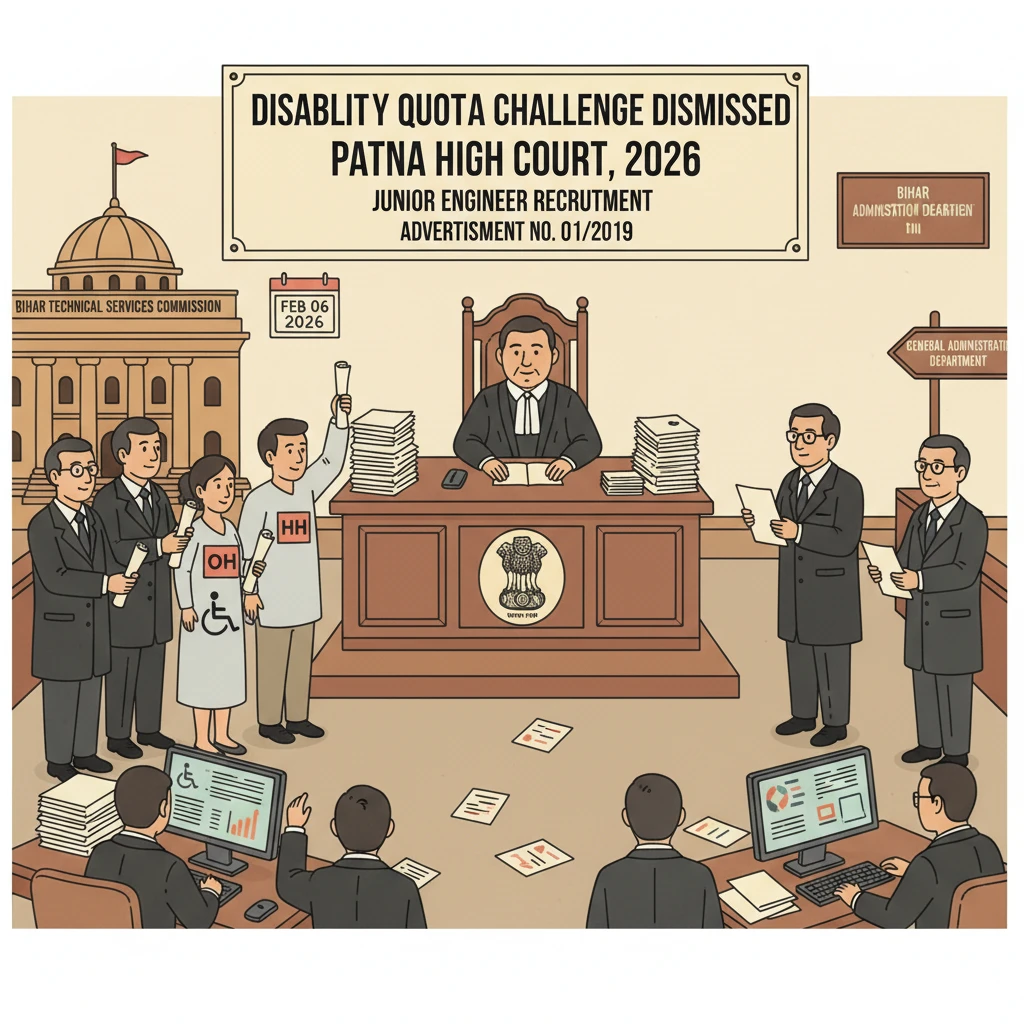
Several diploma-holder candidates in Civil Engineering from different districts of Bihar applied for Junior Engineer posts (Civil/Mechanical/Electrical) advertised by the Bihar Technical Services Commission (BTSC) through Advertisement No. 01/2019 dated 08.03.2019. They belong to different categories of persons with disabilities, mainly Orthopedically Handicapped (OH) and one petitioner from Hearing Handicapped (HH).
The General Administration Department of the State Government had earlier issued Resolution No. 13062 dated 12.10.2017, granting 4% horizontal reservation for persons with disabilities in all State Government posts, with 1% each earmarked for four sub-categories: Orthopedically Handicapped (OH), Visually Handicapped (VH), Hearing Handicapped (HH), and Mentally Handicapped (MH). This resolution also contained rules on how to fill vacancies if candidates in a particular sub-category were not available, including interchange between sub-categories.
The 2019 advertisement for 6379 Junior Engineer posts did not itself spell out how the 4% disability quota would be distributed among the sub-categories. During the ongoing recruitment, the General Administration Department issued another Resolution No. 962 dated 22.01.2021. This second resolution dealt with inclusion of multiple disabilities and, importantly, restated the manner of dealing with unfilled disability vacancies in line with Section 34(2) of the Rights of Persons with Disabilities Act, 2016.
BTSC published a merit list on 02.04.2022 showing that 218 posts were reserved for persons with disabilities. A table in the judgment records that 55 vacancies were shown for OH but 140 OH candidates were selected; 56 VH vacancies with 36 selected; 55 HH vacancies with 38 selected; and 52 MH vacancies with 4 selected, totalling 218 vacancies and 218 selected candidates. Petitioners say this showed redistribution of unfilled seats from some sub-categories to OH.
BTSC published a final select list on 19.04.2022. That select list was not published in view of an interim stay order by the High Court in C.W.J.C. No. 7761 of 2022 dated 01.12.2022. Subsequently, the State decided to scrap the entire selection process. Some candidates approached the Supreme Court in Civil Appeal No. 11030 of 2024 (arising out of SLP (Civil) No. 7257 of 2013) titled Shashi Bhushan Prasad Singh v. State of Bihar & Ors.
On 04.10.2024, the Supreme Court held that scrapping the entire selection was impermissible, particularly considering the long delay and increasing vacancies affecting State functioning. The Supreme Court directed the State to proceed with the fresh select list prepared in compliance with the High Court’s order dated 19.04.2022 in C.W.J.C. No. 7312 of 2021, taking into account, as far as possible, the interests of successful candidates.
Following this, BTSC issued a final merit list on 20.12.2024. The present batch of writ petitions challenges this 20.12.2024 merit list and the manner in which disability quota vacancies were treated, especially the alleged “carry forward” of unfilled disability seats to the unreserved category for the next recruitment year.
What the Court Examined and Decided
The lead case is C.W.J.C. No. 1373 of 2025, filed by 35 petitioners. Similar petitions were filed in C.W.J.C. No. 877 of 2025 (13 petitioners), C.W.J.C. No. 4360 of 2025 (5 petitioners), C.W.J.C. No. 5463 of 2025 (1 petitioner) and C.W.J.C. No. 11177 of 2025 (3 petitioners). Except one petitioner in the Hearing Handicapped category, all others belong to the Orthopedically Handicapped category.
The petitioners sought, among other reliefs, quashing of the final merit list dated 20.12.2024 on the ground that it violated the Rights of Persons with Disabilities Act, 2016 (“2016 Act”), and a direction that a full 4% of total posts be absolutely reserved for persons with disabilities across all sub-categories, without arbitrary carry forward of posts to the unreserved category. They also wanted consideration for appointment under Advertisement No. 01/2019 under the disability category.
Their main grievance was that BTSC, in the 20.12.2024 merit list, ignored the 2017 Resolution and wrongly applied the 2021 Resolution. According to them:
- Under the 2017 Resolution, unfilled vacancies in one disability sub-category were to be filled by candidates from other disability sub-categories, so that the entire 4% quota stayed within the disability category.
- The 2021 Resolution, in their view, allowed unfilled disability posts to be carried forward to the unreserved category for the next recruitment year, which they alleged diluted their rights.
- They argued that applying the 2021 Resolution to an ongoing recruitment that began in 2019 was “changing the rules of the game” mid-way.
- They pointed out that out of 218 disability posts, within the 60% “open” stream, 130 were earmarked and only 92 were filled, one reserved by court order and 37 carried forward to the next year as unreserved; and within the 40% Bihar Government Polytechnic stream, only 23 of 88 posts were filled and 65 carried forward. They said these 102 posts should have been filled by adjusting among disability sub-categories.
BTSC and the State resisted the petitions. BTSC relied on the Bihar Technical Service Commission Selection Procedure Rules, 2018, stating that it was bound to follow State Government instructions and requisitions from the concerned departments. The Water Resources Department was the nodal department and the recruitment was governed by the Bihar Water Resources Department Sub-ordinate Engineering (Civil) Cadre Recruitment Rules, 2015, as amended in 2017.
BTSC stated that Advertisement No. 01/2019 was issued in line with rules framed under Article 309 of the Constitution and vetted by the Water Resources Department. The final result published on 20/24.12.2024 was in compliance with the Supreme Court’s directions in SLP (Civil) No. 7257 of 2023.
On the key issue of the two resolutions, BTSC’s stand was that the 2017 Resolution itself referred to appointments being made “in accordance with Section 34 of the 2016 Act”. The 2021 Resolution, they argued, merely elaborated and clarified the procedure under Section 34(2) and thus was only supplementary and not a change in policy.
The Court framed two central questions for decision:
(i) Whether Resolution No. 13062 dated 12.10.2017 and the recruitment process based on it were in conformity with Section 34(2) of the 2016 Act?
(ii) If not, whether any enforceable legal right survived in favour of the petitioners to justify issuing a writ of mandamus under Article 226 of the Constitution?
The Court examined Section 34 of the 2016 Act. Section 34 provides reservation in employment for persons with benchmark disabilities. Section 34(2) specifically tells how vacancies reserved for persons with disabilities must be dealt with: if in a recruitment year a reserved vacancy cannot be filled due to non-availability of a suitable person with benchmark disability or other sufficient reasons, the vacancy has to be carried forward to the succeeding recruitment year. If even then a suitable disabled person is not available, the vacancy may first be filled by interchange among the five categories of disabilities, and only if no disabled person is available then can it be filled by a non-disabled person. The proviso permits interchange among categories if the nature of vacancies is such that a given category cannot be employed, with prior approval of the appropriate government.
The Court noted that Section 2(b) defines “appropriate Government” and that the State Government is the appropriate Government for State establishments. While the State can issue notifications granting age relaxation or other concessions under Section 34(3), it has no authority to alter the statutory method of recruitment laid down in Section 34(2).
Against this background, the Court closely compared the 2017 Resolution with Section 34(2). It found that Clauses 2(viii) and 2(ix) of the 2017 Resolution did not match the precise order and method mandated by Section 34(2). The 2017 Resolution allowed immediate interchange among disability categories within the same recruitment year and prohibited carrying forward to the next year in certain circumstances, whereas the statute first requires carrying forward, and only then, if still unfilled, interchange.
Citing settled law on delegated legislation, including Rajnarain Singh v. Chairman, Patna Administration Committee (AIR 1954 SC 569), Sant Ram Sharma v. State of Rajasthan (AIR 1967 SC 1910) and State of Tamil Nadu v. P. Krishnamurthy ((2006) 4 SCC 517), the Court reiterated that executive instructions or resolutions cannot override or modify a central statute. They must operate strictly within the statutory framework.
On this reasoning, the Court held that the 2017 Resolution did “not strictly adhere” to Section 34(2). Once that foundational framework was found inconsistent with the statute, the recruitment process undertaken on that basis became legally vulnerable. The later 2021 Resolution was explained by the State as being in conformity with Section 34(2) and issued because Clauses 2(viii) and 2(ix) of the 2017 Resolution were not in line with the Act.
The Court then turned to whether the petitioners could still claim a right to be appointed based on the 2017 Resolution. It relied on the Supreme Court decision in State of U.P. v. Rajkumar Sharma ((2006) 3 SCC 330), which holds that if a selection process is vitiated, the entire selection must go; courts cannot themselves re-draw select lists or rearrange merit. It also relied on Shankarsan Dash v. Union of India ((1991) 3 SCC 47), where it was held that merely being included in a select list does not confer an indefeasible right to appointment, and no mandamus can issue without a subsisting legal right.
Applying these principles, the Court held that where the recruitment framework itself is contrary to the statute, no enforceable legal right can arise in favour of any candidate under that defective framework. The petitioners’ demand that recruitment be completed strictly under the 2017 Resolution could not be accepted, because that resolution was ultra vires Section 34(2).
The Court further clarified that the 2016 Act is the real source of rights for persons with disabilities to get job reservation. If a rule or resolution is framed by delegated legislation and is later found inconsistent with the Act, the executive is entitled—indeed obliged—to correct it by a subsequent notification. This correction cannot be attacked as “changing the rules of the game”, because the “game” itself must always follow the statute.
In other words, once it is found that the earlier 2017 Resolution was de hors the 2016 Act, the Government’s decision in 2021 to bring its procedure in line with Section 34(2) cannot be faulted, even if the recruitment had already started in 2019. The Court held that statutory compliance overrides the argument of change of rules mid-process.
On these findings, the Court concluded that there was no merit in the petitions. It refused to quash the final merit list or to direct that all 4% disability posts be filled strictly in line with the 2017 Resolution. The batch of writ petitions—C.W.J.C. Nos. 1373 of 2025, 877 of 2025, 4360 of 2025, 5463 of 2025 and 11177 of 2025—was dismissed, with no order as to costs.
Why This Judgment Matters
This judgment is important for candidates with disabilities who apply for government jobs in Bihar. It makes clear that their rights come from the central Rights of Persons with Disabilities Act, 2016, not from any State resolution that goes beyond the Act.
If a State resolution promises a procedure that is more favourable but conflicts with the 2016 Act, candidates cannot insist on appointments under that defective resolution. The State can, and must, correct its rules to match the Act, even during an ongoing recruitment.
For disabled jobseekers, this decision means that disputes over reservation will be tested strictly against Section 34(2). Courts will not redesign selection lists or force the Government to follow an ultra vires executive order, even if candidates feel that order was to their advantage.
For administrators and commissions like BTSC, the ruling reinforces that all recruitment rules, especially about reservation and carry-forward of vacancies, must strictly follow central law. Any deviation risks invalidating the process and creating fresh litigation.
Legal Issues and Answers
- Issue: Was Resolution No. 13062 dated 12.10.2017, and the recruitment based on it, in conformity with Section 34(2) of the Rights of Persons with Disabilities Act, 2016?
Answer: No. The Patna High Court held that Clauses 2(viii) and 2(ix) of the 2017 Resolution were not in strict conformity with Section 34(2), making the recruitment framework legally inconsistent with the statute. - Issue: Did the petitioners have an enforceable legal right to appointment or to insist on filling all disability vacancies strictly under the 2017 Resolution?
Answer: No. Since the 2017 Resolution was ultra vires the 2016 Act, no enforceable right could arise from it. Inclusion in a merit list does not create an indefeasible right to appointment, and the Court refused to issue mandamus to alter the recruitment. - Issue: Could the State validly apply the 2021 Resolution, aligning procedure with Section 34(2), to an ongoing recruitment started in 2019?
Answer: Yes. The Court held that correcting statutory inconsistency by a later notification is permissible and cannot be attacked as changing the “rules of the game” once the process has started.
Cases Cited by the Court
- Rajnarain Singh v. Chairman, Patna Administration Committee, AIR 1954 SC 569.
- Sant Ram Sharma v. State of Rajasthan, AIR 1967 SC 1910.
- State of Tamil Nadu v. P. Krishnamurthy, (2006) 4 SCC 517.
- State of U.P. v. Rajkumar Sharma, (2006) 3 SCC 330.
- Shankarsan Dash v. Union of India, (1991) 3 SCC 47.
- The judgment also refers to Shashi Bhushan Prasad Singh v. State of Bihar & Ors., Civil Appeal No. 11030 of 2024 (arising out of SLP (Civil) No. 7257 of 2013), in which the Supreme Court dealt with scrapping of the JE selection process.
Case Details
Case Numbers: Civil Writ Jurisdiction Case No. 1373 of 2025 (lead case), with C.W.J.C. Nos. 877 of 2025, 4360 of 2025, 5463 of 2025 and 11177 of 2025.
Case Title (lead case): Rajeev Ranjan & Ors. v. The State of Bihar & Ors.
Coram: Hon’ble Mr. Justice Bibek Chaudhuri.
Date of Judgment: 06.02.2026.
Citation: 2024(2) PLJR 420.
Advocates (as recorded):
- In C.W.J.C. No. 1373 of 2025: For the petitioners – Ms. Nivedita Nirvikar, Sr. Advocate; Mr. Shashank Shekhar, Advocate; Mr. Arya Achint, Advocate. For the State – Mr. Pratik Kumar Sinha, AC to GA-5. For BTSC – Mr. Nikesh Kumar, Advocate; Mr. Praveen Tiwari, Advocate.
- In C.W.J.C. No. 877 of 2025: For the petitioners – Mr. Alok Kumar, Advocate; Mr. Pranav Kumar, Advocate; Mr. Rishabh Kumar Maurya, Advocate. For the State – Mr. Anwar Karim, AC to GP-10. For BTSC – Mr. Nikesh Kumar, Advocate; Mr. Praveen Tiwari, Advocate.
- In C.W.J.C. No. 4360 of 2025: For the petitioners – Mr. Krishna Kant Pandey, Advocate; Mr. Vikash Kukmar Shukla, Advocate. For the State – Mr. Sarvesh Kumar Singh, AAG-13; Mr. Abhinav Alak, AC to AAG-13. For BTSC – Mr. Nikesh Kumar, Advocate; Mr. Praveen Tiwari, Advocate.
- In C.W.J.C. No. 5463 of 2025: For the petitioner – Mr. Alok Kumar, Advocate; Mr. Pranav Kumar, Advocate; Mr. Rishabh Kumar Maurya, Advocate. For the State – Mr. Vikash Kumar, SC-11. For BTSC – Mr. Nikesh Kumar, Advocate; Mr. Praveen Tiwari, Advocate.
- In C.W.J.C. No. 11177 of 2025: For the petitioners – Mr. Shashi Ranjan Kumar. For the respondents – Mr. Standing Counsel (04). For BTSC – Mr. Nikesh Kumar, Advocate; Mr. Praveen Tiwari, Advocate.
Nature of Case: Batch of writ petitions under Article 226 of the Constitution challenging the final merit list and application of disability reservation in recruitment to the post of Junior Engineer by BTSC.
Link to Judgment: Click here to view the full judgment on the Patna High Court website.
If you found this explanation helpful and wish to stay informed about
how legal developments may affect your rights in Bihar,
you may consider following Samvida Law Associates for more updates.







