

Case Background
The petitioner had joined the Border Security Force as a General Duty constable at Balurghat, West Bengal on 16.03.1970.
During service he fell ill and was referred to hospital on 28.12.1973. He remained admitted there for a long period and was finally discharged from the hospital on 16.06.1974.
Later, a sanction order dated 20.03.1978 was issued in his favour. This order mentioned 10.10.1977 as the date of his invalidation from service. It granted him financial assistance of Rs. 50 per month from the BSF Contributory Benevolent Fund, with effect from 01.11.1977, for a period of ten years.
According to the respondents, this financial assistance is sanctioned when a person is not eligible for disability pension, usually because the required length of service is not completed. The petitioner accepted this amount without protest and did not return to duty after being boarded out.
Decades later, the petitioner started pursuing disability pension. On 12.08.2015 he received a letter from the BSF informing him that he had been medically boarded out on 16.03.1978. The letter also said that his disability pension had not been released because he had not completed ten years of service, and that the matter was pending with higher headquarters for clarification regarding entitlement.
Further, by a letter dated 13.02.2016, he was told that he was not eligible for disability pension. The reason given was that under Rule 3A of the Central Civil Services (Extraordinary Pension) Rules, 1939, disability must be directly attributable to, or aggravated by, government service. The authorities stated that his disability did not meet this requirement.
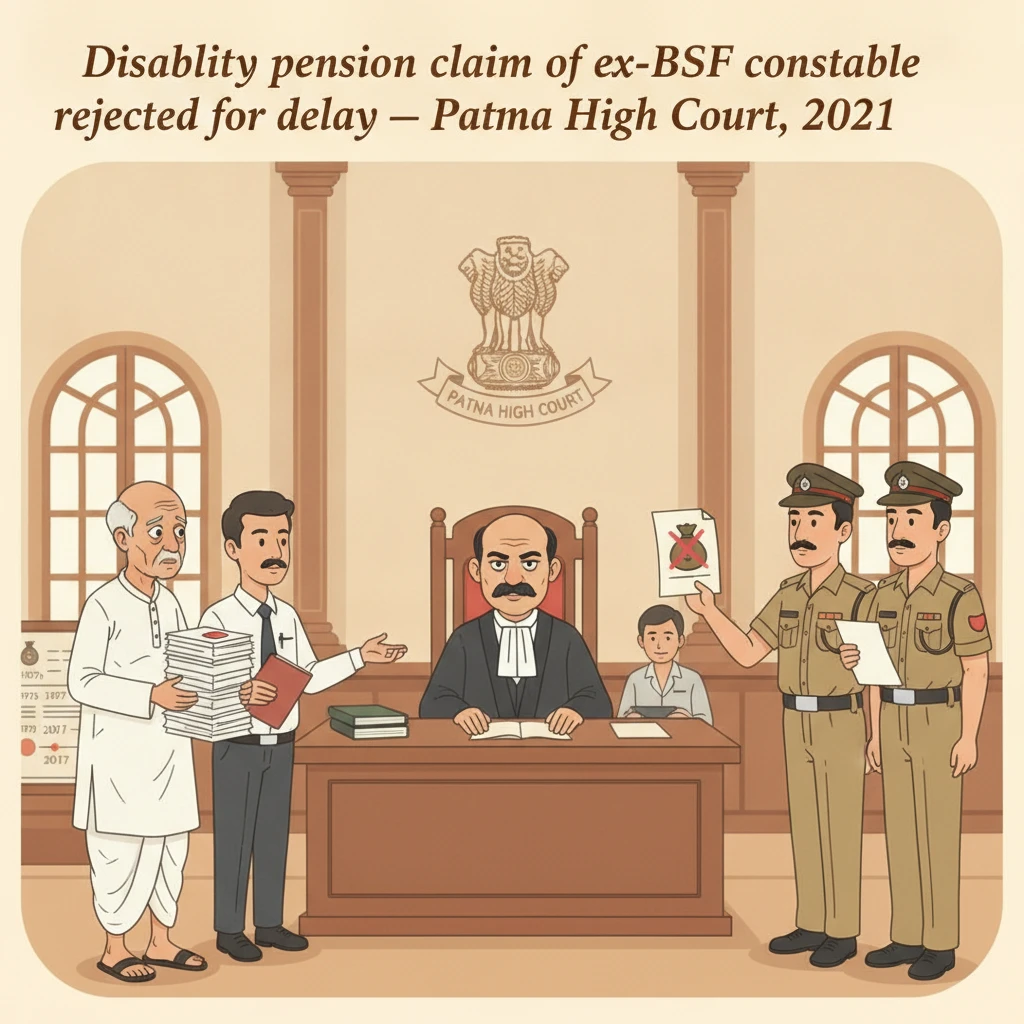
In the writ petition filed in 2017 before the Patna High Court, he challenged these communications and sought disability pension, other pensionary benefits, and compassionate appointment for his son.
What the Court Examined and Decided
The Patna High Court, presided over by Hon’ble Mr. Justice Vikash Jain, heard both sides through video conference.
The petitioner’s primary attack was on the two BSF letters. He argued that Memo No. 13285-86 dated 19.08.2015 and Memo No. 2357 dated 13.02.2016 wrongly denied his disability pension by stating that his disability was neither attributable to, nor aggravated by, service as required by Rule 3A of the CCS (EOP) Rules, 1939.
He asked the Court to set aside these letters and to direct the authorities to grant him disability pension along with all consequential service benefits. These consequential benefits, as pleaded, included pension and pensionary benefits and compassionate appointment of his son on the ground of his medical disability.
The petitioner’s counsel submitted that he had never been served with any order stating that he had been medically boarded out on 16.03.1978. According to him, he came to know about this only in 2015 when he received the letter dated 12.08.2015, and later the letter dated 13.02.2016 rejecting his claim. On this basis, he tried to show that his writ petition was within time, as it was filed soon after these communications.
In support of his stand, the petitioner also relied on Rule 18(3) of the Border Security Force Rules, 1969. This rule contemplates that the Central Government shall communicate the findings of the Medical Board to the concerned officer. After such communication, the officer has a right to file a representation within fifteen days.
The petitioner argued that since no such communication of the Medical Board’s findings was ever given to him, his rights under the rule were violated. He further contended that merely taking Rs. 50 per month as financial assistance from the BSF Contributory Benevolent Fund should not mean that he had given up his right to claim disability pension.
On the other side, counsel for the Union of India opposed the writ petition strongly. They highlighted that the writ petition was filed in 2017, more than three decades after the events of 1977–1978.
The respondents relied on the sanction letter dated 20.03.1978. This letter clearly recorded the date of his invalidation as 10.10.1977 and granted him financial assistance from 01.11.1977 for ten years. According to them, such financial assistance is typically sanctioned where the individual is not eligible for disability pension because he has not completed the required ten years of qualifying service.
From this, the respondents argued that the petitioner was fully aware of the material facts: that he had been invalidated from service on medical grounds and that instead of pension he was being given financial assistance. They also pointed out that he had not worked after 16.03.1978, which showed he knew he had been boarded out.
The State’s stand was that the later letters of 2015 and 2016 were only informatory. These did not create any new rights or obligations. Therefore, they could not give a fresh cause of action to file a writ petition after such an extraordinary delay.
While considering these rival submissions, the Court first took note that there was no dispute about the sanction of Rs. 50 per month as financial assistance from the BSF Contributory Benevolent Fund, for ten years, which the petitioner had accepted without objection.
The Court referred to the contents of the sanction letter dated 20.03.1978. This letter mentioned the date of invalidation as 10.10.1977 and granted the financial assistance accordingly. The Court noted that the petitioner had never claimed that he rendered any service after being boarded out.
From these facts, the Court found it difficult to accept the petitioner’s plea that he did not know he had been boarded out in 1978. His subsequent conduct also went against his claim of ignorance.
Importantly, the Court referred to the petitioner’s own representation dated 08.12.2013. In that representation, he had specifically written that “The Department gave me retirement medically unfitted”. This line was taken as clear proof that, long before 2015, the petitioner was aware that he had been medically retired.
Regarding the allegation that the Medical Board’s report had not been communicated, the Court examined whether this could justify the long delay. It held that the petitioner had not acted with due diligence. He obviously knew he had been medically examined by a Medical Board and that he had been boarded out, yet he did not take any step or file any representation for over three decades.
Instead, he chose to accept the financial assistance for ten years and never attempted to rejoin duty. For the Court, this inaction for such a long period weighed heavily against him.
The Court did not go into the technical details of Rule 3A of the CCS (EOP) Rules, 1939 or Rule 18(3) of the BSF Rules, 1969 beyond noting the submissions. The main focus of the judgment remained on the delay and the petitioner’s knowledge of his medical retirement. The Court effectively treated the case as hopelessly stale.
Taking an overall view, the Court concluded that the writ petition did not deserve interference. The impugned letters of 2015 and 2016 were seen only as information about the existing position. They did not revive any dead claim or create a fresh cause of action.
Accordingly, the Court held that the writ petition was devoid of merit and dismissed it.
Why This Judgment Matters
This judgment is significant for ex-servicemen and paramilitary personnel who seek disability pension or related benefits many years after leaving service.
The Patna High Court has made it clear that if a person has long known about his medical retirement and has even accepted alternate financial assistance, he cannot come to court after decades and treat new letters as a fresh starting point.
For individuals in similar situations, this case underlines the need to act quickly. If someone is unhappy with a Medical Board finding or denial of pension, they must raise objections and approach the proper forum within a reasonable time. Silence and acceptance of other benefits may weaken their case later.
The judgment also shows that courts will closely examine the person’s own earlier writings and conduct, such as representations admitting medical retirement, to decide whether they genuinely lacked knowledge of their status.
Legal Issues and Answers
- Issue: Can a retired BSF constable challenge, after more than three decades, the denial of disability pension by relying on recent letters from the authorities?
Answer: No. The Court held that the petitioner knew about his medical retirement in 1978, accepted financial assistance, and therefore the later letters were only informatory and did not give a fresh cause of action. - Issue: Does non-communication of the Medical Board’s report automatically keep a disability pension claim alive indefinitely?
Answer: No. On the facts, the Court found that the petitioner had knowledge of being medically examined and medically retired, yet took no steps for over thirty years. He was held not to have acted with due diligence. - Issue: Does acceptance of financial assistance from the BSF Contributory Benevolent Fund affect the claim to disability pension?
Answer: While the Court did not hold that such acceptance legally bars a claim, it relied on the sanction and acceptance of this assistance as evidence that the petitioner knew his position and still remained inactive for decades.
Cases Cited by the Court
- The judgment does not mention or rely upon any other reported cases.
Case Details
Case Number: Civil Writ Jurisdiction Case No. 6536 of 2017
Case Title: Ram Naresh Singh v. The Union of India & Ors.
Coram: Hon’ble Mr. Justice Vikash Jain
Citation: 2022 (1) PLJR 314
Advocates:
- For the Petitioner: Mr. Rajeev Kumar Singh, Advocate
- For the Union of India: Mr. Awadhesh Kumar Pandey, Advocate; Mr. Ravinder Kumar Sharma, Advocate
Nature of the Case: Writ petition (civil) seeking quashing of letters denying disability pension and related benefits, and seeking mandamus for grant of disability pension, pensionary benefits, and compassionate appointment.
Link to Judgment: Patna High Court Judgment in CWJC No. 6536 of 2017
If you found this explanation helpful and wish to stay informed about how legal developments may affect your rights in Bihar, you may consider following Samvida Law Associates for more updates.







