
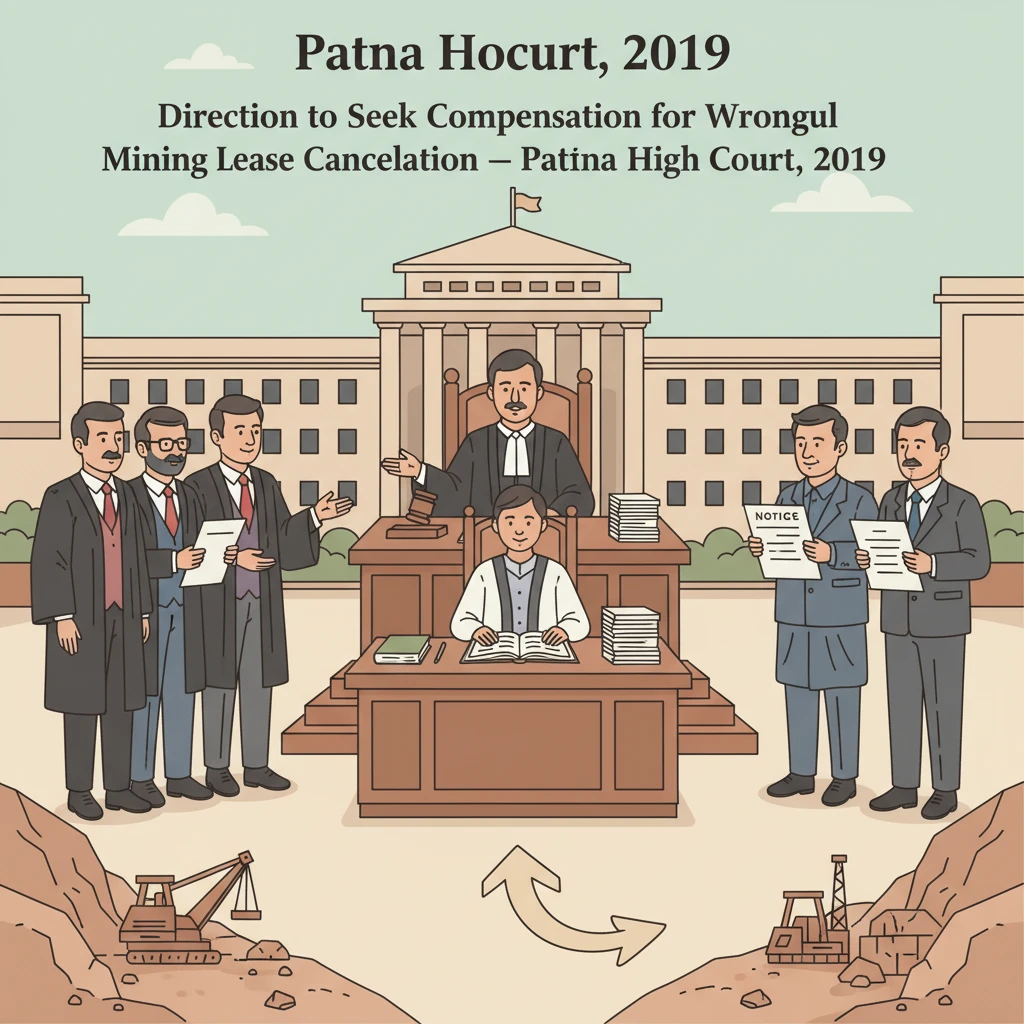
Case Background
The petitioner company obtained a mining lease for minor minerals over Block No.21, Plot No.01 (parts), area 2 acres, in Mauza Khakhandua, P.S. and Circle Govindpur, District Nawada.
The lease was granted under the Bihar Minor Mineral Concession Rules, 1972 after a bid invited under Rules 22-A and 52. A formal registered lease deed in Form-D was executed on 23.11.2008 between the Collector, Nawada and the petitioner company. The Inspector, Mines, Nawada demarcated the lease area and handed over possession to the petitioner for carrying out mining operations.
On 27.04.2010, the Additional Collector, Nawada issued Letter No.256 to the petitioner and two others, alleging illegal mining over 14.40 acres of Plot No.01(P) in Mauza Khakhandua. The notice alleged violation of Sections 4 and 21 of the Mines and Minerals (Development and Regulation) Act, 1957, Rules 4 and 40 of the Bihar Minor Mineral Concession Rules, 1972, and clauses 2 and 23 of Part VIII of the mining lease. The petitioner was required to show cause within 30 days.
The petitioner replied on 26.05.2010, denying illegal mining and terming the allegations as baseless and fabricated. It stated that the allegations were based on a joint report dated 03.04.2010 of the Mines Inspector, Nawada and Anchal Amin, Govindpur, prepared ex parte. The petitioner said it was never given a copy of the measurement report and had no knowledge of such measurement. It requested fresh measurement in its presence by the petitioner’s Amin, the State Amin and the Mines Inspector, followed by proper demarcation of the lease area.
According to the petitioner, the authorities, including the Additional Collector and the Assistant Director, Mines, accepted this show cause and whatever demarcation had been made in Plot No.01(P) as per the lease deed was treated as correct, at least so far as the petitioner was concerned. Other persons were also granted separate leases over portions of the same plot.
Later, on 23.07.2011, the Assistant Director, Mines, Nawada issued Letter No.508, again about fixing a signboard and demarcating the lease property. The petitioner replied by Letter No.74 dated 11.08.2011, again asking that demarcation be done in presence of both sides to avoid future disputes.
Meanwhile, the Assistant Director reported to the Officer-in-Charge of Govindpur P.S. by Letter No.585 dated 16.08.2011, seeking registration of a criminal case against the petitioner under Section 379 of the Indian Penal Code and Sections 4 and 40 of the Bihar Minor Mineral Concession Rules, 1972. According to the petitioner, this was despite the fact that it was not extracting stone from the 14.40 acre portion of Block 21.
By Letter No.649 dated 21.09.2011, the Assistant Director, Mines, demanded Rs.8,81,860/- from the petitioner, alleging illegal mining of 2,46,440 cubic feet of stone. The petitioner filed an appeal on 20.10.2011 before the Deputy Director, Mines and Minerals, Magadh Division, Gaya.
On 08.11.2011, the Assistant Director issued Letter No.774, calling for show cause regarding cancellation of the lease deed and non-payment of Rs.8,81,860/-. The petitioner appealed against this also to the Deputy Director-cum-Appellate Authority, Mines and Minerals Department, Magadh Division, Gaya.
By order dated 05.03.2012, the Collector, Nawada terminated the petitioner’s lease dated 23.11.2008 and forfeited the deposited amount, mainly relying on the ex parte measurement report dated 03.04.2010. The petitioner then filed Revision Case Nos. 26 of 2012 and 14 of 2013 before the Mines Commissioner, Bihar, challenging the Collector’s order.
During this period, a certificate proceeding was initiated for recovery of Rs.8,81,860/- as additional royalty, and an FIR, Govindpur P.S. Case No.60 of 2011, was lodged against the petitioner for alleged illegal mining beyond the leased area.
While these disputes were still alive, the petitioner’s lease was effectively suspended on 03.04.2010 and the company stopped mining operations. The lease tenure of five years, counted from 23.11.2008, expired during the course of the revisions and related litigations.
What the Court Examined and Decided
The Patna High Court considered two writ petitions, CWJC No.9554 of 2015 and CWJC No.13136 of 2015. Both challenged part of the common order dated 11.05.2015 passed by the Mines Commissioner in Revision Case Nos.26 of 2012 and 14 of 2013.
The petitioner’s core grievance was that the Mines Commissioner had set aside the cancellation of its lease and rejected allegations of illegal mining, but had only granted remission of auction money for the period when it could not mine. The Commissioner refused to restore the lease or allow mining even for the balance period, mainly relying on a Supreme Court judgment on environmental requirements for mining leases.
The petitioner argued that:
- Its lease was validly executed in 2008; the authority itself demarcated and handed over possession.
- Allegations of illegal mining over 14.40 acres were based on an ex parte report dated 03.04.2010, which was never shared with it and was therefore unreliable.
- It repeatedly requested proper joint measurement and demarcation, which was not done fairly.
- The Collector’s termination order dated 05.03.2012 was illegal and had been set aside in revision by the Mines Commissioner on 11.05.2015.
- Despite the cancellation being held improper, the Commissioner refused to restore the lease on the ground that the lease period had expired and relying on the Supreme Court decision in Deepak Kumar vs State of Haryana, which mandated a minimum lease area of 5 hectares and environmental clearances.
- During pendency of the writ petitions, the Department of Mines and Geology went ahead and conducted E-auction for New Block A and B (earlier Block No.21, Plot No.01) at Khakhandua. The E-auction was initiated on 27.11.2018 and concluded on 10.12.2018, and the block covering the petitioner’s former 2-acre lease formed part of a 16-acre block that was allotted to a third party.
- By doing this during pendency of the case, the State created third-party rights despite being aware that part of the area was sub judice.
- Having been illegally stopped from mining for three out of five years and later denied restoration, the petitioner was entitled either to re-entry on the land for the remaining period or to reasonable monetary compensation proportionate to the amount fetched by auctioning the entire 16 acres of Block-B.
In support, the petitioner cited Patna High Court decisions in Bhola Sharma vs State of Bihar (2011(4) PLJR 498), M/s Maa Durga Enterprises vs State of Bihar & Ors. (2009(2) PLJR 1000) and Koshmi Devi & Anr. vs State of Bihar & Ors. (2014(1) PLJR 19).
The State, in its counter affidavits, took a different stand. It asserted that:
- Khakhandua village was not granted a No Objection Certificate by the Forest Department for stone mining, as indicated by Letter No.1676 dated 22.07.2013 of the Divisional Forest Officer, Nawada, stating that Khakhandua was not fit for settlement for stone mining.
- Joint inspection by the Mines Inspector and Amin had shown the petitioner and other settlees of Plot No.01(P) illegally excavating mines in neighbouring plots beyond their lease area, in violation of the Bihar Minor Mineral Concession Rules, 1972.
- The petitioner did not install boundary pillars despite being asked, which allowed it to mine beyond its allotted 2 acres.
- Subsequent extensive measurement and demarcation of Khakhandua Hill between 14.08.2011 and 03.09.2011 revealed that the petitioner had illegally excavated about 2,46,440 cubic feet of stone beyond its lease area.
- The demand of Rs.8,81,860/- as additional royalty and initiation of certificate proceedings and FIR were therefore justified.
- During the revision proceedings, a field enquiry also showed that 13.50 acres of unsettled land adjacent to the petitioner’s lease had been excavated illegally by several persons.
- Ultimately, Block-A and Block-B of Mauza Khakhandua were settled by E-auction in favour of new leaseholders, and letters to that effect were issued by the Collector, Nawada, on 31.12.2018.
- Complex disputed questions about extent of illegal mining, area excavated and calculation of compensation could not be properly decided in writ jurisdiction under Article 226 of the Constitution, relying on Supreme Court judgments in Chairman, Grid Corporation of Orissa Ltd. vs Smt. Sukamani Das (1999) 7 SCC 298 and SDO, Grid Corporation of Orissa Ltd. & Ors. vs Timudu Oram (2005) 6 SCC 156.
The Patna High Court first noted what the Mines Commissioner had already decided in the revision order dated 11.05.2015. The Commissioner had found the cancellation of the petitioner’s mining lease by the Collector, Nawada, to be not proper and had set aside that cancellation.
However, the Commissioner, after considering the Supreme Court’s order dated 27.02.2012 in SLP (C) Nos.19628–19629 of 2009, Deepak Kumar vs State of Haryana, refused to permit fresh mining by the petitioner. The Supreme Court in Deepak Kumar had directed States and Union Territories to frame rules under Section 15 of the Mines and Minerals (Development and Regulation) Act, 1957, based on the Ministry of Environment and Forests’ March 2010 report and model guidelines framed by the Ministry of Mines. That decision required a minimum lease area of 5 hectares and made a mining plan and environmental clearance mandatory for any mining operation.
On that basis, the Mines Commissioner concluded that mining could not be allowed even for a short remaining period of the old lease. Instead, the Commissioner granted only remission of the auction amount for the period during which the petitioner could not mine in its lease area.
The petitioner did not challenge the finding about environmental clearances or the refusal to restore the lease, in view of the subsequent E-auction and creation of third-party rights. In the Patna High Court it narrowed its prayer to monetary compensation for being kept out of the lease for three years and for the wrongful cancellation which was later set aside.
The High Court accepted that the Mines Commissioner had indeed held the Collector’s termination order to be illegal. It also held that mere remission of the auction amount for the non-working period was not sufficient compensation to the petitioner for the wrongful cancellation.
At the same time, the Court was cautious about itself undertaking calculation of compensation. The petitioner had suggested a formula in paragraph 7 of I.A. No.01 of 2019, based on the amount received from auctioning a 16-acre block including its former 2-acre area. The Court stated that it was “not competent to adjudicate all such disputed question of facts under Article 226 of the Constitution of India.”
Balancing these aspects, the Court declined to interfere with the Mines Commissioner’s order dated 11.05.2015. Instead, it gave the petitioner a specific remedy: it directed the petitioner to file a detailed representation before the Collector, Nawada, incorporating all particulars given in I.A. No.01 of 2019 and seeking proportionate compensation for the period when it was prevented from mining after termination of the lease.
The Court directed that this representation must be filed within one month from the date of the judgment. It further directed the Collector, Nawada, to consider and dispose of the representation in accordance with law by a speaking (reasoned) order within three months of its filing.
With these directions, both writ petitions were disposed of and no further relief was granted in writ jurisdiction.
Why This Judgment Matters
This judgment is important for small and medium mine leaseholders in Bihar and similar States. It shows that when a lease is wrongly cancelled by the administration, and that cancellation is later found invalid, the lessee is not automatically entitled to resume mining, especially if the lease period has expired or environmental rules have changed.
At the same time, the Patna High Court recognised that simply refunding or remitting auction money may not fully compensate a lessee who has been stopped from working. The Court opened a clear path for such lessees to claim proportionate compensation from the Collector.
The judgment also stresses that heavy factual disputes about illegal mining, quantity of minerals excavated, and valuation of loss are generally not decided directly in writ proceedings. Instead, the affected party is guided to approach the appropriate administrative authority, which must then pass a reasoned order.
For people who take government leases, including for mining, sand ghats or other minor minerals, the decision underlines two practical lessons: first, keep clear records of possession, demarcation and correspondence; and second, if a lease is stopped or cancelled and later found to be wrongly done, compensation can still be claimed even when actual operations cannot restart.
Legal Issues and Answers
Issue: After the Mines Commissioner set aside the Collector’s cancellation of the mining lease but refused to restore mining operations, was the petitioner entitled to more relief than merely remission of auction money?
Answer: The Patna High Court held that mere remission was not sufficient compensation, but instead of modifying the Mines Commissioner’s order, it directed the petitioner to seek proportionate compensation from the Collector, Nawada, who must decide the claim by a speaking order.
Issue: Could the High Court, in writ jurisdiction under Article 226, itself calculate and award monetary compensation based on the petitioner’s proposed formula and allegations of loss?
Answer: No. The Court, following Supreme Court precedents, held that such disputed questions of fact and detailed calculations could not be adjudicated in writ jurisdiction and should be decided by the competent administrative authority (the Collector).
Issue: Should the Patna High Court interfere with the Mines Commissioner’s reliance on the Supreme Court’s decision in Deepak Kumar vs State of Haryana and refusal to allow further mining?
Answer: No. The Court did not interfere with the order dated 11.05.2015 and accepted that, in light of the Supreme Court’s directions on minimum lease area, mining plan and environmental clearance, no further mining could be allowed on the old lease.
Cases Cited by the Court
- Deepak Kumar and Ors. vs State of Haryana and Ors., (2012) 4 SCC 629.
- Chairman, Grid Corporation of Orissa Ltd. vs Smt. Sukamani Das, (1999) 7 SCC 298.
- SDO, Grid Corporation of Orissa Ltd. & Ors. vs Timudu Oram, (2005) 6 SCC 156.
- Bhola Sharma vs State of Bihar, 2011(4) PLJR 498 (relied upon by petitioner).
- M/s Maa Durga Enterprises vs State of Bihar & Ors., 2009(2) PLJR 1000 (relied upon by petitioner).
- Koshmi Devi & Anr. vs State of Bihar & Ors., 2014(1) PLJR 19 (relied upon by petitioner).
Case Details
Case Numbers: Civil Writ Jurisdiction Case No.9554 of 2015 with Civil Writ Jurisdiction Case No.13136 of 2015.
Case Title: M/s Ram Pravesh Rai Estate Private Limited vs The State of Bihar & Ors.
Coram: Hon’ble Mr. Justice Sanjay Priya.
Date of Judgment: 19-04-2019.
Citation: 2019 (2) PLJR 1135.
Advocates (CWJC No.9554 of 2015): For the petitioner: Mr. Chitranjan Sinha, Sr. Advocate; Mr. Ashuthosh Nath, Advocate; Mr. Binod Kumar Singh, Advocate. For the State: Mr. Rakesh Kumar Ranjan, AC to GA-5. For Mines Department: Mr. Naresh Dikshit, Spl. PP.
Advocates (CWJC No.13136 of 2015): For the petitioner: Mr. Chitranjan Sinha, Sr. Advocate; Mr. Ashuthosh Nath, Advocate; Mr. Binod Kumar Singh, Advocate. For the State: Mr. Shashi Shekhar Kr. Prasad, AC to PAAG-2. For Mines Department: Mr. Naresh Dikshit, Spl. PP.
Nature of the Case: Writ petitions under Article 226 of the Constitution of India, seeking certiorari to quash part of the Mines Commissioner’s revisional order and to claim consequential relief including compensation relating to a minor mineral mining lease.
Link to Judgment: Patna High Court Judgment in CWJC No.9554 of 2015 and CWJC No.13136 of 2015
If you found this explanation helpful and wish to stay informed about
how legal developments may affect your rights in Bihar,
you may consider following Samvida Law Associates for more updates.







