

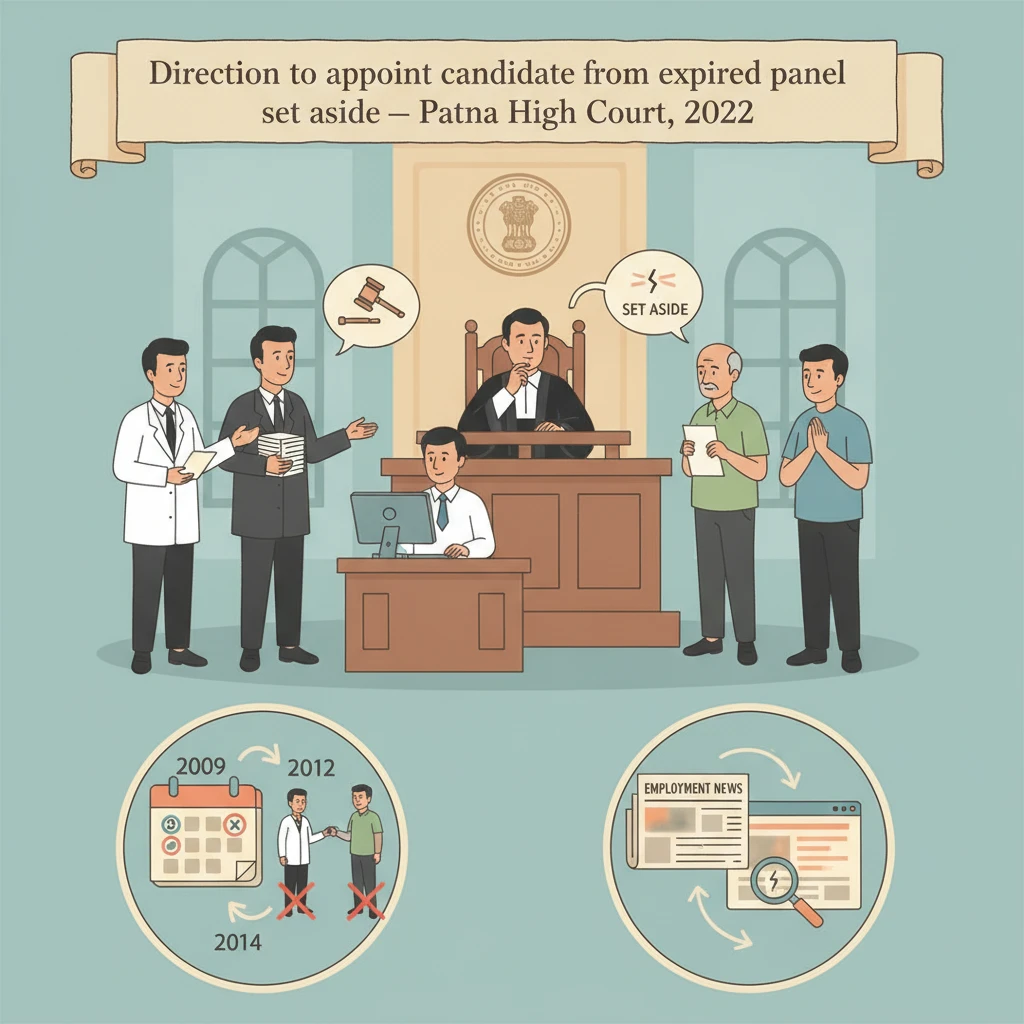
Case Background
This case arises out of recruitment to two posts of Research Assistant (unreserved) at Rajendra Memorial Research Institute of Medical Sciences, Patna, later redesignated as Technical Assistant (Research).
The Institute (RMRIMS), under the Indian Council of Medical Research (ICMR), advertised the posts in the Employment News dated 11 July 2009. Respondent no. 1, an aspirant for these posts, appeared in the written examination held on 18 August 2012 and the viva voce test on 3 January 2013.
After evaluation, a merit list was prepared. Respondent no. 1 was placed at serial no. 3. Appointment letters were issued to two candidates. One of these candidates joined on 11 July 2013. The other did not join and sought extension of time. The Institute granted extension, but did not allow any extension beyond 14 August 2014. Finally, the offer of appointment to this non-joining candidate stood cancelled.
According to respondent no. 1, he later came to know of these developments through information obtained by his father under the Right to Information Act in 2016. The reply stated that the offer of appointment to the candidate at serial no. 1 was cancelled for non-joining; that the panel was not alive; and that no appointment could be made from that panel. It was also stated that respondent no. 1’s name was neither in the wait list nor in the list of selected candidates and that the merit list was neither published in newspapers nor on the website, as there was no such practice then.
Respondent no. 1 claims to have made a representation on 17 August 2017 to the authorities for issuance of an appointment letter against the post which remained vacant due to non-joining of the candidate at serial no. 1. When nothing happened, he approached the Central Administrative Tribunal, Patna Bench, under Section 19 of the Administrative Tribunal Act, 1985, by filing O.A. No. 050/00111 of 2017.
Before the Tribunal, he questioned the alleged cancellation of his appointment and sought a direction to appoint him as Research Assistant/Technical Assistant (Research) (unreserved) with all consequential benefits and compensation.
The Tribunal allowed the Original Application on 4 August 2017 and directed the Institute to issue an appointment letter to him forthwith, holding that he had a right to be appointed when the first-ranked candidate did not join.
RMRIMS and ICMR filed a Review Application (R.A. No. 00/50/0050 of 2017), which the Tribunal dismissed on 30 October 2017. Aggrieved, the Institute and ICMR approached the Patna High Court through Civil Writ Jurisdiction Case No. 25090 of 2018 under Article 226 of the Constitution of India.
What the Court Examined and Decided
The Patna High Court, speaking through Hon’ble Mr. Justice Chakradhari Sharan Singh (with Hon’ble Mr. Justice Madhuresh Prasad agreeing), focused on two central questions: whether the recruitment panel was still valid, and whether a candidate placed at serial no. 3 in the merit list had any enforceable right to appointment once one candidate had already joined.
Before the Tribunal, the Institute had placed reliance on an Office Memorandum dated 30 July 2007 issued by the Government of India, Ministry of Personnel, Public Grievances and Pensions, Department of Personnel and Training. This memorandum provided that a panel recommended by a selection committee for appointment would remain valid for one year from the date of its preparation.
On this basis, the Institute argued that the life of the panel had automatically expired after one year. In its written statement before the Tribunal, it specifically stated that the panel had expired in February 2014. At the latest, it could not be treated as surviving beyond 14 August 2014, which was the last date up to which the non-joining candidate’s joining time had been extended.
The Institute further argued that since the Original Application before the Tribunal was filed only in 2016, it was hopelessly barred by limitation. They also maintained that information received under the Right to Information Act did not extend the period of limitation.
The Tribunal, however, refused to accept the plea of expiry of the panel. It reasoned that once a candidate had come in the merit list, even at serial no. 3, and the candidate at serial no. 1 did not join, the applicant “acquired a right to the post”. The Tribunal held that the Department should have offered the post to the applicant as soon as the selected candidate did not join within one year.
The Tribunal observed that, because the Institute did not publish the result in newspapers or on its website, the applicant could not be faulted for delay. It treated the non-publication as depriving him of the chance to claim his right earlier. It characterised the extension of joining time granted to the selected candidate for more than one-and-a-half years as “certainly illegal” and felt that the Department had allowed time to drift only to deprive the next eligible candidate of the job. On this reasoning, it ordered that the applicant be issued an appointment letter as the post was still lying vacant.
In the High Court, learned senior counsel for the petitioners contended that the Tribunal’s approach was legally unsustainable. They argued that the Tribunal could not have directed appointment on the basis of a panel whose life had already expired, and that mere inclusion in a panel did not confer any right to appointment.
They relied on the Supreme Court judgment in Kulwinder Pal Singh and Another vs. State of Punjab and Ors., reported in 2016 (6) SCC 532, where it was reiterated that a candidate whose name appears in a select list does not get an indefeasible right to appointment.
On the other hand, learned counsel for respondent no. 1 attacked the Institute’s extension of joining time. He cited an Office Memorandum dated 9 August 1995 issued by the Department of Personnel and Training. He argued that an offer of appointment lapses automatically after six months from the date of issue of the original offer, and that in this case the original offer was issued on 5 February 2013. Therefore, according to him, the non-joining candidate could not have been permitted to join beyond August 2013, and once his offer lapsed, the respondent in the waiting position had a right to be appointed.
He relied on the Supreme Court decision in Gujarat State Dy. Executive Engineers’ Association vs. State of Gujarat and Ors., reported in 1994 Supp. (2) SCC 591, to submit that a candidate in the waiting list in order of merit has a right to claim appointment if one or more selected candidates do not join.
He also contended that the life of the panel could not be said to have lapsed since it had never been published in newspapers or uploaded on the website. He argued that without publication of the merit list, it could not be treated as expired and that the respondent’s rightful claim could not be denied on that ground.
The High Court carefully examined the pleadings and materials on record. It noted that on the basis of the merit list in which the respondent’s name appeared, two candidates had been issued appointment letters and one candidate had already joined on 11 July 2013. Once that candidate had joined, the respondent admittedly did not have any better right to be considered for appointment against that filled post.
The Court did not accept the respondent’s plea that, because the panel was not published in newspapers or on the website, its life should be treated as continuing until he obtained information through RTI. The Court recorded that the respondent had participated in the interview on 3 January 2013 and had not shown that he made any effort thereafter to inquire about the result.
From the party description in the writ petition, the Court observed that the office of petitioner no. 1 (RMRIMS) and the residence of respondent no. 1 both fell under the same police station and post office. Yet, more than three years after the viva-voce, only the respondent’s father sought RTI information. The Court found that the claim about lack of publication, based on the RTI reply, could not by itself keep the panel alive.
The High Court agreed with the petitioners that, in any case, the panel could not be said to be alive after the last date given to the other non-joining candidate to join the post. Once that extended joining period ended on 14 August 2014, the panel died a natural death.
Regarding the Office Memorandum of 9 August 1995 relied on by the respondent, the Court held that this memorandum applied only to candidates recommended by the Union Public Service Commission or Staff Selection Commission for appointment to Central Civil Services. On a careful reading, it did not extend to other selection processes like the one conducted by RMRIMS. Therefore, this memorandum did not help the respondent.
The Court further held that, even leaving this aside, once the life of the panel had expired, the respondent could not be appointed on the basis of a “lifeless panel”. The Court noted that it has been repeatedly held that a court cannot direct a non-existent panel to continue once its life has expired.
The Court concluded that the Tribunal’s finding that the life of the panel had not expired was “patently erroneous and unsustainable”. It also endorsed the well-settled legal position, supported by multiple Supreme Court judgments, that mere inclusion in a select list does not give any person a right to be appointed. It referred to several reported decisions (1991(6) SCC 462, 1991(3) SCC 47, 1994 Supp. (2) SCC 541, 1974(3) SCC 220, 1997(6) SCC 584, 2002(4) SCC 726, 1985(1) SCC 122, AIR 1987 SC 1889, 2005(3) SCC 618, 2013(12) SCC 171).
The Court held that the petitioners rightly relied on Kulwinder Pal Singh (2016 (6) SCC 532) in which the Supreme Court reiterated that the mere presence of a candidate’s name in a select list does not give an indefeasible right to appointment.
On this reasoning, the High Court set aside the Tribunal’s order dated 4 August 2017 in O.A. No. 050/00111 of 2017. Once that main order was quashed, the Court found it unnecessary to examine the correctness of the Tribunal’s order dated 30 October 2017 dismissing the Review Application.
The writ application filed by RMRIMS and ICMR was accordingly allowed, with no order as to costs. All interlocutory applications were also disposed of.
Why This Judgment Matters
This judgment is important for job seekers and government bodies alike. It clearly states that once a recruitment panel has a fixed life and that period ends, no one can claim appointment from that old panel, even if a vacancy later arises from non-joining.
For candidates, it underlines that being placed in a merit list or wait list does not automatically create a right to a job. One cannot rely on an expired panel, nor on discovery through RTI, to revive a lapsed claim.
For institutions, especially those following Central Government rules, the judgment supports the stand that recruitment panels have to be operated strictly within their prescribed validity period. Courts will not force them to appoint candidates from panels whose life has ended.
The decision also signals that tribunals and courts cannot ignore binding rules about panel life or convert a candidate in the merit list into someone with a guaranteed post. Equity and sympathy cannot override clear limits fixed by recruitment policy and settled Supreme Court law.
Legal Issues and Answers
Issue: Can a candidate demand appointment from a recruitment panel after its prescribed life has expired, on the ground that a selected candidate did not join and the panel was not publicly published?
Answer: No. The Patna High Court held that once the panel’s life expired—at the latest by 14.08.2014—no appointment could be made from it, regardless of non-publication or later RTI disclosure.
Issue: Does inclusion of a candidate’s name in a merit or select list give an enforceable right to appointment to a government post?
Answer: No. Relying on multiple Supreme Court decisions including Kulwinder Pal Singh (2016 (6) SCC 532), the Court held that mere inclusion in a select list does not create an indefeasible right to appointment.
Issue: Could the Office Memorandum dated 09.08.1995 regarding offers of appointment recommended by UPSC/SSC be invoked to challenge extension of joining time and claim appointment in this case?
Answer: No. The Court held that this memorandum is confined to candidates recommended by UPSC/SSC to Central Civil Services and does not apply to the RMRIMS recruitment in question.
Cases Cited by the Court
- Kulwinder Pal Singh and Another vs. State of Punjab and Ors., 2016 (6) SCC 532.
- Gujarat State Dy. Executive Engineers’ Association vs. State of Gujarat and Ors., 1994 Supp. (2) SCC 591.
- Other Supreme Court decisions cited for the principle that inclusion in a select list does not give a right to appointment: 1991(6) SCC 462; 1991(3) SCC 47; 1994 Supp. (2) SCC 541; 1974(3) SCC 220; 1997(6) SCC 584; 2002(4) SCC 726; 1985(1) SCC 122; AIR 1987 SC 1889; 2005(3) SCC 618; 2013(12) SCC 171.
Case Details
Case Number: Civil Writ Jurisdiction Case No. 25090 of 2018
Case Title: The Director Rajendra Memorial Research Institute of Medical Sciences & Anr. vs. Kushagra Kush & Anr.
Citation: 2022 (1) PLJR 555
Court: High Court of Judicature at Patna
Coram: Hon’ble Mr. Justice Chakradhari Sharan Singh and Hon’ble Mr. Justice Madhuresh Prasad
Date of Judgment: 19-01-2022
Advocates:
- For Petitioner No. 1 (RMRIMS): Mr. P.K. Shahi, Senior Advocate; Mr. Rohit Mishra, Advocate.
- For Petitioner No. 2 (ICMR): Mr. Gautam Bose, Senior Advocate; Mr. Vikash Jha, Advocate.
- For Respondents: Mr. S.D. Sanjay, Additional Solicitor General; Mr. Bibhakar Tiwary, Advocate.
Nature of the Case: Writ petition under Article 226 of the Constitution of India challenging orders of the Central Administrative Tribunal (Original Application and Review Application) regarding appointment from a recruitment panel.
Link to Judgment: Full text of judgment on Patna High Court website
If you found this explanation helpful and wish to stay informed about how legal developments may affect your rights in Bihar, you may consider following Samvida Law Associates for more updates.







