

Case Background
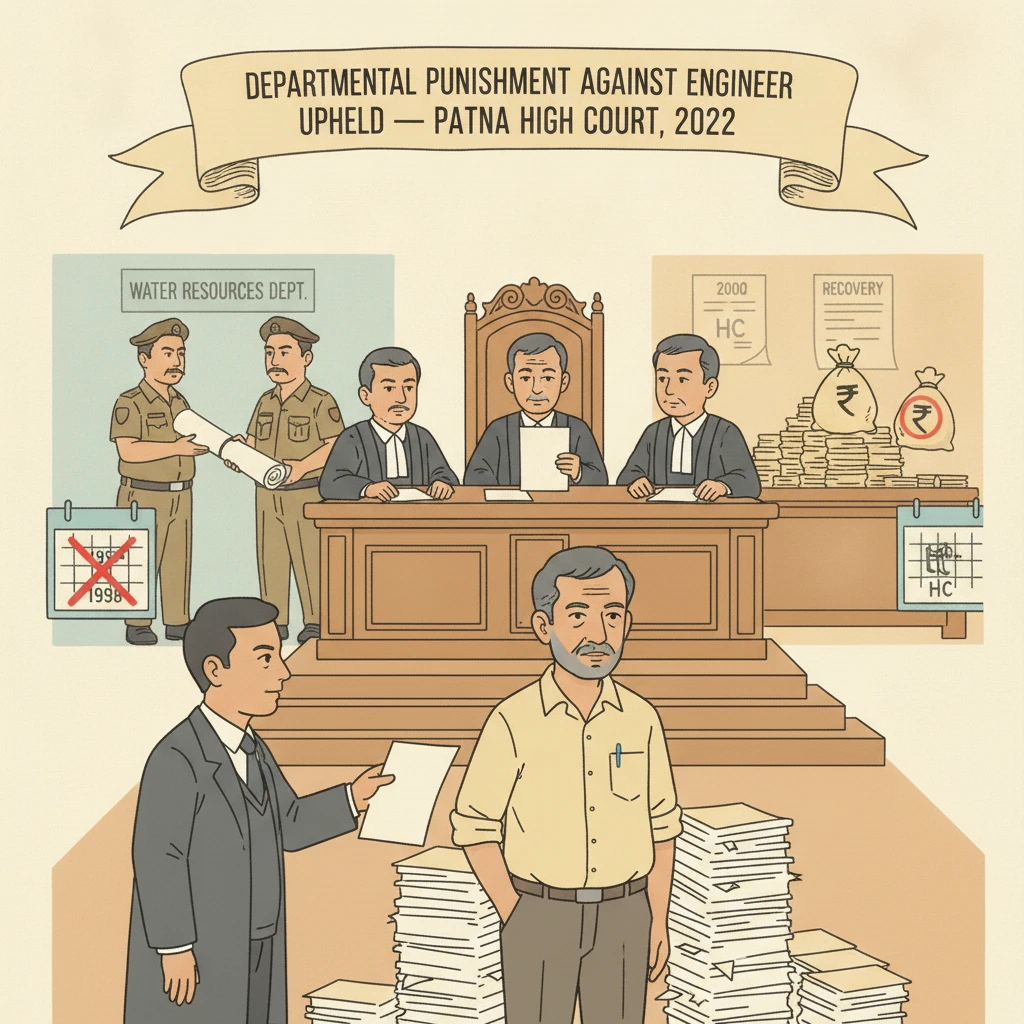
The appellant was a government employee in the Water Resources Department of the State of Bihar. Allegations were made against him in relation to certain works under his charge. The specific accusations were that he had made excess payments by violating applicable rules and had released security money even though the work had not been completed.
Because of these alleged irregularities, the department started a departmental proceeding against him. An inquiry officer was appointed to look into the charges. The appellant took part in this inquiry.
The inquiry officer submitted his inquiry report on 30.05.1995. According to the appellant, this report was never served on him. However, the disciplinary authority went ahead and relied on the report. On 13.02.1998, the authority issued an order of punishment.
The punishment imposed on the appellant was serious. It consisted of a censure entry, withholding of three annual increments with cumulative effect, and recovery of Rs. 1.06 lakhs. The order also stated that during the period of his suspension, he would not be entitled to anything more than the subsistence allowance already paid.
The appellant challenged this first punishment order by filing Civil Writ Jurisdiction Case No. 7997 of 1998 before the Patna High Court. A Bench of the Court found that the order could not be sustained, mainly because the appellant had not been given opportunity to respond to the inquiry report.
Therefore, the High Court in that earlier writ remitted the matter to the concerned authority. The authority was directed to pass a fresh order in accordance with law after giving an opportunity to the appellant to file his response to the inquiry report.
After remand, the disciplinary authority again considered the matter. It once more imposed the same punishment: censure, withholding of three annual increments with cumulative effect, recovery of Rs. 1.06 lakhs, and denial of any amount beyond subsistence allowance during suspension.
This second punishment order was then challenged by the appellant through C.W.J.C. No. 9242 of 2000. However, that writ petition was withdrawn by him. It was withdrawn with the intention of preferring an appeal against the punishment order instead of continuing with the writ.
The appellant thereafter submitted a representation before the Government. According to the record, this representation was treated as an appeal. The competent authority considered it as such and, by order dated 09.08.2000, decided not to interfere with the order of punishment. This appellate order was communicated to the appellant on 04.07.2002.
Later, the appellant filed Civil Writ Jurisdiction Case No. 3457 of 2004. In that writ, he challenged the punishment as well as the treatment of his representation as an appeal. A learned Single Judge of the Patna High Court dismissed his writ petition, upholding the departmental proceedings and punishment.
Aggrieved by the judgment of the Single Judge, the appellant filed the present Letters Patent Appeal No. 1458 of 2018 before a Division Bench of the Patna High Court.
What the Court Examined and Decided
In the Letters Patent Appeal, the Division Bench first heard the submissions of the learned advocate for the appellant and of the State. The appellant’s main objections were directed at both the disciplinary authority and the appellate authority.
The central grievance was that neither authority had properly considered the reasons he had offered to dispute the charges. According to him, his detailed defence against the allegations of excess payment and irregular release of security money was ignored.
The appellant further argued that his representation before the Government was not meant to be a formal appeal. Despite this, it was treated as if it were an appeal. He claimed that several grounds which he had meant to raise in a proper appeal did not find place in that representation.
Because only a limited set of points were mentioned in the representation, he asserted that the appellate authority did not get a full picture of his defence. Consequently, its order, dated 09.08.2000, allegedly did not consider all the relevant issues that he would otherwise have raised.
The appellant also relied on the earlier High Court decision in C.W.J.C. No. 7997 of 1998, where the first punishment order had been set aside and the case remitted. He suggested that even after remand, the authorities once again failed to follow the law, and simply repeated the same punishment without proper independent reasoning.
On the other hand, the State’s stand, as accepted by the Court, was that the departmental proceedings had been conducted in accordance with proper procedure. The appellant had participated in the inquiry and had been given adequate opportunity to defend himself.
The Division Bench noted that the learned Single Judge had carefully examined three key elements: the inquiry report, the order of the disciplinary authority, and the order of the appellate authority. After going through these materials, the Single Judge had recorded clear findings.
According to the Single Judge’s findings, the charges under counts 1, 1a and 2 were conclusively proved. Charge No. 4 was found to have been partially proved. These findings supported the punishment imposed, including the recovery of Rs. 1.06 lakhs and the withholding of increments.
The Division Bench examined the reasoning of the Single Judge and agreed with it. The Bench observed that all procedural formalities had been complied with after the earlier remand. The appellant was not kept in the dark about the proceedings. He took part in the fresh consideration, and he was also given sufficient opportunity to challenge the inquiry report and the punishment order before the appellate authority.
On the issue of the representation being treated as an appeal, the Court addressed the appellant’s complaint in detail. It observed that the appellant had chosen not to file a formal appeal despite clear directions by the Court when the matter had earlier been remitted.
Since the matter had thereafter been placed before the appellate authority, i.e., the Government, for endorsement of the disciplinary authority’s decision, the Government examined the case and passed an order. The appellate authority’s order took note of the circumstances, the background facts, and the evidence collected against the appellant.
In this context, the Division Bench found no force in the appellant’s argument that his representation could not be treated as an appeal. The Court essentially held that the substance of the matter had been considered by the competent appellate authority. The absence of a separate or differently titled appeal document did not make the process invalid, specially when the appellant had voluntarily withdrawn his writ petition to pursue such remedy and his representation was treated as that remedy.
The Court also made it clear that interference in departmental punishments in writ and intra-court appellate jurisdiction is limited. When an employee has been given due opportunity, the inquiry is held fairly, and the findings are backed by evidence, the Court normally does not re-appreciate facts like an appellate authority in a civil suit.
Here, the charges of making excess payment in violation of rules and of releasing security money without completion of work had been found proved by the inquiry officer. These findings had been accepted by both the disciplinary authority and the appellate authority. The Single Judge had also agreed with them after examining the material.
Finding no procedural flaw or perversity in appreciation of evidence, the Division Bench concluded that there was no legal basis to interfere. It therefore held that the appeal had no merit.
In the result, the Letters Patent Appeal was dismissed. The punishment order, as upheld by the Single Judge, remained in force. No further directions were issued, and the matter came to an end at the level of the Division Bench.
Why This Judgment Matters
This judgment is important for government employees and public servants facing departmental proceedings. The Patna High Court has underlined that once an inquiry is conducted with due opportunity and the findings are backed by evidence, the Court will be very slow to interfere.
The decision also shows that if an employee chooses to submit a representation against punishment, and the competent authority treats it as an appeal and considers it on merits, it will generally be treated as a valid appellate exercise. A later complaint that the document was “only a representation” will not easily succeed.
For employees, this reinforces the need to place all their grounds and defences clearly before the disciplinary and appellate authorities at the right time. Failure to file a formal appeal, or filing an incomplete representation, can weaken their case if they later approach the High Court.
For the administration, the case confirms that remand orders from the Court must be followed carefully. Here, after the earlier writ, the authority gave the appellant chance to respond to the inquiry report and then passed a fresh order, which ultimately survived judicial scrutiny.
Legal Issues and Answers
-
Issue: Whether the departmental punishment for excess payment and irregular release of security money was vitiated by procedural irregularities or non-consideration of the appellant’s defence.
Answer: No. The Court held that all procedural formalities were followed, the appellant was given adequate opportunity, and the findings of guilt were supported by the record. -
Issue: Whether the Government could lawfully treat the appellant’s representation as an appeal and decide it accordingly.
Answer: Yes. The Court held that since the appellant did not file a formal appeal despite directions, and the matter was placed before the Government which considered the circumstances and evidence, there was no infirmity in treating the representation as an appeal.
Cases Cited by the Court
- No other judicial precedents are cited or relied upon in the available text of this judgment.
Case Details
Case Number: Letters Patent Appeal No. 1458 of 2018 in Civil Writ Jurisdiction Case No. 3457 of 2004
Case Title: Ram Datta Prasad Sharma v. The State of Bihar & Ors.
Coram: Hon’ble Mr. Justice Ashutosh Kumar and Hon’ble Mr. Justice Anjani Kumar Sharan
Citation: 2022(2) PLJR 59
Advocates: For the appellant – Mr. Raja Ram Mishra, Advocate; For the respondents – Name not specified in the judgment text.
Nature of the Case: Letters Patent Appeal against dismissal of writ petition challenging departmental punishment order in service matter.
Link to Judgment: https://patnahighcourt.gov.in/viewjudgment/MyMxNDU4IzIwMTgjMSNO-DaUjLJBWcGI=
If you found this explanation helpful and wish to stay informed about
how legal developments may affect your rights in Bihar,
you may consider following Samvida Law Associates for more updates.







