

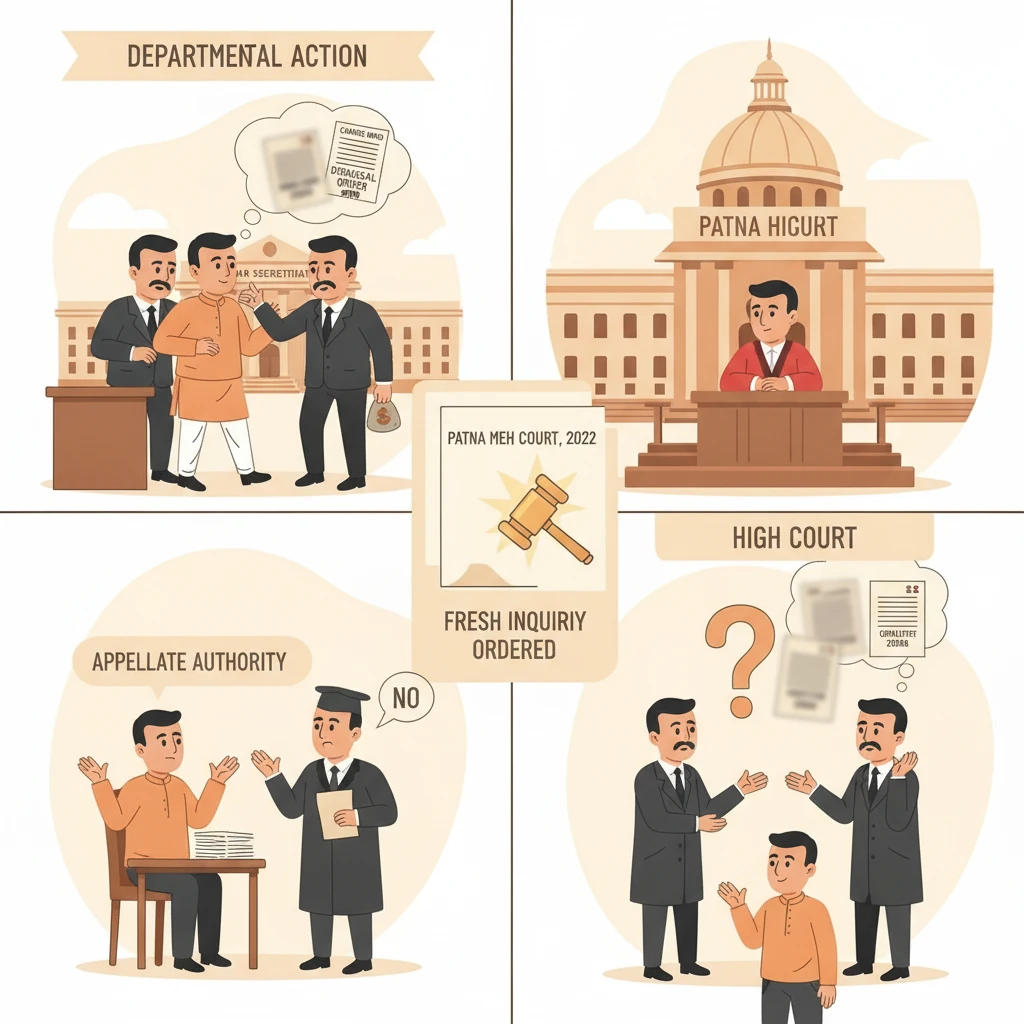
Case Background
The petitioner worked as an Assistant in the Bihar Secretariat Service under the State Government. On 31.07.2008, he was alleged to have demanded and accepted illegal gratification of Rs. 1,600 from a complainant, Radha Mohan Singh.
According to the judgment, the vigilance department arranged a trap on the basis of this complaint. An authorised vigilance officer allegedly caught the petitioner while he was accepting the said amount on 31.07.2008.
After this incident, two separate proceedings started against the petitioner. A criminal case was initiated and remained pending before the competent criminal court at the time of this writ petition. Side by side, the State Government also started departmental proceedings against him.
The departmental proceedings were initiated through a charge memo dated 20.04.2009, containing article of charges. Ultimately, the disciplinary authority passed an order of dismissal from service on 24.05.2016. This punishment order was issued under Rule 14(xi) of the Bihar Government Servants (Classification, Control & Appeal) Rules, 2005.
The petitioner preferred a departmental appeal on 30.06.2016. The Appellate Authority-cum-Member, Board of Revenue, Bihar, Patna, rejected the appeal by order dated 09.05.2017. Later, by order dated 16.02.2017 bearing Memo No. 1819, the department also held that the petitioner would not get any payment other than subsistence allowance for the suspension periods between 31.07.2008 to 21.07.2009 and 13.10.2009 to 23.05.2016.
Aggrieved by these actions, the petitioner filed Civil Writ Jurisdiction Case No. 8941 of 2017 before the Patna High Court. He sought quashing of the dismissal order dated 24.05.2016, the appellate order dated 09.05.2017, and the order regarding denial of pay dated 16.02.2017. He also sought reinstatement as Assistant in the Bihar Secretariat Service with all consequential benefits.
What the Court Examined and Decided
The Patna High Court, through Hon’ble Mr. Justice P. B. Bajanthri, heard both sides. The focus was not on whether the bribe was actually taken, but on whether the departmental inquiry was conducted according to law and principles of natural justice.
Counsel for the petitioner argued that he had been denied basic procedural safeguards during the inquiry. First, he claimed that a letter dated 25.06.2008, said to be a copy of the original complaint made by Radha Mohan Singh, was not supplied to him, despite his specific demand before the competent authority.
Secondly, he submitted that none of the material witnesses were examined in the inquiry. This included the vigilance officer who allegedly laid the trap and any panch or independent witnesses who could confirm the demand and acceptance of the bribe of Rs. 1,600 on 31.07.2008.
Thirdly, the petitioner pointed out that when the article of charges was issued on 21.04.2009 (referred elsewhere as 20.04.2009), it was not supported by a list of witnesses and a proper list of documents. According to him, the charge memo and the statement of imputation were required to be accompanied by such lists under the Bihar Government Servants (Classification, Control & Appeal) Rules, 2005. In their absence, he claimed that the entire proceeding was vitiated.
On these grounds, the petitioner argued that the inquiry violated the Rules, 2005 and the principles of natural justice. Therefore, he sought setting aside of the punishment.
On the other hand, the learned counsel for the respondent-State argued that the charge was serious in nature. The allegation was that the petitioner demanded and accepted illegal gratification to extend some official favour to the complainant. He pointed out that a criminal case was already pending on the same incident.
The State’s counsel maintained that the enquiry officer, disciplinary authority, and appellate authority had not committed any error in conducting the departmental proceedings and, therefore, no interference was called for by the High Court.
However, the State’s counsel made two significant admissions during the hearing. He conceded that the charge memo dated 20.04.2009, though supported by a list of documents, did not contain a list of witnesses. He further admitted that witnesses had not been examined in support of the charge during the inquiry.
After hearing both sides, the Court summarised the undisputed position. Parallel proceedings were indeed initiated: a criminal case still pending and a departmental inquiry which led to dismissal on 24.05.2016. The appeal against dismissal was rejected on 09.05.2017.
The Court then examined the petitioner’s complaint about non-supply of the letter dated 25.06.2008 and the absence of lists of witnesses and documents. The Court looked at the charge memo dated 20.04.2009 (Annexure-2) and noted that it was not supported by a list of witnesses, though some documents were cited. It also recorded that the copy of the list of documents in support of the article of charge and statement of imputation had not been prepared.
On this basis, the Court held that, prima facie, the disciplinary authority had failed to follow the procedure laid down under the Bihar Government Servants (Classification, Control & Appeal) Rules, 2005. The Court found that:
There was no list of witnesses along with the charge memo. Documents cited in the charge memo were not supplied. The demanded document, namely the complaint letter dated 25.06.2008 (described elsewhere as 26.05.2008), was not provided. No witnesses, including vigilance or independent panch witnesses, were examined in support of the charge.
The Court held that these lapses amounted to violation of natural justice. Without a list of witnesses and without providing copies of the relied upon documents, the petitioner was deprived of a fair opportunity to defend himself.
In view of these procedural defects, the Court concluded that the punishment order and the appellate order could not stand. However, the Court did not give a clean chit on the merits of the bribery allegation. Instead, it chose a middle path based on established Supreme Court law.
The Court relied on two Supreme Court decisions: ECIL v. B. Karunakar, (1993) 4 SCC 727, and Chairman-cum-Managing Director, Coal India Ltd. v. Ananta Saha & Ors., (2011) 5 SCC 142. From these cases, the Court extracted the principle that when a punishment is set aside on technical grounds — such as breach of rules or denial of natural justice — the employer must be given an opportunity to conduct a fresh inquiry from the stage where the defect occurred.
The Supreme Court decisions also clarify that in such situations, the delinquent employee should be reinstated for the purpose of holding the fresh inquiry but can be placed under suspension, with entitlement only to subsistence allowance. The question of back wages is not automatic and is to be decided by the disciplinary authority after the fresh inquiry, taking into account all relevant factors and the principle of “no work, no pay”.
Applying these principles, the Patna High Court set aside the impugned dismissal order dated 24.05.2016 (Annexure-32) and the appellate order dated 09.05.2017 (Annexure-35). It remanded the matter to the disciplinary authority to commence a fresh inquiry from the very beginning — that is, from framing the article of charge, statement of imputation, list of witnesses, and list of documents.
The Court directed that the subsequent inquiry must be completed after giving “ample opportunity of hearing” to the petitioner and in strict accordance with the Bihar Government Servants (Classification, Control & Appeal) Rules, 2005. A clear time-limit of six months from the date of receipt of the Court’s order was fixed for completing this process.
Regarding the period between the dismissal order dated 24.05.2016 and the High Court’s judgment, the Court held that this period must be regulated in terms of the Supreme Court rulings cited. Specifically, it noted that if a fresh inquiry is held, its result will relate back to the date of the original order, and the question of back wages and other entitlements will have to be decided by the disciplinary authority after the conclusion of the renewed proceedings.
The Court further directed the disciplinary authority to take a decision either to reinstate the petitioner or to place him under suspension till the fresh disciplinary proceedings are concluded. This decision also must be in line with the Supreme Court’s guidance in ECIL v. B. Karunakar and the Coal India Ltd. case.
In conclusion, the writ petition was allowed in part. The punishment and appellate orders were quashed, and the matter was remitted for a fresh, lawful inquiry. The High Court did not itself order full reinstatement with back wages, leaving those aspects to be determined later depending on the outcome of the renewed proceedings.
Why This Judgment Matters
This judgment is important for government employees in Bihar and for departments conducting disciplinary inquiries. It shows that even in cases involving serious charges like bribery, the State must strictly follow the procedure laid down in the Bihar Government Servants (Classification, Control & Appeal) Rules, 2005.
If a charge memo is issued without a proper list of witnesses, or if crucial documents such as the complaint are not supplied, the entire departmental action can be set aside. The Court’s approach also protects the administration by allowing a fresh inquiry instead of permanently closing the matter on a technical ground.
For employees, it reinforces their right to know the evidence against them and to cross-examine witnesses. For departments, it is a reminder that skipping procedural steps can delay punishment even in strong cases and may require them to restart the process from the beginning.
Legal Issues and Answers
-
Issue: Whether the departmental inquiry leading to the petitioner’s dismissal complied with the Bihar Government Servants (Classification, Control & Appeal) Rules, 2005 and principles of natural justice.
Answer: No. The Patna High Court held that the charge memo was not supported by a list of witnesses, documents cited were not supplied, the demanded complaint letter was not given, and no witnesses were examined. These lapses violated the Rules, 2005 and natural justice. -
Issue: What is the proper remedy when a dismissal order is set aside on technical grounds in a disciplinary matter involving alleged bribery.
Answer: The Court followed Supreme Court precedents to set aside the dismissal and appellate orders and remand the matter for a fresh inquiry from the initial stage, with liberty to the department to reinstate and, if necessary, suspend the employee, and to decide back wages after conclusion of the fresh inquiry.
Cases Cited by the Court
- ECIL v. B. Karunakar, (1993) 4 SCC 727
- Chairman-cum-Managing Director, Coal India Ltd. v. Ananta Saha and Ors., (2011) 5 SCC 142
- R. Thiruvirkolam v. Presiding Officer (citation not specified in the judgment)
- Punjab Dairy Development Corpn. Ltd. v. Kala Singh (citation not specified in the judgment)
- Graphite India Ltd. v. Durgapur Projects Ltd. (citation not specified in the judgment)
- U.P. SRTC v. Mitthu Singh (citation not specified in the judgment)
- Akola Taluka Education Society v. Shivaji (citation not specified in the judgment)
- Balasaheb Desai Sahakari S.K. Ltd. v. Kashinath Ganapati Kambale (citation not specified in the judgment)
Case Details
Case Number: Civil Writ Jurisdiction Case No. 8941 of 2017
Case Title: Dinesh Kumar Singh v. The State of Bihar and Ors.
Coram: Hon’ble Mr. Justice P. B. Bajanthri
Date of Judgment: 23.03.2022
Citation: 2022(2) PLJR 152
Advocates:
- For the petitioner: Mr. Abhinav Srivastava, Advocate
- For the respondents: Mr. Ajay Kumar, AC to GP-4
Nature of the Case: Writ petition under civil writ jurisdiction challenging dismissal from service and related appellate and consequential orders in a departmental proceeding.
Link to the Judgment: Click here to view the full judgment of the Patna High Court
If you found this explanation helpful and wish to stay informed about
how legal developments may affect your rights in Bihar,
you may consider following Samvida Law Associates for more updates.







